Scalar (dot) product of two vectors
NCERT Class 11 Physics Chapter 5 Section 5.1
Quick answer
The scalar product, or dot product, of two non-zero vectors is A·B = AB cos θ, where A and B are their magnitudes and θ is the angle between them. It is a scalar: positive for an acute angle, zero for perpendicular vectors and negative for an obtuse angle. In components, A·B = Ax Bx + Ay By + Az Bz, because the unit vectors along the axes give i·i = 1 and i·j = 0; it is the tool used to define work, W = F·d.
With your textbook
NCERT Physics Part I (Class 11), Chapter 5 “Work, Energy and Power”, Section 5.1 “Introduction”, pages 71–72.
Open the official NCERT chapter (PDF, 2.0 MB, ncert.nic.in) (opens in a new tab)
Checked against the 2026-27 reprint on .
What is the scalar product?
The scalar product in NCERT’s words
So, A.B is the product of the magnitude of A and the component of B along A. Alternatively, it is the product of the magnitude of B and the component of A along B.
NCERT Physics Part I (Class 11), Section 5.1.1, page 72
In plain words: the scalar product (or dot product) of two vectors multiplies the size of one vector by how much of the other points along it. The answer is an ordinary number, a scalar, with no direction.
On this page, as in NCERT, a vector is written in bold, A, and its magnitude in italics, A. (In your notebook, an arrow over the letter does the same job.)
For two vectors A and B with an angle θ between them:
Scalar (dot) product
Here A and B are the magnitudes of the vectors, and θ is the angle between them when they are drawn from the same point; it lies between 0° and 180°. This product is the mathematical tool behind work, the first idea of this chapter: the work done by a force is the scalar product of the force and the displacement.
Projection and the sign of the dot product
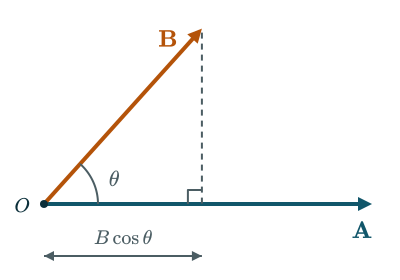
The quantity B cos θ is the projection of B on A: the length of the shadow B casts on the line of A, counted as negative when the shadow points opposite to A (when θ is more than 90°). In the same way, A cos θ is the projection of A on B. So
The sign of the dot product tells you how the two vectors point relative to each other:
| Angle between the vectors | cos θ | Dot product |
|---|---|---|
| 0° (same direction) | 1 | AB, the largest value |
| between 0° and 90° (acute) | positive | positive |
| 90° (perpendicular) | 0 | zero |
| between 90° and 180° (obtuse) | negative | negative |
| 180° (opposite directions) | −1 | −AB |
A dot product of zero, for two vectors that are not zero, means they are perpendicular. This is the quickest test for perpendicular vectors.
Properties of the scalar product
The scalar product is commutative:
It is distributive over addition:
A number λ can be taken outside:
And the dot product of a vector with itself is the square of its magnitude, because the angle is zero:
Together these give a useful identity for the magnitude of a sum or a difference:
In the same way, the square of the magnitude of A − B is the same expression with a minus sign before the last term.
For the unit vectors , and along the x, y and z axes, which have magnitude 1 and are at right angles to each other:
Dot product from components
Write the two vectors in components:
Multiply out using the distributive law. The x-term of A gives three products:
which is just AxBx, because each Cartesian basis vector dotted with itself gives 1 and with a different perpendicular basis vector gives 0. The y- and z-terms give AyBy and AzBz in the same way, so only three terms survive:
Dot product in components
With B = A, this gives the magnitude of a vector:
Putting the two forms together gives the angle between any two vectors:
Angle between two vectors
This holds for any two non-zero vectors.
For non-zero B, the scalar component (projection) of A along B is A · B divided by its magnitude B. A zero vector does not define a projection direction.
Where the dot product is used
- Work. The work done by a constant force F over a displacement d is W = F · d, which equals Fd cos θ. A force at right angles to the motion does no work.
- Power. The power of a force, the rate at which it does work on a body moving with velocity v, is P = F · v.
- Components of any vector. The component of a vector along any direction is its dot product with the unit vector in that direction: the x-component of A is .
- Checking right angles. Two non-zero vectors are perpendicular when their dot product is zero, which is often quicker than finding the angle.
Solved examples
Example 1: Angle between two vectors
Find the angle between these two vectors:
Dot product from components: the products of matching components are 2 × 1 = 2, 3 × (−2) = −6 and (−1) × 4 = −4, so
Magnitudes: A = √(4 + 9 + 1) = √14 and B = √(1 + 4 + 16) = √21.
Angle:
so θ is cos−1(−0.467).
Answer: θ is about 117.8°. The dot product is negative, so the angle is obtuse, as expected.
NCERT Example 5.1 (page 72) uses the same method for a force and a displacement : the dot product is 16 and each magnitude squared is 50, so cos θ is 0.32 and θ is about 71.3°. NCERT also asks for the projection of the force on the displacement, which is 16/√50, about 2.26 units.
Example 2: Making two vectors perpendicular
For what value of p are these two vectors perpendicular?
Perpendicular vectors have a zero dot product. The products of matching components are 2 × 4 = 8, p × (−2) = −2p and 1 × (−2) = −2, so
so 2p = 6 and p = 3.
Answer: p = 3. Check: with p = 3, the dot product is 8 − 6 − 2 = 0.
Example 3: Projection and work
(a) Find the component of A along B, where A is and B is . (b) A force F of N moves a body through a displacement d of m. Find the work done.
(a) The dot product is 3 + 4 = 7 and B = √2, so the component of A along B is
(b) The work is the dot product of force and displacement:
Answer: (a) about 4.95 units; (b) 15 J. Only the x-component of the force does work, because the displacement is along x.
Common mistakes to avoid
Common mistake
Taking a vector’s dot product with itself as its magnitude
The dot product of a vector with itself is A, the square of its magnitude, not A. To find a magnitude from components, take the square root at the end.
Common mistake
Using the angle with an axis instead of the angle between the vectors
In AB cos θ, θ is the angle between the two vectors drawn tail to tail. If two vectors in the xy-plane make 30° and 50° with the +x axis, both measured anticlockwise, the angle between them is 20°. In three dimensions the angles with one axis do not fix the angle between the vectors: use the cos θ formula with components.
Common mistake
Taking the angle between vectors that meet head to tail
In an equilateral triangle ABC of side a, the side vectors and meet head to tail. Drawn tail to tail, the angle between them is 120°, not 60°, so their dot product is a2 cos 120°, which is −a/2.
Common mistake
Cancelling a vector from both sides
If A has the same dot product with B as with C, it does not follow that B = C. It means A · (B − C) = 0. If both vectors in this product are non-zero, they are perpendicular; the product also vanishes when A = 0 or B = C.
Common mistake
Expecting a dot product to have a direction
The dot product is a scalar. Writing it with a unit vector, or drawing it as an arrow, is wrong. (The cross product, which gives a vector, comes in the next chapter.)
Common mistake
Thinking a dot product cannot be negative
It is negative whenever the angle between the vectors is more than 90°, as in Example 1. Negative work, done by friction on a sliding body, is an important case.
Quick revision summary
- The scalar product of two vectors is a scalar: the magnitude of one times the component of the other along it.
- It is positive for an acute angle, zero for perpendicular vectors and negative for an obtuse angle.
- It is commutative and distributive, and the dot product of a vector with itself is the square of its magnitude.
- Each Cartesian basis unit vector dotted with itself gives 1; different mutually perpendicular basis vectors give 0, so only three component products survive. Two arbitrary different unit vectors need not have zero dot product.
- It gives the angle between two vectors, the projection of one on the other, and the work done by a force.
Formula sheet
- A·B = AB cos θ
- A·B = Ax Bx + Ay By + Az Bz
- i·i = 1, i·j = 0 (and the same for j and k)
- A·A = A
- cos θ = A·B/(AB)
- W = F·d (work done by a constant force)
Questions students ask
What is the difference between the dot product and the cross product?
The dot product A · B = AB cos θ is a scalar: it is largest when the vectors point the same way, zero when they are perpendicular, and A · B = B · A. The cross product A × B is a vector of magnitude AB sin θ, perpendicular to both vectors: it is zero for parallel vectors, largest for perpendicular ones, and A × B = −B × A. Work, F · d, is a dot product; torque, r × F, is a cross product.
Why is the dot product of two vectors a scalar?
The dot product of two vectors is a scalar because AB cos θ is built only from the two magnitudes and the angle between the vectors, and none of these depends on how the axes are chosen or points in any direction. Rotate the axes and the components change, but AxBx + AyBy + AzBz comes out the same. That is why work, the dot product of force and displacement, is a scalar even though force and displacement are vectors.
How do you find the angle between two vectors using the dot product?
The angle θ between two non-zero vectors follows from cos θ = A · B/(AB), with the dot product from components, AxBx + AyBy + AzBz, and each magnitude from A = √(Ax2 + Ay2 + Az2). For example, for A = 2î + 2ĵ and B = 3ĵ, A · B = 6, A = 2√2 and B = 3, so cos θ = 1/√2 and θ = 45°.
Is the dot product the same as the scalar product?
Yes, the dot product and the scalar product are two names for the same operation, A · B = AB cos θ: “dot” after the symbol, “scalar” after the kind of answer it gives. In mathematics it is the standard example of an inner product.
Practice questions
Try each question first, then open the answer to check your working.
-
Q1. Two vectors have magnitudes 3 and 4, and the angle between them is 60°. Find their scalar product.
Show answerHide answer
-
Q2. Find the angle between and .
Show answerHide answer
The dot product is 0 + 1 + 0 = 1, and each vector has magnitude √2, so cos θ = 1/(√2 × √2) = 1/2, and the angle is 60°.
-
Q3. Show that the dot product of A + B with A − B is A − B. What does this tell you about the diagonals of a rhombus?
Show answerHide answer
Multiply out with the distributive law:
The two middle terms cancel, because the dot product is commutative, leaving A − B. In a rhombus with sides A and B, the diagonals are A + B and A − B, and A = B, so their dot product is zero: the diagonals of a rhombus are perpendicular.