Solving problems in mechanics
NCERT Class 11 Physics Chapter 4 Section 4.11
Quick answer
A free-body diagram shows one chosen body, or group of bodies, with every force acting on it from outside, and nothing it exerts on others. Draw one for each body, write Newton’s second law along each axis (ΣFx = m ax), add the constraints such as the same acceleration for bodies joined by a taut string over a fixed pulley, and solve. For two bodies pushed or pulled together by a force F on a smooth surface, a = F/(m1 + m2).
With your textbook
NCERT Physics Part I (Class 11), Chapter 4 “Laws of Motion”, Section 4.11 “Solving problems in mechanics”, pages 64–66.
Open the official NCERT chapter (PDF, 2.1 MB, ncert.nic.in) (opens in a new tab)
Checked against the 2026-27 reprint on .
What is a free-body diagram?
A free-body diagram in NCERT’s words
Draw a separate diagram which shows this system and all the forces on the system by the remaining part of the assembly. Include also the forces on the system by other agencies. Do not include the forces on the environment by the system. A diagram of this type is known as ‘a free-body diagram’.
NCERT Physics Part I (Class 11), Section 4.11, page 65
In plain words: pick one body (or a group of bodies) from the problem, draw it on its own, and draw every force that acts on it, and nothing else. That picture is its free-body diagram. (In NCERT’s words above, the system is the part of the problem you chose.) NCERT adds that the name does not mean the system has no net force. Then apply Newton’s second law of motion to what you have drawn.
Most mechanics problems involve several bodies pushing and pulling on each other: blocks in contact, masses joined by strings, a load in a lift. The free-body diagram is the tool that turns such a tangle into a few simple equations, one body at a time.
The system and the environment
NCERT gives names to the two parts of every problem:
We may call the chosen part of the assembly as the system and the remaining part of the assembly (plus any other agencies of forces) as the environment.
NCERT Physics Part I (Class 11), Section 4.11, page 64
You may choose any part as the system, as long as you include every force on it from the environment. Two choices are common:
- One body at a time. Each body gets its own free-body diagram. A direct contact force between two chosen bodies appears on their diagrams as a third-law pair. For bodies joined by a string, the force of the string on each body is paired with that body’s force on the string; the two endpoint tensions are not themselves a third-law pair.
- The whole assembly as one system. Forces between its parts are then internal and cancel in pairs, so they are left out. This gives the acceleration directly when all the parts move together in the same direction (blocks in contact, wagons in a train), but it cannot give the internal forces. For bodies joined over a pulley, which move in different directions, write one equation per body and add them, as in Examples 2 and 3.
Often you use both: the whole system for the acceleration, then one body for a tension or contact force.
The step-by-step method
NCERT lists five steps, (i) to (v), for handling any problem systematically. In short:
- Sketch the set-up: all the bodies, strings, pulleys, supports and surfaces.
- Choose a system: one convenient body or group of bodies.
- Draw its free-body diagram: every force on the system, from the rest of the assembly and from other agencies such as gravity. Leave out the forces the system exerts on its environment.
- Mark what you know: give each force its known size or direction (for example, a tension always pulls along its string). Treat the rest as unknowns.
- Repeat for another system if needed, using Newton’s third law of motion: if body B pushes body A with a force , body A pushes body B with .
NCERT’s list ends there. Then, for each free-body diagram:
- Choose axes, with one axis along the body’s acceleration if you know its direction.
- Write the second law along each axis: and .
- Add the constraints: in the standard set-ups below, a taut inextensible string over fixed pulleys connects bodies moving along its straight end segments, so their accelerations have the same magnitude (derive the length constraint again if the geometry changes); a light string over a smooth, light pulley has the same tension throughout; static friction is at most μs N (see friction).
- Solve the equations, and check that the answers make sense (signs, units, limiting cases).
Standard set-ups
The same few arrangements appear again and again. Here are their results, all on smooth surfaces with light, inextensible strings and smooth, light pulleys unless stated otherwise.
Two blocks in contact, pushed by a force F. Taking both blocks together, the acceleration is a = F/(m1 + m2). The contact force is the only horizontal force on the front block, so it equals the front block’s mass times a.
Two blocks joined by a string, pulled by F. The same acceleration a = F/(m1 + m2). The tension accelerates the trailing block, so it equals the trailing block’s mass times a.
Two masses over a fixed pulley (Atwood machine). With m1 > m2, m1 accelerates down and m2 up with
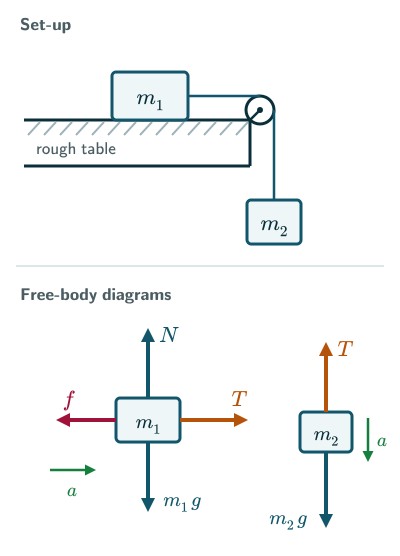
A block on a table pulled by a hanging block (the figure above). For the hanging block m2 g − T = m2 a; for the block on the table T − f = m1 a, where f = μk m1 g if the table is rough. Adding the two equations removes T:
The displayed equation applies while the hanging block moves downward and the table block slides towards the pulley. To start from rest without an extra push requires m2 > μs m1; otherwise static equilibrium is possible. A system already set sliding can move even below that threshold, and its acceleration is found using kinetic friction until it stops or changes direction.
NCERT Example 4.9 (pages 61–62) solves this set-up for a 20 kg trolley pulled by a 3 kg hanging block, with μk = 0.04 between the trolley and the surface and g = 10 m s−2, and gets an acceleration of 0.96 m s and a tension of 27.1 N.
Where this method is used
- Lifts, cranes and ropes. The tension in a lift cable or a crane rope comes from one free-body diagram of the load.
- Trains and trucks with trailers. The pull in each coupling is found by taking the wagons behind it as the system.
- Pulleys and simple machines. Every pulley problem is a set of free-body diagrams joined by string constraints.
- Inclined planes, banked roads and circular motion. The same method, with the axes chosen along and across the slope, or towards the centre.
Solved examples
Example 1: Blocks in contact
Two blocks of masses 4 kg and 2 kg are in contact on a smooth horizontal floor. A horizontal force of 12 N pushes the 4 kg block, which pushes the 2 kg block ahead of it. Find (a) the acceleration and (b) the contact force between the blocks. (c) What is the contact force if the same force pushes the 2 kg block instead?
(a) Whole system: take m1 = 4 kg and m2 = 2 kg. The contact forces are internal, so
(b) The 2 kg block alone: the only horizontal force on it is the contact force P from the 4 kg block:
Check with the 4 kg block: 12 − P = 4 × 2, so P = 4 N again.
(c) Now the 4 kg block is the one being pushed along:
Answer: a = 2 m s−2 either way; the contact force is 4 N when the 4 kg block is pushed, and 8 N when the 2 kg block is pushed. The block in front is accelerated only by the contact force.
Example 2: An Atwood machine
Masses of 5 kg and 3 kg hang on either side of a light string over a smooth, light pulley. Find the acceleration of the masses and the tension in the string. Take g = 9.8 m s−2.
Free-body diagrams: each mass has the tension T upward and its weight downward. The 5 kg mass accelerates down and the 3 kg mass up, both at a.
Adding the two equations removes T:
Then, from the 3 kg equation:
Answer: the acceleration is 2.45 m s and the tension 36.75 N (about 36.8 N). The tension lies between the two weights, 29.4 N and 49 N, as it must: it holds back the heavier mass, so that it falls with an acceleration less than g, and lifts the lighter one.
Example 3: A block pulled by a hanging block
A 4 kg block on a rough table is joined by a light string over a smooth pulley at the edge to a 2 kg block hanging freely, as in the figure. The coefficient of kinetic friction between the block and the table is 0.2. Find the acceleration and tension while the hanging block moves downward and the table block slides towards the pulley; take the pulley as light and the string as taut and inextensible. Take g = 9.8 m s−2.
Block on the table: vertically N = m1 g, that is 39.2 N, so the friction is
Horizontally: T − 7.84 = 4a.
Hanging block: 2 × 9.8 − T = 2a, that is 19.6 − T = 2a.
Add the two equations to remove T:
Answer: the acceleration is 1.96 m s and the tension 15.68 N (about 15.7 N). The tension is less than the hanging block’s weight (19.6 N), because that block is accelerating downward.
Common mistakes to avoid
Common mistake
Drawing forces the body exerts on others
A free-body diagram shows forces on the chosen body only. The push of a block on the floor belongs on the floor’s diagram, not the block’s.
Common mistake
Taking the tension equal to the hanging weight
The tension equals the hanging block’s weight only if that block is not accelerating. In Example 3 the hanging block accelerates down, so T is less than m2 g.
Common mistake
Showing internal forces on a whole-system diagram
When two blocks are taken together as one system, the forces between them cancel in pairs and must be left out. Put them back only when you draw one block on its own.
Common mistake
Calling two equal and opposite forces on one body a third-law pair
NCERT puts it plainly:
Two forces on the same body which happen to be equal and opposite can never constitute an action-reaction pair.
NCERT Physics Part I (Class 11), Section 4.11, page 66
A block’s weight and the normal force on it act on the same body, so they are not a pair; they need not even be equal, as in a lift that is accelerating.
Common mistake
Mixing up directions for connected bodies
Choose the positive direction for each body along its own motion: for the hanging block, down is positive; for the block on the table, towards the pulley. Then the same a appears in every equation with the same sign.
Quick revision summary
- A free-body diagram shows one chosen system and every force on it from its environment, and nothing it exerts on others.
- You may choose any part as the system: one body at a time gives the internal forces; when all parts move together, the whole assembly gives their common acceleration quickly.
- Write the second law along each axis for each diagram, add the constraints (same size of acceleration for bodies joined by a taut string over fixed pulleys, same tension in a light string over a smooth pulley), then solve.
- Direct interaction forces between two bodies form a third-law pair; for string-connected blocks, identify each block–string pair separately.
- Two equal and opposite forces on the same body are never an action-reaction pair.
Formula sheet
- ΣFx = m ax and ΣFy = m ay for each body
- a = F/(m1 + m2) (two bodies pushed or pulled together on a smooth surface)
- a = (m1 − m2)g/(m1 + m2) (Atwood machine)
- T = 2m1m2g/(m1 + m2) (Atwood machine)
- a = (m2g − μk m1g)/(m1 + m2) (block on a table pulled by a hanging block, while m2 moves down; starting from rest requires m2 > μs m1)
Questions students ask
What are the acceleration and tension in an Atwood machine?
For masses m1 > m2 hanging on a light, inextensible string over a light, smooth, fixed pulley, a = (m1 − m2)g/(m1 + m2) and T = 2m1m2g/(m1 + m2). For example, with 3 kg and 1 kg and g = 9.8 m s, a = 4.9 m s and T = 14.7 N. The tension always lies between the two weights, here 9.8 N and 29.4 N.
Is the normal force the reaction to the weight of a body?
No, the normal force is not the reaction to the weight. The weight is the Earth’s pull on the body, so its third-law partner is the body’s pull on the Earth; the normal force is the surface’s push on the body, and its partner is the body’s push on the surface. When the two are equal, as for a book at rest on a table, they balance because the book is in equilibrium, not because of the third law; in an accelerating lift they are not even equal.
Why is the tension the same all along a light string?
For a straight string segment with no other tangential force, the difference in endpoint tensions equals its mass times its acceleration. A massless segment therefore has equal endpoint tensions. A smooth guide can turn the string without tangential friction, while a point load or frictional contact can change the tension; an accelerating pulley with rotational inertia generally needs unequal tensions to supply its torque.
How do you find the tension in a string joining two blocks pulled by a force?
First treat both blocks as one system: on a smooth surface the acceleration is a = F/(m1 + m2). Then draw the free-body diagram of the trailing block, the one F does not act on: the tension in the light string is the only horizontal force on it, so T equals its mass times a. For example, if F = 30 N pulls a 4 kg block that tows a 2 kg block, a = 5 m s and T = 10 N.
What is the apparent weight of a person in a lift?
The apparent weight is the normal force N of the floor, which is what a weighing scale reads. From the second law, N = m(g + a) when the lift accelerates upward (moving up and speeding up, or moving down and slowing down) and N = m(g − a) when it accelerates downward; at constant velocity, N = mg. In free fall (a = g downward) the scale reads zero, which is why the person feels weightless.
Practice questions
Try each question first, then open the answer to check your working.
-
Q1. Blocks of 3 kg and 6 kg on a smooth floor are tied together by a light string. A horizontal force of 18 N pulls the 3 kg block. Find the tension in the string. What is the tension if the force pulls the 6 kg block instead?
Show answerHide answer
Either way, the acceleration is
The string accelerates the trailing block. Pulling the 3 kg block, the 6 kg block trails, so T = 6 × 2, that is 12 N. Pulling the 6 kg block, the 3 kg block trails, so T = 3 × 2, that is 6 N.
-
Q2. Masses of 2 kg and 3 kg hang over a smooth pulley. Find their acceleration and the tension in the string. Take g = 9.8 m s−2.
Show answerHide answer
That is about 23.5 N. The 3 kg mass accelerates down and the 2 kg mass up.
-
Q3. A book rests on a table, and a hand presses down on it. Draw (in words) the free-body diagram of the book, and name the reaction to each force.
Show answerHide answer
Three forces act on the book: its weight (the Earth pulls it down), the push of the hand (down) and the normal force of the table (up). Their reactions act on other bodies: the book pulls the Earth up, the book pushes the hand up, and the book pushes the table down. None of these reactions appears on the book’s diagram.