Friction and other common forces
NCERT Class 11 Physics Chapter 4 Section 4.9
Quick answer
Friction is the component of the contact force parallel to the surfaces in contact, and it opposes impending or actual relative motion. Static friction adjusts itself up to a limit, fs ≤ μs N, where N is the normal reaction and μs the coefficient of static friction; once sliding starts, kinetic friction is nearly constant, fk = μk N, with μk < μs. In this approximate dry-contact model, friction is nearly independent of apparent contact area; rolling resistance is usually much smaller than sliding friction.
With your textbook
NCERT Physics Part I (Class 11), Chapter 4 “Laws of Motion”, Section 4.9 “Common forces in mechanics”, pages 59–62.
Open the official NCERT chapter (PDF, 2.1 MB, ncert.nic.in) (opens in a new tab)
Checked against the 2026-27 reprint on .
What are contact forces, normal reaction and friction?
Normal reaction and friction in NCERT’s words
The component of contact force normal to the surfaces in contact is called normal reaction. The component parallel to the surfaces in contact is called friction.
NCERT Physics Part I (Class 11), Section 4.9, page 59
In plain words: when two surfaces touch, each pushes on the other with a contact force. Split that force into two parts. The part at right angles to the surfaces is the normal reaction N, which stops one body from sinking into the other. The part along the surfaces is friction f, which resists the surfaces sliding over each other.
Put back together, the two parts make the total contact force, of magnitude . When friction is at its limiting value, this total force makes an angle λ with the normal, where tan λ = μs. This angle of friction is equal to the angle of repose met below. (Beyond the NCERT text: NCERT names neither angle.)
Friction is one of several forces that appear again and again in mechanics. This page first sorts out these common forces, then treats friction in detail: static and kinetic friction, the laws of friction, friction on an incline and rolling friction.
Common forces in mechanics
Gravity is the one force in everyday mechanics (for uncharged, non-magnetic bodies) that acts at a distance: every object on the Earth is pulled towards the Earth’s centre, with no contact and no medium needed. Near the surface this pull is the weight mg.
Almost every other force in mechanics is a contact force, which acts only when bodies touch:
- Normal reaction N: the push of a surface, at right angles to it. It is self-adjusting: a table pushes up on a book just as hard as needed to stop it sinking in.
- Friction f: the push of a surface along it, opposing sliding.
- Buoyant force: the upward push of a fluid on a body immersed in it, equal to the weight of the fluid displaced.
- Viscous force and air resistance: the drag of a fluid on a body moving through it.
- Tension T: the pull of a stretched string, rope or cable. In an ideal light string, tension is uniform along a segment without additional tangential forces; a smooth pulley can change its direction without changing its magnitude.
- Spring force: a spring stretched or compressed by x from its natural length pulls or pushes back with a force proportional to x (for small x):
Spring force
Here k is the spring constant (force constant), in N m−1, and the minus sign means the force is opposite to the displacement from the unstretched state. A string behaves like a spring with a very large k: it hardly stretches at all.
Where do contact forces come from? Of the fundamental forces of nature, only gravity and the electrical force matter in mechanics. At the scale of atoms, every contact force is electrical: the charged particles (nuclei and electrons) of the two surfaces repel and attract each other. That detail is far too complex to use in a mechanics problem, so each contact force is described by simple rules found from experiment, such as the laws of friction below.
The friction laws below are the usual approximate model for dry solid contacts. They are not exact material laws; the stated inequalities and area/speed independence describe the regime used in these problems.
Static friction
Push gently on a heavy box resting on the floor and it does not move. If your push were the only horizontal force, the box would have to accelerate, however small the push. So another horizontal force must appear and cancel your push: this is static friction fs.
Static friction opposes impending motion. The term impending motion means motion that would take place (but does not actually take place) under the applied force, if friction were absent.
NCERT Physics Part I (Class 11), Section 4.9.1, page 60
Three facts about static friction matter in every problem:
- It prevents relative slipping. Static friction is zero when no friction is needed to prevent slipping, as for an undisturbed box on a level floor. A block resting on an incline can have non-zero static friction even without a hand pushing it.
- It is self-adjusting. For this stationary box on a level floor, it balances the horizontal push until its limit. In other situations it supplies the force required to prevent relative slipping, and may accelerate the body, as on a moving truck.
- It has a maximum. Static friction can grow only up to a limiting value . Once the push exceeds it, the box starts to slide.
For the dry-contact approximation used here, the limiting friction is approximately independent of apparent contact area and proportional to normal force:
Law of static friction
The constant μs, the coefficient of static friction, is treated as a constant for the specified pair of surfaces and their condition. It has no unit. It is usually less than 1, but for very grippy pairs of surfaces it can be more than 1.
Kinetic friction
Once the box is sliding, friction still acts against the relative motion, but it is a little smaller than the limiting static value. This is kinetic (or sliding) friction:
Law of kinetic friction
Like static friction, kinetic friction does not depend on the area of contact, and it is nearly independent of the speed. With a push F along the floor, the sliding box accelerates at
If F = fk the box slides at constant velocity; if the push is removed, the box decelerates at fk/m and stops.
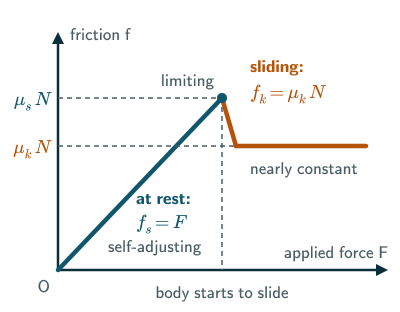
The laws of friction
Friction, by NCERT’s definition, is the part of the contact force that opposes relative motion:
Friction, by definition, is the component of the contact force parallel to the surfaces in contact, which opposes impending or actual relative motion between the two surfaces. Note that it is not motion, but relative motion that the frictional force opposes.
NCERT Physics Part I (Class 11), Section 4.9.1, page 61
Putting the experimental results together, the laws of friction are:
- Friction acts along the surfaces in contact and opposes impending or actual relative motion between them.
- Static friction is self-adjusting, up to a limiting value μs N, which is proportional to the normal force.
- Kinetic friction is μk N, a little less than the limiting static friction, and nearly independent of the speed.
- Both are independent of the area of contact.
- The coefficients μs and μk depend only on the nature of the two surfaces.
These are not fundamental laws like the law of gravitation. They are approximate rules from experiment, but they work well in practical calculations.
Friction can act along the motion. Because friction opposes relative motion, it can push a body forward. A box resting on the floor of an accelerating train moves with the train only because static friction pulls it forward; without friction, the floor would slip away under it. Since ma = fs ≤ μs mg, the box stays at rest relative to the train only while the train’s acceleration is at most μs g. NCERT Example 4.7 works this out for μs = 0.15, giving a maximum acceleration of 1.5 m s−2 with g = 10 m s−2. In the same way, when you walk, your foot pushes the ground backward and static friction pushes you forward.
Friction on an inclined plane
On a rough incline at angle θ, resolve the weight along and perpendicular to the slope (see the figure).
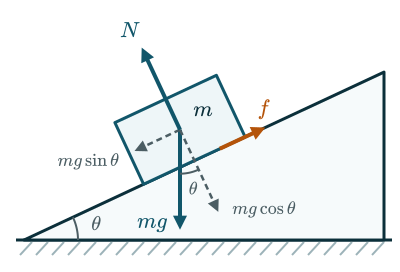
- Perpendicular to the slope there is no acceleration, so N = mg cos θ, not mg.
- Along the slope, a block at rest needs fs = mg sin θ.
As the incline is tilted more, fs grows until it reaches μs N. At that angle, , the block is just about to slide:
Angle of repose
The angle is called the angle of repose. It does not depend on the mass of the block. (NCERT Example 4.8 uses this: a block that starts to slide at 15° has μs = tan 15°, about 0.27.)
When the block slides down, kinetic friction acts up the slope, and its acceleration down the slope is
Sliding down a rough incline
This assumes a fixed incline, maintained contact, and only gravity, normal force and friction acting on the block. If tan θ < μk, the value of a comes out negative: the block slows down and stops. For a block sent up the slope, friction acts down the slope, so it slows down at
Sliding up a rough incline
Rolling friction
A ring or sphere rolling without slipping on a horizontal surface, with nothing pushing or braking it, touches the surface, ideally, at one point, and that point is momentarily at rest on the surface (see rolling as translation plus rotation). In this ideal case no friction acts and the body would roll on at constant velocity for ever. (Rolling without slipping does not mean zero friction in general: a driven or braked wheel, or a ball rolling down a slope, needs static friction at the point of contact.) In practice, the wheel and the surface deform a little, so they touch over a small area rather than a point, and a small force opposes the rolling. This is rolling friction.
For the same weight, rolling friction is much smaller (even by 2 or 3 orders of magnitude) than static or sliding friction.
NCERT Physics Part I (Class 11), Section 4.9.1, page 62
That is why it is far easier to pull a cart on wheels than to drag the same load, and why the invention of the wheel was such a big step.
Friction in daily life: useful and harmful
Friction is often a nuisance, but often essential:
- Walking and driving need friction. Static friction from the ground pushes your foot, and a car’s tyres, forward. On a very slippery road a car cannot start or turn: on a level road, static friction is what supplies the centripetal force for a turn (see circular motion on level and banked roads).
- Brakes use friction. Kinetic friction between the brake pads and the discs or drums slows the wheels and turns kinetic energy into heat; static friction between the tyres and the road then slows the vehicle. If the wheels lock and skid, the road friction becomes kinetic, which is smaller, so the vehicle takes longer to stop (see Q3).
- Friction wastes power in machines and wears out moving parts. It is reduced by:
- lubricants (oil, grease), which reduce kinetic friction between moving parts;
- ball bearings, which replace sliding by rolling, since rolling friction is much smaller;
- a thin cushion of air between the surfaces, as in an air-hockey table or a hovercraft.
Solved examples
Example 1: Push a heavy block
A block of mass 10 kg rests on a horizontal floor. The coefficients of friction are μs = 0.4 and μk = 0.3. A horizontal force F acts on it. Find the friction and the acceleration when (a) F = 30 N and (b) F = 50 N. (c) Once the block is moving, what force keeps it at constant velocity? Take g = 9.8 m s−2.
The floor and F are horizontal, so
The first is the limiting static friction; the second is the kinetic friction.
(a) 30 N is less than 39.2 N, so the block does not move. Static friction adjusts to 30 N, and a = 0.
(b) 50 N is more than 39.2 N, so the block slides, and friction is kinetic:
(c) For constant velocity, F = fk, that is 29.4 N.
Answer: (a) friction 30 N, no motion; (b) friction 29.4 N and an acceleration of 2.06 m s; (c) 29.4 N. Notice that friction in (a) is not μs N.
Example 2: Angle of repose and sliding down
(a) A block on a plank just begins to slide when the plank is tilted to 30°. Find μs. (b) Another block slides down an incline of 37° with μk = 0.5. Find its acceleration. Take g = 9.8 m s−2.
(a) At the angle of repose,
(b) Here sin 37° ≈ 0.6018 and cos 37° ≈ 0.7986, so
Answer: (a) μs is about 0.577; (b) about 1.98 m s down the slope. (With the approximations sin 37° ≈ 3/5 and cos 37° ≈ 4/5, you get about 1.96 m s.) The mass of the block is not needed in either part.
Example 3: Pulling is easier than pushing
A 20 kg box is moved across a level floor by a force of 100 N at 30° to the horizontal. The coefficient of kinetic friction is 0.25. Find the acceleration when the box is (a) pulled with a rope at 30° above the horizontal, and (b) pushed with a rod at 30° below the horizontal. Take g = 9.8 m s−2.
In both cases the force has a horizontal component of 86.6 N (100 cos 30°) and a vertical component of 50 N (100 sin 30°), which changes the normal force.
(a) Pulling: the upward force component reduces the normal force; the box remains on the floor, so
Friction is 0.25 × 146, that is 36.5 N, and
(b) Pushing: the force presses it down, so
Friction is 0.25 × 246, that is 61.5 N, and
Answer: about 2.51 m s when pulled and 1.26 m s when pushed. Pulling reduces the normal force and so the friction, which is why a heavy box, or a lawn roller, is easier to pull than to push.
Common mistakes to avoid
Common mistake
Writing f = μN for a body at rest
Static friction is only as large as it needs to be, up to μs N. Use fs = μs N only when the body is just about to slip; otherwise find fs from the other forces, as in Example 1(a).
Common mistake
Taking N = mg everywhere
For a horizontal surface, N = mg when vertical acceleration is zero and no other vertical forces act. On an incline N = mg cos θ; with a force pulling up at an angle, N is less than mg, and with a force pushing down it is more (Example 3).
Common mistake
Thinking friction always opposes motion
Friction opposes relative motion between the surfaces. It can point along the direction of motion, as for a box on an accelerating truck or the foot of a walking person.
Common mistake
Thinking a larger area means more friction
In the dry-friction model, friction is approximately independent of the apparent contact area. Turning the same rigid brick onto another face leaves the predicted friction unchanged if the surface condition and normal force stay the same; this is not an exact rule for every material or contact.
Common mistake
Using the static coefficient once the body slides
Once sliding starts, friction is kinetic, μk N, which is smaller. The extra force beyond μk N goes into accelerating the body.
Quick revision summary
- The contact force between two surfaces has a normal part (normal reaction) and a parallel part (friction). Gravity acts at a distance; tension, spring force, buoyancy and drag are contact forces, all electrical in origin.
- A spring pulls or pushes back with a force proportional to its stretch or compression, opposite to it; an ideal light string has uniform tension along an unloaded segment with no tangential friction.
- Static friction opposes impending motion and adjusts itself, up to a limit equal to μs N.
- Kinetic friction, μk N, is a little less than the limiting static friction and nearly independent of speed. Both are approximately independent of apparent contact area in this model.
- Friction opposes relative motion, so it can act along the direction of motion.
- On an incline the normal force is mg cos θ, and a block just starts to slide when tan θ = μs (the angle of repose).
- Rolling friction is far smaller than sliding friction; lubricants, ball bearings and air cushions reduce friction.
Formula sheet
- fs ≤ μs N (static friction)
- fk = μk N (kinetic friction), μk < μs
- F = −kx (spring force)
- tan θ = μs (angle of repose)
- a = g(sin θ − μk cos θ) (sliding down a rough incline)
- a = g(sin θ + μk cos θ) (deceleration sliding up)
- amax = μs g (box on an accelerating floor)
Questions students ask
What is the coefficient of friction, and does it have a unit?
The coefficient of friction is the ratio of the friction force to the normal reaction: μs = (fs)max/N for limiting static friction and μk = fk/N for sliding. It is a ratio of two forces, so it has no unit and no dimensions. It depends on the pair of surfaces and their condition, and is usually less than 1, though for very grippy surfaces it can be more than 1.
What is the difference between static and kinetic friction?
Static friction acts while the surfaces do not slide relative to one another: it adjusts to prevent slipping, from zero up to a limit μsN. For a box remaining at rest on a horizontal floor it balances the horizontal push; for a box accelerating with a truck it instead provides the required acceleration. Kinetic friction acts once sliding starts and stays nearly constant at μkN. Since μk < μs, it takes more force to start a body sliding than to keep it sliding at constant velocity.
What is the angle of friction, and is it equal to the angle of repose?
The angle of friction λ is the angle between the total contact force and the normal reaction when friction is at its limiting value, so tan λ = μs. The angle of repose θ is the steepest incline on which a body stays at rest, and it also satisfies tan θ = μs. So for the same two surfaces the two angles are equal, although they are defined differently.
If a block slides down an incline at constant speed, what is the coefficient of kinetic friction?
The coefficient of kinetic friction of a block sliding down an incline at constant speed equals the tangent of the incline’s angle: μk = tan θ. At constant speed the net force is zero, so the pull down the slope, mg sin θ, equals the kinetic friction, μkmg cos θ. For example, a block sliding steadily down a 20° slope has μk = tan 20° ≈ 0.364; since μk < μs, this angle is less than the angle of repose, so the block needs a small push to start sliding.
At what angle should you pull a box to move it with the least force?
A box is moved with the least force by pulling at an angle θ above the horizontal with tan θ = μ, where μ is μs to start the box (this angle is the angle of friction) and μk to keep it sliding steadily. With a pull F at angle θ, the box just moves when F cos θ = μ(mg − F sin θ), so F = μmg/(cos θ + μ sin θ). The denominator is largest, √(1 + μ), when tan θ = μ, which gives Fmin = μmg/√(1 + μ).
Is friction a conservative force?
No, friction is a non-conservative force. On a body sliding over a fixed surface, kinetic friction always opposes the motion, so its work over a closed path is negative, not zero, and its size depends on the length of the path taken. Because this work depends on the path, no potential energy can be defined for friction, unlike gravity or a spring force; the mechanical energy it removes becomes heat.
Practice questions
Try each question first, then open the answer to check your working.
-
Q1. A 5 kg block rests on a horizontal floor with μs = 0.5. A horizontal force of 20 N acts on it. What is the friction on the block? What is the least horizontal force that will start it moving? Take g = 9.8 m s−2.
Show answerHide answer
The limiting friction is
Since 20 N is less than this, the block stays at rest and friction is 20 N (not 24.5 N). A force just over 24.5 N starts it moving.
-
Q2. A coin placed on a book just begins to slide when the book is tilted to 25°. Find the coefficient of static friction between the coin and the book.
Show answerHide answer
At the angle of repose, μs = tan 25°, which is about 0.466.
-
Q3. A car moving at 20 m s brakes hard and its wheels lock, so it skids. The coefficient of kinetic friction between the tyres and the road is 0.6. Find the stopping distance and time. Take g = 9.8 m s−2.
Show answerHide answer
Friction is the only horizontal force, so the deceleration is
It stops in about 34.0 m and 3.40 s.