Rigid bodies: translation and rotation
NCERT Class 11 Physics Chapter 6 Section 6.1
Quick answer
A rigid body is an idealised body whose shape never changes: the distance between every pair of its particles stays fixed. It can move in pure translation, where all its particles have the same velocity at each instant, in rotation about a fixed axis or a fixed point, or in translation and rotation together, as in rolling. A wheel of radius R whose centre moves at speed v and which turns at angular speed ω rolls without slipping on fixed ground when v = ωR; its contact point is then momentarily at rest and its top moves at 2v.
With your textbook
NCERT Physics Part I (Class 11), Chapter 6 “Systems of Particles and Rotational Motion”, Section 6.1 “Introduction”, pages 92–95.
Open the official NCERT chapter (PDF, 4.2 MB, ncert.nic.in) (opens in a new tab)
Checked against the 2026-27 reprint on .
What is a rigid body?
A rigid body in NCERT’s words
Ideally a rigid body is a body with a perfectly definite and unchanging shape. The distances between all pairs of particles of such a body do not change.
NCERT Physics Part I (Class 11), Section 6.1, page 92
In plain words: a rigid body is a solid that never bends, stretches or squashes, however it is pushed. Pick any two of its particles; the distance between them stays the same while the body moves.
So far in mechanics, a moving body was treated as a particle: a point with mass but no size. That works for a car on a long road or a ball thrown across a field, but not for a spinning fan, a rolling wheel or a door turning on its hinges. Different parts of these bodies move differently, so the body must be treated as what it really is, an extended body: a system of very many particles.
No real body is perfectly rigid, because every real body deforms a little under forces. For a wheel, top or beam, treating the body as rigid works when deformation is negligible for the question being studied. Molecules and planets can also be approximated this way for some motions, but vibrations, elastic deformation or fluid motion require other models. The rigid body is an idealisation, like the frictionless surface or the light string.
The kinds of motion a rigid body can have
NCERT answers the question “What kind of motion can a rigid body have?” with examples. There are only a few possibilities.
Pure translation
A block sliding straight down an incline, without turning, is in pure translation.
In pure translational motion at any instant of time, all particles of the body have the same velocity.
NCERT Physics Part I (Class 11), Section 6.1.1, page 93
A quick test: draw a line on the body. In pure translation the line keeps the same direction all the time; it only shifts. The path need not be straight. The cabin of a giant wheel at a fair hangs upright as the wheel turns: every point of the cabin moves on a circle of the same size, every point has the same velocity at each instant, and a line drawn on the cabin stays parallel to itself. The cabin is in pure translation, along a curved path, while the wheel itself rotates.
Rotation about a fixed axis
If a rigid body is fixed along a straight line, it cannot translate; the only motion left is rotation about that line, the axis of rotation. A ceiling fan, a potter’s wheel, a giant wheel, a merry-go-round and a door on its hinges all rotate about fixed axes.
In rotation about a fixed axis, every particle of the rigid body moves in a circle which lies in a plane perpendicular to the axis and has its centre on the axis.
NCERT Physics Part I (Class 11), Chapter 6, Summary, page 123
Three facts follow:
- The radius of each particle’s circle is its perpendicular distance from the axis. Different particles move on circles of different radii, and these circles may lie in different planes, but every one of those planes is perpendicular to the axis.
- Particles on the axis have zero radius, so they stay at rest. That is what a fixed axis means.
- In any interval, every particle turns through the same angle about the axis. That common angle, and its rate of change, describe the rotation of the whole body.
Rotation about a fixed point
Sometimes only one point of the body is fixed, not a whole line. In the ideal fixed-point model, a spinning top’s tip stays at one point on the ground. Its axis passes through the tip at every instant, but the axis itself slowly moves round the vertical, sweeping out a cone; this motion of the axis is called precession. An oscillating table fan is similar: the pivot is fixed, the blades rotate, and the axis of the blades swings from side to side. In such cases the axis always passes through the fixed point but is not fixed itself. This chapter deals only with the simpler case of rotation about a fixed axis, as NCERT says.
Translation and rotation together
A cylinder rolling down an incline moves from the top to the bottom, so it translates, but its particles do not all have the same velocity, so the motion is not pure translation. It is translation plus rotation. A book tossed so that it tumbles through the air, a bicycle wheel on the road and the Earth (spinning while its centre moves round the Sun) all combine the two.
NCERT sums up the whole section:
The motion of a rigid body which is not pivoted or fixed in some way is either a pure translation or a combination of translation and rotation. The motion of a rigid body which is pivoted or fixed in some way is rotation.
NCERT Physics Part I (Class 11), Section 6.1.1, page 95
| Kind of motion | What is fixed | Examples |
|---|---|---|
| Pure translation | nothing | sliding block, giant wheel cabin |
| Rotation about a fixed axis | a line | fan, door, potter’s wheel |
| Rotation about a fixed point | one point | spinning top, table fan |
| Translation and rotation | nothing | rolling wheel, tumbling book |
Rolling: translation plus rotation
Rolling is the most common combined motion, and NCERT notes the key fact in its figure of a rolling cylinder:
In fact, the velocity of the point of contact P is zero at any instant, if the cylinder rolls without slipping.
NCERT Physics Part I (Class 11), Section 6.1.1, page 93
Why? Split the motion of a wheel of radius R into two parts (the method goes slightly beyond the NCERT text, but it uses only ideas from this chapter):
- Translation: every point moves forward with the velocity v of the centre.
- Rotation about the centre: if the wheel turns at ω radians per second, in the sense that rolls it forward (clockwise in the figure), every point on the rim moves round the centre at speed ωR, along the tangent to the rim. At the top this is forward; at the bottom it is backward.
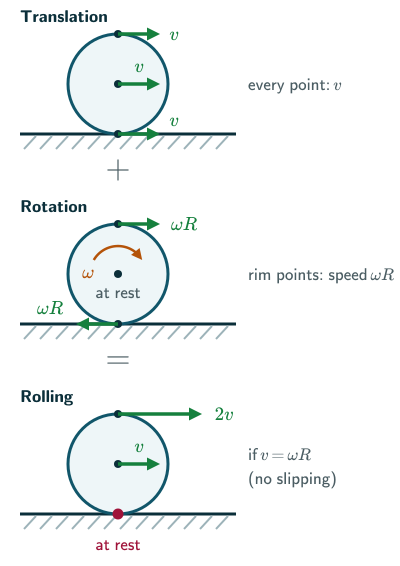
The velocity of each point is the sum of the two parts. At the contact point the forward v and the backward ωR cancel only if they are equal. That is the condition for rolling without slipping:
Rolling without slipping
Then, adding the two parts at each point:
- the contact point is momentarily at rest;
- the centre moves at v;
- the top moves at v + ωR, that is 2v;
- a point on the rim level with the centre has v forward and ωR (equal to v) straight up or down, so its speed is √2 v, at 45° to the horizontal.
Two more facts are useful in problems. First, v = ωR is the condition on ground that is at rest; on a moving belt or plank, rolling without slipping means that the contact point moves with the surface under it. Second, since the contact point is momentarily at rest, the wheel’s instantaneous velocity field is that of rotation about the contact point: every point moves at ω times its distance from the contact point, at right angles to the line joining them. The top, at 2R, moves at 2ωR = 2v; the side point, at √2 R, at √2 v.
The axis through the centre moves with the wheel but keeps its direction, so NCERT describes rolling as rotation about a fixed axis combined with translation.
If v and ωR are not equal, the wheel slips: a car wheel spinning on ice (ωR larger than v) or a locked wheel skidding (ω zero). Then the contact point slides over the ground and the friction there is kinetic.
Why the split into translation and rotation helps
Every motion of a free rigid body can be treated as the motion of one special point, the centre of mass, plus a rotation about it. The rest of this chapter builds the tools for the two parts:
- the centre of mass moves as if all the mass were there and all the external forces acted on it, just like a single particle obeying Newton’s second law;
- the rotation is described by angular velocity and angular acceleration, changed by torque, resisted by moment of inertia, and carried by angular momentum.
It also explains everyday engineering. The contact patch of a tyre rolling without slipping is at rest on the road, so no sliding friction acts there; the small resistance that remains comes from the tyre and the road deforming a little, which is why rolling friction is so much smaller than sliding friction. When the wheels lock and skid, the contact patch slides and kinetic friction acts; in the usual dry-friction model it is smaller than the limiting static friction available before sliding, so locking the wheels reduces the maximum retarding force in that model.
Solved examples
Example 1: Name the motion
Name the kind of motion in each case: (a) a drawer pulled straight out; (b) the blades of a ceiling fan; (c) the wheel of a moving bicycle; (d) a spinning top whose axis traces a cone; (e) a cabin of a giant wheel that hangs upright; (f) a door being opened.
(a) Pure translation: every point of the drawer has the same velocity.
(b) Rotation about a fixed axis, the vertical rod of the fan.
(c) Translation plus rotation: the wheel’s centre moves forward while the wheel turns about it.
(d) Rotation about a fixed point, the tip; the axis itself moves (precession).
(e) Pure translation along a circular path: a line on the cabin stays parallel to itself.
(f) Rotation about a fixed axis, the line of the hinges.
Answer: translation in (a) and (e), rotation about a fixed axis in (b) and (f), a fixed point in (d), and both together in (c).
Example 2: Speeds of points on a rolling wheel
A car moves at 7 m s, and its wheels, of radius 0.35 m, roll without slipping. Find (a) the angular speed of a wheel, and the speeds of (b) the top of the wheel, (c) the point touching the road and (d) a point on the rim level with the axle.
(a) From the rolling condition,
(b) The top moves at v + ωR, that is 7 + 7 = 14 m s.
(c) The contact point moves at v − ωR, that is 0.
(d) The two parts, each 7 m s, are at right angles, so
Answer: 20 rad s; 14 m s at the top; 0 at the road; about 9.90 m s at the side, at 45° to the road: forward and downward at the front of the wheel, forward and upward at the back.
Example 3: Is the wheel slipping?
A car moves at 12 m s on a muddy road while its driven wheels, of radius 0.30 m, turn at 50 rad s. Is each wheel rolling without slipping? If not, how fast does its contact point slide over the road, and in which direction?
The rim speed about the axle is
This is not equal to v, 12 m s, so the wheel slips. At the contact point the translation gives 12 m s forward and the rotation gives 15 m s backward.
Answer: the wheel slips; its contact point slides backward over the road at 15 − 12 = 3 m s, as a wheel spinning in mud does.
Common mistakes to avoid
Common mistake
Thinking a curved path means rotation
A body can move along a circle and still be in pure translation, like the upright cabin of a giant wheel. Rotation means the body’s orientation changes: a line drawn on it turns, unless it is parallel to the axis of rotation.
Common mistake
Thinking every point of a rolling wheel moves with the car’s velocity
In the wheel’s plane, the centre has velocity v, forward; in a wheel of finite thickness every point along its axle shares that velocity. Other points differ in speed or direction: without slipping, the top moves at 2v and the contact point is momentarily at rest.
Common mistake
Assuming the contact point is always at rest
It is at rest only when v = ωR. A wheel spinning in mud or skidding with locked brakes slides at the contact point.
Common mistake
Thinking rotation needs a fixed axis
A top rotates about a fixed point; its axis moves. A fixed axis is the special, simpler case this chapter studies.
Common mistake
Treating a real body as exactly rigid
The rigid body is an idealisation. It works when deformations are tiny; it fails for a stretched spring, a squashed ball or a liquid.
Quick revision summary
- A rigid body keeps the distance between every pair of its particles fixed. Real bodies only approximate it.
- In pure translation all particles have the same velocity at each instant, and a line on the body keeps its direction; the path may be curved.
- In rotation about a fixed axis, every particle moves in a circle in a plane perpendicular to the axis, centred on it; particles on the axis are at rest, and all particles turn through the same angle.
- A body fixed at one point, like a top, rotates about an axis through that point, and the axis may move (precession).
- A free rigid body can translate, rotate about its stationary centre of mass, or combine translation and rotation, as in rolling.
- In rolling without slipping, v = ωR: the contact point is momentarily at rest and the top moves at twice the speed of the centre.
Formula sheet
- v = ωR (rolling without slipping on fixed ground)
- vtop = 2v, vcontact = 0 (pure rolling on fixed ground)
- vside = √2 v (point level with the centre)
Questions students ask
What is the difference between a particle, a rigid body and a deformable body?
A particle is a point with mass but no size, so only its position matters and it cannot rotate. A rigid body has size, but the distance between every pair of its particles stays fixed, so it keeps its shape and can translate, rotate or do both. A deformable body, such as a rubber band, a lump of clay or a balloon, changes shape or size under forces; how real solids deform is the subject of elasticity. The model to use depends on the question: a car is a particle on a long journey, but its wheels must be treated as rigid bodies when their turning matters.
What is the difference between translational and rotational motion?
In translational motion every particle of a body has the same velocity at each instant, so a line drawn on the body keeps its direction, as for a lift going up or a train carriage on a straight track. In rotation about a fixed axis the particles move on circles centred on the axis, all turning through the same angle, with speeds proportional to their distances from the axis, so a line drawn on the body across the axis turns, as for the hands of a clock. Translation is described by velocity and acceleration, rotation by angular velocity and angular acceleration. A rolling wheel does both at once.
What does rolling without slipping (pure rolling) mean?
Rolling without slipping, also called pure rolling, means that the point of a wheel touching the surface has no velocity relative to that surface at each instant, so the wheel never slides over it. On ground at rest this gives v = ωR, where v is the speed of the centre, ω the angular speed and R the radius, and in each turn the centre moves forward exactly one circumference, 2πR. For example, a wheel of radius 0.4 m turning at 10 rad s without slipping rolls forward at 4 m s.
What is the role of friction when a wheel rolls without slipping?
The friction on a wheel rolling without slipping is static friction, because the contact point is momentarily at rest on the surface; it takes whatever value, up to μsN, is needed to stop the wheel sliding, so a car can accelerate or brake only as hard as the tyres’ grip allows, and on ice its wheels spin or skid. An ideal free wheel rolling at constant velocity on level ground needs no friction at all, but friction is needed when it rolls on a slope, or when a driving or braking torque at the axle speeds it up or slows it down. For ideal rolling on a fixed rigid surface, the contact point is instantaneously at rest in the ground frame, so static friction does no work there. On a moving belt, the contact point moves with the belt and friction can transfer energy.
Practice questions
Try each question first, then open the answer to check your working.
-
Q1. Which particles of a rotating ceiling fan are at rest, and why?
Show answerHide answer
The particles on the axis of rotation. Each particle moves in a circle whose radius is its perpendicular distance from the axis; for a particle on the axis that distance is zero, so it does not move.
-
Q2. A bicycle moves at 5 m s and its wheels, of radius 0.35 m, roll without slipping. Find the angular speed of a wheel and the speeds of the top and bottom points of its rim.
Show answerHide answer
ω = v/R = 5/0.35, about 14.3 rad s. The top moves at 2v, that is 10 m s, and the bottom point is momentarily at rest.
-
Q3. Name the kind of motion: (a) a piston in an engine cylinder; (b) the Earth; (c) a book that slides across a table without turning.
Show answerHide answer
(a) Pure translation, back and forth along a straight line. (b) Translation plus rotation: its centre moves round the Sun while it spins about its axis. (c) Pure translation.