Angular momentum about a fixed axis
NCERT Class 11 Physics Chapter 6 Section 6.12
Quick answer
The conservation of angular momentum says that when the total external torque about an axis is zero, the angular momentum about that axis stays constant. For a body turning about a fixed axis this angular momentum is L = Iω, where I is the moment of inertia about the axis, and its rate of change equals the external torque about the axis; with no such torque, Iω = Iω even if I changes, provided the same system shares the angular rate used in Iω. That is why a skater spins faster when she pulls her arms in, while her kinetic energy, L/2I, increases.
With your textbook
NCERT Physics Part I (Class 11), Chapter 6 “Systems of Particles and Rotational Motion”, Section 6.12 “Angular momentum in case of rotations about a fixed axis”, pages 121–123.
Open the official NCERT chapter (PDF, 4.2 MB, ncert.nic.in) (opens in a new tab)
Checked against the 2026-27 reprint on .
What is the angular momentum of a body about a fixed axis?
Angular momentum about a fixed axis
For a rigid body turning about a fixed axis with angular velocity ω, the component of its angular momentum along the axis is
where I is its moment of inertia about that axis.
In plain words: the angular momentum of a spinning body measures “how much rotation” it carries, just as linear momentum mv measures how much straight-line motion a body carries. For rotation about a fixed axis it is simply moment of inertia times angular velocity. A heavy flywheel turning fast has a large angular momentum; a light wheel turning slowly has a small one.
On this page, as in NCERT, a vector is written in bold, L, and its magnitude in italics, L. The axis of rotation is the z-axis, with unit vector .
Where L = Iω comes from
Take a particle of the body at P, moving on a circle with centre C on the axis, with the origin O also on the axis. Its position vector is r = OC + CP, so its angular momentum about O is
The velocity v is tangent to the circle, of size ωr⊥, where r⊥ = CP. The second term points along the axis, with size mr⊥v = mr⊥2ω. The first term is perpendicular to the axis. So each particle’s angular momentum has a part along the axis, mr⊥2ω, and a part perpendicular to it. Adding the parts along the axis over all the particles, with Σmr⊥2 = I:
Component along the axis
Lz = Iω still holds for a body changing shape, as long as all its parts turn with the same ω at that instant.
For a body that is symmetric about the axis, such as a wheel, disc, cylinder or sphere turning about its axis of symmetry, the perpendicular parts cancel in pairs (each particle has a partner diametrically opposite, moving the other way), so the whole angular momentum lies along the axis and . The same holds for a flat body turning about an axis perpendicular to its plane (with the origin in that plane). For other, lopsided bodies, L can have a part perpendicular to the axis as well, and need not be parallel to ω. (For a single particle, l and ω are not in general parallel, unlike p and v.)
Torque and the rate of change of angular momentum
For any system, dL/dt equals the total external torque, both taken about a fixed point (here O on the axis). For a fixed axis, only the torque component along the axis counts (the bearings supply whatever keeps the axis fixed), so
Fixed-axis form
NCERT keeps only the torque along the axis and concludes:
Thus, for rotation about a fixed axis, the component of angular momentum perpendicular to the fixed axis is constant.
NCERT Physics Part I (Class 11), Section 6.12, page 122
Strictly, this holds only when that perpendicular part is zero, as for a body symmetric about the axis. For an unbalanced body the perpendicular part has a direction fixed relative to the rigid body and turns with it, while its magnitude also changes if the angular speed changes, and the bearings must supply the torque that turns it, which is why car wheels and fan blades are balanced. For the motion about the axis, only Iω matters.
If I does not change, d(Iω)/dt = I dω/dt = Iα, and this is τ = Iα again (rotational dynamics), now reached through angular momentum rather than work and energy. The form d(Iω)/dt = τ also permits shape changes when the same particles share a common angular rate about the fixed axis. With independent internal spinning or mass leaving the chosen system, track total angular momentum directly.
Conservation of angular momentum
If the external torque about the axis is zero, d(Iω)/dt = 0:
Conservation of angular momentum (fixed axis)
This is the fixed-axis form of the general law of conservation of angular momentum. It applies to the same closed system even when I changes, provided its parts share the angular velocity used in Lz = Iω and the net external axial torque is zero. Individual external forces or torques can be present and cancel. NCERT describes an experiment you can try.
Sit on a swivel chair with your arms folded and your feet off the ground, and let a friend set the chair spinning. Now stretch your arms out.
Stretching the arms increases I about the axis of rotation, resulting in decreasing the angular speed ω. Bringing the arms closer to the body has the opposite effect.
NCERT Physics Part I (Class 11), Section 6.12.1, page 123
(Friction in the chair’s bearing is neglected; it is the external torque that slowly stops the chair in practice.)
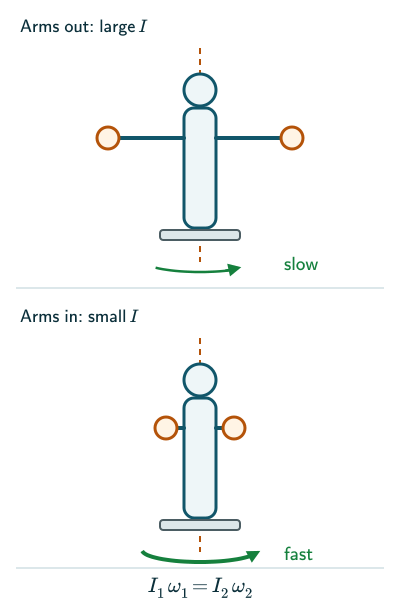
Kinetic energy is not conserved. The rotational part of kinetic energy is K = ½Iω = Lz2/(2I). While parts move radially or otherwise relative to the body, there can be additional kinetic energy; comparisons using this formula alone refer to states with that motion absent. With L fixed, a smaller I means a larger K. When you pull your arms in, your muscles pull them inwards through a distance and so do positive work on them; that work becomes the extra kinetic energy (Example 1). During a controlled extension ending with the arms at rest relative to the body, rotational kinetic energy falls. Internal forces absorb that mechanical energy; its final distribution depends on the muscular motion and dissipation. It need not all become heat at one prescribed place.
Where conservation of angular momentum is used
- Skaters and dancers. A skater or a classical dancer spinning on the toes of one foot (a pirouette) starts with arms and leg stretched out and then pulls them in to spin much faster.
- Divers and acrobats. A diver leaves the board turning slowly, tucks into a ball to make I small and somersault quickly, then stretches out to slow the spin before entering the water.
- Coupling two rotating bodies. When a disc is dropped onto a coaxial rotating disc, the friction between them is internal to the pair, so I1ω1 + I2ω2 is conserved while they come to a common speed (Example 3). Kinetic energy is lost as heat.
- Planets and comets. Gravity on a planet points at the Sun, so the planet’s angular momentum about the Sun is constant; it moves fastest when nearest the Sun. (This is about a point, not a fixed axis of a rigid body, but it is the same law.)
Solved examples
Example 1: A child on a turntable
A child stands at the centre of a turntable with arms outstretched. The turntable rotates at 40 rpm without friction. The child folds the arms, reducing the combined child–turntable moment of inertia to 2/5 of its first value. (a) What is the new angular speed? (b) Show that the kinetic energy of rotation increases, and explain why. (NCERT Exercise 6.12.)
(a) No external torque acts about the axis, so I1ω1 = I2ω2, with I2 = (2/5)I1:
(Any unit of angular speed works here, because only a ratio is used.)
(b) K = L/2I with L constant, so K2/K1 = I1/I2 = 5/2. The kinetic energy is 2.5 times as large. The extra energy comes from the work the child’s muscles do in pulling the arms inwards.
Answer: 100 rpm; the kinetic energy rises by a factor of 2.5, supplied by the child’s muscles.
Example 2: Angular momentum of a cylinder
A solid cylinder of mass 20 kg and radius 0.25 m rotates about its axis at 100 rad s (NCERT Exercise 6.11). Find the magnitude of its angular momentum about the axis.
I = ½MR = ½ × 20 × 0.25 = 0.625 kg m, so
Its kinetic energy, which NCERT also asks for, is ½ × 0.625 × 100 = 3125 J.
Answer: 62.5 kg m s, along the axis. The cylinder is symmetric about its axis, so this is the whole angular momentum, not just its axial part.
Example 3: Two discs locking together
A disc with I1 = 0.1 kg m spins at 100 rad s on a frictionless axle. A second disc with I2 = 0.4 kg m, not rotating, is dropped onto it on the same axle, and friction makes them turn together. Find the common angular speed and the kinetic energy lost.
The friction between the discs is internal, and there is no external torque about the axle, so
Kinetic energy before: ½ × 0.1 × 100 = 500 J. After: ½ × 0.5 × 20 = 100 J.
(In general, ω = (I1ω1 + I2ω2)/(I1 + I2), with ω2 negative if the second disc turns the other way.)
Answer: 20 rad s; 400 J is lost as heat, four-fifths of the original kinetic energy. This is the rotational version of a completely inelastic collision.
Common mistakes to avoid
Common mistake
Conserving kinetic energy when I changes
When a skater pulls in her arms, Iω stays the same but ½Iω rises. When two discs lock together, Iω is conserved but kinetic energy is lost. Conserve angular momentum, not kinetic energy.
Common mistake
Conserving angular momentum with an external torque
Friction at the axle, or a motor, exerts an external torque. Only when the total external torque about the axis is zero (or negligible during a short event) is Iω constant.
Common mistake
Taking L = Iω as the whole angular momentum of any body
Iω is always the component of L along the axis. It is the whole of L for a body symmetric about the axis, or a flat body turning about an axis perpendicular to its plane with the origin in that plane. Otherwise L can have a perpendicular part, but only Iω matters for fixed-axis problems.
Common mistake
Thinking a piece that falls off speeds up the rest
If a bit of putty drops off the rim of a spinning wheel, it leaves with the rim’s speed and carries its own angular momentum away. If detachment gives no angular impulse, the rest has the same ω immediately afterwards; losing a piece does not itself make it spin faster. Later motion depends on any remaining external torque.
Common mistake
Using τ = Iα when I changes
If the body changes shape, use d(Iω)/dt = τ. With zero torque, α need not be zero: the skater speeds up with no torque at all.
Quick revision summary
- For a rigid body turning about a fixed axis, the component of angular momentum along the axis is Lz = Iω; for a body symmetric about the axis, entirely.
- The rate of change of Iω equals the external torque about the axis; with constant I this is τ = Iα.
- For a body symmetric about the axis, L has no part perpendicular to the axis.
- With no external torque about the axis, Iω = constant, even if I changes: I1ω1 = I2ω2.
- Kinetic energy L/2I is not conserved when I changes: pulling in the arms raises it; locking two discs together lowers it.
Formula sheet
- L = Iω (about a fixed axis)
- d(Iω)/dt = τ
- τ = 0 ⇒ Iω = constant; Iω = Iω
- K = ½Iω = L/2I
- ω = (Iω + Iω)/(I + I) (two discs locking together; ω signed)
Questions students ask
What is the difference between conservation of linear momentum and conservation of angular momentum?
Linear momentum is conserved when the total external force on a system is zero; angular momentum about a point or an axis is conserved when the total external torque about it is zero, a separate condition. A planet’s linear momentum keeps changing direction under the Sun’s pull, but that pull points at the Sun and has no torque about it, so the planet’s angular momentum about the Sun stays constant; a couple on a wheel changes its angular momentum with zero net force. Both laws also work one component at a time: linear momentum along a force-free direction, angular momentum about a torque-free axis.
How does the conservation of angular momentum explain tornadoes and whirlpools?
A slowly turning mass of air or water spins faster as it is drawn towards the centre, because the conservation of angular momentum keeps mvr for each parcel roughly constant while little torque acts on it: as its distance r from the axis falls, its speed v round the axis rises in inverse proportion, v ∝ 1/r. Halving the radius doubles the speed, and since ω = v/r, the parcel then goes round four times as often. This is part of how a broad, gentle swirl tightens into the narrow, violent funnel of a tornado, and why water spins quickly as it nears a drain; friction with the ground and the surrounding air keeps real flows from following the rule exactly.
Is conservation of angular momentum in the NEET syllabus?
Yes, the conservation of angular momentum is in the NEET (UG) 2026 syllabus: Unit 5, Rotational Motion, lists “torque, angular momentum, conservation of angular momentum and its applications”. JEE Main 2027 has the same words in its Unit 5, and NCERT Class 11 covers the law in Sections 6.7 and 6.12 of Chapter 6. It is applied through I1ω1 = I2ω2 to skaters, turntables and two discs locking together.
What happens to the length of a day if the polar ice caps melt?
If the polar ice caps melted, the length of the day would increase slightly. The water from the ice resting on land, mainly in Antarctica and Greenland, would spread over the oceans, moving mass from near the Earth’s axis towards the equator and so increasing the Earth’s moment of inertia; with no appreciable external torque, Iω stays constant, so ω would fall and each rotation would take a little longer. The change would be tiny, because the ice is a very small fraction of the Earth’s mass.
Practice questions
Try each question first, then open the answer to check your working.
-
Q1. A skater spins at 2 rev s with arms stretched out, with moment of inertia 4.0 kg m about her axis. She pulls her arms in, reducing it to 1.6 kg m. Find her new rate of spin.
Show answerHide answer
I1ω1 = I2ω2 gives ω2 = 4.0 × 2/1.6 = 5 rev s.
-
Q2. Why does a diver tuck into a ball in the middle of a dive and stretch out before entering the water?
Show answerHide answer
In uniform gravity with air resistance neglected, there is no external torque about the diver’s centre of mass, so the angular momentum is constant. Tucking in reduces the moment of inertia, so the rate of spin rises and more somersaults fit into the time in the air. Stretching out increases the moment of inertia again and slows the spin for a clean entry.
-
Q3. A flywheel with I = 2 kg m turns at 50 rad s. A constant frictional torque of 4 N m acts at its axle. How long does it take to stop, and what is its angular momentum after 10 s?
Show answerHide answer
The angular momentum falls at a rate equal to the torque: L = 2 × 50 = 100 kg m s at first, so it stops after 100/4 = 25 s. After 10 s, L = 100 − 4 × 10 = 60 kg m s (ω = 30 rad s).