Centre of mass
NCERT Class 11 Physics Chapter 6 Section 6.2
Quick answer
The centre of mass of a system is the mass-weighted average position of its particles: X = Σmx/M, and the same for Y and Z, where M is the total mass. For two particles it lies on the line joining them, at distances in the inverse ratio of the masses, mr = mr. For a homogeneous body with a centre of symmetry, such as a rod, ring, disc or sphere, it is at the geometric centre, which need not be inside the material.
With your textbook
NCERT Physics Part I (Class 11), Chapter 6 “Systems of Particles and Rotational Motion”, Section 6.2 “Centre of mass”, pages 95–99.
Open the official NCERT chapter (PDF, 4.2 MB, ncert.nic.in) (opens in a new tab)
Checked against the 2026-27 reprint on .
What is the centre of mass?
The centre of mass, in NCERT’s words
The centre of mass of the system is that point C which is at a distance X from O, where X is given by
NCERT Physics Part I (Class 11), Section 6.2, page 96
Here two particles of masses m1 and m2 lie on the x-axis at signed coordinates x1 and x2 measured from a common origin O. In plain words: the centre of mass is the mass-weighted average position of the particles. Each position counts in proportion to the mass sitting there, so the centre of mass lies nearer the heavier particle.
The centre of mass matters because, as the next topics show, the centre of mass of a system moves as if all the mass were concentrated there and all the external forces acted there. It is the one point whose motion is as simple as that of a single particle obeying Newton’s second law.
On this page, as in NCERT, a vector is written in bold, r, and its magnitude in italics, r.
Centre of mass of two particles
Thus, for two particles of equal mass the centre of mass lies exactly midway between them.
NCERT Physics Part I (Class 11), Section 6.2, page 96
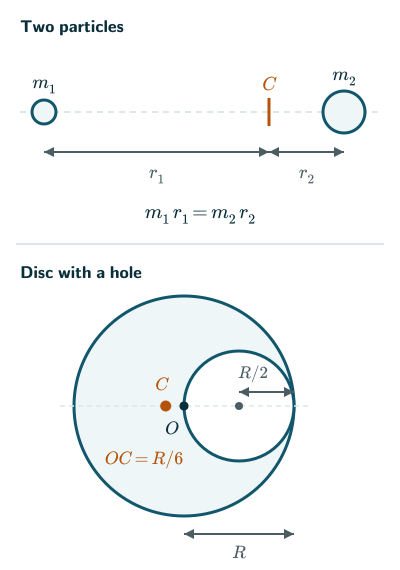
With unequal masses the centre of mass moves towards the heavier one. Put the origin at the centre of mass itself, so that X = 0. Then m1x1 + m2x2 = 0: the two particles are on opposite sides of C, at distances r1 and r2 with
Two particles: distances from the centre of mass
The distances are in the inverse ratio of the masses. If the particles are a distance d apart, r1 = m2d/(m1 + m2), which is a quick way to place the centre of mass of a diatomic molecule or of the Earth and the Moon.
Centre of mass of many particles
For n particles along the x-axis the same weighted average gives X = Σmixi/Σmi. For particles spread out in a plane or in space, average each coordinate separately:
Centre of mass of n particles
Here M = Σmi is the total mass. The three equations combine into one vector equation for the position vector R of the centre of mass, where ri is the position vector of the i-th particle:
Vector form
Two consequences are used again and again:
- If the origin is placed at the centre of mass, Σmiri = 0. The mass-weighted positions balance out about the centre of mass.
- For particles of equal mass, the centre of mass is the plain average of the positions. For three equal masses it is the centroid of their triangle.
Thus, for three particles of equal mass, the centre of mass coincides with the centroid of the triangle formed by the particles.
NCERT Physics Part I (Class 11), Section 6.2, page 96
For calculating the centre of mass of a larger system, any group of particles can be replaced by its total mass placed at its own centre of mass. That is how composite bodies are handled in Example 3 and in Q4 and Q6.
Centre of mass of a rigid body
A metre stick or a flywheel is a system of a huge number of closely packed particles, far too many to add one by one. Treat the body as a continuous distribution of mass: split it into small elements of mass dm at (x, y, z), and turn each sum into an integral:
Continuous body
with similar integrals for Y and Z. For a homogeneous body (mass spread uniformly) with a centre of symmetry, so that for every dm at (x, y, z) there is an equal dm at (−x, −y, −z), symmetry does the work. If the body has only an axis or a plane of symmetry, the centre of mass lies on it, and integration finds where. In a uniform thin rod with the origin at its middle, every element dm at x has a partner of equal mass at −x, so the integral is zero and the centre of mass is the middle of the rod.
By using symmetry consideration, we can easily show that the centres of mass of these bodies lie at their geometric centres.
NCERT Physics Part I (Class 11), Section 6.2, page 97
NCERT means homogeneous rings, discs, spheres and rods; the same holds for a uniform cube or cylinder. Other standard results (the triangle is NCERT Example 6.2; the rest are found by integration and go beyond the NCERT text):
| Uniform body | Centre of mass |
|---|---|
| Triangular plate | centroid (meet of the medians) |
| Semicircular ring, radius R | 2R/π from the centre, on the axis |
| Semicircular disc, radius R | 4R/(3π) from the centre, on the axis |
| Solid hemisphere, radius R | 3R/8 from the flat face |
| Hollow hemisphere, radius R | R/2 from the flat face |
| Solid cone, height h | h/4 from the base, on the axis |
For a triangular plate, NCERT Example 6.2 (page 98) cuts it into thin strips parallel to one side; each strip balances at its midpoint, so the centre of mass lies on the median through those midpoints, and on each of the other medians too.
The centre of mass need not be inside the body. For a ring it is the centre of the ring, where there is no mass at all; the same is true of a horseshoe or a boomerang.
Where the idea is used
- Composite and cut-out bodies. Treat each piece as a point mass at its own centre of mass. A hole is a piece of negative mass: take away its mass, placed at its centre (Example 3).
- Molecules. In a diatomic molecule nearly all the mass is in the nuclei, so the centre of mass lies on the line joining them, much nearer the heavier atom (Q1).
- The Earth and the Moon. With the Earth’s mass 5.97 × 10 kg, the Moon’s 7.35 × 10 kg and their distance 3.84 × 10 m, the centre of mass is about 4.67 × 10 m from the Earth’s centre, inside the Earth. To a two-body approximation, both orbit their common centre of mass on a roughly monthly timescale.
- Balancing. With only weight and the support force acting, a body can balance when the support force passes vertically through its centre of mass; that balance can be unstable (in uniform gravity this is also the centre of gravity, met later in this chapter).
Solved examples
Example 1: Two particles on a line
A 2 kg particle is at x = 1 m and a 3 kg particle is at x = 6 m. Find the centre of mass, and check that the distances from it are in the inverse ratio of the masses.
The 2 kg particle is 3 m from C and the 3 kg particle is 2 m from it, so m1r1 = 2 × 3 = 6 and m2r2 = 3 × 2 = 6, as expected.
Answer: X = 4 m, nearer the heavier particle.
Example 2: Three particles at the corners of a triangle
This is NCERT Example 6.1 (pages 97–98). Masses of 100 g, 150 g and 200 g sit at the corners O, A and B of an equilateral triangle of side 0.5 m. Find their centre of mass.
Put O at the origin and A on the x-axis, so the corners are O (0, 0), A (0.5, 0) and B (0.25, 0.25√3), in metres. The 100 g mass at O adds nothing to either sum. The total mass is 450 g, and the grams cancel:
Answer: C is at (5/18 m, √3/9 m), about (0.278 m, 0.192 m). It is not the centroid, which is at (0.25 m, 0.144 m), because the masses are unequal: C is shifted upward and rightward from the centroid, towards the more heavily weighted corners.
Example 3: A disc with a hole
A circular hole of radius R/2 is cut from a uniform disc of radius R. The centre of the hole is R/2 from the centre O of the disc. Locate the centre of mass of the plate that remains. (This is NCERT Exercise 6.15, which asks for the centre of gravity, the same point in uniform gravity.)
For a uniform plate, mass is proportional to area. If the full disc has mass M, the cut-out piece has a quarter of its area, so its mass is M/4. Take O as the origin and the x-axis through the centre of the hole. Treat the plate as the full disc (mass M at x = 0) plus the hole (mass −M/4 at x = R/2):
Answer: the centre of mass is R/6 from O, on the side away from the hole. (By symmetry it lies on the line through O and the centre of the hole.)
Common mistakes to avoid
Common mistake
Assuming the centre of mass is always inside the body
For a ring it is the empty centre. For a bent wire, a horseshoe or a hollow shape it can lie outside the material.
Common mistake
Taking the centroid when the masses are unequal
The centroid (or midpoint) is the centre of mass for equal masses or a uniform body, but not in general. In Example 2 the centre of mass is not the centroid of the triangle.
Common mistake
Adding the hole’s mass instead of subtracting it
For a cut-out, subtract: the hole is negative mass at its own centre. And for a uniform plate, its mass is the fraction of the area removed, a quarter in Example 3, not a half. For a solid, use volume: a spherical cavity of radius R/2 in a sphere of radius R has mass M/8, not M/4.
Common mistake
Measuring positions from different origins
Every position in one calculation must be measured from the same origin, with signs. A particle to the left of the origin has a negative x.
Common mistake
Forgetting that a non-uniform body has a shifted centre
Symmetry must apply to the mass distribution, not just the outline. A rod that is denser at one end has its centre of mass nearer that end (Q5). A non-uniform body can still have its centre of mass at the geometric centre if equal masses are arranged symmetrically on opposite sides.
Quick revision summary
- The centre of mass is the mass-weighted average position of a system of particles.
- For two particles it divides the line joining them in the inverse ratio of the masses; for equal masses it is the midpoint, and for three equal masses the centroid.
- For many particles, average each coordinate with the masses as weights; in vector form R = Σmiri/M.
- For a continuous body the sums become integrals; homogeneous symmetric bodies have their centre of mass at the geometric centre.
- Composite bodies: replace each part by its mass at its own centre of mass; a hole counts as negative mass.
- The centre of mass may lie outside the material of the body, as for a ring.
Formula sheet
- X = (mx + mx)/(m + m) (two particles)
- mr = mr (distances from the centre of mass)
- X = Σmx/M, Y = Σmy/M, Z = Σmz/M
- R = Σmr/M (vector form)
- X = (1/M)∫x dm (continuous body)
Questions students ask
What is the difference between centre of mass and centre of gravity?
The centre of mass is the mass-weighted average position of a body’s particles, so it depends only on how the mass is spread; the centre of gravity is the point about which the total torque of gravity on the body is zero, so it also depends on the gravitational field. In uniform gravity the two are the same point, which is true to a very good approximation for ordinary bodies near the Earth. A non-uniform field can make the effective gravitational point differ from the centre of mass, and the difference need not always be small. In a general varying field, a single centre of gravity valid for every orientation need not exist.
Is the centre of mass the same as the centroid?
The centre of mass and the centroid coincide for a body of uniform density, but not in general: the centroid depends on the shape alone, while the centre of mass weights each part by its mass. For example, a 1 m rod made of a 1 kg half joined to a 3 kg half has its centroid 0.5 m from the light end, but its centre of mass at (1 × 0.25 + 3 × 0.75)/4 = 0.625 m from that end, inside the heavier half.
How do you find the centre of mass of a semicircular ring?
The centre of mass of a uniform semicircular ring of radius R lies on its axis of symmetry, 2R/π (about 0.64R) from the centre, found by integration. Put the centre at the origin with the ring above the x-axis, so X = 0 by symmetry. An element at angle θ has mass dm = (M/π) dθ and height y = R sin θ, so Y = (1/M)∫y dm = (R/π)∫sin θ dθ, from θ = 0 to π, which is 2R/π. The point lies in the empty space inside the arc, not on the wire.
What is the SI unit of the centre of mass?
The centre of mass is a point, so it has no unit of its own; what you calculate are its coordinates X, Y and Z (or its position vector R), which are lengths, in metres in SI. The masses in X = Σmixi/M appear in both the top and the bottom of the fraction, so any mass unit, kg or g, gives the same position, as long as every mass is in the same unit.
Which chapter of Class 11 Physics has the centre of mass?
The centre of mass is in Chapter 6 of NCERT Class 11 Physics Part I (2026–27), Systems of Particles and Rotational Motion, Section 6.2. Both the JEE Main 2027 and NEET (UG) 2026 syllabuses list the centre of mass of a two-particle system and of a rigid body in Unit 5, Rotational Motion. The same chapter goes on to the motion of the centre of mass under external forces.
Practice questions
Try each question first, then open the answer to check your working.
-
Q1. In the HCl molecule the nuclei are about 1.27 Å apart (1 Å = 10 m), and a chlorine atom is about 35.5 times as massive as a hydrogen atom. Where is the centre of mass of the molecule? (NCERT Exercise 6.2.)
Show answerHide answer
Nearly all the mass is in the nuclei. With the hydrogen mass m and the chlorine mass 35.5m, the distance of C from the hydrogen nucleus is
So the centre of mass is about 1.24 Å (more precisely 1.235 Å) from the hydrogen nucleus, that is about 0.035 Å from the chlorine nucleus, on the line joining them.
-
Q2. Masses of 1 kg, 2 kg, 3 kg and 4 kg are placed at the corners (0, 0), (1, 0), (1, 1) and (0, 1) of a square, in metres. Find their centre of mass.
Show answerHide answer
The total mass is 10 kg. X = (0 + 2 + 3 + 0)/10 = 0.5 m and Y = (0 + 0 + 3 + 4)/10 = 0.7 m, so the centre of mass is at (0.5 m, 0.7 m).
-
Q3. Where is the centre of mass of a uniform (i) sphere, (ii) cylinder, (iii) ring and (iv) cube? Does the centre of mass of a body always lie inside it? (NCERT Exercise 6.1.)
Show answerHide answer
At the geometric centre in each case, by symmetry. No: for the ring the centre of mass is at its centre, where there is no material.