Newton’s second law of motion
NCERT Class 11 Physics Chapter 4 Section 4.5
Quick answer
In an inertial frame, Newton’s second law for a fixed collection of particles states that its net external force equals the rate of change of its momentum: F = dp/dt. For constant mass this becomes F = ma, so the acceleration is proportional to the net force, inversely proportional to the mass, and along the net force. Force is measured in newtons (1 N = 1 kg m s).
With your textbook
NCERT Physics Part I (Class 11), Chapter 4 “Laws of Motion”, Section 4.5 “Newton’s second law of motion”, pages 53–56.
Open the official NCERT chapter (PDF, 2.1 MB, ncert.nic.in) (opens in a new tab)
Checked against the 2026-27 reprint on .
What is Newton’s second law?
Newton’s second law in NCERT’s words
The rate of change of momentum of a body is directly proportional to the applied force and takes place in the direction in which the force acts.
NCERT Physics Part I (Class 11), Section 4.5, page 54
In an inertial frame, the net external force on a fixed collection of particles equals the rate of change of its total momentum. For a constant-mass body this becomes Fnet = ma.
Newton’s first law of motion tells us when the motion of a body changes: only when a net external force acts on it. The second law tells us by how much. It links a cause (force) to its effect (change in momentum), which is why it is the working equation for almost every mechanics problem in Class 11, JEE and NEET.
Two ideas in the statement matter in every calculation:
- Net force. Add all the forces acting on the body as vectors first. The acceleration comes from the resultant, not from any single force.
- Direction. The acceleration always points along the net force. It need not point along the velocity: a ball thrown upward is still moving up while its acceleration, g, points down.
Formula and derivation: F = dp/dt and F = ma
The momentum of a body of mass m moving with velocity is
Momentum is a vector in the direction of the velocity, and its SI unit is kg m s−1. It combines the two things that decide how hard a body is to stop, its mass and its speed: a loaded truck needs a much larger force than a car to stop in the same time from the same speed, and a fast bullet needs a much larger force than a slow one. NCERT Section 4.5 adds the key observation: the same force acting for the same time gives the same change in momentum to bodies of different masses.
The second law says that the net force is proportional to the rate of change of momentum:
The unit of force is chosen so that k = 1: one newton is the force that gives a mass of 1 kg an acceleration of 1 m s−2. So the general form of the law is
General form
For a body whose mass does not change, m comes out of the derivative:
Constant mass
Because this is a vector equation, it holds separately along each axis. In problems, resolve the forces along convenient axes and apply
So a force at an angle to the velocity changes only the velocity component along the force: in projectile motion, gravity is vertical and the horizontal velocity stays the same (NCERT Section 4.5).
When matter joins or leaves the chosen body, track the momentum carried across its boundary as well as the external forces. For example, a cart collects sand falling vertically, with zero incoming horizontal velocity in the ground frame. If m is the cart-plus-collected-sand mass and v its horizontal velocity, horizontal momentum balance gives
The extra term supplies the horizontal momentum of the incoming sand. This is a special case, not a general variable-mass formula. Sand leaking from a cart with the cart’s horizontal velocity gives no horizontal thrust, so Fx = max there; a rocket’s exhaust leaves with a different velocity and contributes a thrust term.
Integrating over a time interval gives the impulse–momentum relation, most useful for collisions, catches and hits, where a large force acts for a short time:
Impulse is a vector along , and its SI unit is the newton second (N s), the same as kg m s−1. A large force that acts for a very short time, such as the force of a bat on a ball, is called an impulsive force. NCERT notes that it is like any other force, except that it is large and acts for a short time; its size and duration are often hard to measure separately, but the impulse can be found from the change in momentum.
Points to remember about the law:
- It holds in inertial frames of reference. In an accelerating frame, you must add a pseudo force before using it.
- It is a local relation: the acceleration at an instant depends on the net force at that instant, not on the earlier history of the motion.
- The first law is a special case: if , then and the velocity stays constant.
- For a system of particles, only external forces count: Fext = Macm, where is the acceleration of the centre of mass.
Units and dimensions of force
From F = ma, the dimensional formula of force is
The SI unit of force is the newton (N):
The table compares the units of force you will meet in textbooks and exam papers.
| Unit | In newtons |
|---|---|
| newton (N) | 1 N |
| dyne (dyn) | 10−5 N |
| kilogram-force (kgf) | 9.80665 N |
| gram-force (gf) | 0.00980665 N |
These conversions are exact. One dyne gives 1 g an acceleration of 1 cm s. A kilogram-force is the force on 1 kg under standard gravity, 9.80665 m s; a gram-force uses 1 g under the same standard gravity.
Since 1 kg = 103 g and 1 m = 102 cm, it follows that 1 N = 105 dyn. The kilogram-force conversion follows NIST Special Publication 811, Appendix B.9 (Force conversion table); 9.8 N is a classroom approximation. Note that kgf (also written kg-wt) is a unit of force, while kg alone is a unit of mass.
The second law in everyday life
The law explains many things you see every day. In each case, ask which quantity is fixed (the mass, the force or the change in momentum) and what the law then predicts.
- Pushing a trolley. The same push gives an empty shopping trolley a larger acceleration than a loaded one, because for a fixed force a ∝ 1/m.
- Catching a fast ball. A fielder pulls the hands back while catching. The change in momentum is fixed, because the ball must stop, so spreading it over a longer time Δt reduces the average force F = Δp/Δt on the hands.
- Seat belts and airbags. They stretch or compress so that a passenger stops over a longer time in a crash, which lowers the force on the body.
- Landing in a sand pit. A long jumper lands in loose sand for the same reason: the sand increases the stopping time.
- Packing fragile goods. Thermocol and bubble wrap increase the time over which a dropped package stops, reducing the force on its contents.
- Rockets and jet engines. The engine pushes exhaust gas backward at high speed. The rate of change of the gas’s momentum is the force on the gas, and by Newton’s third law of motion the gas pushes the engine forward with an equal force.
Solved examples
Example 1: Block pulled on a smooth floor
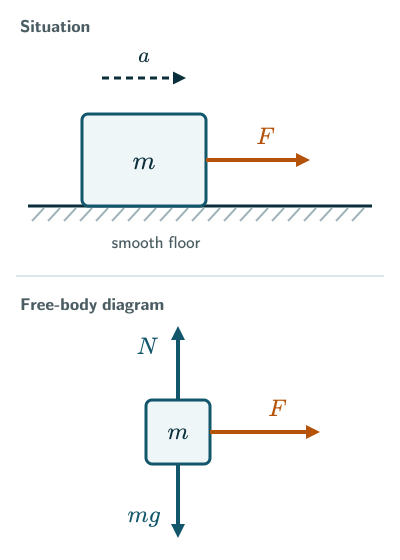
A 5 kg block rests on a frictionless horizontal floor. A horizontal force of 20 N acts on it. Find (a) its acceleration and (b) its speed after 3 s.
Given: m = 5 kg, F = 20 N, u = 0, t = 3 s.
(a) The normal force N and the weight mg are vertical and cancel, so the net force is the 20 N pull (see the free-body diagram above).
(b) Using v = u + at:
Answer: a = 4 m s−2 along the force, and v = 12 m s−1 after 3 s.
Example 2: Average force on a cricket ball
A cricket ball of mass 150 g moving at 20 m s−1 is hit straight back by the bat at 30 m s−1. The ball is in contact with the bat for 0.01 s. Neglect the impulse of gravity and air resistance during contact and find the average force exerted by the bat on the ball.
Given: m = 0.15 kg (grams converted to kilograms) and Δt = 0.01 s. Take the direction in which the ball leaves the bat as positive, so u = −20 m s−1 and v = +30 m s−1.
Answer: 750 N, in the direction in which the ball moves after the hit.
Compare NCERT Example 4.4 (page 56), where a batsman hits the ball straight back without changing its speed.
Example 3: Weighing scale in a lift
A student of mass 60 kg stands on a weighing scale in a lift. Find the scale reading when the lift accelerates (a) upward at 2 m s−2 and (b) downward at 2 m s−2. Take g = 9.8 m s−2.
The scale reads the normal force N that it exerts on the student. Two forces act on the student: N upward and the weight mg downward.
(a) Taking upward as positive, N − mg = ma:
(b) Taking downward as positive, mg − N = ma:
Answer: 708 N (about 72.2 kgf) while accelerating up and 468 N (about 47.7 kgf) while accelerating down. This scale reading is the student’s apparent weight. The true weight, mg = 588 N, does not change; only the normal force does.
Common mistakes to avoid
Common mistake
Using one force instead of the net force
F in F = ma is the vector sum of all the forces on the body. Draw a free-body diagram and add every force (weight, normal force, tension, friction) before dividing by m.
Common mistake
Dropping the sign of velocity in the change of momentum
In Example 2, writing Δp = 0.15 (30 − 20) = 1.5 kg m s−1 gives 150 N, which is wrong. Velocity is a vector: when the ball reverses, the two speeds add.
Common mistake
Drawing ma as an extra force
is the result of the forces, not another force. Never add it to a free-body diagram drawn in an inertial frame.
Common mistake
Mixing units
Convert grams to kilograms, km/h to m s−1 (divide by 3.6) and milliseconds to seconds before substituting. The answer then comes out in newtons.
Common mistake
Using F = ma when mass joins a body
For a cart collecting vertically falling sand, zero incoming horizontal velocity gives Fx = m dv/dt + v dm/dt. Derive this by accounting for the momentum carried by the incoming mass, not by applying the closed-system formula blindly to an open system. Do not add this term for every changing mass, though: a cart leaking sand through a hole in its floor still obeys F = ma, and a rocket needs the momentum carried away by its exhaust.
Quick revision summary
- The net external force on a body equals the rate of change of its momentum; for a constant mass, that is mass times acceleration.
- The acceleration is along the net force: a ∝ F for a fixed mass and a ∝ 1/m for a fixed force.
- The SI unit of force is the newton (N); 1 N = 105 dyn and 1 kgf = 9.80665 N (approximately 9.8 N).
- Dimensional formula of force: .
- Impulse equals the change in momentum. For the same change, a longer contact time means a smaller average force, which is why a fielder pulls the hands back while catching.
- A scale in a lift reads more than mg while the lift accelerates up, and less while it accelerates down.
- The law holds in inertial frames; for a system of particles, Fext = Macm.
Formula sheet
- F = dp/dt
- F = ma (constant mass)
- 1 N = 1 kg m s
- J = Favg Δt = Δp
- N = m(g + a) in a lift accelerating up
- N = m(g − a) in a lift accelerating down
Questions students ask
What is the difference between momentum and impulse?
Momentum, p = mv, belongs to a moving body at one instant, while impulse, J = FavgΔt, is what a force gives a body over a time interval. By the second law, the impulse of the net force equals the change in momentum, J = Δp, so impulse changes momentum but is not the same quantity. Both are vectors: momentum points along the velocity, and impulse along the average force.
What is the difference between force and momentum?
Momentum, p = mv, measures the quantity of motion a body has, in kg m s, while the net force on it, in newtons, is the rate at which that momentum changes, F = dp/dt. A body can have a large momentum with zero net force, such as a train moving at constant velocity, and zero momentum with a net force, such as a ball thrown straight up, at the top of its flight. The net force decides only the rate and direction of the change in momentum, not the momentum itself.
What is the SI unit and dimensional formula of impulse?
The SI unit of impulse is the newton second, N s, because impulse is a force multiplied by a time. Since 1 N s = 1 kg m s, impulse has the same unit and the same dimensional formula as momentum, [M L T]. That must be so, because the impulse of the net force equals the change in momentum.
Practice questions
Try each question first, then open the answer to check your working.
-
Q1. A constant net force of 15 N acts on a body of mass 3 kg that is initially at rest in an inertial frame. How far does the body travel in 4 s?
Show answerHide answer
a = F/m = 15/3 = 5 m s−2. Then
.
-
Q2. A ball of mass 0.5 kg moving at 10 m s−1 is stopped by a player in 0.05 s. Neglect gravity’s impulse during the short catch and find the average force exerted by the player.
Show answerHide answer
Δp = 0 − (0.5)(10) = −5 kg m s−1, so Favg = Δp/Δt = −5/0.05 = −100 N. The force is 100 N, opposite to the ball’s motion.
-
Q3. The momentum of a particle varies with time as p = (4t2 + 3t) kg m s−1, with t in seconds. Find the force on the particle at t = 2 s.
Show answerHide answer
F = dp/dt = 8t + 3. At t = 2 s, F = 8(2) + 3 = 19 N.