Equilibrium of a particle
NCERT Class 11 Physics Chapter 4 Section 4.8
Quick answer
A particle is in equilibrium when the net external force on it is zero, so it stays at rest or moves with uniform velocity. For concurrent forces, ΣF = 0 means ΣFx = 0, ΣFy = 0 and ΣFz = 0 separately (only the first two for forces in a plane), and three forces in equilibrium form a closed triangle when drawn head to tail.
With your textbook
NCERT Physics Part I (Class 11), Chapter 4 “Laws of Motion”, Section 4.8 “Equilibrium of a particle”, pages 58–59.
Open the official NCERT chapter (PDF, 2.1 MB, ncert.nic.in) (opens in a new tab)
Checked against the 2026-27 reprint on .
What is equilibrium of a particle?
Equilibrium of a particle in NCERT’s words
Equilibrium of a particle in mechanics refers to the situation when the net external force on the particle is zero.
NCERT Physics Part I (Class 11), Section 4.8, page 58
In an inertial frame, a particle is in equilibrium when all the forces on it cancel out. By Newton’s first law of motion, it is then either at rest or moving with uniform velocity. Equilibrium does not mean “no forces”; it means the forces add up to zero.
A particle here is any body whose size and turning do not matter in the problem, such as a small block, a knot in a set of strings, or a point on a rope. All the forces on it act at one point, so they are concurrent forces. (A real extended body, such as a ladder or a beam, also needs zero net torque so that it does not start to turn; that is rotational equilibrium, which comes later.)
Conditions for equilibrium
Two forces. If only two forces act on a particle, equilibrium needs them to be equal in size and opposite in direction:
A lamp hanging at rest from a cord is an example: the tension in the cord is equal and opposite to the lamp’s weight.
Three forces. For three concurrent forces, the vector sum must be zero:
Three concurrent forces in equilibrium
This has three useful readings:
- The resultant of any two of the forces is equal and opposite to the third. The third force is called the equilibrant of the other two.
- Drawn head to tail, the three force arrows form a closed triangle, with the arrows going round in the same sense. This is the triangle of forces.
- Because they must close a triangle, three forces can balance only if each is no larger than the sum of the other two and no smaller than their difference. So forces of 3 N, 4 N and 8 N can never keep a particle in equilibrium. Three forces in equilibrium always lie in one plane.
Any number of forces. The same idea extends to n forces: the particle is in equilibrium when the forces, drawn head to tail, form a closed polygon with their arrows in the same sense. In short:
Equilibrium of a particle
Resolving forces into components
Drawing triangles works for three forces, but the general method is to resolve every force along two (or three) perpendicular axes. A vector equation is zero only if each of its components is zero, so becomes:
Equilibrium in components
For a force F that makes an angle θ with the x-axis:
The component along the axis the angle is measured from takes cos; the component along the other axis takes sin. With θ measured anticlockwise from the +x axis, these formulas also give the right signs. If you use the sharp (acute) angle with an axis instead, give each component a + or − sign by the way it points: in Example 1, T1 points to the left, so its x-component is −T1 cos 30°.
For the coplanar particle problems in this lesson:
- Pick the particle: usually the point where the strings or forces meet.
- Draw its free-body diagram, with every force on it and the known angles.
- Choose axes, usually horizontal and vertical, or along and across an incline.
- Resolve each force and write and .
- Solve for the unknowns when the equations are independent and sufficient; extra unknowns require additional information or additional bodies’ equations.
Lami’s theorem
Lami’s theorem is not part of the NCERT text, but it is a quick shortcut for three forces that is used widely in JEE and NEET problems. If three concurrent forces keep a particle in equilibrium, each force is proportional to the sine of the angle between the other two:
Lami’s theorem
Here α is the angle between and , β the angle between and , and γ the angle between and , all measured between the forces drawn outward from the particle. It follows from the sine rule in the triangle of forces: the triangle’s inside angle opposite F1 is 180° − α, and the sine of 180° − α equals sin α. The three angles α, β and γ add up to 360° (in Example 1, 150° + 120° + 90°). It works only for exactly three forces that do not all lie along one line, and it gives the same answers as the component method.
Where you meet equilibrium
- Clothes lines and power cables. A wire carrying a load always sags. To balance a weight with two nearly horizontal halves, each half needs a very large tension, so a loaded wire can never be pulled perfectly straight.
- Hanging signs and lamps. A shop sign hung from two chains, or a lamp held by a cord and a bracket, is a knot in equilibrium under three forces.
- Tug of war at a standstill. While the rope does not move, the two teams pull with equal and opposite forces on it.
- A book at rest on a table, a car moving straight at steady speed. Both are in equilibrium: zero net force, whether the body is at rest or moving uniformly.
Solved examples
Example 1: Tensions in two strings
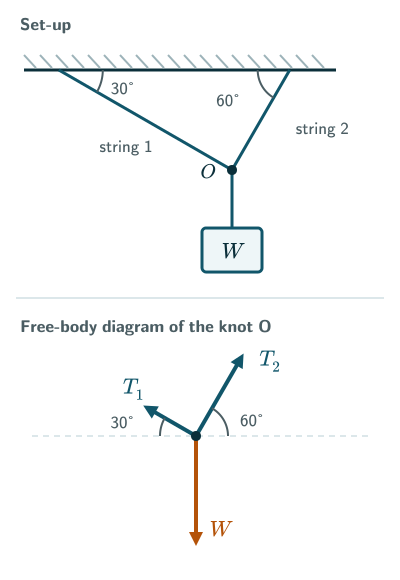
A weight of 100 N hangs from a knot O. The knot is held by two strings fixed to the ceiling, making angles of 30° and 60° with the ceiling, as in the figure above. Find the tensions in the two strings.
Free-body diagram of O: T1 along string 1, at 30° above the horizontal to the left; T2 along string 2, at 60° above the horizontal to the right; W = 100 N downward.
Horizontal components:
Vertical components:
Substituting :
(the second term is ), and
Check with Lami’s theorem (beyond NCERT). The angle between T2 and W is 150°, between W and T1 is 120°, and between T1 and T2 is 90°:
All three ratios are equal, as Lami’s theorem says.
Answer: 50 N in the string at 30°, and about 86.6 N in the string at 60°. The steeper string carries more of the load.
Example 2: Pulling a hanging mass aside
A mass of 5 kg hangs from a light rope fixed to the ceiling. A horizontal force F, applied at a point P on the rope, holds the upper part of the rope at 30° to the vertical. Find F and the tension in the upper part of the rope. Take g = 9.8 m s−2.
Lower part of the rope: the mass is in equilibrium, so the tension below P is
Point P: three forces act on it: T1 along the upper rope (at 30° to the vertical), T2 downward, and F horizontal.
Vertical components:
Horizontal components:
Answer: F is about 28.3 N and T1 about 56.6 N. The answer does not depend on the length of the rope or on where P is.
Compare NCERT Example 4.6 (pages 58–59), where a 50 N horizontal force acts at the midpoint of a rope holding 6 kg, with g = 10 m s−2: the same two equations give tan θ = 50/60, that is 5/6, so θ is about 40° with the vertical.
Example 3: Finding the equilibrant
Two forces act on a particle: 3 N towards the east and 4 N towards the north. What single force keeps the particle in equilibrium?
The resultant of the two forces has components Rx = 3 N and Ry = 4 N:
north of east. The third force must cancel it, so its components are −3 N and −4 N.
Answer: A force of 5 N pointing 53.1° south of west (exactly opposite to the resultant). With it, and .
Common mistakes to avoid
Common mistake
Thinking that equilibrium means rest
A particle moving in a straight line at constant speed is also in equilibrium. Equilibrium means zero net force, which is zero acceleration, not zero velocity.
Common mistake
Taking the same tension in two different strings
An ideal light string has constant tension along a segment with no additional tangential load or friction. An applied force at a point can change the tension across that point, as in Example 2. Two strings meeting at a knot need not have equal tensions. In Example 1 they carry 50 N and 86.6 N. Give each string its own symbol.
Common mistake
Mixing up sin and cos while resolving
Check which axis the angle is measured from. In Example 2 the angle is measured from the vertical, so the vertical component of T1 is T1 cos 30° and the horizontal one is T1 sin 30°, the reverse of Example 1.
Common mistake
Using the wrong angles in Lami’s theorem
Each force goes with the angle between the other two forces, measured with all three drawn outward from the particle. Angles with the ceiling or with the horizontal must be converted first.
Quick revision summary
- A particle is in equilibrium when the net external force on it is zero; it is then at rest or in uniform motion.
- Two forces in equilibrium are equal and opposite. Three forces in equilibrium form a closed triangle; any number of forces, a closed polygon.
- The equilibrant of a set of forces is equal and opposite to their resultant.
- In components: the sums of the x, y and z components are each zero. Resolve each force with cos along the axis the angle is measured from and sin along the other, and give each component its sign.
- Lami’s theorem (beyond NCERT; three forces only): each force divided by the sine of the angle between the other two is the same.
- An extended body also needs zero net torque; a particle needs only zero net force.
Formula sheet
- ΣF = 0 (equilibrium of a particle)
- ΣFx = 0, ΣFy = 0, ΣFz = 0
- F + F + F = 0 (three forces: a closed triangle)
- F/sin α = F/sin β = F/sin γ (Lami’s theorem)
- Fx = F cos θ, Fy = F sin θ
Questions students ask
Is Lami’s theorem in the JEE Main and NEET syllabus?
Lami’s theorem is not named in the JEE Main 2027 or NEET (UG) 2026 syllabus, and it is not in the NCERT text. But both syllabuses list equilibrium of concurrent forces under Laws of Motion, and Lami’s theorem is a quick way to solve three-force problems of exactly that kind. Any such problem can also be solved by resolving the forces into components.
What are concurrent forces?
Concurrent forces are forces whose lines of action pass through one point. All the forces on a particle are concurrent, because they act at the single point where the particle is. A particle under concurrent forces is in equilibrium when their vector sum is zero, ΣF = 0.
What is the difference between Lami’s theorem and the sine rule?
The sine rule is true of any triangle: each side divided by the sine of the opposite angle gives the same value. Lami’s theorem applies it to the triangle of forces, but uses the angles between the forces drawn outward from the particle. Each of those angles is 180° minus the inside angle of the triangle opposite the same force, and since sin (180° − α) = sin α, the ratios F/sin α come out equal.
What is the difference between static and dynamic equilibrium?
Both mean that the net force on the particle is zero. In static equilibrium the particle is at rest, like a lamp hanging from a cord; in dynamic equilibrium it moves with constant velocity, like a raindrop falling at its terminal speed. The conditions ΣFx = 0 and ΣFy = 0 are the same in both.
What is an equilibrant force?
The equilibrant of a set of forces is the single force that, added to them, keeps a particle in equilibrium. It is equal in size and opposite in direction to their resultant. For three forces in equilibrium, each one is the equilibrant of the other two.
Is a body moving in a circle at constant speed in equilibrium?
No, a body moving in a circle at constant speed is not in equilibrium. Its velocity keeps changing direction, so it has an acceleration v/R towards the centre, and the net force on it, mv/R, is not zero. Equilibrium needs zero acceleration, so only a body at rest or moving in a straight line at constant speed is in equilibrium.
Practice questions
Try each question first, then open the answer to check your working.
-
Q1. A 2 kg mass hangs from two strings, each making 45° with the vertical. Find the tension in each string. Take g = 9.8 m s−2.
Show answerHide answer
By symmetry the tensions are equal. Vertically,
-
Q2. Three forces of 6 N, 8 N and 10 N keep a particle in equilibrium. What is the angle between the 6 N and 8 N forces?
Show answerHide answer
The 6 N and 8 N forces must have a resultant of 10 N (equal and opposite to the third force). With θ the angle between them,
so cos θ = 0 and θ = 90°. Careful: the inside angle of the triangle of forces is 180° − θ, which is also 90° here only by coincidence. Three equal forces make a triangle with 60° angles, but the forces themselves are 120° apart.
-
Q3. A car moves along a straight, level road at a constant 25 m s. Is it in equilibrium? Explain.
Show answerHide answer
Yes. Its velocity is constant, so its acceleration is zero, and by the first law the net force on it is zero. The forward friction on the driving wheels balances air drag and rolling resistance, and the normal force balances the weight.