Adding and subtracting vectors graphically
NCERT Class 11 Physics Chapter 3 Section 3.4
Quick answer
To add two vectors, place the tail of the second at the head of the first; the resultant runs from the tail of the first to the head of the second (the triangle law). Equivalently, draw both from one point and complete the parallelogram: the diagonal from that point is the sum. To subtract, add the negative, A − B = A + (−B); a vector plus its negative gives the null vector, whose direction cannot be specified.
With your textbook
NCERT Physics Part I (Class 11), Chapter 3 “Motion in a Plane”, Section 3.4 “Addition and subtraction of vectors – graphical method”, pages 29–31.
Open the official NCERT chapter (PDF, 2.2 MB, ncert.nic.in) (opens in a new tab)
Checked against the 2026-27 reprint on .
How are vectors added graphically?
Adding and subtracting vectors graphically
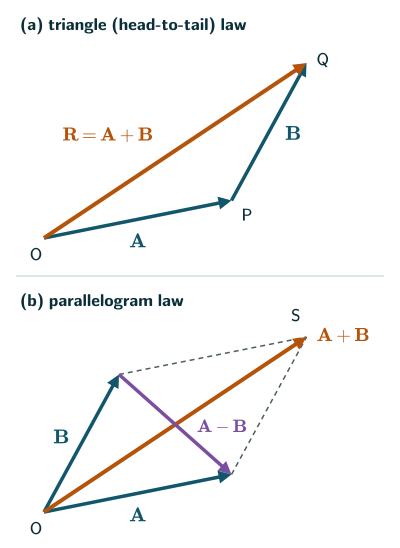
- Triangle (head-to-tail) law: draw B with its tail at the head of A. The sum, or resultant, R = A + B, is the arrow from the tail of A to the head of B.
- Parallelogram law: draw A and B from a common point and complete the parallelogram. The diagonal from that point is A + B.
- Subtraction: A − B = A + (−B). Adding a vector to its negative gives the null vector, 0.
(NCERT Section 3.4, pages 29–31.)
The two vectors and their resultant form three sides of a triangle, so this method is also known as triangle method of vector addition.
NCERT Physics Part I (Class 11), Section 3.4, page 30
In plain words: walking 3 km east and then 4 km north does not put you 7 km from home; it puts you 5 km away, about 53° north of east. To combine vectors you must join the arrows, not add the numbers.
The triangle law
To find A + B, draw A, then draw B starting where A ends. The arrow from the start of A to the end of B is the resultant (NCERT Fig. 3.4, page 29). Moving B there is allowed because it is a free vector: sliding it parallel to itself does not change it. Because the arrows go head to tail, this is also called the head-to-tail method (page 30). (NCERT’s Section 3.4 opens by saying that this law was mentioned in “section 4.2”; it means Section 3.2 (Scalars and vectors, page 28), a leftover from older chapter numbering.)
Vector addition obeys the same two laws as adding numbers (NCERT Eqs. 3.1 and 3.2, page 30):
- commutative: A + B = B + A; adding in either order gives the same resultant;
- associative: (A + B) + C = A + (B + C); for several vectors, chain them head to tail in any order, and the resultant runs from the first tail to the last head.
The length of the resultant is set by the angle between the vectors:
- same direction: |A + B| = A + B, the largest possible;
- opposite directions: |A + B| = |A − B|, the smallest possible;
- at any angle in between, the length lies between these two: |A − B| ≤ |A + B| ≤ A + B (the triangle inequality; NCERT Exercise 3.6, pages 46–47);
- equal magnitudes A at angle θ: the parallelogram is a rhombus, its diagonal bisects θ, so |A + B| = 2A cos(θ/2): 2A at 0°, √2A at 90°, A at 120°, zero at 180°.
For the exact length and direction at any angle, add the components or use the law of cosines given there.
If the chained arrows end where they started, the resultant is zero. This is how forces on a particle in equilibrium behave: drawn head to tail, they close into a triangle or polygon.
The parallelogram law
Draw A and B from a common point O. Through the head of A draw a line parallel to B, and through the head of B a line parallel to A. They meet at S. The diagonal OS is A + B (NCERT Fig. 3.6, page 31). The side of the parallelogram opposite B is a copy of B sitting at the head of A, so this is the triangle law again: the two methods are equivalent (page 30).
The null vector
A + (−A) has zero magnitude. This is the null vector or zero vector, 0 (NCERT Eq. 3.3, page 30). Its properties (NCERT Eq. 3.4):
- A + 0 = A;
- λ0 = 0;
- 0A = 0.
Physically, a null vector is, for example, the displacement of an object that moves from P to P′ and comes back to P (page 30).
Subtracting vectors
Subtraction is defined through addition (NCERT Eq. 3.5, page 30):
Subtracting vectors
Reverse B (that is, multiply it by −1) and add it to A head to tail (NCERT Fig. 3.5, page 30). In the parallelogram of A and B, one diagonal is A + B and the other, from the head of B to the head of A, is A − B (figure above). Check: B + (A − B) = A. For non-zero A and B, |A + B| = |A − B| means the parallelogram is a rectangle and the vectors are perpendicular. If either vector is zero the equality also holds, but an angle with that vector is undefined.
Subtraction is not commutative: B − A = −(A − B), the same length pointing the other way. A common use is the change in a vector, such as Δv = vfinal − vinitial (Example 5).
Solved examples
Example 1: Rain and wind (NCERT Example 3.1)
In an idealised model, rain falls vertically at 35 m s relative to the air, and the air moves at 12 m s from east to west relative to the ground. In which direction should a boy standing at a bus stop hold his umbrella?
The rain’s velocity vr (down) and the wind’s vw (westwards) add by the triangle law. They are at right angles, so R = √(35 + 12) = 37 m s. The angle with the vertical: tan θ = 12/35 ≈ 0.343, so θ ≈ 19°.
The rain falls slanting towards the west, so it comes from the east.
Answer: in the vertical plane, tilted about 19° from the vertical towards the east (NCERT page 31).
Example 2: A walk
A girl walks 4 km east and then 3 km north. Find her resultant displacement.
Head to tail, the two legs are at right angles: R = √(4 + 3) = 5 km. Direction: tan α = 3/4, α ≈ 37° north of east.
Answer: 5 km, about 37° north of east, though she walked 7 km.
Example 3: The range of a resultant
Two forces of 3 N and 4 N act at a point. What are the largest and smallest possible resultants, and what is it when they are at right angles?
Largest (same direction): 3 + 4 = 7 N. Smallest (opposite): 4 − 3 = 1 N. At right angles: √(3 + 4) = 5 N.
Answer: 7 N, 1 N and 5 N. Any resultant between 1 N and 7 N is possible.
Example 4: A difference of two vectors
A is 5 units east and B is 5 units north. Find A − B and B − A.
A − B = A + (−B): 5 units east plus 5 units south. Magnitude √(25 + 25) = 5√2 ≈ 7.07 units, pointing south-east (45° south of east). B − A has the same magnitude and points north-west.
Answer: about 7.07 units south-east; 7.07 units north-west.
Example 5: Change in velocity at a corner
A car moving east at 10 m s turns a corner and then moves north at 10 m s. Find the change in its velocity.
Δv = v2 − v1 = (10 north) + (10 west). Magnitude 10√2 ≈ 14.1 m s, towards the north-west.
Answer: about 14.1 m s towards the north-west, though the speed did not change. A change of direction alone is a change of velocity.
Example 6: Four vectors with zero sum (NCERT Exercise 3.7, page 47)
Given a + b + c + d = 0, which are correct? (a) a, b, c and d must each be null vectors; (b) |a + c| = |b + d|; (c) the magnitude of a can never exceed the sum of the magnitudes of b, c and d; (d) b + c must lie in the plane of a and d if they are not collinear, and on their line if they are.
(a) False: the four arrows can form a closed quadrilateral. (b) True: a + c = −(b + d), and a vector and its negative have equal magnitudes. (c) True: a = −(b + c + d), and a resultant is never longer than the sum of the lengths. (d) True: b + c = −(a + d). The sum a + d lies in the plane of a and d (on their common line if they are collinear), and reversing a vector keeps it in that plane or line.
Answer: (b), (c) and (d) are correct; (a) is not.
Common mistakes to avoid
Common mistake
Adding magnitudes
|A + B| equals A + B only when the vectors point the same way. 3 km east plus 4 km north is 5 km, not 7 km.
Common mistake
Drawing B from the tail of A in the triangle law
In the triangle law, B starts at the head of A. Tails together is the parallelogram method, where the sum is the diagonal, not the third side.
Common mistake
Getting A − B the wrong way round
In the parallelogram, A − B runs from the head of B to the head of A. The reverse arrow is B − A.
Common mistake
Giving the null vector a direction
The null vector has zero magnitude, and its direction cannot be specified. It is still a vector, not the number 0.
Common mistake
Expecting any two vectors to cancel
Two vectors add to 0 only if they are equal and opposite, so two vectors of different magnitudes never cancel. Three can, if they close a triangle (each no longer than the sum of the other two) and lie in one plane. Vectors not all in one plane need at least four.
Common mistake
Thinking same speed means no change in velocity
Turning at constant speed changes the velocity: in Example 5, Δv is 14.1 m s though the speed stays 10 m s.
Quick revision summary
- Triangle law: B from the head of A; R = A + B from the tail of A to the head of B.
- Parallelogram law: A and B from one point; A + B is the diagonal from that point; the other diagonal is A − B.
- Addition is commutative and associative; |A − B| ≤ |A + B| ≤ A + B; for equal magnitudes, |A + B| = 2A cos(θ/2).
- A + (−A) = 0, the null vector, whose direction cannot be specified.
- A − B = A + (−B); B − A = −(A − B).
Formula sheet
- R = A + B (tail of B at head of A)
- A + B = B + A; (A + B) + C = A + (B + C)
- A − B = A + (−B)
- A + (−A) = 0; A + 0 = A
- ||A| − |B|| ≤ |A + B| ≤ |A| + |B|
Questions students ask
What is the difference between the triangle law and the parallelogram law of vector addition?
The triangle law and the parallelogram law of vector addition give exactly the same resultant; they are two ways of drawing the same sum. The triangle law joins the vectors head to tail, which extends easily to three or more vectors, while the parallelogram law draws both from one point, which matches two forces acting on the same particle and also shows A − B as the second diagonal.
What is the formula for the parallelogram law of vector addition?
For two vectors of magnitudes A and B with an angle θ between them (drawn tail to tail), the parallelogram law gives a resultant of magnitude R = √(A + B + 2AB cos θ), at an angle α to A with tan α = B sin θ/(A + B cos θ). Use component signs to choose the quadrant of α. If A + B cos θ = 0 and the resultant is non-zero, it is perpendicular to A; a zero resultant has no direction. The triangle law leads to the same formula, since it is the same sum drawn differently. For example, forces of 3 N and 5 N at 60° give R = √(9 + 25 + 15) = √49 = 7 N, at about 38.2° to the 3 N force; the formula is derived in NCERT Example 3.2 (page 34).
What is the polygon law of vector addition?
The polygon law of vector addition states that if several vectors are drawn head to tail, one after another, their resultant is the vector from the tail of the first to the head of the last, the side that closes the polygon. It is the triangle law applied again and again, and the order of the vectors does not change the result, because vector addition is commutative and associative. If the vectors themselves form a closed polygon, their resultant is the null vector.
Can the resultant of two vectors be smaller than each of them?
Yes, the resultant of two vectors can be smaller than each of them, but only when they largely oppose each other: with A the smaller magnitude, the condition is cos θ < −B/(2A), so the angle between them must be more than 120° and B less than 2A. For example, forces of 5 N and 7 N at 150° give R = √(25 + 49 + 70 cos 150°) ≈ 3.7 N, less than both. At 90° or less, the resultant is always longer than the larger of the two.
Practice questions
Try each question first, then open the answer to check your working.
-
Q1. Two vectors of magnitudes 6 and 8 units are added. What are the largest and smallest possible magnitudes of the resultant?
Show answerHide answer
Largest 6 + 8 = 14 units (same direction); smallest 8 − 6 = 2 units (opposite directions).
-
Q2. A man walks 30 m north, then 40 m east. How far is he from his starting point?
Show answerHide answer
√(30 + 40) = 50 m, towards the north-east (about 53° east of north).
-
Q3. Is A − B the same as B − A?
Show answerHide answer
In general, no: B − A = −(A − B). If A ≠ B, the differences have opposite directions and equal magnitudes. If A = B, both differences are the zero vector and are equal.