Adding vectors by components
NCERT Class 11 Physics Chapter 3 Section 3.6
Quick answer
To add vectors, add matching components: Rx = Ax + Bx and Ry = Ay + By, then R = √(Rx2 + Ry2). For Rx ≠ 0, use tan θ = Ry/Rx and the component signs to choose the quadrant; a vertical resultant follows the sign of Ry, while a zero resultant has no direction. Given magnitudes A and B and their tail-to-tail angle θ, the resultant magnitude is √(A2 + B2 + 2AB cos θ).
With your textbook
NCERT Physics Part I (Class 11), Chapter 3 “Motion in a Plane”, Section 3.6 “Vector addition – analytical method”, pages 33–34.
Open the official NCERT chapter (PDF, 2.2 MB, ncert.nic.in) (opens in a new tab)
Checked against the 2026-27 reprint on .
How are vectors added by components?
Vector addition by components (analytical method)
If A = Axî + Ayĵ and B = Bxî + Byĵ, their sum R = A + B has components
Its magnitude is R = √(Rx2 + Ry2). For Rx ≠ 0, tan θ = Ry/Rx; use both signs to choose the quadrant. If Rx = 0, a non-zero resultant lies along +y or −y. The zero resultant has no direction. The same works for any number of vectors, for subtraction and in three dimensions (NCERT Section 3.6, pages 33–34).
It is much easier to add vectors by combining their respective components.
NCERT Physics Part I (Class 11), Section 3.6, page 33
In plain words: resolve every vector into its x- and y-parts, add all the x-parts and all the y-parts as ordinary numbers, then put the two totals back together. No drawing to scale is needed, and the answer is as accurate as your arithmetic.
Adding component by component
NCERT notes that the graphical method helps to visualise vectors but is sometimes tedious and has limited accuracy (page 33). With components, because vector addition is commutative and associative, the î parts and the ĵ parts can be regrouped (NCERT Eqs. 3.18–3.21, page 33):
Thus, each component of the resultant vector R is the sum of the corresponding components of A and B.
NCERT Physics Part I (Class 11), Section 3.6, page 33
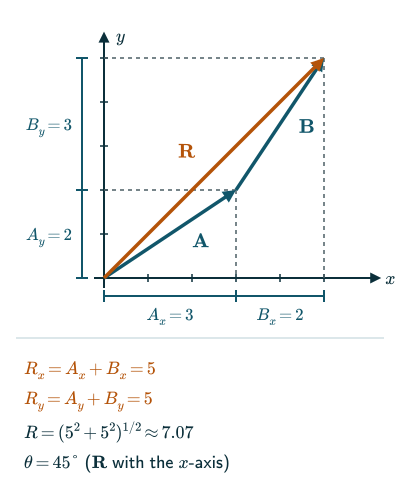
The method extends directly (NCERT Eqs. 3.22–3.23):
- three dimensions: Rz = Az + Bz as well;
- several vectors and subtraction: for T = a + b − c, Tx = ax + bx − cx, and the same for y and z.
Two vectors are equal exactly when their components are equal, Ax = Bx and Ay = By. A vector equation in a plane is therefore two ordinary equations, one for each axis.
Magnitude and direction of the resultant
Often two vectors are given by their magnitudes A and B and the angle θ between them. Take A along the x-axis; then B has components B cos θ and B sin θ, so Rx = A + B cos θ and Ry = B sin θ. Squaring and adding, with cos θ + sin θ = 1:
and tan α = Ry/Rx. NCERT Example 3.2 (pages 33–34) gets the same from the parallelogram:
Law of cosines (magnitude of the resultant)
Direction of the resultant, measured from A
For a non-degenerate triangle (non-zero vectors with 0° < θ < 180°), NCERT also gives the law of sines, R/sin θ = A/sin β = B/sin α, where α and β are the angles the resultant makes with A and B (NCERT Eq. 3.24d, page 34). It is the sine rule for the triangle with sides A, B and R. The angle opposite R is 180° − θ, and sin(180° − θ) = sin θ. So sin α = (B/R) sin θ.
Useful special cases:
- θ = 0°: R = A + B; θ = 180°: R = |A − B|; θ = 90°: R = √(A + B).
- Since cos θ lies between −1 and 1, the resultant always lies between |A − B| and A + B. So 3 N and 5 N can give any value from 2 N to 8 N, never 1 N or 9 N. Three forces can add to zero only if none is larger than the sum of the other two.
- For non-zero A and B, |A + B| = |A − B| implies cos θ = 0, so they are perpendicular. If either is zero, equality still holds but the angle is undefined.
- For the difference, replace θ by 180° − θ: |A − B| = √(A + B − 2AB cos θ). This is the form used for relative velocity in two dimensions.
Resolving and adding components is also how forces are handled: a particle is in equilibrium when the x-components and the y-components of all the forces separately add to zero (see resolving forces into components).
Solved examples
Example 1: The motorboat (NCERT Example 3.3)
A motorboat heads north at 25 km/h relative to the water. The current is 10 km/h relative to the bank, directed 60° east of south. Find the boat’s velocity relative to the bank.
Take î east and ĵ north. vb = 25ĵ. The current points 60° east of south: vc = 10 sin 60° î − 10 cos 60° ĵ ≈ 8.66î − 5ĵ.
R = 8.66î + 20ĵ. R = √(8.66 + 20) = √475 ≈ 21.8 km/h. Angle east of north: tan φ = 8.66/20, so φ ≈ 23.4°.
NCERT gets the same from the law of cosines, with θ = 120° between the two velocities: 25 = 625, 10 = 100 and 2 × 25 × 10 × cos 120° = −250, so R = √(625 + 100 − 250) = √475 ≈ 22 km/h, and sin φ = (10 sin 120°)/21.8 ≈ 0.397 (page 34). Its printed formula reads √(vb2 + vb2 + 2vbvc cos 120°); the second term should be vc2, as the numbers it substitutes show. In its question the degree sign after 60 shows as a blank space in the PDF; read it as 60°.
Answer: about 21.8 km/h (22 km/h), 23.4° east of north.
Example 2: Several vectors
A = 3î + 2ĵ, B = −î + 4ĵ and C = 2î − 3ĵ. Find A + B + C and A + B − C.
A + B + C: x: 3 − 1 + 2 = 4; y: 2 + 4 − 3 = 3. So 4î + 3ĵ, magnitude 5, at tan(3/4) ≈ 36.9° to the +x-axis.
A + B − C: x: 3 − 1 − 2 = 0; y: 2 + 4 + 3 = 9. So 9ĵ.
Answer: 4î + 3ĵ (5 units at 36.9° to the +x-axis); 9ĵ (9 units along +y).
Example 3: Two forces at 60°
Forces of 5 N and 8 N act at a point with 60° between them. Find the resultant.
Here 2 × 5 × 8 × cos 60° = 40, so R = √(25 + 64 + 40) = √129 ≈ 11.4 N. tan α = 8 sin 60°/(5 + 8 cos 60°) = 6.93/9 ≈ 0.770, so α ≈ 37.6° from the 5 N force.
Answer: about 11.4 N, at about 37.6° to the 5 N force.
Example 4: Equal vectors
Two vectors each of magnitude A are at angle θ. Find the resultant for θ = 60°, 90° and 120°.
R = √(2A(1 + cos θ)). Since 1 + cos θ = 2 cos(θ/2), R = 2A cos(θ/2), and R bisects the angle between the vectors. At 60°: √3A ≈ 1.73A. At 90°: √2A ≈ 1.41A. At 120°: A.
Answer: 1.73A, 1.41A and A. At 120° the resultant equals each vector.
Example 5: Change in velocity
A car’s velocity changes from 20 m s east to 20 m s at 60° north of east. Find the change in velocity.
v1 = 20î; v2 = 20 cos 60° î + 20 sin 60° ĵ = 10î + 17.32ĵ. Δv = v2 − v1 = −10î + 17.32ĵ.
|Δv| = √(100 + 300) = 20 m s. Since Δvx < 0 and Δvy > 0, the direction is in the second quadrant: 180° − 60° = 120° from east, that is 30° west of north.
Answer: 20 m s, 30° west of north. The speed is unchanged, yet the velocity changes. Shortcut for equal speeds: |Δv| = 2v sin(θ/2) = 2 × 20 × sin 30° = 20 m s.
Common mistakes to avoid
Common mistake
Adding magnitudes instead of components
Add x-components to x-components and y to y. The magnitudes add only when the vectors point the same way.
Common mistake
Using the angle between the vectors in the wrong place
In R = A + B + 2AB cos θ, θ is the angle between the vectors drawn tail to tail. In Example 1 it is 120°, not the 60° given in the question.
Common mistake
Losing signs when resolving
A vector pointing west or south has a negative component. Draw the axes and check each sign before adding.
Common mistake
Using + in the formula for a difference
|A − B| = A + B − 2AB cos θ, with a minus sign, because −B makes 180° − θ with A.
Common mistake
Reading the direction off tan alone
tan θ = Ry/Rx gives the same value for opposite vectors. Use the signs of Rx and Ry to fix the quadrant. The same holds for tan α = B sin θ/(A + B cos θ): if A + B cos θ < 0, α is more than 90°. If that denominator is zero and the numerator is non-zero, α = 90°; if both are zero, the resultant vanishes.
Quick revision summary
- R = A + B ⇒ Rx = Ax + Bx, Ry = Ay + By (and Rz in 3D); subtract components for a difference.
- R = √(Rx2 + Ry2); tan θ = Ry/Rx, with the quadrant from the signs.
- From magnitudes and the angle θ between them: R = √(A + B + 2AB cos θ) (law of cosines); tan α = B sin θ/(A + B cos θ).
- Law of sines: R/sin θ = A/sin β = B/sin α.
- Equal magnitudes: R = 2A cos(θ/2).
Formula sheet
- Rx = Ax + Bx; Ry = Ay + By
- R = √(Rx2 + Ry2); tan θ = Ry/Rx
- R = √(A2 + B2 + 2AB cos θ)
- tan α = B sin θ/(A + B cos θ)
- R/sin θ = A/sin β = B/sin α
- |A − B| = √(A2 + B2 − 2AB cos θ)
Questions students ask
Why does the resultant of two vectors use +2AB cos θ when the law of cosines has a minus sign?
The resultant formula R = A + B + 2AB cos θ and the law of cosines c = a + b − 2ab cos C are the same rule written with different angles. In the vector formula, θ is the angle between A and B drawn tail to tail, while C is the angle of the triangle opposite the resultant when the vectors are drawn head to tail, and that angle is 180° − θ. Since cos(180° − θ) = −cos θ, the minus sign of the law of cosines becomes the plus sign of the resultant formula.
Why do we resolve vectors into components before adding them?
Resolving vectors into perpendicular components turns vector addition into ordinary arithmetic: all the x-parts add as signed numbers, all the y-parts add separately, and one axis never affects the other. This works the same way for two vectors or twenty, for differences and in three dimensions, with no angle between pairs of vectors to work out and no scale drawing. It is also how Newton’s second law is used in problems, one axis at a time: ΣFx = max and ΣFy = may.
When is the resultant of two vectors perpendicular to one of them?
The resultant R = A + B is perpendicular to A when its component along A is zero, A + B cos θ = 0, that is when cos θ = −A/B; this is possible only if B > A, with θ obtuse. The resultant then has magnitude R = B sin θ = √(B − A). For example, vectors of 4 and 5 units at θ = cos(−0.8) ≈ 143° have a resultant of 3 units, at right angles to the 4-unit vector.
How do you find the resultant of two vectors when the angle between them is not given?
When two vectors are given in component form, the angle between them is not needed: add the matching components and find the magnitude from the totals. For A = 2î + ĵ − 2k̂ and B = î + 3ĵ + 4k̂, R = 3î + 4ĵ + 2k̂ and R = √(9 + 16 + 4) = √29 ≈ 5.39 units. If the angle between A and B is wanted too, the scalar product gives it: here cos θ = A·B/(AB) = −3/(3√26), so θ ≈ 101°.
Practice questions
Try each question first, then open the answer to check your working.
-
Q1. Add A = 2î + 5ĵ and B = 4î − ĵ, and find the magnitude of the sum.
Show answerHide answer
R = 6î + 4ĵ; R = √(36 + 16) = √52 ≈ 7.21 units.
-
Q2. Two forces of 3 N and 4 N act at 90° to each other. Find the resultant and its angle with the 3 N force.
Show answerHide answer
R = √(9 + 16) = 5 N. tan α = 4/3, so α ≈ 53.1°.
-
Q3. Two vectors of 10 units each have a resultant of 10 units. What is the angle between them?
Show answerHide answer
100 = 100 + 100 + 200 cos θ, so cos θ = −½ and θ = 120°.