Projectile motion
NCERT Class 11 Physics Chapter 3 Section 3.9
Quick answer
A projectile launched with speed v at angle θ above the horizontal, with air resistance neglected, keeps a constant horizontal velocity v cos θ while gravity gives it a constant downward acceleration g, so a nonvertical throw follows a parabola (a vertical throw follows a line). For launch and landing at the same level, the time of flight is 2v sin θ/g, the maximum height is (v sin θ)/2g and the range is v sin 2θ/g, largest at 45°. Angles that differ from 45° by equal amounts give equal ranges.
With your textbook
NCERT Physics Part I (Class 11), Chapter 3 “Motion in a Plane”, Section 3.9 “Projectile motion”, pages 38–40.
Open the official NCERT chapter (PDF, 2.2 MB, ncert.nic.in) (opens in a new tab)
Checked against the 2026-27 reprint on .
What is projectile motion?
Projectile motion
A projectile is an object in flight after being thrown or projected. In the near-surface model with uniform gravity, no air resistance and no other force after launch, its acceleration is the acceleration due to gravity g, vertically downwards, so
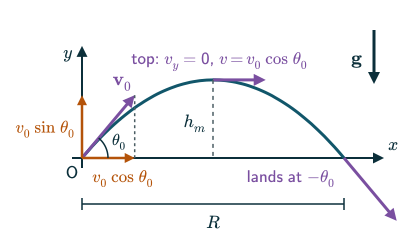
- horizontally it moves with constant velocity v0 cos θ0;
- vertically it moves with constant acceleration −g, like a body in free fall, starting with v0 sin θ0.
For a non-zero horizontal launch velocity, its path is a parabola; a vertical launch follows a straight line. Launched from the ground and landing at the same level, it has time of flight 2v0 sin θ0/g, maximum height (v0 sin θ0)/2g and range v02 sin 2θ0/g (NCERT Section 3.9, pages 38–40).
An object that is in flight after being thrown or projected is called a projectile.
NCERT Physics Part I (Class 11), Section 3.9, page 38
In plain words: a thrown ball does two things at once. It drifts sideways at a steady speed, and it rises and falls exactly as it would if thrown straight up. Put the two together and you get the familiar curved path.
In our discussion, we shall assume that the air resistance has negligible effect on the motion of the projectile.
NCERT Physics Part I (Class 11), Section 3.9, page 38
The equations of a projectile
Take the launch point as the origin, x horizontal and y vertically up, and launch speed v0 at angle θ0 above the horizontal. Then ax = 0, ay = −g, and the initial velocity has components v0x = v0 cos θ0, v0y = v0 sin θ0 (NCERT Eqs. 3.35–3.36, page 38). The equations of motion with constant acceleration, applied along each axis, give (NCERT Eqs. 3.37–3.38, page 39):
The horizontal component of velocity never changes; only the vertical one does. Galileo first stated that the horizontal and vertical motions of a projectile are independent (NCERT page 38).
Equation of the path
For v0 cos θ0 ≠ 0, eliminating t = x/(v0 cos θ0) between the two position equations (NCERT Eq. 3.39, page 39):
Path of a projectile
This has the form y = ax + bx (NCERT page 39), with constants a = tan θ0 and b = −g/(2v02 cos θ0): a parabola, opening downwards because b is negative (NCERT Fig. 3.17).
Time of flight and maximum height
At the highest point vy = 0, so the time to reach it is (NCERT Eq. 3.40a)
Time to the highest point
Putting y = 0 in the y-equation gives t(v0 sin θ0 − ½gt) = 0. The root t = 0 is the launch; the other is the time of flight (NCERT Eq. 3.40b), twice tm, as the symmetry of the parabola suggests:
Time of flight
Putting t = tm into the y-equation gives hm = (v0 sin θ0)/g − (v0 sin θ0)/2g, the maximum height (NCERT Eq. 3.41, page 39):
Maximum height
At the top of a nonvertical upward throw, the velocity is horizontal and non-zero, v0 cos θ0. For a vertical throw it is zero. In both cases the acceleration remains g downwards.
Horizontal range
The range is the horizontal distance travelled during the time of flight, back to the launch level: R = (v0 cos θ0)(2v0 sin θ0/g). Since 2 sin θ0 cos θ0 = sin 2θ0 (NCERT Eq. 3.42a, page 40):
Horizontal range
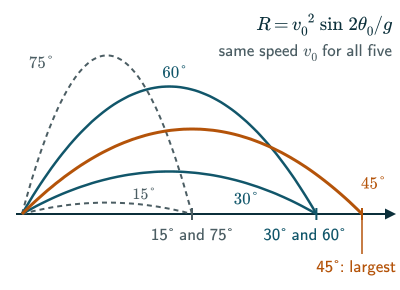
For a given speed, R is largest when sin 2θ0 = 1, at θ0 = 45° (NCERT Eq. 3.42b):
Maximum range
Angles 45° + α and 45° − α give the same range, because sin(90° + 2α) = sin(90° − 2α) = cos 2α; for example 30° and 60° (NCERT Example 3.6, page 40). The steeper throw goes higher and stays up longer.
The formulas for Tf and R assume landing at launch height. The maximum rise hm above the launch point needs an initially upward vertical component and an uninterrupted ascent, but does not require landing at that same height. For a cliff or table launch, solve the y-equation at the actual landing level to find the flight time (Example 2).
Solved examples
Example 1: A cricket ball (NCERT Example 3.8)
A cricket ball is thrown at 28 m s at 30° above the horizontal. Find (a) the maximum height, (b) the time to return to the same level, and (c) the distance from the thrower to where it returns to that level. Take g = 9.8 m s.
(a) hm = (28 sin 30°)/(2 × 9.8) = 14/19.6 = 10.0 m.
(b) Tf = 2 × 28 × sin 30°/9.8 = 28/9.8 ≈ 2.9 s.
(c) R = 28 × sin 60°/9.8 = 784 × 0.866/9.8 ≈ 69 m.
Answer: 10.0 m, 2.9 s and 69 m (NCERT page 40).
Example 2: A stone thrown from a cliff (NCERT Example 3.7)
A hiker on the edge of a cliff 490 m high throws a stone horizontally at 15 m s. Find the time to reach the ground and the speed on impact. Take g = 9.8 m s.
Origin at the cliff edge, y up. Horizontally vx = 15 m s throughout. Vertically, starting from v0y = 0: −490 = −½ × 9.8 × t, so t = 10 s.
At impact vx = 15 m s and vy = 0 − 9.8 × 10 = −98 m s, so the speed is √(15 + 98) ≈ 99 m s, at tan(98/15) ≈ 81° below the horizontal.
NCERT’s working labels these final components vox and voy, the symbols for the initial components (page 40); they are vx and vy at impact.
Answer: 10 s; about 99 m s, at about 81° below the horizontal.
Example 3: Complementary angles (NCERT Example 3.6)
Galileo stated in Two New Sciences that for elevations which exceed or fall short of 45° by equal amounts, the ranges are equal. Prove it.
For θ0 = 45° + α, 2θ0 = 90° + 2α; for 45° − α, 2θ0 = 90° − 2α. Both sines equal cos 2α, so R = v02 sin 2θ0/g is the same.
Answer: the ranges are equal (NCERT page 40); for example, 30° and 60°.
Example 4: How high can the cricketer throw? (NCERT Exercise 3.13, page 47)
A cricketer can throw a ball at most 100 m horizontally. How high can he throw the same ball?
The greatest range is at 45°: v02/g = 100 m. Thrown straight up with the same speed, the ball rises to v02/2g = 50 m.
Answer: 50 m.
Example 5: Under a ceiling (NCERT Exercise 3.12, page 47)
A ball is launched from floor level at 40 m s beneath a ceiling 25 m above it. Find the limiting horizontal range back to floor level as the ball’s highest point approaches the ceiling from below. Treat the ball as a point. Take g = 9.8 m s.
The range grows with the angle up to 45°, but at 45° the ball would rise to 40/(4 × 9.8) ≈ 40.8 m, above the ceiling. So choose the angle that just reaches 25 m: (40 sin θ0) = 2 × 9.8 × 25 = 490, so sin θ0 = √490/40 ≈ 0.553 and θ0 ≈ 33.6°.
R = 40 × sin 67.2°/9.8 ≈ 1600 × 0.922/9.8 ≈ 150.5 m.
Answer: a limiting range of about 150.5 m at about 33.6°. To avoid touching the ceiling, choose a slightly smaller angle and obtain a slightly smaller range.
Example 6: Velocity during the flight
A ball is projected at 20 m s at 60° above the horizontal. Find its velocity after 1 s. Take g = 9.8 m s.
vx = 20 cos 60° = 10 m s. vy = 20 sin 60° − 9.8 × 1 ≈ 17.32 − 9.8 = 7.52 m s.
Speed = √(100 + 56.6) ≈ 12.5 m s, at tan(7.52/10) ≈ 37° above the horizontal, still rising.
Answer: about 12.5 m s at 37° above the horizontal.
Common mistakes to avoid
Common mistake
Saying the velocity is zero at the top
For a nonvertical launch, only the vertical component is zero; the horizontal component remains v0 cos θ0. A vertical throw does momentarily stop at the top. Its acceleration is still g in either case.
Common mistake
Letting the horizontal speed change
With air resistance neglected there is no horizontal force, so vx stays v0 cos θ0 for the whole flight.
Common mistake
Using the range formula off a cliff
R = v02 sin 2θ0/g and Tf = 2v0 sin θ0/g assume landing at the launch height. From a height, solve the y-equation for t.
Common mistake
Thinking 45° always gives the longest throw
45° gives the largest range only on level ground with no air resistance. From a height, or with a ceiling (Example 5), the best angle is different.
Common mistake
Forgetting what changes between launch and landing
On level ground the ball lands with speed v0, but its velocity turns from θ0 above to θ0 below the horizontal: the change in velocity is 2v0 sin θ0 vertically downwards, and the change in momentum 2mv0 sin θ0. At the top the speed is v0 cos θ0, so the kinetic energy there is K cos θ0, where K is the kinetic energy at launch.
Common mistake
Making the time of flight depend on the horizontal speed
Time in the air is set by the vertical motion alone. A ball thrown horizontally and a ball dropped from the same height land together.
Quick revision summary
- a = −gĵ: horizontal velocity constant, vertical motion is free fall.
- x = (v0 cos θ0)t; y = (v0 sin θ0)t − ½gt; vy = v0 sin θ0 − gt.
- Path: a parabola, y = x tan θ0 − gx/(2v02 cos θ0).
- Same launch and landing level: tm = v0 sin θ0/g, Tf = 2tm, hm = (v0 sin θ0)/2g, R = v02 sin 2θ0/g.
- R is largest at 45°, Rm = v02/g; angles 45° ± α give equal ranges.
- Tf = 2√(2hm/g): paths reaching the same height stay up equally long; hm/R = ¼ tan θ0.
Formula sheet
- x = (v cos θ) t; y = (v sin θ) t − ½gt
- vx = v0 cos θ0; vy = v0 sin θ0 − gt
- y = x tan θ − gx/(2v cos θ)
- tm = v0 sin θ0/g; Tf = 2v0 sin θ0/g
- hm = (v0 sin θ0)2/2g
- R = v02 sin 2θ0/g; Rm = v02/g at 45°
Questions students ask
Which chapter is projectile motion in, and is it in the JEE Main and NEET syllabus?
Projectile motion is in Chapter 3, Motion in a Plane, of NCERT Class 11 Physics Part I (Section 3.9). Both the JEE Main 2027 and the NEET (UG) 2026 syllabuses name it under Physics Unit 2: Kinematics, along with motion in a plane and uniform circular motion.
What is the difference between projectile motion and free fall?
Free fall means motion under gravity alone; it does not require starting from rest or moving vertically. An ideal projectile is therefore in free fall throughout its flight. A dropped body and a vertically thrown body are one-dimensional examples, while a nonvertical throw also has a horizontal velocity and follows a parabola in uniform gravity. Its vertical component obeys the same free-fall equations.
Does the mass of a projectile affect its range?
No, with air resistance neglected the mass of a projectile does not affect its range, maximum height or time of flight for a given launch speed and angle, because every body near the Earth falls with the same acceleration g, whatever its mass. The formulas R = v02 sin 2θ0/g, hm = (v0 sin θ0)/2g and Tf = 2v0 sin θ0/g contain only the launch speed, the angle and g. With air resistance, mass can matter: for otherwise identical balls (same size, shape and surface) at the same speed, a given drag force produces a greater acceleration in magnitude on the lighter ball. The actual range also depends on the drag law, wind and launch conditions.
Is the range of a projectile a horizontal or a vertical distance?
The range of a projectile is a horizontal distance: on level ground, the distance from the point of projection to where the projectile returns to the launch level, R = v02 sin 2θ0/g with air resistance neglected. For a throw from a height, it is the horizontal distance from the point directly below the launch to the landing point, x = (v0 cos θ0)t at the moment of landing. The vertical counterpart is the maximum height, hm; only for a projectile on an inclined plane, beyond NCERT, is the range measured along the slope.
What are the formulas for a projectile thrown horizontally from a height?
For a body thrown horizontally with speed u from a height h, with air resistance neglected, the time to reach the ground is t = √(2h/g), the horizontal distance covered is x = u√(2h/g) and the speed on landing is √(u + 2gh). Its path is the parabola y = gx/(2u), with y measured downwards from the launch point. For example, from h = 20 m with u = 10 m s and g = 10 m s, the body lands after 2 s, 20 m out from the point directly below the launch, at about 22.4 m s.
Why is projectile motion two-dimensional?
Projectile motion is two-dimensional because the initial velocity and the acceleration g do not lie along one line: the motion takes place in the vertical plane that contains both, and with air resistance and wind neglected no force acts out of that plane, so the projectile never leaves it. If the projectile is thrown straight up or down, its velocity stays along the line of g and the motion is one-dimensional.
Practice questions
Try each question first, then open the answer to check your working.
-
Q1. A ball is kicked at 20 m s at 45°. Find its range and time of flight (g = 10 m s).
Show answerHide answer
R = 400 × 1/10 = 40 m. Tf = 2 × 20 × 0.707/10 ≈ 2.83 s.
-
Q2. What is the acceleration of a projectile at the top of its path?
Show answerHide answer
g, vertically downwards: the same as everywhere else on the path.
-
Q3. For the same launch speed, which two angles give a range half the maximum?
Show answerHide answer
sin 2θ0 = ½, so 2θ0 = 30° or 150°: θ0 = 15° or 75°.