Equations of motion for uniform acceleration
NCERT Class 11 Physics Chapter 2 Section 2.4
Quick answer
The equations of motion for a body moving along a straight line with constant acceleration a are v = v + at, x = vt + ½at and v = v + 2ax, where v is the initial velocity, v the velocity after time t and x the displacement from the starting point. They hold only when the acceleration is constant in size and direction, as in free fall near the Earth with air resistance neglected, where a = −g if upwards is positive. All quantities carry signs, so choose a positive direction first.
With your textbook
NCERT Physics Part I (Class 11), Chapter 2 “Motion in a Straight Line”, Section 2.4 “Kinematic equations for uniformly accelerated motion”, pages 17–21.
Open the official NCERT chapter (PDF, 1.4 MB, ncert.nic.in) (opens in a new tab)
Checked against the 2026-27 reprint on .
What are the equations of motion?
Kinematic equations for uniformly accelerated motion
For motion along a straight line with constant acceleration a, starting at t = 0 from position x = 0 with velocity v0, the velocity v and position x at time t obey
- v = v0 + at
- x = v0t + ½at
- v = v02 + 2ax
If the object starts at x0 instead, x is replaced by x − x0, the displacement (NCERT Section 2.4, Eqs. 2.9a–2.9c, pages 17–18).
These are kinematic equations of rectilinear motion for constant acceleration.
NCERT Physics Part I (Class 11), Section 2.4, page 18
In plain words: if the acceleration never changes, five quantities (v0, v, a, t and x) are tied together. Usually three suitable, consistent known quantities let you solve for the others, but check degenerate cases and admissible roots. For example, one height can be reached twice, on ascent and descent; an equation for the time may have two positive solutions.
Deriving the equations from the v-t graph
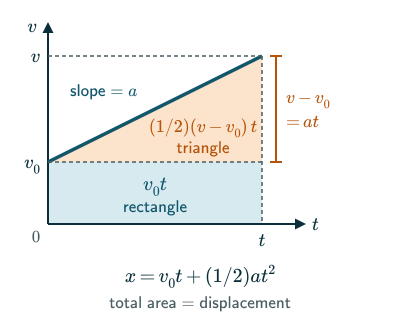
With constant acceleration, a = (v − v0)/t, so
First equation
The v-t graph is then a straight line, and the displacement is the area under it (NCERT Fig. 2.5, page 17). That area is a rectangle of height v0 plus a triangle of height v − v0:
Second equation
The area x = v0t + ½(v − v0)t can also be written x = ½(v0 + v)t: the displacement is the average of the initial and final velocities times the time, guaranteed for constant acceleration (NCERT Eqs. 2.7a–2.7b, page 17). It may also happen to hold over a particular interval of a non-uniform motion, but cannot then be assumed. For non-zero a, putting t = (v − v0)/a into it removes the time:
Third equation
The third equation also holds for a = 0, when v = v0, although the division-by-a derivation above cannot be used in that case. Multiplied by m/2, the third equation becomes ½mv − ½mv02 = max, which is where the work-energy theorem starts.
Deriving the equations with calculus
NCERT Example 2.2 (page 18) obtains the same results by integration, starting from the definitions:
- From a = dv/dt: dv = a dt. Integrating from v0 at 0 to v at t, with a constant, gives v − v0 = at.
- From v = dx/dt: dx = v dt = (v0 + at) dt. Integrating gives x − x0 = v0t + ½at.
- Writing a = dv/dt = (dv/dx)(dx/dt) = v dv/dx gives v dv = a dx. Integrating gives v − v02 = 2a(x − x0).
The advantage of this method is that it can be used for motion with non-uniform acceleration also.
NCERT Physics Part I (Class 11), Section 2.4, page 18
If a changes with time, dv = a(t) dt can still be integrated, but the three equations above no longer hold.
Using the equations
The quantities are algebraic: velocity, acceleration and displacement carry signs, fixed by the positive direction you choose (NCERT Points to Ponder 5, page 23). Choose the origin and the positive direction first, write down what is known with signs, then pick the equation that contains the unknown and no other unknowns.
Every term in each equation has the same dimensions: [L T] in the first equation, [L] in the second (and in x = ½(v0 + v)t) and [L T] in the third, as a dimensional check confirms. That shows the equations are consistent, not that they hold for every motion.
NCERT’s Points to Ponder contrast the definitions of velocity and acceleration, which are always exact, with the kinematic equations, which
are true only for motion in which the magnitude and the direction of acceleration are constant during the course of motion.
NCERT Physics Part I (Class 11), Chapter 2, Points to Ponder, page 23
Two useful results (beyond the NCERT text):
- Displacement in the nth second. From t = n − 1 to t = n, the displacement is x(n) − x(n − 1) = v0 + a(n − ½), with v0 in m/s, a in m s and the answer in metres. It is the distance covered only if the object does not turn back during that second; if it does, add the distances before and after the turning point.
- x is a displacement. If the object turns back during the interval, the equations give the displacement, not the distance travelled.
Free fall
Near the Earth’s surface, with air resistance neglected, every object falls with the same downward acceleration g, about 9.8 m s, constant as long as the height is small compared with the Earth’s radius (NCERT Example 2.4, page 19; see acceleration due to gravity).
Free fall is thus a case of motion with uniform acceleration.
NCERT Physics Part I (Class 11), Section 2.4, page 19
Taking upwards as positive, a = −g. For an object released from rest at y = 0:
- v = −gt = −9.8t m/s;
- y = −½gt = −4.9t m;
- v = −2gy = −19.6y m s (here y is negative, so v is positive).
NCERT calls y here “the distance travelled”, and the caption of Fig. 2.7(c) reads “Variation of distance with time” though the graph plots y from 0 down to about −80 m (pages 19–20). Strictly y is the position, negative below the starting point; its size is the distance fallen.
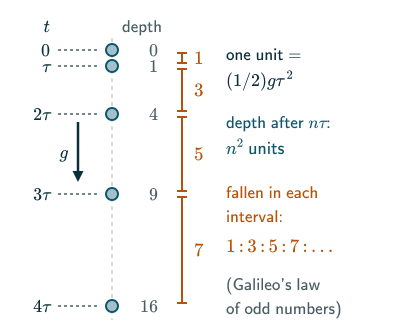
Galileo’s law of odd numbers (NCERT Example 2.5, page 20):
The distances traversed, during equal intervals of time, by a body falling from rest, stand to one another in the same ratio as the odd numbers beginning with unity
NCERT Physics Part I (Class 11), Section 2.4, page 20
After times τ, 2τ, 3τ, 4τ, … the body has fallen 1, 4, 9, 16, … units of ½gτ (the squares), so in the successive intervals it falls 1, 3, 5, 7, … units, the odd numbers (Example 4).
Stopping distance and reaction time
Stopping distance (NCERT Example 2.6, page 20). A vehicle moving at v0 brakes with a deceleration of size |a| until it stops. NCERT calls the distance it covers once the brakes act the stopping distance ds; below it is also called the braking distance, and the total stopping distance adds the distance covered during the reaction time. With v = 0 in v = v02 + 2ax:
Braking distance
Thus, the stopping distance is proportional to the square of the initial velocity.
NCERT Physics Part I (Class 11), Section 2.4, page 20
Doubling the speed makes the braking distance four times as long. NCERT quotes braking distances of 10, 20, 34 and 50 m for one car at 11, 15, 20 and 25 m/s (page 21); these fit v02/ds ≈ 12 m s, that is |a| ≈ 6 m s (Example 5).
Reaction time (NCERT Example 2.7, page 21). Before the brakes even act, a driver needs time to see, decide and move. It can be measured by catching a falling ruler: if it drops a distance d before you catch it, then d = ½gtr2, so
Reaction time from a falling ruler
NCERT’s working writes this relation as d = −½gtr2, with a minus sign that would make the distance negative; with d as the distance fallen, as in its question, the sign should not be there. Its answer is right: for d = 21.0 cm, tr ≈ 0.2 s.
During the reaction time the vehicle keeps moving at v0, so the total stopping distance is v0tr + v02/(2|a|) (Example 6).
Solved examples
Example 1: A ball thrown up from a building (NCERT Example 2.3)
A ball is thrown vertically upwards at 20 m/s from the top of a building, 25.0 m above the ground. (a) How high does it rise? (b) How long is it before it hits the ground? Take g = 10 m s.
Take y upwards, with the ground at y = 0, so y0 = 25 m, v0 = +20 m/s, a = −10 m s.
(a) At the top v = 0: 0 = 20 + 2(−10)(y − y0), so y − y0 = 20 m.
(b) First method: up to the top, 0 = 20 − 10t1, so t1 = 2 s; then from 45 m above the ground, falling from rest, 0 = 45 − 5t22, so t2 = 3 s. Total 5 s.
Second method, in one step: 0 = 25 + 20t − 5t, that is t − 4t − 5 = 0, so t = 5 s (the other root, −1 s, is before the throw).
Answer: it rises 20 m above the launch point (45 m above the ground) and lands after 5 s (NCERT pages 18–19).
Example 2: Braking from 126 km/h (NCERT Exercise 2.5, page 24)
A car moving at 126 km/h must stop within 200 m. Find the minimum magnitude of uniform retardation required, and the stopping time in that limiting case.
v0 = 126 × 5/18 = 35 m/s, v = 0, x = 200 m. From v = v02 + 2ax: a = −35/(2 × 200) = −1225/400 ≈ −3.06 m s.
From v = v0 + at: t = 35/3.0625 ≈ 11.4 s.
Answer: at least about 3.06 m s of retardation is required. At that minimum value, the car stops in about 11.4 s after travelling 200 m; a larger constant retardation stops it sooner.
Example 3: A ball thrown up and caught (NCERT Exercise 2.6, page 24)
A player throws a ball upwards at 29.4 m/s. How high does it rise, and after how long does it come back to the player’s hands? Take g = 9.8 m s.
Height: 0 = 29.4 − 2 × 9.8 × h, so h = 864.36/19.6 = 44.1 m.
Time up: 0 = 29.4 − 9.8t, so t = 3 s. The fall back takes the same time, so the ball returns after 6 s.
At the top its velocity is zero but its acceleration is still 9.8 m s downwards.
Answer: 44.1 m; 6 s.
Example 4: Galileo’s law of odd numbers (NCERT Example 2.5)
Show that a body falling from rest covers distances in the ratio 1 : 3 : 5 : 7 … in equal successive intervals τ.
From rest, the distance fallen in time t is ½gt. After nτ it is n × ½gτ. In the nth interval it falls [n − (n − 1)] × ½gτ = (2n − 1) × ½gτ.
For n = 1, 2, 3, 4: 1, 3, 5, 7 units.
Answer: the distances are in the ratio of the odd numbers 1 : 3 : 5 : 7 …
Example 5: Is the braking data consistent? (from NCERT Example 2.6)
NCERT gives braking distances of 10, 20, 34 and 50 m at 11, 15, 20 and 25 m/s. What deceleration does each imply?
|a| = v02/(2ds): 121/20 ≈ 6.1, 225/40 ≈ 5.6, 400/68 ≈ 5.9, 625/100 ≈ 6.3 m s.
Answer: about 5.6 to 6.3 m s, roughly constant, so the distances do grow as v02, as NCERT says.
Example 6: Reaction time and total stopping distance
A ruler drops 21.0 cm before a student catches it (NCERT Example 2.7). For an idealised calculation, assume a driver has that same reaction time while travelling at 20 m/s, then brakes with constant deceleration 6 m s. Find the total stopping distance. Take g = 9.8 m s; a ruler-catching time is not a reliable estimate of a real driver’s response time.
Reaction time: tr = √(2 × 0.21/9.8) ≈ 0.207 s, about 0.2 s.
Distance during the reaction time: 20 × 0.207 ≈ 4.1 m. Braking distance: 20/(2 × 6) ≈ 33.3 m.
Answer: about 37 m in all, of which about 4 m is covered before the brakes are even applied.
Common mistakes to avoid
Common mistake
Using the equations when the acceleration changes
The three equations hold only for constant acceleration. If a depends on time or position, go back to a = dv/dt and v = dx/dt and integrate.
Common mistake
Getting the sign of g wrong
If upwards is positive, a = −g on the way up and on the way down. The acceleration does not reverse at the top; the velocity does.
Common mistake
Taking x as the distance travelled
x in the equations is a displacement. For a ball thrown up and caught at the same height, the displacement for the whole flight is x = 0, though the ball travelled twice the height.
Common mistake
Using the average of the two velocities when a is not constant
x = ½(v0 + v)t is guaranteed for constant acceleration. With non-uniform acceleration, the mean of the endpoint velocities may agree by coincidence, but in general find the average from displacement/time or from the area under the velocity-time graph.
Common mistake
Keeping both roots of a quadratic
In 0 = 25 + 20t − 5t the root t = −1 s is before the throw. Keep the root that fits the physical situation. When both roots are positive, both can be real: for example, the times at which a ball passes the same height going up and coming down.
Common mistake
Forgetting the reaction distance
Total stopping distance = distance covered during the reaction time + braking distance. The first part, v0tr, is covered before the brakes even act and grows in proportion to the speed; leaving it out always underestimates the stopping distance.
Common mistake
Taking zero initial velocity for an object dropped from a moving body
A packet dropped from a balloon rising at 5 m/s starts with the balloon’s velocity, v0 = +5 m/s upwards, not zero. It rises a little before falling, and a = −g from the moment of release.
Quick revision summary
- For constant acceleration: v = v0 + at; x = v0t + ½at; v = v02 + 2ax; x = ½(v0 + v)t. With a starting position x0, replace x by x − x0.
- They follow from the area under the straight v-t graph, or by integrating a = dv/dt and v = dx/dt.
- All quantities carry signs; choose the positive direction first.
- Free fall: a = −g (upwards positive); from rest, distances in equal intervals go as 1 : 3 : 5 : 7.
- Braking distance v02/(2|a|) grows as the square of the speed; reaction time from a ruler, √(2d/g).
Formula sheet
- v = v + at
- x = vt + ½at
- v = v + 2ax
- x = ½(v + v)t
- starting at x: replace x by x − x
- free fall, upwards positive: a = −g
- nth second: x(n) − x(n − 1) = v + a(n − ½)
- ds = v02/(2|a|); tr = √(2d/g)
Questions students ask
How many equations of motion are there?
There are three equations of motion for a body moving along a straight line with constant acceleration: v = v0 + at, x = v0t + ½at and v = v02 + 2ax, each linking four of the five quantities v0, v, a, t and x. Only two of them are independent, since any one follows from the other two. Some books add further relations, such as x = ½(v0 + v)t (without a), x = vt − ½at (without v0) and the displacement in the nth second, v0 + a(n − ½); all of them follow from the three.
Are v = u + at, s = ut + ½at and v = u + 2as the same as the Class 11 equations of motion?
Yes, v = u + at, s = ut + ½at and v = u + 2as are the same three equations of motion in the notation of Class 9 and many other books: u is the initial velocity, written v0 in NCERT Class 11, and s is the displacement, written x (or x − x0 when the start is not at the origin). In either notation s or x is a displacement with a sign, not the distance travelled, and the equations need a constant acceleration.
Can the equations of motion be used if the acceleration is zero or changes partway?
Yes, the equations of motion can be used when the acceleration is zero, since zero is a constant acceleration: with a = 0 they reduce to v = v0 and x = v0t, uniform motion. If the acceleration changes in steps, apply them to each stage separately, taking the final velocity of one stage as the initial velocity of the next. For example, a car that starts from rest at 3 m s for 4 s reaches 12 m s after 24 m, then brakes at 4 m s and stops in another 3 s and 18 m: 42 m in 7 s.
What are the formulas for the time and speed of a body dropped from a height?
A body dropped from rest from a height h, with air resistance neglected, reaches the ground after t = √(2h/g) with speed v = √(2gh), and in a time t it falls ½gt. These follow from the equations of motion with v0 = 0 and a = g, taking downwards as positive. For example, from h = 20 m with g = 9.8 m s, the body lands after about 2.02 s at about 19.8 m s.
What is the difference between free fall and falling at terminal velocity?
In free fall gravity is the only force, so a falling body keeps speeding up with acceleration g, about 9.8 m s, whatever its mass; at terminal velocity the upward drag of the air, with the small buoyant force, balances the weight, so the body falls at a constant speed with no acceleration. A real falling body, such as a raindrop or a skydiver, starts close to free fall and approaches its terminal velocity as its speed, and so the drag, increases. The equations of motion with a = g hold only while air resistance is negligible; the terminal velocity of a small sphere follows from Stokes’ law.
Practice questions
Try each question first, then open the answer to check your working.
-
Q1. A car starts from rest and accelerates uniformly at 2 m s for 10 s. Find its final velocity and the distance covered.
Show answerHide answer
v = 0 + 2 × 10 = 20 m/s; x = 0 + ½ × 2 × 10 = 100 m.
-
Q2. A stone is dropped from a cliff and hits the sea 3 s later. How high is the cliff, and how fast is the stone moving at impact? Take g = 9.8 m s.
Show answerHide answer
Height = ½ × 9.8 × 3 = 44.1 m. Speed = 9.8 × 3 = 29.4 m/s.
-
Q3. Why does the second method of Example 1 work in one step, even though the ball goes up and then comes down?
Show answerHide answer
The acceleration is the same, −g, throughout the flight, so one equation with signed quantities covers both the rise and the fall. Only the start and end positions matter for the displacement.