Frame of reference, position and displacement
Beyond NCERT In the JEE Main and NEET syllabus; the Class 11 book has no section for it.
Quick answer
A frame of reference is an origin, a set of axes and a clock from which positions and times are measured; for motion along a line one axis is enough, and position is a signed coordinate x. Displacement is the change in position, x − x, and can be positive, negative or zero, while path length is the total distance actually covered and is never less than the size of the displacement. Average velocity is displacement divided by time, and average speed is path length divided by time.
What are a frame of reference, position and displacement?
Frame of reference, position and displacement
- A frame of reference is a chosen origin, a set of axes and a clock, from which positions and times are measured. For motion along a straight line one axis, the x-axis, is enough.
- The position of an object is its coordinate x on that axis: positive on one side of the origin, negative on the other.
- Displacement is the change in position, Δx = x2 − x1. It can be positive, negative or zero.
- Path length (distance travelled) is the total length of the path actually covered. It is never negative and never less than the size of the displacement.
Motion is change in position of an object with time.
NCERT Physics Part I (Class 11), Section 2.1, page 13
Both the JEE Main 2027 and the NEET (UG) 2026 syllabuses list the frame of reference, uniform and non-uniform motion, average speed and position-time graphs in Unit 2, Kinematics. The 2026–27 NCERT book no longer has a section on position, displacement or average velocity: its Section 2.2 (page 14) opens with the average velocity, and the definitions survive only in the table of quantities at the end of the chapter (pages 22–23). This page explains those ideas in full.
In plain words: to say where something is, you need a starting mark and a direction. Displacement is how far the object ends up from where it started, with a sign for the direction; path length is how far it actually went.
Frame of reference
Motion is always measured relative to something. A passenger sitting in a moving train is at rest relative to the train but moving relative to the platform (see relative velocity). So before describing motion we fix a frame of reference:
- an origin O, the point from which positions are measured;
- an axis with a positive direction (for a straight line, usually “to the right is positive”);
- a clock to measure time from a chosen instant, t = 0.
The origin and the positive direction of an axis are a matter of choice.
NCERT Physics Part I (Class 11), Chapter 2, Points to Ponder, page 23
Once the choice is made, it must be kept for the whole problem. Shifting the origin by a fixed distance changes the position coordinates but leaves displacements, velocities and accelerations unchanged. This is different from choosing an origin that moves with time: a moving frame can change the measured velocity and acceleration. Reversing the axis flips the signs of the coordinate components.
NCERT also treats moving objects as point objects, which is fair when an object’s size is much smaller than the distance it moves in the time of interest (Section 2.1, page 13). A train travelling between two cities can be treated as a point when only its overall position matters. A spinning ball needs an extended-body model when its rotation or contact with the pitch is relevant; its centre-of-mass trajectory can still be studied as that of a point.
Position, path length and displacement
Take a car on a straight road, with the origin at O and the positive direction to the right. The car drives from O to P, 400 m away, then turns back to Q, at +250 m.
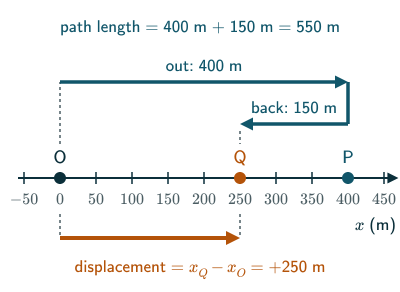
- Path length = 400 m + 150 m = 550 m.
- Displacement = xQ − xO = 250 m − 0 = +250 m.
If the car had come all the way back to O, its displacement would be zero though it had driven 800 m. Displacement depends only on the start and the end; path length depends on the whole route. Path length equals the magnitude of displacement when the motion is along the line without reversing. Displacement itself can be negative, so it need not equal the non-negative path length.
Average velocity and average speed
For motion from position x1 at time t1 to x2 at time t2:
Average velocity
Average speed
Average velocity has a sign, which gives the direction; average speed is never negative. NCERT gives this definition in its end-of-chapter table (page 23) and in a note to Exercise 2.9 (page 25), and states the link between the two:
The average speed of an object is greater or equal to the magnitude of the average velocity over a given time interval.
NCERT Physics Part I (Class 11), Chapter 2, Summary, page 21
Average speed equals the magnitude of average velocity when the object does not reverse direction. NCERT Exercise 2.10 (page 25) shows why average speed is defined from path length: a man who walks to a market and back home has zero average velocity, but nobody would tell the tired man his average speed was zero (Example 3).
Uniform and non-uniform motion
- Uniform motion: the object covers equal displacements in equal intervals of time, however small the intervals. Its velocity is constant, and its average velocity over any interval equals that constant velocity.
- Non-uniform motion: the velocity changes, so equal intervals of time can give different displacements. Most real motion, such as a car in traffic or a falling stone, is non-uniform.
In an inertial frame, uniform motion in a straight line corresponds to zero net force, just like rest (see rest and uniform motion are equivalent).
Position-time graphs
A position-time (x-t) graph plots position x upwards against time t. Its slope between two points, Δx/Δt, is the average velocity over that interval.
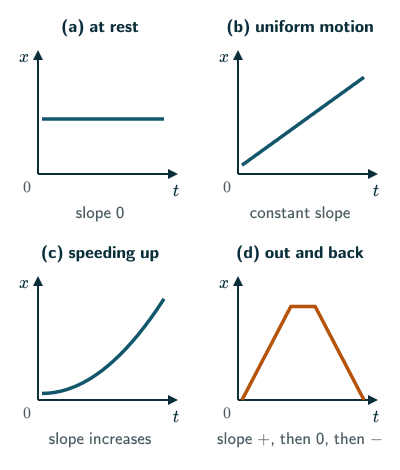
- A horizontal line: the object is at rest.
- A straight sloping line: uniform motion; a steeper line means a higher speed.
- A curve: non-uniform motion; the slope changes as the velocity changes, and the way the curve bends shows the sign of the acceleration.
- Straight pieces at different slopes: also non-uniform motion; the velocity changes at each corner.
- A falling line: the object moves in the negative direction.
- Two graphs that intersect: the objects share a position at that time. Their slopes tell whether they approach, overtake or momentarily move together; the intersection alone does not say what happens after they meet.
An x-t graph is not a picture of the path. A straight-line motion can give a curved graph, and a curve such as the cosine graph of simple harmonic motion describes an object moving back and forth along a line. A graph can never be vertical or turn back in time: an object cannot be at two places at once. NCERT Exercises 2.12 and 2.13 (page 25) test exactly these two ideas.
Solved examples
Example 1: Path length and displacement
In the figure above, the car goes from O (0) to P (+400 m) and back to Q (+250 m). Find the path length and the displacement. What would they be if the car returned to O?
Path length = 400 + 150 = 550 m. Displacement = 250 − 0 = +250 m.
If it returned to O: path length = 400 + 400 = 800 m, displacement = 0.
Answer: 550 m and +250 m; for the full round trip, 800 m and 0.
Example 2: Average velocity and average speed
The car in Example 1 takes 50 s for the whole trip from O to P to Q. Find its average velocity and average speed.
Average velocity = +250 m/50 s = +5 m/s. Average speed = 550 m/50 s = 11 m/s.
Answer: +5 m/s and 11 m/s. The average speed is larger because the car turned back.
Example 3: The walk to the market (NCERT Exercise 2.10, page 25)
A man walks 2.5 km from home to a market at 5 km/h, finds it closed, and at once walks back home at 7.5 km/h. Find his average velocity and average speed over (i) 0 to 30 min, (ii) 0 to 50 min, (iii) 0 to 40 min.
The walk out takes 2.5/5 = 0.5 h = 30 min; the walk back takes 2.5/7.5 h = 20 min.
(i) 0 to 30 min: displacement 2.5 km, path 2.5 km, time 0.5 h. Average velocity 5 km/h; average speed 5 km/h.
(ii) 0 to 50 min: he is home, so displacement 0 and average velocity 0. Path 5 km in 50/60 h: average speed 6 km/h.
(iii) 0 to 40 min: in the last 10 min he walks back 7.5 × (10/60) = 1.25 km. Displacement 2.5 − 1.25 = 1.25 km; path 2.5 + 1.25 = 3.75 km; time 40/60 h. Average velocity 1.875 km/h; average speed 5.625 km/h.
Answer: (i) 5 and 5 km/h; (ii) 0 and 6 km/h; (iii) 1.875 and 5.625 km/h.
Example 4: The average of two speeds
A car goes 60 km to a town at 40 km/h and returns along the same road at 60 km/h. Find its average speed for the round trip.
Time out = 60/40 = 1.5 h; time back = 60/60 = 1 h. Average speed = 120 km/2.5 h = 48 km/h.
Answer: 48 km/h, not 50 km/h. For equal distances at speeds v1 and v2, the average speed is 2v1v2/(v1 + v2), because more time is spent at the lower speed.
Example 5: Steps forward and back (NCERT Exercise 2.4, page 24)
A man in a narrow lane takes 5 steps forward and 3 steps back, again and again. Each step is 1 m and takes 1 s. How long does he take to reach a pit 13 m ahead?
Each cycle of 8 steps takes 8 s and moves him 5 − 3 = 2 m forward. His farthest points are at the ends of the forward runs: 5, 7, 9, 11 and 13 m, at t = 5, 13, 21, 29 and 37 s. So after 4 cycles (32 s) he is at 8 m, and his next 5 forward steps take him from 8 m to 13 m: he falls in after 5 more seconds, before stepping back. On an x-t graph his motion is a zig-zag whose peaks rise by 2 m every 8 s; the fifth peak touches 13 m.
Answer: 37 s. (Dividing 13 m by 2 m per 8 s would wrongly give 52 s: the last stretch is covered in one forward run.)
Common mistakes to avoid
Common mistake
Treating distance and displacement as the same
Path length counts every metre covered; displacement only compares the start and the end, with a sign. A round trip has zero displacement. Read the word “distance” with care: it usually means path length, but NCERT Exercise 2.9 (page 25) uses it for the magnitude of displacement.
Common mistake
Taking average speed as the size of the average velocity
They are equal only if the object never turns back. For a round trip the average velocity is zero but the average speed is not.
Common mistake
Averaging two speeds
Over equal distances, the average speed is 2v1v2/(v1 + v2), not (v1 + v2)/2. The simple mean is right only when equal times are spent at the two speeds. Always divide the total path by the total time.
Common mistake
Reading an *x*-*t* graph as the path
A curved x-t graph does not mean a curved path. The motion is along a straight line; the curve shows how the position changes with time.
Common mistake
Forgetting to fix the origin and direction
A position of +5 m in one frame can be −5 m in another. State the origin and the positive direction before giving signs.
Quick revision summary
- A frame of reference is an origin, axes and a clock; for straight-line motion one axis is enough.
- Position x is a signed coordinate; displacement Δx = x2 − x1; path length is the total distance covered.
- Average velocity = displacement/time; average speed = path length/time; average speed ≥ |average velocity|.
- Uniform motion: constant velocity, a single straight x-t line. Non-uniform motion: changing velocity, an x-t graph that curves or changes slope (like panel (d) of the figure).
- The slope of the chord joining two points of an x-t graph is the average velocity; the slope of the tangent at a point is the velocity at that instant (NCERT Section 2.2, page 14).
Formula sheet
- Δx = x − x
- v̄ = Δx/Δt = (x − x)/(t − t)
- average speed = path length/time interval
- average speed ≥ |v̄|
- equal distances at v and v: average speed = 2vv/(v + v)
Questions students ask
What is the difference between a frame of reference and a reference point?
A reference point is only the point from which positions are measured, while a frame of reference is the full set-up for describing motion: that point taken as the origin, axes with chosen positive directions, and a clock for time. With a reference point alone you can say how far away an object is, but not on which side or at what instant. A frame is usually attached to a body or an observer, such as the ground, a train or a lift, and the motion is described as seen from it.
Can a body be at rest and in motion at the same time?
Yes, a body can be at rest and in motion at the same time, relative to different frames of reference, because rest and motion are always measured relative to something. A bag on the seat of a moving bus is at rest relative to the bus but moving at the bus’s speed relative to the road. So every statement of position or velocity needs its frame; for everyday problems it is usually the ground, and changing from one frame to another is done with relative velocity.
Can displacement be greater than distance?
No, the magnitude of the displacement can never be greater than the distance travelled (the path length), because displacement only compares the start and the end, while the distance counts every metre actually covered. The two are equal when the object moves along a straight line in one direction without turning back; otherwise the distance is larger. For example, a cyclist who rides 30 m east and then 10 m back west has travelled 40 m, but her displacement is only 20 m east.
Can displacement be negative or zero?
Yes, displacement can be negative or zero, while the distance travelled is never negative. Displacement, Δx = x2 − x1, is negative when the object ends up on the negative side of its starting point: moving from x = +2 m to x = −3 m gives Δx = −5 m. It is zero whenever the object returns to its starting point, however far it went, whereas the distance is zero only if the object did not move at all.
Why is displacement a vector but distance a scalar?
Displacement is a vector because it has a direction as well as a size: it points from the initial position to the final position, and successive displacements combine by vector addition. Distance (path length) is a scalar, since it only measures how much path was covered and has no direction. In straight-line motion the direction of a displacement is shown by its sign on the chosen axis. Both are lengths, with the SI unit metre (m) and dimensions [L].
What are the distance and displacement after half a revolution of a circle?
After half a revolution of a circle of radius r, the distance travelled is half the circumference, πr, while the displacement is the diameter, 2r, pointing straight across from the start to the end point. So the distance is π/2 ≈ 1.57 times the magnitude of the displacement. For example, a runner going halfway round a circular track of radius 35 m covers about 110 m but is displaced by only 70 m.
Practice questions
Try each question first, then open the answer to check your working.
-
Q1. A runner completes one lap of a 400 m circular track and stops at the starting point. Find the path length and the displacement.
Show answerHide answer
Path length 400 m; displacement 0, because the runner ends where she started.
-
Q2. A particle moves from x = +6 m to x = −4 m in 5 s without turning back. Find its displacement, average velocity and average speed.
Show answerHide answer
Displacement = −4 − 6 = −10 m. Average velocity = −10/5 = −2 m/s. Path length = 10 m, so average speed = 2 m/s.
-
Q3. On an x-t graph, what does a horizontal line mean, and what does a line sloping downwards mean?
Show answerHide answer
A horizontal line means the object is at rest. A line sloping downwards means it is moving in the negative direction.