Acceleration
NCERT Class 11 Physics Chapter 2 Section 2.3
Quick answer
Acceleration is the rate of change of velocity with time: the average acceleration over an interval is Δv/Δt, and the instantaneous acceleration is a = dv/dt, the slope of the tangent to the velocity-time graph. Its sign shows direction, not whether the object speeds up: it speeds up when a and v have the same sign and slows down when they are opposite. The area under a velocity-time graph gives the displacement, with parts below the time axis counted as negative.
With your textbook
NCERT Physics Part I (Class 11), Chapter 2 “Motion in a Straight Line”, Section 2.3 “Acceleration”, pages 15–17.
Open the official NCERT chapter (PDF, 1.4 MB, ncert.nic.in) (opens in a new tab)
Checked against the 2026-27 reprint on .
What is acceleration?
Acceleration
Acceleration is the rate of change of velocity with time.
- The average acceleration over a time interval is the change of velocity divided by the interval: ā = (v2 − v1)/(t2 − t1) = Δv/Δt.
- The instantaneous acceleration is its limit as Δt → 0: a = dv/dt, the slope of the tangent to the velocity-time graph.
Its SI unit is m s (NCERT Section 2.3, pages 15–16).
This led to the concept of acceleration as the rate of change of velocity with time.
NCERT Physics Part I (Class 11), Section 2.3, page 15
In plain words: velocity says how fast position changes; acceleration says how fast velocity changes. A car that speeds up steadily from rest to 20 m/s in 10 s gains 2 m/s every second, an acceleration of 2 m s.
Why “with time”?
Should the change of velocity be measured per metre travelled or per second? It was first thought to be per unit distance. From his studies of falling bodies and of balls on inclined planes, Galileo concluded that for a body in free fall the change of velocity per unit time is constant, while the change per unit distance is not: it decreases as the body falls further (NCERT page 15). That is why acceleration is defined as a rate with time.
Average and instantaneous acceleration
Average acceleration
Instantaneous acceleration
On a velocity-time graph, the average acceleration is the slope of the chord joining (t1, v1) and (t2, v2), and the instantaneous acceleration is the slope of the tangent (pages 15–16).
The acceleration at an instant is the slope of the tangent to the v–t curve at that instant.
NCERT Physics Part I (Class 11), Section 2.3, page 16
Since v = dx/dt (see instantaneous velocity), the acceleration is the second derivative of position, a = dx/dt. When the acceleration is constant, the average acceleration over any interval equals it, and v = v0 + at (NCERT Eq. 2.4, page 16), the first of the equations of motion.
On a branch of motion where velocity is a differentiable function of position, the chain rule gives a = (dv/dx)(dx/dt) = v dv/dx. At a turning point, dv/dx can be undefined even when a is finite; use a = dv/dt there instead. For example, if v = 2x (v in m/s, x in m), then a = v × 2 = 4x, which is 12 m s at x = 3 m.
Velocity has a direction, so acceleration can come from a change of speed, a change of direction, or both (page 16). In a straight line the direction can only reverse, and the velocity has to pass through zero to do that, so in one dimension any acceleration shows up as a change in the value of v. Acceleration can be positive, negative or zero. In an inertial frame it is what a net force produces, by Newton’s second law, F = ma; and it need not be constant: in simple harmonic motion it changes all the time, so only a = dv/dt applies there, not v = v0 + at.
Speeding up or slowing down? The sign of a alone does not say. NCERT’s Points to Ponder (page 23) put it this way: when a particle speeds up, its acceleration is in the direction of its velocity; when it slows down, the acceleration is opposite to the velocity.
- v and a with the same sign: speeding up.
- v and a with opposite signs: slowing down.
Retardation (deceleration) means slowing down, and it is quoted as a positive size: a retardation of 3 m s on a car moving in the +x direction means a = −3 m s. Retardation and negative acceleration are not the same thing (NCERT Exercise 2.5 asks for a retardation).
A ball thrown upwards (taking up as positive, air resistance neglected) has a = −g all the time: it slows down on the way up (v > 0) and speeds up on the way down (v < 0).
Acceleration on a position-time graph
The x-t graph is concave upward (bends like a cup, ∪: its slope, the velocity, increases with time) for positive acceleration, concave downward (like a cap, ∩: slope decreasing) for negative acceleration, and a straight line for zero acceleration. What matters is the bend, not whether x is rising: in NCERT Fig. 2.2 (a) x first falls and then rises, yet a > 0 throughout. For constant non-zero acceleration the x-t graph is a parabola (NCERT Summary, page 22). NCERT’s text refers to these graphs as Figs. 2.4 (a), (b) and (c) on page 16, but the figure printed there is Fig. 2.2; Fig. 2.4 is the area under a v-t graph.
Velocity-time graphs
For constant acceleration the velocity-time (v-t) graph is a straight line whose slope is a. NCERT’s Fig. 2.3 (page 16) shows four cases:
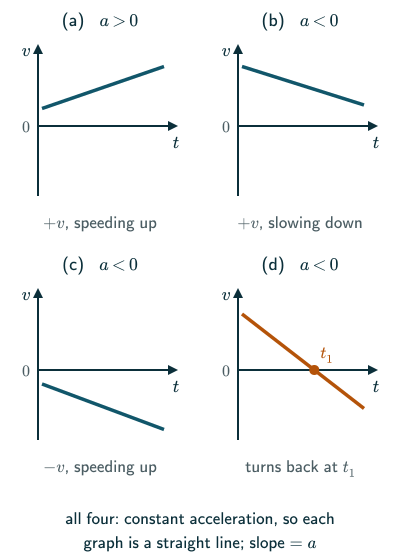
- (a) moving in the positive direction with positive acceleration: speeding up;
- (b) moving in the positive direction with negative acceleration: slowing down;
- (c) moving in the negative direction with negative acceleration: speeding up;
- (d) negative acceleration throughout: the object moves in the positive direction until t1, stops for an instant, then moves in the negative direction.
At t1 in (d) the velocity is zero but the acceleration is not:
A particle may be momentarily at rest and yet have non-zero acceleration.
NCERT Physics Part I (Class 11), Chapter 2, Points to Ponder, page 23
Displacement as the area under the v-t graph
An interesting feature of a velocity-time graph for any moving object is that the area under the curve represents the displacement over a given time interval.
NCERT Physics Part I (Class 11), Section 2.3, page 16
For constant velocity u, the graph is a horizontal line and the area from 0 to T is a rectangle, u × T = uT, which is the displacement (NCERT Fig. 2.4, page 17). NCERT asks how an area can equal a distance: the “area” has units of velocity × time, m s × s = m, a length.
Two rules for reading areas:
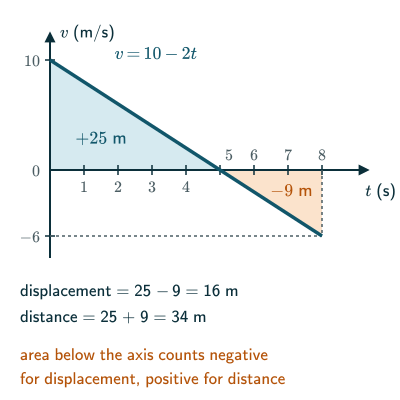
- area above the t-axis counts as positive displacement and area below as negative, so the displacement is the net area;
- the distance travelled (path length) is the total area with every part counted as positive.
The same rule works one step up: the area under an acceleration-time (a-t) graph between t1 and t2 is the change of velocity, v2 − v1 (area below the axis counts negative). It is the change, not the velocity: add the initial velocity to get v2.
NCERT adds that the sharp corners on some of its x-t, v-t and a-t graphs are idealisations: in reality velocity and acceleration change smoothly, never abruptly at an instant (page 17).
Solved examples
Example 1: Average acceleration
A car speeds up from 18 km/h to 72 km/h in 10 s. Find its average acceleration.
18 km/h = 5 m/s and 72 km/h = 20 m/s. ā = (20 − 5)/10 = 1.5 m s.
Answer: 1.5 m s. Always convert km/h to m/s first (multiply by 5/18).
Example 2: Acceleration from x(t)
A particle moves along the x-axis with x = 2t − 3t + 4 (metres, seconds). Find its velocity and acceleration at t = 2 s, and when its acceleration is zero.
v = dx/dt = 6t − 6t; a = dv/dt = 12t − 6.
At t = 2 s: v = 24 − 12 = 12 m/s, a = 24 − 6 = 18 m s. a = 0 when t = 0.5 s.
Answer: 12 m/s and 18 m s at 2 s; a = 0 at t = 0.5 s.
Example 3: Speeding up or slowing down?
In each case, is the object speeding up or slowing down? (a) v = −6 m/s, a = +2 m s; (b) v = −6 m/s, a = −2 m s; (c) v = +6 m/s, a = −2 m s.
(a) Opposite signs: slowing down. (b) Same sign: speeding up. (c) Opposite signs: slowing down.
Answer: slowing, speeding up, slowing. A negative acceleration does not always mean slowing down.
Example 4: Displacement and distance from a v-t graph
An object moves with v = 10 − 2t (m/s, s) from t = 0 to t = 8 s. Find its displacement and the distance travelled.
The graph crosses the axis at t = 5 s. Area from 0 to 5 s: ½ × 5 × 10 = +25 m. Area from 5 to 8 s: ½ × 3 × (−6) = −9 m.
Displacement = 25 − 9 = 16 m. Distance = 25 + 9 = 34 m.
Answer: 16 m and 34 m.
Example 5: True or false? (NCERT Exercise 2.7, page 24)
For a particle in one-dimensional motion, decide with reasons: (a) with zero speed at an instant it may have non-zero acceleration; (b) with zero speed it may have non-zero velocity; (c) with constant speed it must have zero acceleration; (d) with a positive acceleration it must be speeding up.
(a) True: a ball at the top of its flight has v = 0 but a = −g (taking up as positive).
(b) False: speed is the size of velocity, so zero speed means zero velocity.
(c) True: in one dimension the velocity is +u or −u. Velocity changes continuously (NCERT page 17), so to go from +u to −u it would have to pass through zero, and the speed would not stay constant. So the velocity itself is constant and a = 0 (if the constant speed is zero, v = 0 throughout and again a = 0). An ideal bounce that reversed v instantly at the same speed would need an infinite acceleration; a real ball slows to rest during contact.
(d) False: if the velocity is negative, a positive acceleration slows the particle down, as when the downward direction is taken as positive and a ball is thrown upwards.
Answer: (a) true, (b) false, (c) true, (d) false.
Common mistakes to avoid
Common mistake
Taking negative acceleration to mean slowing down
The sign of a depends on the chosen positive direction. The object slows down only when a and v have opposite signs.
Common mistake
Thinking zero velocity means zero acceleration
At the top of a vertical throw v = 0 but a = −g. The velocity is passing through zero, not staying there.
Common mistake
Adding areas below the axis as positive displacement
Area below the t-axis is negative displacement. Only the distance travelled counts it as positive.
Common mistake
Reading acceleration from an x-t graph’s slope
The slope of an x-t graph is velocity; the slope of a v-t graph is acceleration. On an x-t graph, acceleration shows only as curvature.
Common mistake
Mixing units
A velocity change in km/h divided by seconds gives units of km h s, not m s. To obtain acceleration directly in SI units, first convert the velocity change to m/s (× 5/18), then divide by seconds.
Quick revision summary
- Average acceleration: ā = Δv/Δt; instantaneous acceleration: a = dv/dt = dx/dt; unit m s.
- a is the slope of the tangent to the v-t graph; an x-t graph that bends like a cup (slope increasing) means a > 0, whether x is rising or falling.
- Same signs of v and a: speeding up; opposite signs: slowing down.
- Zero velocity does not mean zero acceleration.
- Area under the v-t graph = displacement (below the axis counts negative); total area = distance.
Formula sheet
- ā = (v − v)/(t − t) = Δv/Δt
- a = dv/dt
- a = dx/dt
- constant a: v = v + at
- displacement = net area under the v-t graph; distance = total area
- a = v dv/dx
- area under the a-t graph = change of velocity
Questions students ask
Why is the unit of acceleration m s, and what is its dimensional formula?
The unit of acceleration is m s (metre per second squared) because acceleration is a change of velocity, in m s, divided by the time taken, in s, and (m s)/s = m s. A steady acceleration of 3 m s means the velocity changes by 3 m s in every second. Its dimensional formula is [M L T], and in CGS units it is measured in cm s, with 1 m s = 100 cm s.
What is the difference between velocity and acceleration?
Velocity is the rate of change of position, measured in m s, while acceleration is the rate of change of velocity, measured in m s: velocity says how fast and in which direction a body moves, acceleration how quickly that velocity is changing. Neither fixes the other at a given instant: a train cruising at a steady 30 m s on a straight track has a large velocity but zero acceleration, while a car pulling away from a traffic light has zero velocity but a non-zero acceleration at the instant it starts. Both are vectors, and they need not point the same way.
What is the difference between uniform and non-uniform acceleration?
Uniform acceleration, also called constant acceleration, means the velocity changes by equal amounts in equal intervals of time, however short, so a keeps the same size and direction and the v-t graph is a straight line; with non-uniform (variable) acceleration, a changes and the v-t graph curves. A stone falling freely near the Earth, with air resistance neglected, has uniform acceleration g, while a car in city traffic or a body in simple harmonic motion has non-uniform acceleration. The equations of motion apply only to uniform acceleration; uniform velocity is the special case of zero acceleration.
What is the difference between a position-time graph and a velocity-time graph?
A position-time (x-t) graph shows where the object is at each instant, and its slope is the velocity; a velocity-time (v-t) graph shows its velocity, and its slope is the acceleration while the area under it is the displacement. For uniform motion the x-t graph is a sloping straight line and the v-t graph a horizontal line; for constant non-zero acceleration the x-t graph is a parabola and the v-t graph a sloping straight line. Zero acceleration instead gives a straight x-t graph and a horizontal v-t graph. A v-t graph does not show the starting position, which must be known separately to find where the object is.
How do you find the average acceleration of a ball that bounces off the floor?
The average acceleration of a bouncing ball is its change of velocity, with signs, divided by the time of contact, ā = (v2 − v1)/Δt, where the velocity reverses direction during the bounce. For a ball that hits the floor at 8 m s and leaves it at 6 m s after 0.02 s of contact, taking upwards as positive, v1 = −8 m s and v2 = +6 m s, so ā = 14/0.02 = 700 m s upwards. Subtracting the speeds instead, 8 − 6 = 2 m s, would give an answer seven times too small.
What is the rate of change of acceleration called?
The rate of change of acceleration with time is called jerk, j = da/dt, measured in m s; it is the third derivative of position, dx/dt. For x = t (metres, seconds), v = 3t, a = 6t and the jerk is a constant 6 m s. Lifts and trains are designed to keep the jerk small, so that passengers are not jolted when the acceleration starts or stops.
Practice questions
Try each question first, then open the answer to check your working.
-
Q1. A train moving along a straight track slows from 20 m/s to 8 m/s in 6 s without reversing. Taking its initial direction as positive, find its average acceleration.
Show answerHide answer
ā = (8 − 20)/6 = −2 m s. The minus sign means the acceleration is opposite to the motion: the train is slowing down.
-
Q2. The velocity of a particle is v = 3t − 4t (m/s, s). Find its acceleration at t = 2 s.
Show answerHide answer
a = dv/dt = 6t − 4, so at t = 2 s, a = 8 m s.
-
Q3. A velocity-time graph is a horizontal line at 4 m/s from t = 0 to t = 5 s. What are the acceleration and the displacement?
Show answerHide answer
The slope is zero, so a = 0. The area is 4 × 5 = 20 m, so the displacement is 20 m.