Velocity and speed
NCERT Class 11 Physics Chapter 2 Section 2.2
Quick answer
Instantaneous velocity is the limit of the average velocity Δx/Δt as the time interval shrinks to zero, that is v = dx/dt, the rate of change of position at an instant. On a position-time graph it is the slope of the tangent at that instant, while a chord between two points gives only an average velocity. Instantaneous speed is the magnitude of the instantaneous velocity.
With your textbook
NCERT Physics Part I (Class 11), Chapter 2 “Motion in a Straight Line”, Section 2.2 “Instantaneous velocity and speed”, pages 14–15.
Open the official NCERT chapter (PDF, 1.4 MB, ncert.nic.in) (opens in a new tab)
Checked against the 2026-27 reprint on .
What are instantaneous velocity and speed?
Instantaneous velocity and speed
The instantaneous velocity v at time t is the limit of the average velocity Δx/Δt as the time interval Δt shrinks to zero:
On a position-time graph it is the slope of the tangent at that instant. The instantaneous speed is the magnitude of the instantaneous velocity (NCERT Section 2.2, pages 14–15).
It is the rate of change of position with respect to time, at that instant.
NCERT Physics Part I (Class 11), Section 2.2, page 14
In plain words: a car’s average velocity over a trip hides how fast it was going at each moment. For a smooth position-time curve, shrinking the time interval gives the velocity at that instant. A speedometer displays the speed, its magnitude; the direction must be supplied separately. At an ideal sharp corner of a position-time graph, the derivative may not exist, so do not assign a unique instantaneous velocity there.
NCERT builds this on the average velocity, Δx/Δt, the displacement divided by the time taken. The 2026–27 book has no section defining it: Section 2.2 opens with it, and its definition, Δx/Δt, appears only in the table of quantities at the end of the chapter (page 22). Average speed, used later on this page, is the total path length divided by the time taken (the same table, page 23, and NCERT Exercise 2.9, page 25).
From average to instantaneous velocity
NCERT’s example is a car whose position is x = 0.08t (x in metres, t in seconds), and it asks for the velocity at t = 4 s, point P in its Fig. 2.1 (page 14). Take intervals Δt centred on t = 4 s, from t1 = 4 − Δt/2 to t2 = 4 + Δt/2, and work out the average velocity over each (for Δt = 2.0 s, from 3.0 s to 5.0 s):
| Δt (s) | Δx (m) | Δx/Δt (m/s) |
|---|---|---|
| 2.0 | 7.84 | 3.92 |
| 1.0 | 3.86 | 3.86 |
| 0.5 | 1.9225 | 3.845 |
| 0.1 | 0.38402 | 3.8402 |
| 0.01 | 0.0384 | 3.8400 |
(These are the values of NCERT Table 2.1, page 14, which also lists t1, t2, x(t1) and x(t2).) As Δt shrinks, the average velocity approaches 3.84 m/s: that is the velocity at t = 4 s.
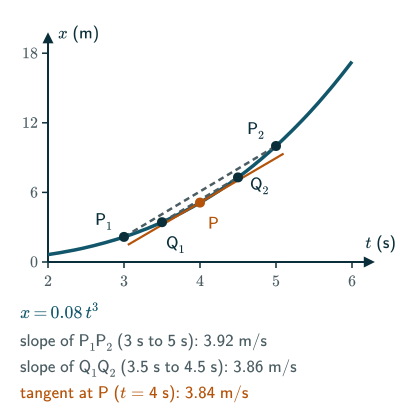
Geometrically, the slope of the chord P1P2 is the average velocity from 3 s to 5 s. As Δt → 0 the chord turns into the tangent at P, so the velocity at an instant is the slope of the tangent to the x-t graph there (page 14).
Velocity from a formula
When x is given as a function of t, calculus gives the limit directly: v = dx/dt. The main rule needed in this chapter is
Derivative of a power of t
together with three simple ones: a constant factor stays as it is, d(ctn)/dt = cntn−1; a sum is differentiated term by term; and the derivative of a constant is zero. For x = 0.08t, v = 0.08 × 3t = 0.24t, which at t = 4 s is 0.24 × 16 = 3.84 m/s, exactly the limit in the table.
NCERT notes that the graphical method is not always convenient: the x-t graph must be plotted carefully and the average velocity worked out for smaller and smaller Δt. With position data or a formula for x(t), it is easier to compute Δx/Δt or use calculus (page 15).
Note that for uniform motion, velocity is the same as the average velocity at all instants.
NCERT Physics Part I (Class 11), Section 2.2, page 15
Instantaneous speed
Instantaneous speed or simply speed is the magnitude of velocity.
NCERT Physics Part I (Class 11), Section 2.2, page 15
A velocity of +24.0 m/s and one of −24.0 m/s both mean a speed of 24.0 m/s (page 15). NCERT then asks why, although the average speed over an interval can be greater than the size of the average velocity, the instantaneous speed is always equal to the size of the instantaneous velocity (NCERT Exercise 2.11, page 25, asks the same). Think of the instantaneous speed as the limit of the average speed, path length/Δt, as Δt → 0:
- over a finite interval the object may turn back, so the path length can exceed the size of the displacement;
- if v ≠ 0 at that instant, a short enough interval contains no turn, so path length = |Δx| and the two limits are equal: speed = |v|;
- at a turning point (v = 0) even a tiny interval contains the turn, but the object hardly moves, so path length/Δt and |Δx|/Δt both shrink to zero: speed = |v| = 0.
Reading velocity from an x-t graph
- The sign of the slope gives the direction: rising graph, positive velocity; falling graph, negative velocity.
- The steepness gives the speed: a steeper tangent means a faster motion.
- A horizontal tangent means zero velocity at that instant. It may be a turning point, but a reversal is not guaranteed: with x = t, the velocity 3t is zero at t = 0 and positive on both sides, so the object continues in the same direction.
- A straight x-t graph has the same slope everywhere: uniform motion, and the velocity equals the average velocity at every instant.
- Read the slope in axis units, Δx/Δt, not from the angle on paper, which depends on the scales chosen. Only on the same axes can you compare velocities as tan θ: lines at 30° and 60° to the t-axis have velocities in the ratio tan 30° : tan 60° = 1 : 3.
The same idea works for any motion described by a formula. In simple harmonic motion, for example, differentiating the displacement gives the velocity in SHM.
Solved examples
Example 1: Velocity from x = a + bt (NCERT Example 2.1)
The position of an object on the x-axis is x = a + bt, with a = 8.5 m and b = 2.5 m s. Find its velocity at t = 0 s and t = 2.0 s, and its average velocity between t = 2.0 s and t = 4.0 s.
v = dx/dt = 2bt = 5.0t m/s. At t = 0, v = 0; at t = 2.0 s, v = 10 m/s.
x(4.0) − x(2.0) = (a + 16b) − (a + 4b) = 12b = 30 m, so average velocity = 30 m/2.0 s = 15 m/s.
Answer: 0 and 10 m/s; average velocity 15 m/s (NCERT page 15).
Example 2: Velocity from the limit
For x = 0.08t, find the average velocity from 3.9 s to 4.1 s and compare it with the velocity at 4 s.
x(4.1) = 0.08 × 68.921 = 5.51368 m; x(3.9) = 0.08 × 59.319 = 4.74552 m. Δx = 0.76816 m, so Δx/Δt = 0.76816/0.2 = 3.8408 m/s.
From calculus, v = 0.24t = 3.84 m/s at t = 4 s.
Answer: 3.8408 m/s, only about 0.02% above 3.84 m/s.
Example 3: Speed and velocity
An object moves with x = 12t − 2t (metres, seconds). Find its velocity and speed at t = 1 s and at t = 5 s.
v = dx/dt = 12 − 4t. At t = 1 s, v = +8 m/s, speed 8 m/s. At t = 5 s, v = −8 m/s, speed 8 m/s.
Answer: +8 m/s and −8 m/s; the speed is 8 m/s both times, but the object is moving in opposite directions.
Example 4: Where does it stop?
For the object in Example 3, when and where is it momentarily at rest?
v = 12 − 4t = 0 at t = 3 s. Then x = 12 × 3 − 2 × 9 = 18 m.
Answer: at t = 3 s, at x = 18 m. The x-t graph has a horizontal tangent there, and the object turns back.
Example 5: Average speed versus instantaneous speed
For the same object, find the average velocity and the average speed from t = 0 to t = 5 s.
x(0) = 0, x(3) = 18 m, x(5) = 60 − 50 = 10 m. Displacement = 10 m, so average velocity = 10/5 = 2 m/s.
Path length = 18 m out + (18 − 10) m back = 26 m, so average speed = 26/5 = 5.2 m/s.
Answer: 2 m/s and 5.2 m/s. Over a finite interval with a turn, average speed exceeds the size of the average velocity; at any single instant, speed equals |v|.
Common mistakes to avoid
Common mistake
Using a chord instead of the tangent
The slope of a line joining two points on the x-t graph is an average velocity. The instantaneous velocity is the slope of the tangent at the point.
Common mistake
Calling a negative velocity a slowing down
A negative velocity only means motion in the negative direction. Whether the object speeds up or slows down depends on the acceleration.
Common mistake
Dividing position by time
At t = 4 s, x/t = 5.12/4 = 1.28 m/s for x = 0.08t, but the velocity is 3.84 m/s. Velocity is dx/dt, the rate of change, not x/t.
Common mistake
Averaging the two end velocities
Average velocity is Δx/Δt, not (v1 + v2)/2. For x = 0.08t, v(3) = 2.16 m/s and v(5) = 6.00 m/s average to 4.08 m/s, but Δx/Δt from 3 s to 5 s is 3.92 m/s. The shortcut is guaranteed when velocity changes uniformly with time, as in Example 1 (10 m/s and 20 m/s give 15 m/s). It can happen to agree for some non-uniform motions too, but that agreement cannot be assumed from the endpoint velocities alone.
Common mistake
Thinking zero velocity means no motion at all
At a turning point the velocity is zero for an instant, yet the object is moving just before and just after.
Common mistake
Treating average speed like instantaneous speed
Instantaneous speed always equals |v|. Average speed equals |average velocity| only if the object never turns back.
Quick revision summary
- Instantaneous velocity: v = limΔt→0 Δx/Δt = dx/dt, the rate of change of position at an instant.
- On an x-t graph, v is the slope of the tangent; a chord gives only an average velocity.
- For uniform motion, the velocity equals the average velocity at every instant.
- Instantaneous speed = |v|; average speed can exceed |average velocity|.
- Calculus rule: d(tn)/dt = ntn−1.
Formula sheet
- v = lim(Δt→0) Δx/Δt
- v = dx/dt (slope of the tangent to the x-t graph)
- speed = |v|
- d(t)/dt = n t
- x = a + bt: v = 2bt
Questions students ask
What is the difference between speed and velocity?
Speed is a scalar that tells only how fast an object moves, while velocity is a vector that also gives the direction of motion: velocity is the rate of change of position, and speed the rate at which path length is covered. At any instant the speed is the magnitude of the velocity, so two cars driving at 15 m s in opposite directions have the same speed but different velocities. In straight-line motion the direction of the velocity is its sign, + or −.
Can velocity be negative, and can speed be negative?
Velocity can be negative but speed cannot: the sign of a velocity just shows its direction along the chosen axis, while speed is the magnitude of the velocity and is never less than zero. The sign depends on the axis you choose: for a stone falling at 5 m s, v = −5 m s if upwards is taken as positive and +5 m s if downwards is, but its speed is 5 m s either way.
What are the SI unit and dimensional formula of velocity?
The SI unit of velocity, and of speed, is the metre per second, m s, and the dimensional formula of both is [M L T]. To convert km/h to m s multiply by 5/18, because 1 km/h = 1000 m/3600 s; so 108 km/h = 30 m s, and to go back multiply by 18/5. In CGS units velocity is measured in cm s, with 1 m s = 100 cm s.
Can a body have constant speed but changing velocity?
Yes, a body moving at constant speed along a curved path has a changing velocity, because velocity also has a direction and that direction keeps turning, as in uniform circular motion. A car taking a bend at a steady 54 km/h has constant speed but changing velocity, so it is accelerating, towards the centre of the bend. Along a straight line, a constant non-zero speed means a constant velocity, since the direction can only reverse by passing through zero.
Does a speedometer measure speed or velocity?
A car’s speedometer measures instantaneous speed, the magnitude of the velocity at that moment, not velocity, because it shows no direction: it reads the same whichever way the car is heading. The odometer beside it measures the total path length covered, not the displacement.
Practice questions
Try each question first, then open the answer to check your working.
-
Q1. The position of a particle is x = 4t + 3t (metres, seconds). Find its velocity at t = 2 s.
Show answerHide answer
v = 8t + 3, so at t = 2 s, v = 19 m/s.
-
Q2. On an x-t graph, the tangent at some instant is horizontal. What is the velocity then?
Show answerHide answer
Zero: the slope of the tangent is zero, so the object is momentarily at rest.
-
Q3. Why is instantaneous speed always equal to the magnitude of instantaneous velocity, though average speed need not equal the magnitude of average velocity?
Show answerHide answer
Instantaneous speed is the limit of path length/Δt. Except at a turning point, a short enough interval contains no turn, so path length = |Δx| and the limit equals |v|; at a turning point both limits are zero. Over a longer interval the object may turn back, so average speed can exceed |average velocity|.