Uniform circular motion
NCERT Class 11 Physics Chapter 3 Section 3.10
Quick answer
In uniform circular motion an object moves on a circle of radius R at constant speed v, but its velocity keeps changing direction, so it accelerates. The acceleration always points towards the centre and has magnitude ac = v2/R = ω2R, where ω is the angular speed and v = ωR. Its size is constant but its direction is not, so it is not a constant vector.
With your textbook
NCERT Physics Part I (Class 11), Chapter 3 “Motion in a Plane”, Section 3.10 “Uniform circular motion”, pages 40–42.
Open the official NCERT chapter (PDF, 2.2 MB, ncert.nic.in) (opens in a new tab)
Checked against the 2026-27 reprint on .
What is uniform circular motion?
Uniform circular motion
An object in uniform circular motion moves on a circle of radius R at constant speed v. Its velocity changes direction all the time, so it accelerates. This centripetal acceleration
- always points towards the centre of the circle;
- has magnitude ac = v/R = ωR, where ω is the angular speed and v = ωR.
(NCERT Section 3.10, pages 40–42.)
When an object follows a circular path at a constant speed, the motion of the object is called uniform circular motion.
NCERT Physics Part I (Class 11), Section 3.10, page 40
In plain words: “uniform” refers only to the speed. A car going round a roundabout at a steady 36 km/h is accelerating, because the direction of its velocity keeps turning, and something must keep pulling it inwards to make it turn.
The direction of the acceleration
Let the object be at P, with position vector r from the centre C and velocity v, and a short time Δt later at P′, with r′ and v′ (NCERT Fig. 3.18, page 41). The velocity is always along the tangent, so v is perpendicular to r and v′ to r′. Both have the same length v.
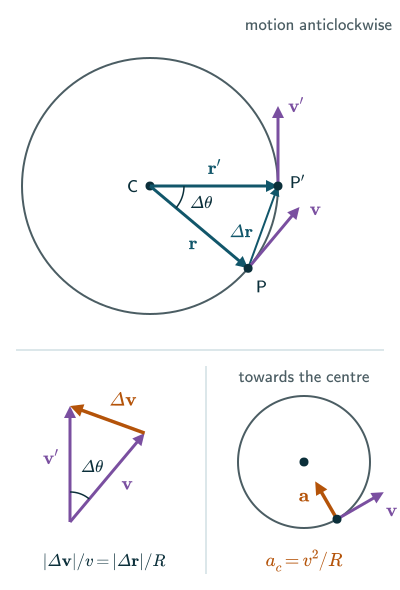
Draw v and v′ from one point: the change Δv = v′ − v (a vector subtraction) joins the head of v to the head of v′. Each velocity is its radius vector turned through 90° (in the sense of motion) and scaled by v/R, so Δv is Δr turned through 90°: it is perpendicular to the chord PP′. So Δv lies along the line that bisects the angle between r and r′, pointing towards C (NCERT page 41). As Δt → 0, P′ closes in on P, this bisector becomes the radius at P, and the acceleration, the limit of Δv/Δt, points to the centre at every point of the circle.
The magnitude: a = v/R
The angle between v and v′ equals the angle Δθ between r and r′, because each velocity is at right angles to its radius. So the triangle of position vectors (sides R, R, |Δr|) and the triangle of velocities (sides v, v, |Δv|) are similar (page 41):
So |Δv| = (v/R)|Δr|. Divide both sides by Δt and let Δt → 0. The left side becomes ac, the magnitude of the acceleration. On the right, for a small Δθ the chord |Δr| is almost the arc PP′ = vΔt, so |Δr|/Δt → v (NCERT page 41):
Centripetal acceleration
(NCERT Eq. 3.43, page 42.) The name “centripetal” means “centre-seeking”; NCERT notes that the term was proposed by Newton, and that Christiaan Huygens first published a thorough analysis of centripetal acceleration in 1673 (page 42).
Therefore, a centripetal acceleration is not a constant vector.
NCERT Physics Part I (Class 11), Section 3.10, page 42
Its magnitude stays the same but its direction keeps turning, which is why the equations for constant acceleration do not apply here. The inward pull needed to produce this acceleration is the centripetal force, mv/R.
Angular speed
As the object moves from P to P′, the radius turns through the angular distance Δθ. The angular speed is the angle turned per unit time (NCERT Eq. 3.44):
Angular speed
Strictly, Δθ/Δt is the average angular speed over Δt; the instantaneous value is its limit as Δt → 0. Here θ is accumulated angular distance, so ω = dθ/dt ≥ 0. For a signed angular coordinate φ, angular speed is |dφ/dt|. In uniform circular motion the two are equal. With θ in radians, ω is in rad/s. The arc length is Δs = RΔθ; dividing by Δt gives v = Rω, and putting this into v/R gives ac = ωR (NCERT Eqs. 3.45–3.46):
Speed and centripetal acceleration in terms of ω
Time period and frequency
The time period T is the time for one revolution, and the frequency ν = 1/T is the number of revolutions per second (NCERT page 42). In one revolution the object covers 2πR and the radius turns through 2π rad, so (NCERT Eqs. 3.47–3.48):
Period, frequency and angular speed
The projection of uniform circular motion on a diameter is simple harmonic motion, the link used in SHM and uniform circular motion.
Solved examples
Example 1: An insect in a groove (NCERT Example 3.9)
An insect in a circular groove of radius 12 cm goes round steadily, completing 7 revolutions in 100 s. Find (a) its angular and linear speed, and (b) whether its acceleration is constant, and its magnitude.
(a) T = 100/7 s, so ω = 2π/T = 2π × 7/100 ≈ 0.44 rad/s. v = ωR = 0.44 × 12 ≈ 5.3 cm/s.
(b) The acceleration points to the centre, a direction that keeps changing, so it is not a constant vector. Its magnitude is constant: a = ωR = 0.44 × 12 ≈ 2.3 cm s.
Answer: 0.44 rad/s and 5.3 cm/s; the acceleration has constant size 2.3 cm s but changing direction (NCERT page 42).
Example 2: A stone on a string (NCERT Exercise 3.14, page 48)
A stone tied to a string 80 cm long is whirled in a horizontal circle at constant speed, making 14 revolutions in 25 s. Find the magnitude and direction of its acceleration.
ν = 14/25 = 0.56 Hz, so ω = 2π × 0.56 ≈ 3.52 rad/s. a = ωR = 3.52 × 0.80 ≈ 9.9 m s.
Answer: about 9.9 m s, towards the centre of the circle at every instant (along the string, since the problem treats the string as horizontal).
Example 3: An aircraft in a loop (NCERT Exercise 3.15, page 48)
An aircraft executes a horizontal loop of radius 1.00 km at a steady 900 km/h. Compare its centripetal acceleration with g (9.8 m s).
v = 900/3.6 = 250 m/s. a = v/R = 62 500/1000 = 62.5 m s. a/g = 62.5/9.8 ≈ 6.4.
Answer: 62.5 m s, about 6.4 times g.
Example 4: A point on the equator
Taking the Earth’s radius as 6.4 × 10 m and one rotation as 24 h, find the speed and centripetal acceleration of a point on the equator.
T = 86 400 s, so ω = 2π/86 400 ≈ 7.27 × 10 rad/s. v = ωR ≈ 465 m/s. a = ωR ≈ 0.034 m s.
Answer: about 465 m/s, but an acceleration of only about 0.034 m s, about 0.35% of g.
Example 5: True or false? (NCERT Exercise 3.16, page 48)
(a) The net acceleration of a particle in circular motion is always along the radius towards the centre. (b) The velocity of a particle at a point is always along the tangent to its path there. (c) The acceleration of a particle in uniform circular motion, averaged over one cycle, is a null vector.
(a) False: only in uniform circular motion. If the speed changes, the acceleration also has a part along the tangent. (b) True. (c) True: after one cycle the velocity is back to its starting value, so the average acceleration Δv/T is zero.
Answer: (a) false, (b) true, (c) true.
Common mistakes to avoid
Common mistake
Thinking constant speed means no acceleration
In circular motion the direction of the velocity keeps changing, so there is an acceleration, v/R, even at constant speed.
Common mistake
Calling the centripetal acceleration constant
Its magnitude is constant but its direction turns with the object. It is not a constant vector, and v = v0 + at does not apply.
Common mistake
Using rpm or degrees directly
Convert revolutions per minute to revolutions per second (Hz) and use ω = 2πν in rad/s. With angles in degrees, v = ωR gives wrong answers.
Common mistake
Applying a = v/R to the whole acceleration in non-uniform motion
If the speed is changing, v/R is only the inward (centripetal) part. The total acceleration also has a tangential part at = dv/dt, so its size is √(ac2 + at2) and it no longer points at the centre (NCERT Points to Ponder 6, page 46).
Common mistake
Mixing up period and frequency
T is seconds per revolution and ν = 1/T is revolutions per second. 7 revolutions in 100 s means ν = 0.07 Hz, not T = 0.07 s.
Quick revision summary
- Uniform circular motion: constant speed on a circle; the velocity is along the tangent and changes direction.
- The acceleration points to the centre: ac = v/R = ωR = 4πνR.
- Angular speed ω = Δθ/Δt (rad/s); v = ωR.
- T = time per revolution, ν = 1/T, ω = 2π/T = 2πν, v = 2πR/T.
- The centripetal acceleration has constant size but changing direction: it is not a constant vector.
Formula sheet
- ac = v2/R = ω2R (towards the centre)
- ω = Δθ/Δt
- v = ωR
- ω = 2π/T = 2πν; ν = 1/T
- v = 2πR/T = 2πRν
- ac = 4π2ν2R
Questions students ask
Is centripetal acceleration the same as centripetal force?
No, centripetal acceleration and centripetal force are different quantities linked by Newton’s second law: the acceleration, ac = v/R towards the centre, describes how the velocity changes, while the centripetal force, F = mac = mv/R, is the net inward force that produces it. The centripetal force is not a new kind of force; real forces such as the tension in a string, gravity or friction supply it. A 2 kg stone moving at 3 m s on a circle of radius 1.5 m has ac = 6 m s and needs a net inward force of 12 N.
Does uniform circular motion have angular acceleration?
No, uniform circular motion has zero angular acceleration, because the angular velocity ω stays constant in size and, for a fixed axis, in direction. It still has a centripetal acceleration of ωR, which is a linear acceleration, not an angular one. For a fixed axis, an angular acceleration α = dω/dt appears when the rotation speeds up or slows down, and the particle then also has a tangential acceleration αR.
What is non-uniform circular motion?
Non-uniform circular motion is motion on a circle with a changing speed, such as a stone whirled on a string in a vertical circle. Its acceleration then has a tangential part, dv/dt, along or against the velocity, as well as the centripetal part v/R: when v = 6 m s on a circle of radius 3 m and the speed is rising at 9 m s, the parts are 12 and 9 m s, giving √(12 + 9) = 15 m s, not towards the centre. Neither the JEE Main 2027 nor the NEET (UG) 2026 syllabus uses the term, but both list motion in a vertical circle, the standard non-uniform case, in Unit 4 (Work, Energy and Power).
Is uniform circular motion simple harmonic motion?
No, uniform circular motion is periodic but not simple harmonic: the object goes round a circle at constant speed, while simple harmonic motion is a to-and-fro motion along a line, with an acceleration −ωx proportional to the displacement from the mean position. The two are closely linked, because the projection (shadow) of uniform circular motion on any diameter is simple harmonic motion with the same ω, as shown in NCERT Section 13.4 (pages 264–265).
What are the SI units and dimensions of angular speed and centripetal acceleration?
Angular speed is measured in radians per second, rad s, with dimensions [T], because the radian is the ratio of an arc to a radius and has no dimensions; for the same reason ω is often written simply in s. Centripetal acceleration, like any acceleration, is measured in m s, with dimensions [L T]. Both forms of the formula agree: v/R gives (m s)/m = m s, and ωR gives s × m = m s.
Is angular speed the same as angular velocity?
No, angular speed is only the magnitude of angular velocity: the angular speed is the non-negative magnitude of the rate of change of a signed angle, ω = |dφ/dt|, in rad s, while the angular velocity is a vector of that size pointing along the axis of rotation, by the right-hand rule. In uniform circular motion about a fixed axis both are constant, which is why NCERT’s Section 3.10 needs only the angular speed; the vector form comes with rotational motion.
Practice questions
Try each question first, then open the answer to check your working.
-
Q1. A car goes round a circular track of radius 50 m at 10 m/s. Find its centripetal acceleration.
Show answerHide answer
a = v/R = 100/50 = 2 m s, towards the centre of the track.
-
Q2. A wheel turns at 120 revolutions per minute. Find its angular speed in rad/s.
Show answerHide answer
ν = 120/60 = 2 Hz, so ω = 2π × 2 ≈ 12.6 rad/s.
-
Q3. If the speed of an object in uniform circular motion is doubled, keeping the radius the same, what happens to its centripetal acceleration?
Show answerHide answer
a = v/R, so it becomes four times as large.