Dynamics of circular motion
NCERT Class 11 Physics Chapter 4 Section 4.10
Quick answer
Centripetal force is the net force towards the centre that keeps a body moving in a circle: fc = mv2/R for mass m, speed v and radius R. It is not a new kind of force but is supplied by tension, gravity, friction or a normal force. On a level road friction supplies it, so the ideal maximum speed before skidding is vmax = √(μs R g), where μs is the coefficient of static friction and g the acceleration due to gravity; on a road banked at angle θ, the speed that needs no friction is vo = √(R g tan θ).
With your textbook
NCERT Physics Part I (Class 11), Chapter 4 “Laws of Motion”, Section 4.10 “Circular motion”, pages 63–64.
Open the official NCERT chapter (PDF, 2.1 MB, ncert.nic.in) (opens in a new tab)
Checked against the 2026-27 reprint on .
What is centripetal force?
Centripetal force in NCERT’s words
The centripetal force should not be regarded as yet another kind of force. It is simply a name given to the force that provides inward radial acceleration to a body in circular motion.
NCERT Physics Part I (Class 11), Chapter 4, Points to ponder, page 68
In plain words: a body moving in a circle at constant speed is still accelerating, because its direction keeps changing. That acceleration points towards the centre, so by Newton’s second law some net force must also point towards the centre. Whatever force (or combination of forces) does that job is called the centripetal force. It is a role, not a new kind of force.
Centripetal force from the second law
You saw in the chapter on motion in a plane that a body moving in a circle of radius R at a constant speed v has an acceleration v/R, directed towards the centre. Newton’s second law of motion then gives the net inward force needed:
Centripetal force
Here m is the mass of the body. With the angular speed ω (in rad s), v = ωR, so the same force can be written fc = mωR. It is measured in newtons, and it always points towards the centre of the circle.
A faster body, or a tighter circle, needs a larger inward force. Some force in the situation must supply it:
| Circular motion | What supplies the centripetal force |
|---|---|
| A stone whirled on a string | Tension in the string |
| A planet going round the Sun | The Sun’s gravitational pull |
| A car turning on a level road | Static friction from the road on the tyres |
| A car on a banked road | Parts of the normal force and of friction |
| An electron round a nucleus (in a simple model) | Electrical attraction |
If the constraint supplying the inward force is removed without an impulse, the instantaneous velocity remains along the tangent. With no remaining net force the path then stays straight; gravity or other remaining forces can curve it. It does not acquire an instantaneous radially outward velocity.
On a merry-go-round you feel pushed outward. NCERT points out that this is only a feeling: every part of your body actually has an inward force on it, and the outward feeling is the direction of your impending motion relative to the seat: your body tends to keep going straight, along the tangent, while the seat curves away beneath you.
Car on a level road
Model the car as a particle moving at constant speed on a horizontal circular road, neglecting drag, braking, wheel dynamics and tipping. Three resultant forces act: its weight mg down, the normal force N up, and friction f from the road, along the road surface. There is no vertical acceleration, so
For a car taking a circular turn on a horizontal road, the only horizontal force is friction, so friction must supply the centripetal force:
For a car taking a circular turn on a horizontal road, the centripetal force is the force of friction.
NCERT Physics Part I (Class 11), Section 4.10, page 63
This friction is static: the tyres are not meant to slide sideways, and static friction opposes the car’s impending motion away from the circle. Static friction can be at most μsN = μsmg, where μs is the coefficient of static friction between the tyres and the road, so the turn is safe only if
Highest safe speed on a level road
The mass cancels from this ideal skidding condition. With the same friction coefficient, a loaded truck and a small car have the same predicted skidding threshold; this does not establish an actual safe driving speed, because tipping, tyre behaviour and other vehicle effects are outside the model. On a wet or icy road μs is smaller, so the safe speed falls.
Car on a banked road
On a highway curve or a racetrack, the road is banked: its outer edge is raised, so the road surface is tilted at an angle θ towards the centre of the turn. The normal force is then tilted towards the centre too, and its horizontal part helps to supply the centripetal force. This reduces how much friction is needed.
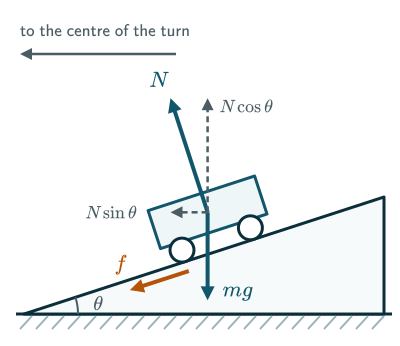
At the highest safe speed the car tends to slide up and out, so friction acts down the slope. Resolve vertically (no vertical acceleration) and horizontally (towards the centre):
At the limit, f = μsN. Then
Dividing the second equation by the first, and then dividing the top and bottom by cos θ:
Highest safe speed on a banked road
This is larger than , the limit on a level road: banking lets cars take the curve faster. The formula needs μs tan θ < 1. If μs tan θ ≥ 1, the ideal point-particle friction inequalities impose no finite upper skidding bound. Do not evaluate the square-root formula there or interpret this ideal limit as permission for unlimited physical speed; tyre loads, tipping and vehicle dynamics have been excluded.
The optimum speed. Put μs = 0: the normal force alone supplies the centripetal force, at the speed
Optimum speed (no friction needed)
At this speed, frictional force is not needed at all to provide the necessary centripetal force. Driving at this speed on a banked road will cause little wear and tear of the tyres.
NCERT Physics Part I (Class 11), Section 4.10, page 64
At vo, the vertical balance gives N cos θ = mg, so
which is more than mg. For a speed below vo, the car tends to slide down and in, so friction acts up the slope. The lowest safe speed goes beyond the NCERT text, which does not derive it. With friction up the slope, the vertical and horizontal equations become
At the limit f = μsN:
Dividing as before gives
The displayed minimum-speed square root applies when tan θ > μs. If tan θ ≤ μs, the minimum is zero in this model: the car can be stationary without sliding down.
Circular motion in daily life
- Banked highways and racetracks. Curves are banked so that vehicles can turn at higher speeds with less dependence on friction, and with less wear on the tyres.
- Railway curves. The outer rail is laid higher than the inner one. The tilted push of the rails then supplies most of the centripetal force, instead of a large sideways push on the wheel flanges.
- A cyclist leaning into a turn. Friction from the road supplies the centripetal force, so the road’s total push (normal force plus friction) is tilted towards the centre. The cyclist leans in so that this tilted push passes through the body instead of toppling it outward.
- Wet or icy roads. With a smaller μs, the safe speed on a curve drops sharply, which is why speed limits on curves matter more in the rain.
- A sling or a hammer throw. When the thrower lets go, the stone or hammer flies off along the tangent, not outward along the radius.
Solved examples
Example 1: A stone whirled on a string
A stone of mass 0.5 kg moves on a smooth horizontal table in a circle of radius 1.2 m, making 2 revolutions per second, held by a horizontal string. Find the string tension; the table supports the stone’s weight.
Given: m = 0.5 kg, R = 1.2 m, frequency 2 rev s.
The angular speed is
and the speed is
The tension supplies the centripetal force:
Answer: about 94.7 N. Check with the other form of the formula:
Example 2: How fast can a car take a flat curve?
A car turns on a level road of radius 50 m. The coefficient of static friction between the tyres and the road is 0.6. (a) Find the highest safe speed. (b) Can the car take the curve at 72 km/h? Take g = 9.8 m s−2.
(a)
which is about 61.7 km/h.
(b) 72 km/h is 20 m s. The coefficient this speed would need is
which is more than 0.6.
Answer: (a) about 17.1 m s−1 (61.7 km/h); (b) no: at 72 km/h friction cannot supply enough centripetal force, and the car skids outward.
Compare NCERT Example 4.10 (page 64): a cyclist at 18 km/h on a turn of radius 3 m with μs = 0.1 slips, because v is 25 m s, more than μsRg, which is 2.94 m s.
Example 3: Safe speeds on a banked road
A curve of radius 100 m is banked at 15°, and μs = 0.25. Find (a) the optimum speed, (b) the highest safe speed and (c) the lowest safe speed. Take g = 9.8 m s−2 and tan 15° ≈ 0.26795.
Here Rg = 100 × 9.8, that is 980 m s.
(a)
(b) The fraction in the formula is
so
(c) Now the fraction is
so
Answer: about 16.2 m s (58 km/h) with no friction needed; at most 23.3 m s (84 km/h); at least 4.06 m s (15 km/h). Below the optimum speed friction acts up the slope; above it, down the slope.
NCERT Example 4.11 (page 64) uses the same formula for a racetrack of radius 300 m banked at 15°, and finds an optimum speed of 28.1 m s.
Common mistakes to avoid
Common mistake
Drawing the centripetal force as an extra force
On a free-body diagram, draw only real forces: tension, weight, normal force, friction. Their resultant towards the centre is the centripetal force. Adding a separate arrow labelled mv/R counts the same force twice.
Common mistake
Drawing a centrifugal force in the ground frame
Seen from the ground, nothing pushes a turning body outward. The outward “push” you feel in a turning car is your body’s inertia. If the inward force stops, the body moves off along the tangent.
Common mistake
Using kinetic friction for a car taking a turn
A car that turns without skidding has no sideways sliding, so the friction is static, and the condition is f ≤ μsN. Kinetic friction applies only once the car is already skidding.
Common mistake
Writing N = mg cos θ on a banked turn
On an incline where a block is at rest or slides along the slope, there is no acceleration across the slope, so N = mg cos θ. On a banked turn the acceleration is horizontal, towards the centre, so that result does not hold. At the optimum speed, N cos θ = mg, which gives N = mg/cos θ.
Common mistake
Setting friction to its maximum at every speed
Static friction adjusts itself. Below the highest safe speed on a level road, the friction is just mv/R, which is less than μsmg. Use f = μsN only at the limiting speed (NCERT warns about this in its Points to ponder).
Common mistake
Assuming friction always acts down the slope on a banked road
Friction acts down the slope only above the optimum speed. Below it, the car tends to slide down, and friction acts up the slope.
Quick revision summary
- For constant-speed circular motion, the acceleration and net force point towards the centre. If speed changes, mv/R is the inward radial component of force and there is also a tangential component. It is a role played by real forces, not a new force.
- Tension, gravity, friction and the normal force can each supply it. If it vanishes, the body moves off along the tangent.
- On a level road, static friction supplies the centripetal force; the highest safe speed does not depend on the mass.
- On a banked road, the normal force is tilted towards the centre. At the optimum speed no friction is needed; above it friction acts down the slope, below it up the slope.
- On a banked turn at the optimum speed, the normal force is mg/cos θ, more than the weight.
Formula sheet
- fc = mv2/R = mω2R
- vmax = √(μs R g) (level road)
- vo = √(R g tan θ) (banked road, no friction)
- vmax2 = R g (μs + tan θ) / (1 − μs tan θ) (banked road)
- vmin2 = R g (tan θ − μs) / (1 + μs tan θ) (banked road)
- tan θ = v2/(R g) (banking angle at which speed v needs no friction)
Questions students ask
Why are roads banked on curves?
Roads are banked so that the normal force tilts towards the centre of the curve and its horizontal part, N sin θ, supplies some or all of the centripetal force. On a level road only static friction can supply it, so the highest safe speed, √(μsRg), falls sharply on a wet or icy road. Banking lets vehicles take the curve faster and more safely, with less wear on the tyres.
What is the difference between centripetal and centrifugal force?
Centripetal force is the net inward force, mv/R, that real forces such as tension, gravity, friction or a normal force supply to keep a body moving in a circle. Centrifugal force is an outward pseudo force of the same size, mωR, that you add only when you describe the motion from a frame rotating with the body. The two are not an action-reaction pair, and a centrifugal force never goes on a free-body diagram drawn in the ground (inertial) frame.
How do you find the angle of banking for a given speed?
The angle of banking θ for a speed v on a curve of radius R is given by tan θ = v/(Rg): at this angle the normal force alone supplies the centripetal force, so no friction is needed at speed v. For example, for v = 20 m s on a curve of radius R = 100 m, with g = 9.8 m s, tan θ = 400/980 ≈ 0.41, so θ is about 22°. Read the other way, a road already banked at θ has the optimum speed vo = √(Rg tan θ).
Does the safe speed on a curve depend on the mass of the car?
The ideal skidding threshold in this particle model is independent of mass; an actual vehicle’s safe speed is not determined by this formula alone. On a level road the condition mv/R ≤ μsmg gives vmax = √(μsRg), and the mass cancels; the speed limits on a banked road do not depend on the mass either. A loaded truck and a small car have the same skidding limit on a curve if their tyres grip equally well (the same μs).
Why does a cyclist lean inwards while taking a turn?
A cyclist leans inwards so that the total push of the road, the normal force plus the inward friction that supplies the centripetal force, passes through the centre of mass. If the rider stayed upright, this tilted push would have a turning effect that topples the rider outward. The lean from the vertical is given by tan θ = v/(Rg), so a faster or tighter turn needs more lean.
What happens if a car takes a curve faster than the maximum safe speed?
The car skids outward, because the road can no longer supply the centripetal force mv/R: static friction has already reached its limit, μsN. Once the tyres slide, friction becomes kinetic and smaller still, so the car moves onto a wider path; on a banked road it slides up the slope. If the inward force vanished completely, the car would move off along the tangent.
Practice questions
Try each question first, then open the answer to check your working.
-
Q1. A ball of mass 0.2 kg on a string of length 0.8 m moves in a horizontal circle on a smooth table at 3 m s. Find the tension in the string.
Show answerHide answer
The tension supplies the centripetal force:
which is 2.25 N.
-
Q2. What is the highest speed at which a car can take a level curve of radius 30 m if μs = 0.4? Take g = 9.8 m s−2.
Show answerHide answer
That is about 39 km/h.
-
Q3. At what angle should a curve of radius 80 m be banked so that cars at 20 m s need no friction? Take g = 9.8 m s−2.
Show answerHide answer
At the optimum speed, v2 = Rg tan θ, so
and θ is about 27.0°.