The law of inertia
NCERT Class 11 Physics Chapter 4 Section 4.3
Quick answer
The law of inertia, developed from Galileo’s work, says that in an inertial frame if the net external force on a body is zero, a body at rest stays at rest and a moving body keeps moving with uniform velocity. So Fnet = 0 means the velocity v is constant. This resistance to a change in the state of motion is called inertia, and mass is its measure.
With your textbook
NCERT Physics Part I (Class 11), Chapter 4 “Laws of Motion”, Section 4.3 “The law of inertia”, pages 50–51.
Open the official NCERT chapter (PDF, 2.1 MB, ncert.nic.in) (opens in a new tab)
Checked against the 2026-27 reprint on .
What is the law of inertia?
The law of inertia in NCERT’s words
To summarise, if the net external force is zero, a body at rest continues to remain at rest and a body in motion continues to move with a uniform velocity. This property of the body is called inertia. Inertia means ‘resistance to change’.
NCERT Physics Part I (Class 11), Section 4.3, page 51
In plain words: a body does not change its state of rest or of uniform motion by itself. If no net external force acts on it, a body at rest stays at rest, and a moving body keeps moving with the same speed in the same direction. This property is inertia; the zero-net-force statement applies in an inertial frame.
Galileo arrived at this law in the seventeenth century from experiments with balls on inclined planes. It later became Newton’s first law of motion. It overturned Aristotle’s old idea that a force is needed to keep a body moving.
Galileo’s inclined plane experiments
One inclined plane
Galileo noticed three things about a ball on a smooth inclined plane:
- A ball moving down the plane speeds up (it accelerates).
- A ball moving up the plane slows down (it retards).
- Motion on a horizontal plane lies between these two cases.
So on a frictionless horizontal plane the ball should neither speed up nor slow down: it should move with constant velocity.
The double inclined plane
In a second experiment, two inclined planes face each other. A ball released from rest at a height h on one plane rolls down and climbs the other.
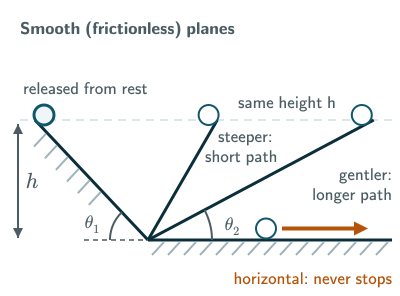
- On well-polished planes the ball rises to nearly the same height it started from: a little less, but never more. With no friction at all (perfectly smooth planes), it would reach exactly the same height.
- If the second plane is made less steep, the ball still reaches the same height, but it travels a longer distance along the plane to get there.
- If the second plane is horizontal, the ball can never regain its height, so it keeps rolling forever. Its motion never stops.
In practice the ball does stop on a horizontal plane, because friction can never be removed completely. But the limiting case shows the real law: without friction, a moving body keeps moving with constant velocity.
Why the ball regains its height
You can check Galileo’s result with the equations of motion for constant acceleration. On a smooth plane inclined at θ, the component of gravity along the plane gives the ball an acceleration g sin θ down the slope, so it slows at g sin θ while climbing. (We treat the ball as sliding without friction, ignore its spin, and assume the two planes are joined by a short smooth curve so that no speed is lost at the bottom.)
Coming down the first plane, inclined at θ1, from a height h, the ball covers a path of length h/sin θ1. From v2 = u2 + 2as with u = 0:
The speed at the bottom depends only on the height, not on the slope. Climbing a second plane inclined at θ2, the ball slows at g sin θ2 and stops after a path L. From v2 = u2 + 2as, with final speed zero:
The height it reaches is L sin θ2 = h, the starting height, whatever the slope. As θ2 gets smaller, sin θ2 gets smaller and L gets longer; when θ2 = 0 there is no deceleration at all and the ball moves on at for ever.
Rest and uniform motion are equivalent
Galileo’s key insight is stated in NCERT this way:
The state of rest and the state of uniform linear motion (motion with constant velocity) are equivalent.
NCERT Physics Part I (Class 11), Section 4.3, page 51
In both states the acceleration is zero, and so is the net force. A body at rest is not “more natural” than a body moving at constant velocity. What needs a net force is a change from one state to another: starting, stopping, speeding up, slowing down or turning.
On the Earth, keeping a body in uniform motion usually needs a push, but only to cancel friction. The push and friction then add up to zero net force.
Inertia and its measure
Inertia is the property of a body by which it resists any change in its state of rest or of uniform motion in a straight line. It shows up in three familiar ways:
- Inertia of rest: a body at rest tends to stay at rest. When a bus starts suddenly, a standing passenger falls backward.
- Inertia of motion: a moving body tends to keep moving. When the bus brakes, the passenger lurches forward.
- Inertia of direction: a moving body tends to keep its direction. Mud flies off a spinning wheel along the tangent, not outward along the spokes.
These are three faces of one property, not three different kinds of inertia.
Mass is the measure of inertia. The same net force gives a larger mass a smaller acceleration, so the larger mass resists the change more:
Same force, different masses
In Newtonian mechanics, a body’s inertia for translational motion depends only on its mass. It does not depend on its speed or on where it is. (Rotational inertia, the moment of inertia, also depends on how the mass is spread out; it comes in a later chapter.) An astronaut in orbit feels weightless, but a 100 kg box there is still just as hard to set moving as on a smooth floor on the Earth, because its mass has not changed.
The law of inertia itself can be written as one line:
Law of inertia
NCERT’s box on ancient Indian ideas of motion (on page 51) notes that the idea of vega in the Vaisesika theory, the tendency to move in a straight line, perhaps comes closest to the concept of inertia.
Inertia in daily life
- Shaking a branch. Fruit drops off when a branch is shaken suddenly: the branch moves, while the fruit tends to stay at rest and breaks away (inertia of rest).
- Tightening a hammer head. Strike the bottom of the handle on the floor. The handle stops, but the heavy head keeps moving down and wedges itself tighter (inertia of motion).
- A long jumper’s run-up. The athlete runs before jumping, so the body’s forward motion carries it farther through the air (inertia of motion).
- Pulling a tablecloth quickly. Dishes on it stay nearly where they are if the cloth is pulled away sharply, because friction acts on them for too short a time to move them much (inertia of rest).
- Seat belts. In a sudden stop, the passenger’s body keeps moving forward. The belt supplies the force that stops it safely (inertia of motion).
- Mud from a cycle tyre. Mud leaves the spinning tyre along the tangent to the wheel, as seen from the cycle (inertia of direction).
Solved examples
Example 1: Galileo’s planes in numbers
A ball is released from rest at a height of 0.5 m on a smooth inclined plane and climbs a second smooth plane. How far along the second plane does it travel before stopping if that plane is inclined at (a) 30°, (b) 15°, (c) 5°? (d) What happens if the second plane is horizontal? Take g = 9.8 m s−2, and treat the ball as sliding without friction.
The ball always regains the height h = 0.5 m, so the path along the second plane is L = h/sin θ.
(a)
(b)
(c)
(d) On a horizontal plane nothing slows it, so it keeps its speed at the bottom for ever:
Answer: 1.0 m, about 1.93 m and about 5.74 m; on a horizontal plane the ball never stops and moves on at about 3.13 m s−1. The gentler the slope, the longer the path, exactly as Galileo argued.
Example 2: Mass as the measure of inertia
The same horizontal net force of 12 N acts on two trolleys at rest on a smooth floor: one of mass 2 kg and one of mass 6 kg. (a) Find each acceleration. (b) How long does each take to reach 3 m s? (c) Which has more inertia?
(a) Using a = Fnet/m:
(b) From v = u + at with u = 0, t = v/a:
(c) The 6 kg trolley has three times the mass, so it gets one-third of the acceleration and takes three times as long to reach the same speed.
Answer: 6 m s−2 and 2 m s−2; 0.5 s and 1.5 s. The 6 kg trolley has three times the inertia of the 2 kg trolley.
Example 3: A ball on the floor of a braking train
A train moves on a straight track at a steady 15 m s. A ball rests on its smooth, level floor. The train now brakes with a deceleration of 2 m s. Describe the ball’s motion, and find how far it moves relative to the train in the first 1.5 s.
The floor is smooth, so no horizontal force acts on the ball. By the law of inertia, it keeps moving at 15 m s relative to the ground while the train slows down.
In 1.5 s the ball covers 22.5 m relative to the ground (15 × 1.5). The train covers
So the ball gains on the train by
Answer: The ball slides towards the front of the train, moving 2.25 m forward relative to the train in 1.5 s. Seen from inside, it seems to be pushed forward, but no force acts on it: the train is slowing down beneath it. The braking train is a non-inertial frame: the ball accelerates relative to it with no real horizontal force. Weight and the floor’s normal force still act and balance vertically. The law of inertia holds only in inertial frames, such as the ground.
Common mistakes to avoid
Common mistake
Calling inertia a force
Inertia is a property of a body, not a force. It has no direction and is not drawn on a free-body diagram. Its measure, mass, is in kilograms, not newtons. Aristotle’s fallacy, the old belief that a force is needed to keep a body moving, comes from treating motion itself as something that needs a cause.
Common mistake
Thinking a faster body has more inertia
Inertia depends only on mass. A fast bullet is hard to stop because it has a large momentum, not because it has more inertia than the same bullet at rest. A 1 kg ball has the same inertia at 1 m s and at 100 m s.
Common mistake
Thinking a weightless body has no inertia
In orbit, or far out in space, a body may feel weightless, but its mass is unchanged. It still needs a force to start, stop or turn it, exactly as on the Earth.
Quick revision summary
- Law of inertia: if the net external force on a body is zero, a body at rest stays at rest and a moving body keeps moving with uniform velocity.
- Galileo found it from inclined planes: on smooth planes a ball regains its starting height, and on a horizontal plane it would never stop.
- Rest and uniform motion are equivalent: both have zero acceleration and zero net force. A net force is needed only to change the state of motion.
- Inertia is resistance to change of the state of rest or of uniform motion; it shows up as inertia of rest, of motion and of direction.
- Mass is the measure of inertia: the same force gives a larger mass a smaller acceleration. Inertia does not depend on speed or gravity.
- The law holds only in inertial (non-accelerating) frames; in a braking train, a ball on a smooth floor seems to move with no force on it.
Formula sheet
- Fnet = 0 means v is constant (law of inertia)
- a = Fnet/m, so a1/a2 = m2/m1 for the same force
- a = g sin θ along a smooth incline
- v = √(2gh) at the foot of a smooth incline of height h
- L = h/sin θ (path up a smooth incline to regain height h)
Questions students ask
Who gave the law of inertia?
Galileo Galilei arrived at the law of inertia in the seventeenth century, from his experiments with balls rolling on inclined planes. Isaac Newton later made it the first of his three laws of motion, so the law of inertia and Newton’s first law say the same thing.
Why is Newton’s first law called the law of inertia?
Newton’s first law is called the law of inertia because it describes inertia: a body stays at rest, or keeps moving with uniform velocity, unless a net external force acts on it. This tendency to resist any change in its state of rest or of uniform motion is what inertia means.
What are the three types of inertia?
Inertia is usually described in three types: inertia of rest (dust falls out of a carpet when it is beaten), inertia of motion (a person who jumps off a moving bus tends to fall forward) and inertia of direction (sparks from a grinding wheel fly off along the tangent). They are three faces of one property, and all three are measured by the body’s mass.
What is the SI unit of inertia?
Inertia has no separate unit. Mass is the measure of inertia for straight-line motion, so inertia is expressed through mass, in kilograms (kg). For rotation, the matching quantity is the moment of inertia, in kg m.
What is the difference between inertia and momentum?
Inertia is a property of a body that depends only on its mass; it has no direction and is the same at rest or in motion. Momentum, p = m v, is a vector that depends on both mass and velocity, so a body at rest has inertia but zero momentum. For example, a 1000 kg car has the same inertia parked or moving, but at 20 m s its momentum is 2 × 10 kg m s.
What is an inertial frame of reference?
An inertial frame is a frame in which the law of inertia holds. A frame translating uniformly relative to it, with non-rotating axes, is also inertial: a body with no net force on it stays at rest or moves with constant velocity. The ground is very nearly an inertial frame for everyday problems. A braking train is not, which is why a ball on its smooth floor seems to move with no force on it.
Practice questions
Try each question first, then open the answer to check your working.
-
Q1. Why does the head of a loose hammer get tighter when the bottom of the handle is struck hard on the floor?
Show answerHide answer
When the handle hits the floor it stops suddenly, but the heavy head keeps moving down because of its inertia of motion. It slides farther onto the handle and wedges itself tight.
-
Q2. A net force of 6 N acts in turn on a body of mass 3 kg and on a body of mass 12 kg. Find the ratio of their accelerations. Which body has more inertia, and by what factor?
Show answerHide answer
a1 is 6/3 = 2 m s−2 and a2 is 6/12, which is 0.5 m s−2. So a1 : a2 = 4 : 1. The 12 kg body has four times the mass, so it has four times the inertia.
-
Q3. A ball is released from rest at a height of 0.8 m on a smooth plane and climbs a second smooth plane inclined at 10°. How far along the second plane does it travel? At what angle should the second plane be set for the ball to travel 8 m along it?
Show answerHide answer
For L = 8 m:
so θ = sin−1(0.1), about 5.7°.