Conservation of mechanical energy
NCERT Class 11 Physics Chapter 5 Section 5.8
Quick answer
The total mechanical energy of a body, the sum of its kinetic and potential energies, stays constant when only conservative forces such as gravity or a spring force do work: Ki + Vi = Kf + Vf. A body falling from rest through a height H reaches a speed v = √(2gH). A bob on a string just completes a vertical circle of radius L if its speed at the bottom is √(5gL).
With your textbook
NCERT Physics Part I (Class 11), Chapter 5 “Work, Energy and Power”, Section 5.8 “The conservation of mechanical energy”, pages 78–80.
Open the official NCERT chapter (PDF, 2.0 MB, ncert.nic.in) (opens in a new tab)
Checked against the 2026-27 reprint on .
What is the conservation of mechanical energy?
The principle in NCERT’s words
The total mechanical energy of a system is conserved if the forces, doing work on it, are conservative.
NCERT Physics Part I (Class 11), Section 5.8, page 78
In plain words: the total mechanical energy of a body is its kinetic energy plus its potential energy, E = K + V. As the body moves, kinetic energy can turn into potential energy and back again, but if only conservative forces such as gravity or a spring force do work, the total stays the same.
Conservation of mechanical energy
This equation applies when the potential energy has no explicit time dependence and the net work of forces not included in that potential is zero. More generally, the change in mechanical energy equals that additional work: Δ(K + V) = Wnc. Such work can add energy, as for a motor, or remove it, as for sliding friction on a fixed surface.
Why mechanical energy is conserved
Take a constant-mass particle in an inertial frame moving through an infinitesimal displacement dx under a time-independent conservative force F(x).
By the work-energy theorem, the change in kinetic energy is the work done:
Because the force is conservative, it has a potential energy V(x) whose change is the negative of the work done:
Adding the two equations:
So K + V does not change from point to point: its value at the start equals its value at the end. The kinetic and potential energies may each vary, but their sum is constant.
Three ways to recognise a conservative force
NCERT gives three equivalent definitions. A force F(x) is conservative if:
- It comes from a potential energy, through F = −dV/dx (in three dimensions this needs a vector derivative, beyond Class 11).
- Its work depends only on the end points, not on the path: W = V(xi) − V(xf).
- Its work around any closed path is zero, since a closed path starts and ends at the same point.
Gravity and the ideal spring force pass all three tests. Friction and air resistance fail them: their work depends on the path, and they turn mechanical energy into heat. When such forces do work, mechanical energy is not conserved; the loss equals the work done against them.
A falling ball
Drop a ball of mass m from rest from a cliff of height H (taking the ground as the reference level for potential energy). Ignoring air resistance, its total mechanical energy is the same at every height:
| Height | Potential | Kinetic | Total |
|---|---|---|---|
| H (top) | mgH | 0 | mgH |
| h | mgh | mgH | |
| 0 | 0 | mgH |
Equating the totals gives the speed at the ground and at height h:
the same results as from the equations of motion for free fall. At the top the energy is all potential; on the way down it is partly kinetic; at the ground it is all kinetic.
Motion in a vertical circle
A bob of mass m on a light inextensible string of length L, attached to a fixed pivot and moving without air resistance, is given a horizontal speed v0 at the lowest point A, so that it swings round a vertical circle. Only gravity does work: the tension is always at right angles to the bob’s motion. So mechanical energy is conserved. NCERT Example 5.7 (pages 79–80) finds the limiting circular motion for which tension just vanishes at the top, C. The bob remains on the circle; zero tension at that single instant does not mean that it leaves the circle.
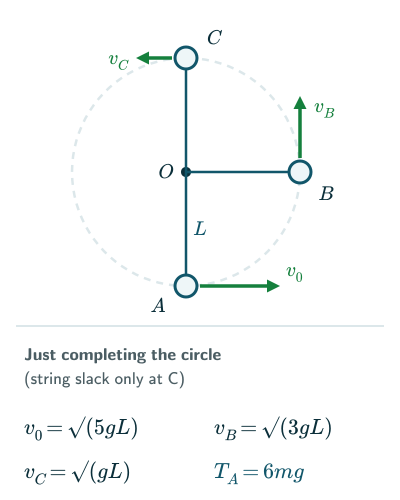
At the top C, the tension is zero, so gravity alone supplies the centripetal force:
C is 2L above A, so the energy at C is
At the bottom A, all of this energy is kinetic:
At B, level with the centre, a height L above A:
so the ratio of kinetic energies is
The tensions follow from the second law towards the centre: the net inward force is the centripetal force mv/L. At A, TA − mg = mv02/L, so TA = 6mg. At B, the tension alone points to the centre: TB = mvB2/L = 3mg. At C, TC = 0. NCERT writes the equation at A but does not solve it; these values are a standard extension. In general, as long as the string stays taut, TA − TC = 6mg for any starting speed; TA = 6mg only when TC = 0.
After C the bob keeps moving round the circle. As NCERT notes, if the string were cut at C, the bob would move off horizontally to the left as a projectile.
Two more standard results go beyond NCERT’s example:
- If v0 is between and , the string goes slack somewhere above the level of O, at a height (v02 + gL)/(3g) above A, and the bob leaves the circle as a projectile. If , the bob never rises above the level of O and the string never goes slack: it just swings to and fro.
- With a light rod instead of a string, the rod can push as well as pull, so the bob only needs to reach the top with (just over) zero speed: a speed just over at the bottom is enough.
Energy conservation around us
- A swinging pendulum. Its energy changes from potential at the ends of the swing to kinetic at the bottom, and back. Air resistance slowly takes energy away, so the swing dies down.
- Roller coasters. The car is pulled to the top once; after that, its speed at any point follows from the height it has fallen, minus small losses to friction.
- Hydroelectric power. Water falling from a dam turns potential energy into kinetic energy, which the turbines then convert into electrical energy.
- A bouncing ball. Each bounce is lower because some energy is lost as heat and sound in the collision: mechanical energy is not conserved there.
Solved examples
Example 1: A ball dropped from a height
A ball is dropped from rest from a height of 20 m. Ignoring air resistance, find its speed (a) when it is 5 m above the ground and (b) just before it hits the ground. Take g = 9.8 m s−2.
(a) It has fallen 15 m, so v = 2g(H − h):
(b) It has fallen the full 20 m:
Answer: about 17.1 m s at 5 m, and 19.8 m s at the ground. The mass of the ball is not needed.
Example 2: A pendulum released from 60°
A pendulum bob of mass 0.5 kg on a string 1.0 m long is pulled aside until the string makes 60° with the vertical, and released. Find (a) its speed at the lowest point and (b) the tension in the string there. Take g = 9.8 m s−2.
(a) The bob falls through h = L(1 − cos 60°), that is 1.0 × 0.5 or 0.5 m:
(b) At the bottom, T − mg = mv/L:
Answer: about 3.13 m s, and a tension of 9.8 N, twice the bob’s weight.
Example 3: Just completing a vertical circle
A 0.2 kg bob on a string 0.8 m long is to just complete a vertical circle. Find the speeds at the bottom, at the side (level with the centre) and at the top, and the tension at the bottom. Take g = 9.8 m s−2.
Here gL = 9.8 × 0.8, that is 7.84 m s.
Answer: about 6.26, 4.85 and 2.8 m s; the tension at the bottom is 11.76 N, six times the weight.
Common mistakes to avoid
Common mistake
Using conservation when friction does work
Mechanical energy is conserved when net non-conservative work is zero. With dissipative resistance on a fixed track or drag in still air, the initial mechanical energy equals the final mechanical energy plus the energy converted to other forms:
Common mistake
Changing the reference level in the middle
The potential energy can be measured from any level, but the same level must be used for both the initial and the final state.
Common mistake
Thinking the bob can reach the top of the circle with zero speed on a string
A string can only pull. At the top the bob needs at least , so that gravity alone can supply the centripetal force. A rigid rod can also push, so its limiting bottom speed is √(4gL). To pass over the top in finite time its bottom speed must be strictly greater than this limit; equality approaches the unstable top position asymptotically.
Common mistake
Counting the work done by the tension
For the fixed-pivot, inextensible-string model used here, tension is perpendicular to the motion and does no work. It changes the direction of the velocity, not the energy.
Quick revision summary
- Total mechanical energy is kinetic plus potential energy, E = K + V.
- If only conservative forces do work, it stays constant: the kinetic and potential energies trade off but their sum does not change.
- A force is conservative if it comes from a potential energy, if its work depends only on the end points, and if its work around a closed path is zero.
- For a body falling from rest through H, the speed is √(2gH); at height h it is √(2g(H − h)).
- In a vertical circle on a string, the bob just completes the circle with √(5gL) at the bottom, √(3gL) level with the centre and √(gL) at the top, where the tension is zero.
Formula sheet
- Ki + Vi = Kf + Vf
- E = K + V = constant (time-independent V; net non-conservative work zero)
- v = √(2gH) (falling from rest through H)
- v0 = √(5gL), vB = √(3gL), vC = √(gL) (just completing a vertical circle)
- TA = 6mg at the bottom (just completing the circle)
- TA − TC = 6mg (string taut, any speed)
Questions students ask
What is the difference between conservation of energy and conservation of mechanical energy?
Conservation of energy says that the total energy of an isolated system, in all its forms, never changes. Conservation of mechanical energy is narrower: for a time-independent potential, kinetic plus potential energy stays constant when net non-conservative work is zero. Dissipative sliding friction on a fixed surface converts mechanical energy into internal energy. Other non-conservative forces, such as a motor’s drive, can increase mechanical energy while total energy remains conserved.
What is the minimum speed at the bottom needed to complete a vertical circle?
The minimum speed at the lowest point for a bob on a light string of length L to complete a vertical circle is √(5gL). At that limiting speed the tension just vanishes at the top, where the bob moves at √(gL) and its weight alone supplies the centripetal force, and energy conservation over the height 2L gives v02 = gL + 4gL = 5gL. Between √(2gL) and √(5gL) the string goes slack above the level of the centre and the bob leaves the circle; below √(2gL) it only swings to and fro.
Why is the tension at the bottom of a vertical circle 6mg more than at the top?
The tension at the bottom of a vertical circle is 6mg more than at the top because the bob is faster at the bottom and gravity pulls against the tension there but with it at the top. At the bottom A, TA − mg = mv02/L, and at the top C, TC + mg = mvC2/L, so TA − TC = 2mg + m(v02 − vC2)/L. Energy conservation over the height 2L gives v02 − vC2 = 4gL, so TA − TC = 6mg at any speed, as long as the string stays taut.
Is motion in a vertical circle in the JEE Main and NEET syllabus?
Yes, motion in a vertical circle is in both syllabuses: the JEE Main 2027 syllabus and the NEET (UG) 2026 syllabus list it in the Work, Energy and Power unit, alongside conservative and non-conservative forces. In NCERT it is Example 5.7 of the Class 11 chapter Work, Energy and Power, solved with conservation of mechanical energy.
Practice questions
Try each question first, then open the answer to check your working.
-
Q1. A roller coaster car starts from rest at a point 30 m high. Ignoring friction, find its speed at a point 10 m high. Take g = 9.8 m s−2.
Show answerHide answer
It has fallen 20 m:
-
Q2. A pendulum 2 m long is pulled aside to 30° from the vertical and released. Find its speed at the lowest point. Take g = 9.8 m s−2.
Show answerHide answer
It falls through h = 2(1 − cos 30°), about 0.268 m, so
-
Q3. What is the least speed a bob on a string 1.2 m long must have at the lowest point to complete a vertical circle? Take g = 9.8 m s−2.
Show answerHide answer