Collisions
NCERT Class 11 Physics Chapter 5 Section 5.11
Quick answer
In every collision of an isolated system the total momentum is conserved, but kinetic energy is conserved only in an elastic collision; in a completely inelastic collision the bodies stick together and the loss of kinetic energy is the largest possible, though usually not all of it. For a head-on elastic collision of m1 moving with velocity v1i and m2 at rest, v1f = (m1 − m2)v1i/(m1 + m2) and v2f = 2m1v1i/(m1 + m2). Equal masses then exchange velocities.
With your textbook
NCERT Physics Part I (Class 11), Chapter 5 “Work, Energy and Power”, Section 5.11 “Collisions”, pages 83–86.
Open the official NCERT chapter (PDF, 2.0 MB, ncert.nic.in) (opens in a new tab)
Checked against the 2026-27 reprint on .
What happens in a collision?
Momentum in collisions, in NCERT’s words
In all collisions the total linear momentum is conserved; the initial momentum of the system is equal to the final momentum of the system.
NCERT Physics Part I (Class 11), Section 5.11.1, page 84
In plain words: when two bodies collide, they push on each other with large forces for a short time. By Newton’s third law these forces are equal and opposite at every instant, so the impulses they give each other are equal and opposite, so these internal forces do not change the pair’s total momentum. The pair’s momentum is conserved only when the net external impulse is zero or negligible over the collision; measure all velocities in the same inertial frame. Kinetic energy is a different matter: some of it may turn into heat, sound or the work of denting the bodies.
For the isolated-pair approximation used below, start from the conservation of momentum. Whether kinetic energy is also conserved decides what kind of collision it is.
Elastic and inelastic collisions
A useful picture is to imagine a compressed spring between the two bodies during the collision.
If the ‘spring’ connecting the two masses regains its original shape without loss in energy, then the initial kinetic energy is equal to the final kinetic energy but the kinetic energy during the collision time ∆t is not constant. Such a collision is called an elastic collision.
NCERT Physics Part I (Class 11), Section 5.11.1, page 84
A collision in which the two particles move together after the collision is called a completely inelastic collision.
NCERT Physics Part I (Class 11), Section 5.11.1, page 84
A completely inelastic collision is also called a perfectly inelastic collision.
| Type | Momentum | Kinetic energy |
|---|---|---|
| Elastic | conserved | conserved |
| Inelastic | conserved | partly lost |
| Completely inelastic | conserved | maximum allowed loss |
The table assumes negligible external impulse and ordinary collisions without release of stored internal energy. The maximum loss can be all the initial bulk kinetic energy: equal masses approaching with opposite velocities stop when they stick, because their total momentum is zero.
Collisions between billiard balls are nearly elastic. A ball that bounces lower each time makes inelastic collisions with the floor. A bullet that embeds itself in a block makes a completely inelastic collision: the two move on together. The in-between case, where some kinetic energy is lost but the bodies do not stick, is the most common, and is simply called an inelastic collision.
A common measure beyond NCERT is the coefficient of restitution, e: the relative speed of separation after a head-on collision divided by the relative speed of approach before it. For an elastic collision e = 1; for a completely inelastic one e = 0; for an ordinary inelastic collision e is between 0 and 1.
Collisions in one dimension
Take a body of mass m1 moving at v1i that hits a body of mass m2 at rest, head-on, so that everything happens along one line.
Completely inelastic. The bodies move off together at vf:
Completely inelastic collision
The kinetic energy lost is
which is always positive, as it must be.
Elastic. Now both momentum and kinetic energy are conserved:
(the factor ½ in each kinetic energy cancels). Rewrite the two equations as
The left side of the second has the factor (v1i − v1f)(v1i + v1f). Divide the second equation by the first:
So the bodies separate with the same relative speed with which they approached. Putting this back into the momentum equation:
which gives
Elastic collision, second body at rest
If the second body is also moving, at v2i along the same line (velocities towards +x positive), the same steps give a standard result beyond NCERT:
For an elastic head-on collision with the target initially at rest, three special cases are worth remembering:
- Equal masses (m1 = m2): v1f = 0 and v2f = v1i. The moving body stops and the other moves off with its velocity, as in a head-on hit between two carrom coins.
- Very heavy target (m2 ≫ m1): v1f ≈ −v1i and v2f ≈ 0. A ball bouncing off a wall comes back with its speed unchanged.
- Very heavy projectile (m1 ≫ m2): v1f ≈ v1i and v2f ≈ 2v1i. A heavy body hardly slows down and knocks a light one forward at about twice its own speed.
Slowing down neutrons
NCERT Example 5.11 (page 85) applies the elastic results to moderation in a thermal reactor. Fast neutrons are slowed by collisions with light nuclei in a moderator, such as heavy water or graphite. Fast reactors instead operate without this slowing-down moderator. In a head-on elastic collision, the fraction of the neutron’s kinetic energy that it keeps is
and the rest, f2 = 1 − f1, goes to the nucleus. (NCERT’s text calls f1 the fractional kinetic energy “lost”; it is the fraction the neutron keeps.) For deuterium (m2 = 2m1), f1 = 1/9: almost 90% of the energy is handed over in one collision. For carbon (m2 = 12m1), f1 ≈ 71.6% and f2 ≈ 28.4%. Light nuclei make good moderators. (In practice the transfer is smaller, because head-on collisions are rare.)
Collisions in two dimensions
If the moving body does not hit the other head-on, the two fly apart at angles. Choose the x-axis along the initial velocity of m1, with m2 at rest, and let the bodies move off at angles θ1 and θ2 on either side of it.
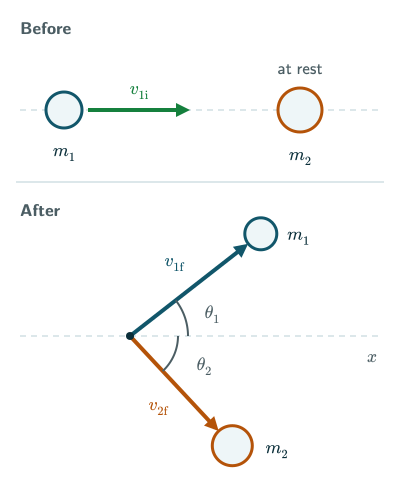
Momentum is conserved along each axis. With p1 = m1v1f and p2 = m2v2f, the momenta after the collision:
Two-dimensional collision (m at rest)
If the collision is elastic, kinetic energy conservation adds a third equation. With the masses and v1i known, there are still four unknowns (v1f, v2f, θ1, θ2), so one of them, usually an angle, must be measured or given before the rest can be found.
A neat result follows for equal masses in an elastic glancing collision with one at rest. With m1 = m2, momentum conservation gives
Squaring (taking the dot product of each side with itself):
Energy conservation gives
so the dot product of the two final velocities is zero, and the angles add up to 90°: the bodies move off at right angles to each other.
This proves the following result : when two equal masses undergo a glancing elastic collision with one of them at rest, after the collision, they will move at right angles to each other.
NCERT Physics Part I (Class 11), Section 5.11.3, page 86
NCERT Example 5.12 (pages 85–86) arrives at this result from a billiard shot: if the target ball must go off at θ2 = 37°, the cue ball goes off at θ1 = 53°.
Not every collision needs contact. A comet swinging past the Sun, or an alpha particle deflected by a nucleus, interacts through forces acting at a distance. Such an event is called scattering. If external impulse is negligible, total momentum of both interacting bodies is conserved; the comet or alpha particle alone changes momentum.
Solved examples
Example 1: An elastic head-on collision
A 2 kg ball moving at 5 m s hits a 3 kg ball at rest head-on, and the collision is elastic. Find their velocities after the collision, and check that kinetic energy is conserved.
Check: momentum before is 2 × 5 = 10, after is 2(−1) + 3(4) = 10 kg m s. Kinetic energy before is 25 J; after it is 1 + 24 = 25 J.
Answer: the 2 kg ball bounces back at 1 m s, and the 3 kg ball moves forward at 4 m s.
Example 2: Two cars that lock together
A car of mass 1500 kg moving at 20 m s runs into the back of a stationary car of mass 1000 kg, and the two lock together. Find (a) their common velocity and (b) the kinetic energy lost.
(a)
(b) Kinetic energy before is , that is 300 000 J; after, it is , that is 180 000 J. The loss is 120 000 J. Check with the formula:
Answer: 12 m s; 120 kJ, 40% of the kinetic energy, goes into heat, sound and crumpled metal.
Example 3: A glancing collision of equal masses
A ball moving at 4 m s makes an elastic glancing collision with an identical ball at rest. The first ball moves off at 30° to its original direction. Find the speeds of both balls and the direction of the second.
For equal masses in an elastic glancing collision, the balls move off at right angles, so the second ball goes off at 60° on the other side. The two final velocities and the initial velocity form a right-angled triangle, with the initial velocity as the hypotenuse, so
Check (the equal masses cancel): along x, 3.46 cos 30° + 2 cos 60° gives 3 + 1 = 4; along y, 1.73 − 1.73 = 0; and 3.46 + 2 is about 16, which is 4, so kinetic energy is conserved.
Answer: about 3.46 m s at 30°, and 2 m s at 60° on the other side.
Common mistakes to avoid
Common mistake
Assuming kinetic energy is conserved in every collision
Only momentum is conserved in every collision (of an isolated system). Kinetic energy is conserved only in elastic collisions; sticking bodies with a non-zero initial relative velocity lose bulk kinetic energy.
Common mistake
Applying kinetic energy conservation during the collision
Even in an elastic collision, kinetic energy is the same only before and after; during the contact some of it is stored as deformation. Momentum is conserved at every instant. In a one-dimensional head-on collision, at the moment of greatest compression the two bodies move with a common velocity (momentarily at rest relative to each other), as when a moving block compresses a spring fixed to a block at rest.
Common mistake
Using the elastic formulas for an inelastic collision
The formulas for v1f and v2f use energy conservation. For an inelastic collision you need extra information, such as the bodies sticking together or a given coefficient of restitution.
Common mistake
Expecting equal masses always to exchange velocities
Equal masses exchange velocities only in a head-on elastic collision. In a glancing elastic collision with one at rest, they move off at right angles instead.
Common mistake
Adding speeds instead of momenta in two dimensions
In two dimensions, conserve the x-component and the y-component of momentum separately. Adding the speeds of the outgoing bodies gives nothing meaningful.
Quick revision summary
- In every collision of an isolated system, total momentum is conserved; kinetic energy is conserved only in elastic collisions.
- In a completely inelastic collision the bodies stick together, and the loss of kinetic energy is greatest.
- In a one-dimensional elastic collision the relative speed of separation equals the relative speed of approach.
- Equal masses in a head-on elastic collision exchange velocities; a light ball bouncing elastically off a heavy wall keeps its speed.
- In two dimensions, conserve each component of momentum. Equal masses in an elastic glancing collision with one at rest move off at right angles.
Formula sheet
- m1v1i = m1v1f + m2v2f (momentum, m2 at rest)
- vf = m1v1i/(m1 + m2) (completely inelastic)
- v1f = (m1 − m2)v1i/(m1 + m2) (elastic, m2 at rest)
- v2f = 2m1v1i/(m1 + m2) (elastic, m2 at rest)
- ΔK = m1m2v1i2/[2(m1 + m2)] (loss, completely inelastic)
Questions students ask
What are real-life examples of elastic and inelastic collisions?
Collisions between billiard balls or carrom coins, and between gas molecules, are nearly elastic: very little kinetic energy is lost. A ball that bounces lower each time, a car crash and a hammer hitting a nail are inelastic. A bullet that embeds itself in a wooden block, or two railway wagons that couple, make a completely inelastic collision: the bodies move on together.
What is the coefficient of restitution?
The coefficient of restitution e is the relative speed of separation after a head-on collision divided by the relative speed of approach before it: e = (v2f − v1f)/(v1i − v2i). It is 1 for an elastic collision, 0 for a completely inelastic one and between 0 and 1 for an ordinary partially inelastic collision. An energy-releasing, superelastic collision can have e > 1; that case is outside the dissipative model used here. For a ball dropped from a height h1 that bounces back to h2 off a fixed floor, e = √(h2/h1) (ignoring air resistance).
What is a perfectly inelastic collision?
A perfectly inelastic collision, also called a completely inelastic collision, is one in which the bodies stick together and move off with a common velocity. Momentum is still conserved, so for m1 moving at v1i hitting m2 at rest, vf = m1v1i/(m1 + m2). It loses the most kinetic energy that momentum conservation allows, ΔK = m1m2v1i2/[2(m1 + m2)], though usually not all of it.
How can you tell whether a collision is elastic?
Compare the total kinetic energy just before and just after the collision: if it is the same, the collision is elastic; if some is lost, it is inelastic. Equivalently, in a head-on elastic collision the bodies separate with the same relative speed with which they approached (e = 1). Momentum cannot tell you, because in an isolated system it is conserved in both kinds.
Practice questions
Try each question first, then open the answer to check your working.
-
Q1. A 0.2 kg ball moving at 6 m s makes a head-on elastic collision with an identical ball at rest. Find their velocities after the collision.
Show answerHide answer
For equal masses in a head-on elastic collision the velocities are exchanged: the first ball stops, and the second moves off at 6 m s.
-
Q2. A bullet of mass 10 g moving at 300 m s embeds itself in a 2 kg block at rest on a smooth table. Find the velocity of the block and the fraction of kinetic energy lost.
Show answerHide answer
Dividing the loss ΔK by the initial kinetic energy gives the fraction lost, m2/(m1 + m2), that is 2/2.01, about 0.995: about 99.5% of the kinetic energy is lost.
-
Q3. A tennis ball hits a wall head-on at 15 m s and the collision is elastic. With what speed does it bounce back, and why?
Show answerHide answer
At 15 m s. The wall (fixed to the Earth) is far heavier than the ball, so in the elastic formulas v1f ≈ −v1i: the ball reverses its velocity with the same speed, and the wall hardly moves.