Potential energy of a spring
NCERT Class 11 Physics Chapter 5 Section 5.9
Quick answer
The potential energy of an ideal Hookean spring stretched or compressed by x from its natural length is V = ½kx, where k is its spring constant: zero at the natural length and positive for both stretching and compressing. It equals the work done against the spring force in deforming it slowly from its natural length; for an ideal spring that force obeys Hooke’s law, F = −kx, and is conservative. For a block attached to the spring on a smooth horizontal surface, ½mv + ½kx stays constant, and the speed is greatest at the natural length.
With your textbook
NCERT Physics Part I (Class 11), Chapter 5 “Work, Energy and Power”, Section 5.9 “The potential energy of a spring”, pages 80–83.
Open the official NCERT chapter (PDF, 2.0 MB, ncert.nic.in) (opens in a new tab)
Checked against the 2026-27 reprint on .
What is the potential energy of a spring?
The spring force in NCERT’s words
The spring force is an example of a variable force which is conservative.
NCERT Physics Part I (Class 11), Section 5.9, page 80
In plain words: when you stretch or compress a spring, you do work against its force, and that work is stored in the spring. Let go, and the spring gives it back, for example as the kinetic energy of a block attached to it. The stored energy is the elastic potential energy of the spring. For an ideal Hookean spring with positive spring constant k, stretched or compressed by x from its natural length:
Potential energy of a spring
It is zero when the spring is at its natural length, and positive for both stretching and compressing.
The spring force and Hooke’s law
Fix one end of a light spring to a wall, attach a block to the other end, and let the block rest on a smooth horizontal surface. Measure the block’s displacement x from the position where the spring has its natural length. For an ideal spring, the force it exerts is proportional to x and opposite to it:
Hooke’s law
This is Hooke’s law. Real springs obey it only for small stretches and compressions, up to the proportional limit (see Hooke’s law for solids). The minus sign says that the force always points back towards the natural length: pull the block out (x > 0) and the spring pulls it in; push it in (x < 0) and the spring pushes it out. That is why it is called a restoring force.
The constant k is the spring constant, in N m−1: the force needed per metre of stretch.
The spring is said to be stiff if k is large and soft if k is small.
NCERT Physics Part I (Class 11), Section 5.9, page 80
Work done by the spring force
The spring force changes with x, so its work is an integral, the area under the force–displacement graph (see work done by a variable force). As the block is pulled out from x = 0 to xm, the spring force does
This is negative, because the spring force points against the stretch. On a graph of Fs against x, it is the area of a triangle below the axis. If no other force does work and the stretch is quasistatic, the person does of work.
From any xi to any xf, the spring force does
Work done by the spring force
This depends only on the end points. If the block is pulled out and returns to where it started (xf = xi), the work is zero:
The work done by the spring force in a cyclic process is zero.
NCERT Physics Part I (Class 11), Section 5.9, page 81
So the spring force is conservative, and it has a potential energy. Taking V = 0 at the natural length, the potential energy is , and you can check that −dV/dx = −kx, the spring force.
Energy of a block on a spring
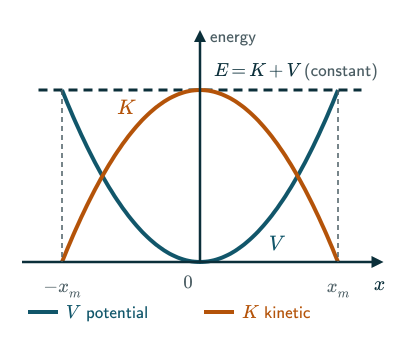
Pull the block out to xm and release it from rest on the smooth surface. Only the spring force does work, so mechanical energy is conserved. At any position x between −xm and xm:
At the ends (x = ±xm) the block is momentarily at rest and all the energy is potential. At x = 0 the spring has its natural length, the potential energy is zero, and the kinetic energy and speed are largest:
Greatest speed of the block
In , k/m has dimensions [T−2], so has dimensions [T−1] and vm has the dimensions of speed, as it should.
Springs around us
- Crash testing. NCERT Example 5.8 describes how car makers study collisions of cars with mounted springs: the car’s kinetic energy becomes the spring’s potential energy at maximum compression.
- Shock absorbers and mattresses. Springs store energy briefly and spread the impact over a longer time, or turn the energy into heat with dampers.
- Spring balances. The stretch is proportional to the force, so the scale can be marked evenly in newtons.
- Toy guns, staplers and retractable pens. A compressed spring stores energy that is released as the kinetic energy of the dart, the staple or the pen’s button.
Solved examples
Example 1: Force and stored energy
A spring of spring constant 400 N m is stretched by 5 cm. Find (a) the force it exerts, (b) the energy stored in it, and (c) the extra work needed to stretch it slowly from 5 cm to 10 cm, with no other work or energy losses.
(a) The size of the force is kx = 400 × 0.05, that is 20 N, directed back towards the natural length.
(b)
(c) The extra work is the increase in stored energy:
Answer: 20 N, 0.5 J, and 1.5 J more. Doubling the stretch makes the stored energy four times as large (2 J), so the second 5 cm takes three times the work of the first.
Example 2: Speed of a block on a spring
A 0.5 kg block on a smooth floor is attached to a spring with k = 200 N m−1. It is pulled out 10 cm and released. Find (a) its greatest speed and (b) its speed when it is 5 cm from the natural length.
(a)
(b) From energy conservation:
so
Answer: 2 m s at the natural length, and about 1.73 m s at 5 cm.
Example 3: A car hits a spring buffer
A car of mass 800 kg moving at 10 m s (36 km/h) on a level road runs into a spring buffer of spring constant 2.0 × 10⁴ N m. Find the greatest compression (a) if the road is smooth, and (b) if the coefficient of kinetic friction between the tyres and the road is 0.5, with the wheels locked. Take g = 9.8 m s−2.
(a) All the kinetic energy becomes spring energy:
(b) The friction force has size μmg, that is 0.5 × 800 × 9.8, or 3920 N, and it does work −3920 xm. By the work-energy theorem, the change in kinetic energy, , equals the work done by the spring and by friction, so
Taking the positive root of this quadratic:
where
Answer: 2.0 m on a smooth road and about 1.81 m with friction.
NCERT Examples 5.8 and 5.9 (pages 81–82) do the same for a 1000 kg car at 18 km/h, finding 2.00 m without friction and 1.35 m with μ = 0.5 (NCERT takes g = 10 m s−2). NCERT prints the spring constant as 5.25 × 10³ N m−1, but its answers match 6.25 × 10³ N m−1; with 5.25 × 10³, the compressions would be about 2.18 m and 1.43 m.
Common mistakes to avoid
Common mistake
Using ½k(x − x) for the work between two stretches
The energy stored goes as x2, so the work from x1 to x2 is . In Example 1(c), (x2 − x1)2 would give 0.5 J instead of 1.5 J.
Common mistake
Getting the sign of the spring’s work wrong
The spring force does negative work when the spring is stretched or compressed further, and positive work when it returns towards its natural length. For a quasistatic stretch with no other work, the person does the opposite work.
Common mistake
Thinking a compressed spring has negative potential energy
is positive whether x is positive (stretched) or negative (compressed). A compressed spring stores energy just like a stretched one.
Common mistake
Thinking the speed is always greatest at the natural length
That is true for a horizontal spring. For an ideal undamped vertical spring with fixed support, gravity also acts, and the speed is greatest where the spring force balances the weight, at a stretch of mg/k. A mass attached to the unstretched spring and let go suddenly falls until the stretch is 2mg/k, not mg/k.
Common mistake
Changing the zero of potential energy halfway
NCERT puts it memorably:
However, once the zero of the potential energy is fixed in a given discussion, it must be consistently adhered to throughout the discussion. You cannot change horses in midstream !
NCERT Physics Part I (Class 11), Section 5.9, page 82
Quick revision summary
- An ideal spring, or a real spring within its proportional limit, obeys Hooke’s law: its force is proportional to the stretch or compression and points back towards the natural length.
- The spring constant k is the force per unit stretch, in N m; a stiff spring has a large k.
- The spring force is conservative: its work depends only on the end points, and is zero over a cycle.
- A spring stretched or compressed by x stores potential energy ½kx, zero at its natural length.
- For a block on a spring on a smooth horizontal surface, K + V is constant; the speed is greatest at the natural length.
Formula sheet
- F = −kx (Hooke’s law)
- V = ½kx
- Ws = ½kxi2 − ½kxf2
- ½mv2 + ½kx2 = ½kxm2
- vm = xm√(k/m)
Questions students ask
What is the SI unit and dimensional formula of the spring constant?
The SI unit of the spring constant k is the newton per metre (N m), the same as kg s, because k is the force per unit stretch, |F|/|x|. Its dimensional formula is [M T]. A stiff spring has a large k and a soft one a small k; joining springs in series or in parallel, or cutting a spring, changes the spring constant (see combinations of springs).
How do you derive V = ½kx for a spring?
The potential energy of a spring, ½kx, is the work done against the spring force in stretching or compressing it slowly from its natural length by x. The force needed grows steadily from 0 to kx, so the work is the area of the triangle under the force–extension line: ½ × x × kx = ½kx. Because the spring force is conservative, this work is stored, and the spring gives it back as it returns to its natural length.
Why is the spring force conservative?
The spring force is conservative because its work depends only on the initial and final stretch, Ws = ½kxi2 − ½kxf2, not on the path in between. Over any cycle that brings the spring back to its starting stretch its work is zero, so the work done against it is stored as potential energy and can be fully recovered. Friction is different: its work around a closed path is negative, and the energy turns into heat.
Practice questions
Try each question first, then open the answer to check your working.
-
Q1. A force of 50 N stretches a spring by 2 cm. Find its spring constant and the energy stored in it.
Show answerHide answer
k = 50/0.02, that is 2500 N m, and the energy is
-
Q2. The extension of a spring is doubled. By what factor does its stored energy change?
Show answerHide answer
It goes as x2, so it becomes four times as large.
-
Q3. A 0.2 kg ball is pushed against a spring with k = 500 N m−1, compressing it by 4 cm on a smooth horizontal surface, and released. With what speed does it leave the spring?
Show answerHide answer
All the stored energy becomes kinetic energy: