Resolution of vectors
NCERT Class 11 Physics Chapter 3 Section 3.5
Quick answer
Resolving a vector means expressing it as a sum along chosen directions; on perpendicular axes A = Ax î + Ay ĵ, with Ax = A cos θ and Ay = A sin θ for θ measured from +x. Its magnitude is √(Ax + Ay), and for Ax ≠ 0 the direction satisfies tan θ = Ay/Ax, with the quadrant chosen from the signs. If the x-component vanishes, a non-zero vector points along the y-axis; the zero vector has no direction.
With your textbook
NCERT Physics Part I (Class 11), Chapter 3 “Motion in a Plane”, Section 3.5 “Resolution of vectors”, pages 31–33.
Open the official NCERT chapter (PDF, 2.2 MB, ncert.nic.in) (opens in a new tab)
Checked against the 2026-27 reprint on .
What is resolution of a vector?
Resolution of vectors
Resolving a vector means writing it as a sum of vectors along chosen directions, its components. Along the x- and y-axes, with unit vectors î and ĵ,
where, if A makes an angle θ with the x-axis, Ax = A cos θ and Ay = A sin θ (NCERT Section 3.5, pages 31–33).
A unit vector is a vector of unit magnitude and points in a particular direction.
NCERT Physics Part I (Class 11), Section 3.5, page 32
In plain words: a vector pointing diagonally can be replaced by two arrows, one along each axis, that together have the same effect. Each of them is easy to handle on its own, which is why almost every problem in this chapter starts by resolving vectors: once resolved, they can be added component by component.
Resolving along any two directions
Take any two non-zero vectors a and b in a plane that do not lie along one line (non-collinear: a and −a will not do), and a third vector A in the same plane. Draw a line through the tail O of A parallel to a, and a line through its head P parallel to b; let them meet at Q. Then, by the triangle law, A = OQ + QP, and since OQ is along a and QP along b,
Resolving along two directions
with real numbers λ and μ, since a vector along a is a number times a (NCERT Eqs. 3.6–3.8, page 31). The two directions need not be at right angles, but it is most convenient when they are, along the axes.
Unit vectors
A unit vector has magnitude 1, no dimension and no unit; it only marks a direction (NCERT page 32). The unit vectors along the x-, y- and z-axes are î, ĵ and k̂, perpendicular to each other, with |î| = |ĵ| = |k̂| = 1 (NCERT Eq. 3.9).
A non-zero vector can be written as its magnitude times the unit vector along it, A = |A| n̂ (NCERT Eq. 3.10), so n̂ = A/|A|. The zero vector cannot be normalised: its magnitude is zero and it has no unique direction.
NCERT writes the product of a scalar λ and the unit vector n̂ as λ = λn̂ (page 32): bold λ is the vector, plain λ the number. In print the two are easy to confuse, and λ may be negative (then the magnitude is |λ|), so it is clearer to give the vector a different letter.
Rectangular components
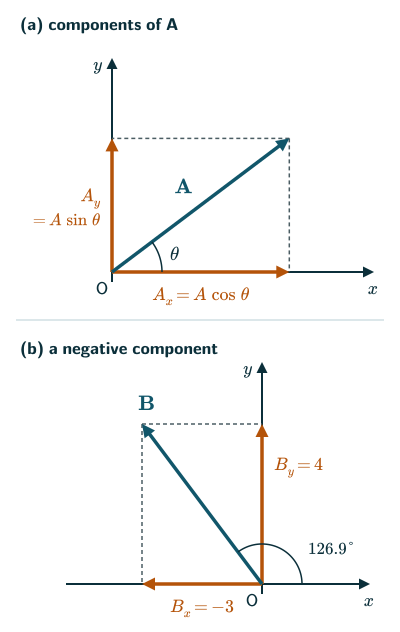
Drop perpendiculars from the head of A to the axes. The two pieces along the axes, Axî and Ayĵ, add up to A (NCERT Eqs. 3.11–3.13, page 32):
Components from magnitude and angle
Ax and Ay are numbers (scalars), not vectors; Axî and Ayĵ are vectors (page 32). A component can be positive, negative or zero, depending on θ.
Going the other way, from the components to the magnitude and direction (NCERT Eqs. 3.14–3.15):
Magnitude and direction from components
Watch the quadrant. tan θ = Ay/Ax holds in every quadrant, but NCERT’s θ = tan(Ay/Ax) (Eq. 3.15) does not say which angle to take. A calculator’s tan gives an angle between −90° and 90°, which is right only when Ax > 0. If Ax < 0, add 180°: for B = −3î + 4ĵ, tan(4/−3) gives −53.1°, but B points into the second quadrant, at −53.1° + 180° = 126.9° (Example 3). If Ax = 0 and Ay ≠ 0, read the direction directly as +90° or −90°; do not divide by zero. If both components vanish, the direction is undefined. Sketch the vector first.
Components along perpendicular axes do not interfere with each other. That is why forces on a particle in equilibrium can be balanced separately along x and y, and why the scalar product is easy to work out from components.
Three dimensions
The same method works in space. If A makes angles α, β and γ with the x-, y- and z-axes (NCERT Eqs. 3.16a–c, page 33):
- Ax = A cos α, Ay = A cos β, Az = A cos γ;
- A = Axî + Ayĵ + Azk̂;
- A = √(Ax2 + Ay2 + Az2).
A position vector is r = xî + yĵ + zk̂ (NCERT Eq. 3.17). The cosines of the three angles, the direction cosines, satisfy cosα + cosβ + cosγ = 1 (beyond the NCERT text), since dividing A = Ax2 + Ay2 + Az2 by A gives it.
NCERT’s footnote on page 33 says that α, β and γ are angles in space, between pairs of lines which are not coplanar. Read it as: the three angles do not all lie in one plane, unlike θ in the x-y plane. Each angle on its own is between A and one axis, two lines that meet at the origin, so each lies in a plane of its own.
Solved examples
Example 1: Components of a force
A force of 10 N acts at 30° above the x-axis. Find its components.
Fx = 10 cos 30° ≈ 8.66 N; Fy = 10 sin 30° = 5 N.
Answer: F ≈ (8.66î + 5ĵ) N.
Example 2: Magnitude and direction from components
Find the magnitude and direction of A = 3î − 4ĵ.
A = √(9 + 16) = 5. tan θ = −4/3, and Ax > 0, so θ = tan(−4/3) ≈ −53.1°: 53.1° below the +x-axis.
Answer: 5 units, 53.1° below the +x-axis (in the fourth quadrant).
Example 3: A negative x-component
Find the direction of B = −3î + 4ĵ.
B = 5. tan(4/−3) on a calculator gives −53.1°, which points into the fourth quadrant. But Bx < 0 and By > 0, so B is in the second quadrant: θ = −53.1° + 180° = 126.9°.
Answer: 5 units at 126.9° from the +x-axis.
Example 4: A unit vector
Find the unit vector along A = 6î + 8ĵ.
A = √(36 + 64) = 10, so n̂ = A/A = 0.6î + 0.8ĵ. Check: 0.6 + 0.8 = 1.
Answer: 0.6î + 0.8ĵ.
Example 5: Direction cosines
For A = 2î + 3ĵ + 6k̂, find A and the cosines of the angles it makes with the axes.
A = √(4 + 9 + 36) = 7. cos α = 2/7, cos β = 3/7, cos γ = 6/7. Check: (4 + 9 + 36)/49 = 1.
Answer: 7 units; 2/7, 3/7 and 6/7.
Example 6: Resolving along tilted axes (NCERT Exercise 3.19, page 48)
What are the magnitude and direction of î + ĵ and of î − ĵ? What are the components of A = 2î + 3ĵ along these two directions?
|î + ĵ| = √2, at 45° above the x-axis; |î − ĵ| = √2, at 45° below it.
Write A = λ(î + ĵ) + μ(î − ĵ), as in A = λa + μb. Matching components: λ + μ = 2 and λ − μ = 3, so λ = 2.5 and μ = −0.5.
These are not yet the components, because |î ± ĵ| = √2, not 1. Along î + ĵ the component is 2.5 × √2 = 5/√2 ≈ 3.54; along î − ĵ it is −0.5 × √2 = −1/√2 ≈ −0.71. Check: the directions are perpendicular, and (5/√2) + (1/√2) = 12.5 + 0.5 = 13 = A.
Answer: both have magnitude √2, at +45° and −45° to the x-axis; A = 2.5(î + ĵ) − 0.5(î − ĵ), so its components along them are 5/√2 ≈ 3.54 and −1/√2 ≈ −0.71.
Common mistakes to avoid
Common mistake
Using cos for the x-component out of habit
Ax = A cos θ and Ay = A sin θ only when θ is measured from the x-axis. If the angle is given from the y-axis, the sine and cosine swap: 10 N at 30° from the +y-axis, leaning towards +x, has Fx = 10 sin 30° = 5 N and Fy = 10 cos 30° ≈ 8.66 N.
Common mistake
Reading λ as the component
In A = λa + μb, the vector component is λa; λ alone is the component only when a is a unit vector. In NCERT Exercise 3.19 (Example 6), λ = 2.5 but the component along î + ĵ is 2.5√2 ≈ 3.54. For perpendicular directions this is A cos θ = A·â, which is what “the component of A along a” means when no second direction is named.
Common mistake
Resolving weight on an incline
On an incline of angle θ, the weight mg makes angle θ with the normal to the surface, not with the surface. So mg sin θ acts along the incline and mg cos θ into it. Check: at θ = 0 the whole weight is perpendicular to the surface.
Common mistake
Trusting tan without looking at the signs
tan(Ay/Ax) cannot tell (3, 4) from (−3, −4). Sketch the vector and add 180° when Ax < 0.
Common mistake
Calling a component a vector
Ax is a number; Axî is the vector component. A component can be negative, a magnitude cannot.
Common mistake
Adding magnitudes instead of squares
A = √(Ax2 + Ay2), not Ax + Ay. For 3î + 4ĵ the magnitude is 5, not 7.
Common mistake
Forgetting the unit vector has no unit
î, ĵ, k̂ and n̂ are pure directions. The unit of A sits in its components or its magnitude.
Quick revision summary
- Any vector in a plane can be resolved uniquely along two non-collinear directions in that plane: A = λa + μb.
- Unit vectors î, ĵ, k̂ have magnitude 1, no unit, and lie along the axes; A = |A| n̂.
- A = Axî + Ayĵ with Ax = A cos θ, Ay = A sin θ.
- A = √(Ax2 + Ay2) and tan θ = Ay/Ax; check the quadrant.
- In 3D: Ax = A cos α and so on; cosα + cosβ + cosγ = 1.
Formula sheet
- A = λa + μb (resolution along two directions)
- A = |A| n̂
- A = Ax î + Ay ĵ
- Ax = A cos θ; Ay = A sin θ
- A = √(Ax2 + Ay2); tan θ = Ay/Ax
- 3D: A = √(Ax2 + Ay2 + Az2); cos2α + cos2β + cos2γ = 1
Questions students ask
How many rectangular components can a vector have?
A vector has at most three rectangular components: two in a plane, Ax and Ay, and three in space, Ax, Ay and Az, one along each of a set of mutually perpendicular axes. Since the axes can be turned to any orientation, a vector can be split into rectangular components in infinitely many ways, but never into more than three at once. If the directions need not be perpendicular, a vector in a plane can be resolved along any pair of non-collinear directions in it.
What is the difference between direction cosines and direction ratios?
Direction cosines are the cosines of the angles a vector makes with the x-, y- and z-axes, cos α = Ax/A, cos β = Ay/A and cos γ = Az/A; they satisfy cosα + cosβ + cosγ = 1 and are the components of the unit vector along A. Direction ratios are any three numbers proportional to them, such as the components themselves, so they are not unique. For A = î − 2ĵ + 2k̂, with A = 3, the direction ratios can be 1, −2, 2 (or 2, −4, 4), while the direction cosines are 1/3, −2/3 and 2/3.
How do you find the component of a vector along another vector?
For non-zero B, the component of A along B is A cos θ = A·B/B, where θ is the angle between them; it is a scalar, negative if θ > 90°, and the vector component is this number times the unit vector along B. For A = 5î + 2ĵ along B = 12î − 5ĵ, the component is (60 − 10)/13 ≈ 3.85 units. This is the projection of A on B, explained with the scalar product.
Can a vector have zero magnitude if one of its components is not zero?
No, a vector cannot have zero magnitude if any of its rectangular components is non-zero, because A = √(Ax2 + Ay2 + Az2) is built from a sum of squares, which is zero only when every component is zero. The reverse is possible: a non-zero vector can have a zero component, as 4ĵ has Ax = 0 because it is perpendicular to the x-axis.
Practice questions
Try each question first, then open the answer to check your working.
-
Q1. A velocity of 20 m s is directed at 60° above the x-axis. Find its components.
Show answerHide answer
vx = 20 cos 60° = 10 m s; vy = 20 sin 60° ≈ 17.3 m s.
-
Q2. Find the magnitude of 5î + 12ĵ.
Show answerHide answer
√(25 + 144) = 13 units.
-
Q3. Can a component of a vector be larger than the vector itself?
Show answerHide answer
Not for rectangular components: |A cos θ| ≤ A, and the projection of A on any one direction is never larger than A. Along two directions that are not perpendicular, yes: ĵ = î + (−î + ĵ), so along î and −î + ĵ (135° apart) the unit vector ĵ has a component of magnitude √2 > 1.