Position, velocity and acceleration in a plane
NCERT Class 11 Physics Chapter 3 Section 3.7
Quick answer
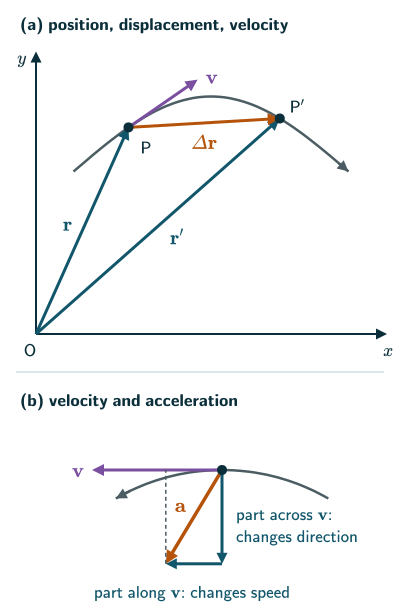
In a plane, position is a vector r = x î + y ĵ, and the displacement between two positions is Δr = r′ − r. The velocity v = dr/dt has components vx = dx/dt and vy = dy/dt and, when non-zero on a smooth path, points along its tangent. The acceleration a = dv/dt can make any angle with the velocity: its part along v changes the speed, and its part across v changes the direction.
With your textbook
NCERT Physics Part I (Class 11), Chapter 3 “Motion in a Plane”, Section 3.7 “Motion in a plane”, pages 34–37.
Open the official NCERT chapter (PDF, 2.2 MB, ncert.nic.in) (opens in a new tab)
Checked against the 2026-27 reprint on .
How are position, velocity and acceleration described in a plane?
Position, velocity and acceleration in a plane
- Position vector: r = xî + yĵ, from the origin to the particle. Displacement: Δr = r′ − r = Δxî + Δyĵ.
- Velocity: v = dr/dt = vxî + vyĵ, with vx = dx/dt and vy = dy/dt. When non-zero on a smooth path, it points along the tangent.
- Acceleration: a = dv/dt = axî + ayĵ, with ax = dvx/dt and ay = dvy/dt.
(NCERT Section 3.7, pages 34–37.)
Therefore, the direction of velocity at any point on the path of an object is tangential to the path at that point and is in the direction of motion.
NCERT Physics Part I (Class 11), Section 3.7, page 36
Use fixed Cartesian axes for the component derivatives below; rotating axes require additional terms. In plain words: in a plane, each vector quantity of straight-line kinematics becomes a pair, one for x and one for y. Differentiate each coordinate separately, just as v = dx/dt on a line, and you have the velocity; differentiate again and you have the acceleration.
Position vector and displacement
With the origin O of an x-y frame, the position vector of a particle P is r = xî + yĵ, where x and y are its coordinates and î, ĵ the unit vectors along the axes (NCERT Section 3.7.1, page 35). If it moves from P at time t to P′ at time t′, its displacement is
Displacement in a plane
with Δx = x′ − x and Δy = y′ − y (NCERT Eqs. 3.25–3.26). It points from P to P′, along the chord, whatever the path between them.
Velocity in a plane
The average velocity over Δt is Δr/Δt, in the direction of Δr (NCERT Eq. 3.27). The velocity is its limit as Δt → 0:
Velocity
As Δt shrinks, the chord P→P′ turns into the tangent at P, so the velocity is along the tangent to the path, in the direction of motion (NCERT Fig. 3.13, pages 35–36). The caption of NCERT Fig. 3.13 prints the average-velocity symbol (v with a bar) where it means v: the average velocity lies along the chord, and only its limit, the velocity, lies along the tangent. In components (NCERT Eqs. 3.29–3.30):
- vx = dx/dt and vy = dy/dt;
- the speed is v = √(vx2 + vy2);
- the direction is given by tan θ = vy/vx, with the quadrant read from the signs.
Acceleration in a plane
The average acceleration is Δv/Δt, and the acceleration is its limit (NCERT Eqs. 3.31–3.32):
Acceleration
with ax = dvx/dt = dx/dt and ay = dvy/dt = dy/dt. The average acceleration points along Δv, found by the triangle law; as Δt → 0 its direction becomes that of a (NCERT Fig. 3.15, page 37). It is generally not along the velocity.
However, for motion in two or three dimensions, velocity and acceleration vectors may have any angle between 0° and 180° between them.
NCERT Physics Part I (Class 11), Section 3.7, page 37
The angle between v and a tells you what the acceleration does (beyond the NCERT text; figure (b)):
- the part of a along v changes the speed: speeding up if the angle is less than 90°, slowing down if it is more;
- the part of a across v changes the direction of motion;
- at exactly 90° the speed is not changing at that instant and only the direction changes; at the top of a projectile’s path the speed is momentarily at its minimum. If the angle stays 90° all the time, the speed is constant, as in uniform circular motion, where the acceleration points to the centre (see centripetal force).
Whether the angle φ between them is less or more than 90° shows in the scalar product, v·a = va cos φ: v·a > 0 means speeding up, v·a < 0 slowing down. Differentiating v = vx2 + vy2 gives 2v dv/dt = 2(vxax + vyay) = 2v·a, so dv/dt = v·a/v (for v ≠ 0). The part across v equals v/R, where R is the radius of curvature of the path there.
Solved examples
Example 1: Velocity and acceleration from r(t) (NCERT Example 3.4)
r = 3.0tî + 2.0tĵ + 5.0k̂ m, with t in seconds. Find v(t) and a(t), and the magnitude and direction of v at t = 1.0 s.
v = dr/dt = 3.0î + 4.0tĵ m s (the constant 5.0k̂ drops out). a = dv/dt = 4.0ĵ m s, a constant 4.0 m s along y.
At t = 1.0 s, v = 3.0î + 4.0ĵ: v = √(9 + 16) = 5.0 m s, at tan(4/3) ≈ 53° to the x-axis.
Answer: v = (3.0î + 4.0tĵ) m s, a = 4.0ĵ m s; at 1.0 s, 5.0 m s at 53° (NCERT page 37, where the degree sign is misprinted as another symbol).
Example 2: Average velocity
A particle moves from r1 = 2î + 3ĵ m at t = 1 s to r2 = 8î + 11ĵ m at t = 3 s. Find its average velocity.
Δr = 6î + 8ĵ m in 2 s, so the average velocity is 3î + 4ĵ m s: magnitude 5 m s, at 53.1° to the x-axis.
Answer: (3î + 4ĵ) m s, that is 5 m s at 53.1°.
Example 3: NCERT Exercise 3.17 (page 48)
r = 3.0tî − 2.0tĵ + 4.0k̂ m. Find v and a, and the magnitude and direction of the velocity at t = 2.0 s.
v = 3.0î − 4.0tĵ m s; a = −4.0ĵ m s.
At t = 2.0 s: v = 3.0î − 8.0ĵ, v = √(9 + 64) = √73 ≈ 8.54 m s. Since vx > 0 and vy < 0, the angle is below the +x-axis: tan(8/3) ≈ 69.4°.
Answer: 8.54 m s, about 69.4° below the +x-axis.
Example 4: Speeding up or slowing down?
At some instant v = 3î + 4ĵ m s and a = −2î m s. Is the particle speeding up? How much of the acceleration changes its speed?
v·a = 3 × (−2) + 0 = −6 < 0, so the angle is more than 90°: it is slowing down. The part of a along v is v·a/v = −6/5 = −1.2 m s, the rate at which the speed changes. The part across v is √(2 − 1.2) = 1.6 m s, which turns the motion.
Answer: slowing down, at 1.2 m s; the perpendicular part, 1.6 m s, changes the direction (1.2 + 1.6 = 2).
Example 5: Which relations always hold? (NCERT Exercise 3.20, page 48)
For any motion in space, which are true? (a) vaverage = ½[v(t1) + v(t2)]; (b) vaverage = [r(t2) − r(t1)]/(t2 − t1); (c) v(t) = v(0) + at; (d) r(t) = r(0) + v(0)t + ½at; (e) aaverage = [v(t2) − v(t1)]/(t2 − t1).
(b) and (e) are the definitions of average velocity and average acceleration, so they always hold. Constant acceleration guarantees (a), (c) and (d), but they cannot be assumed for arbitrary motion. In particular, the endpoint average in (a) can happen to agree for an interval of non-uniform motion too.
Answer: (b) and (e) are true for any motion; (a), (c) and (d) are not.
Common mistakes to avoid
Common mistake
Drawing the velocity along the position vector
r points from the origin to the particle; v points along the path. They are in different directions in general.
Common mistake
Expecting the acceleration along the velocity
In a plane, a can make any angle with v. On a curved path it always has a part pointing to the inside of the curve.
Common mistake
Averaging the two end velocities
Average velocity is Δr/Δt. Constant acceleration guarantees equality with the mean of the endpoint velocities. For non-uniform motion, any such agreement must be established rather than assumed.
Common mistake
Confusing the rate of change of speed with the size of the acceleration
d|v|/dt is the part of a along v, not |dv/dt|. In uniform circular motion the speed is constant but the acceleration is not zero.
Common mistake
Taking d|r|/dt as the speed
d|r|/dt is how fast the distance from the origin changes; the speed is |dr/dt|. On a circle centred at the origin |r| is constant, so d|r|/dt = 0, yet the speed is not zero.
Common mistake
Forgetting the constant term
In r = 3.0tî + 2.0tĵ + 5.0k̂, the constant 5.0k̂ has zero derivative: it affects the position but not the velocity.
Quick revision summary
- r = xî + yĵ; Δr = r′ − r = Δxî + Δyĵ.
- Average velocity Δr/Δt; velocity v = dr/dt, tangent to the path; vx = dx/dt, vy = dy/dt.
- v = √(vx2 + vy2); tan θ = vy/vx.
- a = dv/dt; ax = dvx/dt, ay = dvy/dt; a can make any angle with v.
- Part of a along v changes the speed; part across v changes the direction.
Formula sheet
- r = x î + y ĵ; Δr = r′ − r
- v = dr/dt = vx î + vy ĵ; vx = dx/dt, vy = dy/dt
- v = √(vx2 + vy2); tan θ = vy/vx
- a = dv/dt = ax î + ay ĵ; ax = dvx/dt, ay = dvy/dt
- rate of change of speed: dv/dt = (v·a)/|v|
Questions students ask
Is position a vector or a scalar?
Position is a vector quantity: in a plane it is given by the position vector r = xî + yĵ, the arrow from a chosen origin to the particle, whose magnitude √(x + y) is the distance from the origin and whose direction is that of the particle as seen from the origin. In straight-line motion a single coordinate x, with its sign, is enough, which is why position can look like a plain number there. The distance from the origin, |r|, on its own is a scalar.
Is instantaneous velocity the same as average velocity?
No, the average velocity over an interval equals the instantaneous velocity at every moment of it only when the velocity is constant. Average velocity is the total displacement divided by the time taken, Δr/Δt, while instantaneous velocity, v = dr/dt, is its limit as Δt → 0, the velocity at a single moment, which can change in size and direction. For a projectile that lands at its launch level, with air resistance neglected, the average velocity over the whole flight is horizontal, v0 cos θ0, though the velocity at launch points θ0 above the horizontal.
How do you find the vector from one point to another using position vectors?
The vector from a point P to a point Q is the difference of their position vectors, PQ = rQ − rP: the position vector of the end point minus that of the starting point. For P at (2 m, 1 m) and Q at (10 m, 16 m), PQ = (10 − 2)î + (16 − 1)ĵ = (8î + 15ĵ) m, of length √(64 + 225) = 17 m. If a particle moves from P to Q, this vector is its displacement.
What is the difference between motion in a plane and motion in a straight line?
Motion in a straight line needs only one coordinate, x, whose sign gives the direction, while motion in a plane needs two, x and y, so its displacement, velocity and acceleration must be handled as vectors. On a line the acceleration can only point along or against the velocity, changing the speed; in a plane it can make any angle from 0° to 180° with the velocity, and its part across the velocity bends the path. Each component of a plane motion still behaves like a straight-line motion, so when the acceleration is constant the one-dimensional equations of motion apply along each axis separately.
Practice questions
Try each question first, then open the answer to check your working.
-
Q1. A particle’s position is r = 2tî + 3tĵ m (t in s). Find its velocity and acceleration at t = 1 s.
Show answerHide answer
v = 4tî + 3ĵ, so at 1 s, v = 4î + 3ĵ m s (5 m s). a = 4î m s, constant.
-
Q2. Can a particle have zero velocity and non-zero acceleration at the same instant? Give an example in a plane.
Show answerHide answer
Yes. An ideal projectile with a non-zero horizontal component is never at rest, but a ball thrown straight up has zero velocity at the top while its acceleration is g. A pendulum bob at a non-zero turning angle has zero speed and non-zero tangential acceleration towards equilibrium.
-
Q3. Why is the velocity always along the tangent to the path?
Show answerHide answer
The velocity is the limit of Δr/Δt, and Δr is the chord from P to P′. As Δt → 0, P′ approaches P and the chord turns into the tangent at P.