Motion in a plane with constant acceleration
NCERT Class 11 Physics Chapter 3 Section 3.8
Quick answer
With a constant acceleration a, the velocity and position in a plane are v = v + at and r = r + vt + ½at. In components these split into two one-dimensional motions, along x and along y, which can be solved separately and are linked only by the common time t. The equations need a to be constant in size and direction, so they do not apply to circular motion.
With your textbook
NCERT Physics Part I (Class 11), Chapter 3 “Motion in a Plane”, Section 3.8 “Motion in a plane with constant acceleration”, pages 37–38.
Open the official NCERT chapter (PDF, 2.2 MB, ncert.nic.in) (opens in a new tab)
Checked against the 2026-27 reprint on .
What are the equations of motion in a plane?
Motion in a plane with constant acceleration
If the acceleration a is constant, and the velocity is v0 and the position r0 at t = 0, then at time t
- v = v0 + at;
- r = r0 + v0t + ½at.
Each vector equation is two scalar equations, one along x and one along y, and the two can be solved independently, linked only by the common time t (NCERT Section 3.8, pages 37–38).
motion in a plane (two-dimensions) can be treated as two separate simultaneous one-dimensional motions with constant acceleration along two perpendicular directions.
NCERT Physics Part I (Class 11), Section 3.8, page 38
In plain words: a particle moving in a plane with a steady push is really doing two straight-line motions at once, one along x and one along y. Solve each with the familiar equations of motion, using the same clock for both, and then combine.
The equations in vector form
With a constant, the average acceleration over any interval equals a, so a = (v − v0)/t (NCERT page 37):
Velocity with constant acceleration
For constant acceleration the average velocity over the interval is (v0 + v)/2, and the displacement is the average velocity times the time (NCERT pages 37–38):
Position with constant acceleration
Differentiating this gives back v = v0 + at, and at t = 0 it gives r = r0, as it should (NCERT Eqs. 3.33a and 3.34a).
A third relation, without the time, comes from the scalar product (beyond the NCERT text). Take the scalar product of v = v0 + at with itself:
It gives the speed, not the direction. Along a straight line it becomes v = v02 + 2a(x − x0).
Treating the x and y motions separately
In components (NCERT Eqs. 3.33b and 3.34b):
The x-equations contain only x-quantities and the y-equations only y-quantities. So:
- the x-motion is unaffected by what happens along y, and the other way round;
- the only link is the time: the particle reaches a given x and the matching y at the same instant, so find t from one equation and use it in the other;
- the speed and direction at any instant come from combining the components, v = √(vx2 + vy2).
The same holds in three dimensions. The most important use is projectile motion under gravity, where ax = 0 and ay = −g (NCERT Section 3.9).
These equations need a to be constant in both size and direction. They do not apply to uniform circular motion, where the size of the acceleration is constant but its direction keeps changing (NCERT Points to Ponder 4, page 46).
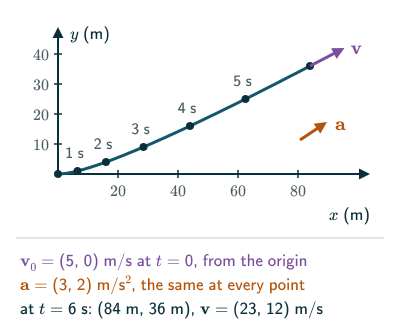
If a = 0, the particle moves uniformly on a straight line or stays at rest. For non-zero constant a, the path is a line if v0 = 0 or is parallel or antiparallel to a. Otherwise it is a parabola, as in the figure, so the same a can give either path, depending on how the motion starts (NCERT Points to Ponder 7, page 46).
Any two perpendicular axes will do (NCERT Points to Ponder 3, page 46). For a projectile in free flight near an incline of angle θ, choose x up the slope and y normal to it, away from the surface. Gravity then gives ax = −g sin θ and ay = −g cos θ. A block sliding in contact with a smooth fixed incline is different: its normal reaction cancels the perpendicular gravitational component, so its net ay = 0 and ax = −g sin θ.
Solved examples
Example 1: Where is it when x is 84 m? (NCERT Example 3.5)
A particle starts from the origin at t = 0 with velocity 5.0î m/s and has a constant acceleration (3.0î + 2.0ĵ) m/s. Find (a) its y-coordinate when its x-coordinate is 84 m, and (b) its speed then.
r = v0t + ½at = (5.0t + 1.5t)î + 1.0tĵ.
(a) 5.0t + 1.5t = 84 gives 1.5t + 5t − 84 = 0, so t = [−5 + √(25 + 504)]/3 = (−5 + 23)/3 = 6 s (4 × 1.5 × 84 = 504; the other root is negative). Then y = 1.0 × 6 = 36 m.
(b) v = (5.0 + 3.0t)î + 2.0tĵ = 23î + 12ĵ m/s at t = 6 s. Speed = √(23 + 12) = √673 ≈ 26 m/s.
Answer: y = 36 m; speed about 26 m/s (NCERT page 38).
Example 2: NCERT Exercise 3.18 (page 48)
A particle starts from the origin at t = 0 with velocity 10.0ĵ m/s and moves with constant acceleration (8.0î + 2.0ĵ) m s. (a) When is its x-coordinate 16 m, and what is its y-coordinate then? (b) What is its speed then?
x = ½ × 8.0 × t = 4t = 16, so t = 2.0 s. y = 10.0 × 2 + ½ × 2.0 × 4 = 24 m.
v = 8.0tî + (10.0 + 2.0t)ĵ = 16î + 14ĵ m/s. Speed = √(256 + 196) = √452 ≈ 21.3 m/s.
Answer: t = 2.0 s, y = 24 m; speed about 21.3 m/s.
Example 3: The highest point
A particle starts at the origin with v0 = (2î + 3ĵ) m/s and has a = −1.0ĵ m s (y upwards). When does it stop rising, and where is it then?
vy = 3 − 1.0t = 0 at t = 3 s. Then x = 2 × 3 = 6 m and y = 3 × 3 − ½ × 1 × 9 = 4.5 m, and v = 2î m/s.
Answer: at t = 3 s, at (6 m, 4.5 m), moving horizontally at 2 m/s.
Example 4: Acceleration at right angles to the initial velocity
A puck starts at the origin, sliding at 4 m/s along x on smooth ice. Model a sideways force as producing a constant acceleration of 3 m s along y. Find its velocity and position after 2 s.
x: no acceleration, so vx = 4 m/s and x = 8 m. y: from rest, vy = 3 × 2 = 6 m/s and y = ½ × 3 × 4 = 6 m.
Answer: v = (4î + 6ĵ) m/s, about 7.2 m/s; r = (8î + 6ĵ) m. For the path, put t = x/4 into y = ½ × 3t: y = 3x/32, a parabola.
Example 5: Speed without the time
v0 = (3î + 4ĵ) m/s and a = −2ĵ m s. Find the speed when the particle is 3 m above its start.
a·(r − r0) = 0 × Δx + (−2) × 3 = −6 m s, whatever Δx is. So v = 25 − 12 = 13 m s.
Check: 4t − t = 3 gives t = 1 s (v = 3î + 2ĵ) or t = 3 s (v = 3î − 2ĵ). Both give v = 13.
Answer: v ≈ 3.6 m/s, both on the way up and on the way down.
Common mistakes to avoid
Common mistake
Using different times for x and y
There is one clock. Find t from one component equation and put that same t into the other.
Common mistake
Mixing components across equations
The x-equation uses v0x and ax only. Putting ay into the x-equation is a common slip.
Common mistake
Using these equations for circular motion
They need a constant acceleration vector. In uniform circular motion the acceleration turns with the particle, so they do not apply.
Common mistake
Adding components to get the speed
v = √(vx2 + vy2), not vx + vy. In Example 1, 23 + 12 = 35, but the speed is 26 m/s.
Common mistake
Forgetting the starting position
If the particle does not start at the origin, keep x0 and y0 in the position equations.
Quick revision summary
- Constant a: v = v0 + at; r = r0 + v0t + ½at.
- In components: vx = v0x + axt, x = x0 + v0xt + ½axt, and the same for y.
- The x- and y-motions are independent one-dimensional motions linked only by the common time.
- v = v02 + 2a·(r − r0).
- Not valid when the direction of a changes, as in circular motion.
Formula sheet
- v = v + at
- r = r + vt + ½at
- vx = v0x + ax t; vy = v0y + ay t
- x = x0 + v0x t + ½ax t2; y = y0 + v0y t + ½ay t2
- v = v + 2a·(r − r)
Questions students ask
Which motions have a constant acceleration vector?
Motions with a constant acceleration vector include a projectile near the Earth’s surface with air resistance neglected (a = g, vertically downwards), a block sliding freely across a smooth inclined plane (g sin θ down the line of greatest slope) and, in Class 12, a charged particle in a uniform electric field. For all of these, the equations v = v0 + at and r = r0 + v0t + ½at hold for as long as the acceleration stays the same.
Does v = u + 2as work in two dimensions?
Yes, for constant acceleration the relation v = u + 2as holds in a plane in the vector form v = v02 + 2a·(r − r0), with a scalar product in place of as, and also separately along each axis, as vx2 = v0x2 + 2axΔx. It gives the speed but not the direction of motion. For example, a stone thrown at 10 m s in any direction (air resistance neglected) is moving at √(100 − 2 × 9.8 × 2) ≈ 7.8 m s whenever it is 2 m above the launch point, whatever the angle of the throw, provided it gets that high.
Why is the path of a particle with constant acceleration a parabola?
For non-zero constant acceleration, the path is a parabola unless the initial velocity is zero or along the acceleration line. If the acceleration itself is zero, the motion is a straight line at constant velocity (or rest). Take the y-axis along a and start at the origin: across the acceleration the motion is uniform, x = v0xt, and along it uniformly accelerated, y = v0yt + ½at. Eliminating t = x/v0x gives y = (v0y/v0x)x + ax/(2v0x2), a quadratic in x and so a parabola whenever v0x ≠ 0; projectile motion, with a = g, is the best-known case.
Can a particle with constant acceleration in a plane come to rest?
A particle with constant acceleration comes to rest, even for an instant, only if its velocity is zero to begin with or points exactly opposite to the acceleration, so that it moves along a straight line. Otherwise the part of the velocity perpendicular to a never changes, and the speed can never fall below it. For example, with v0 = 10 m s at 120° to an acceleration of 2 m s, the 5 m s component against a is cancelled after 5/2 = 2.5 s, when the speed reaches its minimum, 10 sin 120° ≈ 8.7 m s; after that the speed rises again.
Practice questions
Try each question first, then open the answer to check your working.
-
Q1. v0 = (1î + 2ĵ) m/s and a = (2î − 1ĵ) m s. Find the velocity at t = 4 s.
Show answerHide answer
v = (1 + 8)î + (2 − 4)ĵ = (9î − 2ĵ) m/s.
-
Q2. Starting from rest at the origin with a = (4î + 3ĵ) m s, how far from the origin is a particle after 2 s?
Show answerHide answer
r = ½at = ½(4î + 3ĵ) × 2 = (8î + 6ĵ) m, so it is √(8 + 6) = 10 m from the origin.
-
Q3. Why can the x- and y-motions be solved separately?
Show answerHide answer
In the component equations each axis has only its own quantities: x-motion depends on v0x and ax, y-motion on v0y and ay. The two share only the time.