Multiplying a vector by a real number
NCERT Class 11 Physics Chapter 3 Section 3.3
Quick answer
Multiplying a vector A by a real number λ gives a vector λA of magnitude |λ| times the magnitude of A. For non-zero A and λ, a positive multiplier preserves direction and a negative multiplier reverses it; if either is zero, the result is the null vector. A multiplier can carry dimensions, as in momentum as mass times velocity or displacement = constant velocity × elapsed time.
With your textbook
NCERT Physics Part I (Class 11), Chapter 3 “Motion in a Plane”, Section 3.3 “Multiplication of vectors by real numbers”, page 29.
Open the official NCERT chapter (PDF, 2.2 MB, ncert.nic.in) (opens in a new tab)
Checked against the 2026-27 reprint on .
What happens when a vector is multiplied by a number?
Multiplying a vector by a real number
Multiplying a vector A by a real number λ gives a vector λA whose
- magnitude is |λ| times the magnitude of A: |λA| = |λ|A;
- direction is the same as that of A if λ > 0, and opposite to it if λ < 0.
These direction rules apply to a non-zero A. If λ = 0 or A = 0, the result is the null vector, with no specified direction (NCERT Sections 3.3 and 3.4, pages 29–30).
Multiplying a vector A with a positive number λ gives a vector whose magnitude is changed by the factor λ but the direction is the same as that of A
NCERT Physics Part I (Class 11), Section 3.3, page 29
In plain words: multiplying by 3 makes the arrow three times as long; multiplying by ½ halves it; a minus sign turns it round. The line the arrow lies along never changes.
Positive and negative factors
NCERT’s examples (page 29, Fig. 3.3):
- 2A points the same way as A and is twice as long;
- −A has the same length as A but points the opposite way;
- −1.5A points opposite to A and is 1.5 times as long.
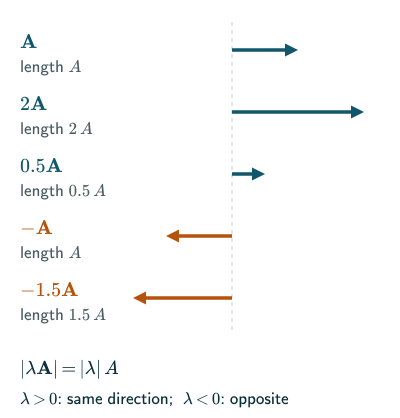
The magnitude of a vector is never negative, so for a negative factor the length is multiplied by the size of the number: |−1.5A| = 1.5A. NCERT’s summary (page 43) says the magnitude of λA is “λ times” that of A for any real λ; for negative λ it should be |λ| times. Section 3.3 itself is correct: it writes the negative number as −λ, with λ positive, so its “λ times |A|” is our |λ|A.
For non-zero A and λ, B = λA is parallel to A if λ > 0 and antiparallel if λ < 0. Drawn from a common tail, they lie on the same line. In components (NCERT Section 3.5, page 32), λA = λAxî + λAyĵ: every component is multiplied by λ. So two non-zero vectors are parallel or antiparallel exactly when their components are in the same ratio, Bx/Ax = By/Ay = λ, and the sign of λ tells you which. Take ratios only for non-zero components of A. If a component of A is zero, the same component of B must also be zero; the component equations B = λA avoid division by zero.
The negative of a vector is −B = (−1)B, and NCERT uses it to define subtraction: A − B = A + (−B) (NCERT Eq. 3.5, page 30).
Multiplying by a quantity with dimensions
The number λ can be a physical scalar with its own dimensions. Then the dimensions of λA are the product of the dimensions of λ and of A (NCERT page 29). Many laws of physics are of this form:
- displacement = constant velocity × elapsed time (NCERT’s example, page 29); for varying velocity, use the average velocity over that interval;
- momentum p = mv: a scalar mass times a velocity;
- force F = ma, from Newton’s second law: for a constant positive mass in an inertial frame, a non-zero net force points along the acceleration.
Rules of scalar multiplication
For real numbers λ and μ and vectors A and B (beyond the NCERT text, but used throughout the chapter):
- λ(A + B) = λA + λB;
- (λ + μ)A = λA + μA;
- λ(μA) = (λμ)A;
- 1A = A; 0A = 0 and λ0 = 0 (the last two are NCERT Eq. 3.4, page 30).
Dividing a vector by a non-zero number λ means multiplying by 1/λ. In particular, dividing a non-zero vector A by its own magnitude gives a vector of length 1 along A, its unit vector, so A = A n̂ (NCERT Eq. 3.10, page 32). Division by a vector is not defined. Multiplying a vector by a scalar is also not the same as the scalar product of two vectors, which gives a number.
Solved examples
Example 1: Multiples of a vector
A has magnitude 4 units and points east. Describe 3A, −2A and 0.5A.
3A: 12 units east. −2A: 8 units west. 0.5A: 2 units east.
Answer: 12 units east, 8 units west, 2 units east.
Example 2: Displacement from a constant velocity
A boat moves with a constant velocity of 5 m s towards the north-east. Find its displacement in 4 s.
Displacement = velocity × time = 4 s × (5 m s north-east) = 20 m north-east. The time, a positive scalar, changes the size and the unit but not the direction.
Answer: 20 m towards the north-east.
Example 3: Momentum
A ball of mass 0.2 kg moves at 15 m s towards the west. Find its momentum.
p = mv = 0.2 kg × (15 m s west) = 3 kg m s west.
Answer: 3 kg m s towards the west, the same direction as the velocity.
Example 4: A vector of given size along another
Find the vector of magnitude 15 units along A = 3î + 4ĵ, and the value of m for which B = mî + 8ĵ is parallel to A.
A = √(3 + 4) = 5, so n̂ = A/A = 0.6î + 0.8ĵ. 15n̂ = 9î + 12ĵ.
Parallel: m/3 = 8/4 = 2, so m = 6 and B = 2A.
Answer: 9î + 12ĵ; m = 6.
Example 5: Are these vectors parallel?
Particle P moves at 6 m s along a direction n̂, and particle Q at 9 m s in the opposite direction, that is, vP = 6n̂ m s and vQ = −9n̂ m s. Express vQ as a multiple of vP and describe it.
vP = 6n̂ m s, so vQ = −9n̂ m s = −1.5 × (6n̂ m s) = −1.5vP.
Answer: vQ = −1.5vP: antiparallel to vP and 1.5 times as fast.
Common mistakes to avoid
Common mistake
Giving a vector a negative magnitude
−A is not a vector of magnitude −A. It has magnitude A and points the other way. Magnitudes are never negative.
Common mistake
Writing |λA| = λA for negative λ
The magnitude is |λ|A. For λ = −2, |−2A| = 2A, not −2A.
Common mistake
Getting a number from zero times a vector
0A is the null vector 0, not the number 0. It is still a vector, though its direction cannot be specified.
Common mistake
Dividing by a vector
Expressions like A/B have no meaning. Only division by a scalar is defined. (The ratio of magnitudes A/B, two scalars, is fine.)
Common mistake
Thinking a multiplier with units changes the direction
Multiplying by a positive physical scalar, such as a time or a mass, keeps the direction. A constant velocity times a positive elapsed time gives a displacement in that direction; for varying motion use the interval-average velocity. A negative physical scalar does reverse it: in F = qE (Class 12), the force on an electron is opposite to the field.
Quick revision summary
- λA has magnitude |λ|A; same direction as A if λ > 0, opposite if λ < 0; 0 if λ = 0.
- B = λA means A and B are parallel (λ > 0) or antiparallel (λ < 0).
- Product dimensions multiply: constant velocity × elapsed time = displacement; mass × velocity = momentum. Dimensions can also cancel, as when dividing a vector by its magnitude.
- λ(A + B) = λA + λB; (λ + μ)A = λA + μA.
- A non-zero vector divided by its magnitude gives its unit vector: A = A n̂.
Formula sheet
- |λA| = |λ| A
- λ > 0: λA along A; λ < 0: λA opposite to A
- 0A = 0 (null vector)
- λ(A + B) = λA + λB
- A = |A| n̂ (n̂ = unit vector along A)
- displacement = constant velocity × elapsed time
Questions students ask
What is the negative of a vector, and can a vector be negative?
The negative of a vector A is −A = (−1)A, a vector with the same magnitude as A but the opposite direction, so that A + (−A) = 0; if A is 5 m s towards the north, −A is 5 m s towards the south. It is the same thing as the opposite vector, and any negative multiple of A, such as −3A, is antiparallel to it. A vector as a whole is neither positive nor negative, but its components can be: −7î + 24ĵ has a negative x-component and a magnitude of 25.
Can a unit vector be negative?
Yes, a unit vector can point in a negative direction, such as −î along the −x-axis, but its magnitude is always 1. Multiplying a unit vector n̂ by −1 reverses it without changing its length, so −n̂ is the unit vector opposite to n̂. Multiplying it by a number λ gives a vector of length |λ|, so the result is a unit vector only for λ = ±1.
Why is momentum a vector quantity?
Momentum is a vector because it is a positive scalar, the mass, multiplied by a vector, the velocity: p = mv has magnitude mv and always points in the direction of motion. A 0.5 kg ball moving at 4 m s towards the east has a momentum of 2 kg m s towards the east; moving west at the same speed, it has a different momentum, 2 kg m s towards the west. Its kinetic energy, ½mv = 4 J, is the same in both cases, because kinetic energy depends only on the speed and is a scalar.
What are the different ways of multiplying vectors?
Three vector multiplication operations used in this course are: by a scalar, and with each other as the scalar product or the vector product. Multiplying a vector by a scalar λ gives a vector λA along the same line. The scalar (dot) product, A·B = AB cos θ, is a number and gives work, while the vector (cross) product, A × B, is a vector of magnitude AB sin θ perpendicular to both and gives torque.
Practice questions
Try each question first, then open the answer to check your working.
-
Q1. A force F of 10 N acts vertically upwards. Describe the force −0.5F.
Show answerHide answer
5 N, vertically downwards: half the size, opposite direction.
-
Q2. What is the magnitude of −3A if A = 2 units?
Show answerHide answer
|−3|A = 3 × 2 = 6 units.
-
Q3. A car’s acceleration is 2 m s towards the south and its mass is 1000 kg. In which direction is the net force on it, and how large is it?
Show answerHide answer
F = ma = 1000 kg × 2 m s = 2000 N, towards the south: a positive mass keeps the direction of the acceleration.