Vector (cross) product of two vectors
NCERT Class 11 Physics Chapter 6 Section 6.5
Quick answer
The vector product of two non-parallel, non-zero vectors a and b is a vector a × b of magnitude ab sin θ, where θ is the angle between them, perpendicular to the plane of a and b, in the direction given by the right-hand rule. It is not commutative, since b × a = −a × b, and it is zero for parallel vectors. With unit vectors, i × j = k, j × k = i and k × i = j, which gives the determinant form for components.
With your textbook
NCERT Physics Part I (Class 11), Chapter 6 “Systems of Particles and Rotational Motion”, Section 6.5 “Vector product of two vectors”, pages 101–103.
Open the official NCERT chapter (PDF, 4.2 MB, ncert.nic.in) (opens in a new tab)
Checked against the 2026-27 reprint on .
What is the vector product?
Definition (NCERT Section 6.5)
A vector product of two vectors a and b is a vector c such that
NCERT Physics Part I (Class 11), Section 6.5, page 102
- its magnitude is c = ab sin θ, where θ is the angle between a and b;
- it is perpendicular to the plane containing a and b;
- its direction is given by the right-handed screw rule (or, equivalently, the right-hand rule).
In plain words: the vector product (or cross product) of two vectors is a new vector, at right angles to both of them. For fixed non-zero magnitudes, its size is largest when the two vectors are at right angles and zero when they are parallel or antiparallel (θ = 0° or 180°). It is written a × b, read “a cross b”.
On this page, as in NCERT, a vector is written in bold, a, and its magnitude in italics, a. The unit vectors along the x, y and z axes are , and .
Vector (cross) product
Compare the scalar product, a · b = ab cos θ, which gives a number. The two products answer different questions: the scalar product measures how much two vectors point along each other; the vector product measures how much they point across each other, and in which sense they turn.
The right-hand rule
For non-zero, non-parallel vectors, the magnitude leaves two possible directions, both perpendicular to their plane. If either input is zero or the inputs are parallel or antiparallel, the product is the zero vector and has no defined direction. The right-hand rule picks one.
Open up your right hand palm and curl the fingers pointing from a to b. Your stretched thumb points in the direction of c.
NCERT Physics Part I (Class 11), Section 6.5, page 102
NCERT’s definition itself uses the right-handed screw rule: hold a screw at right angles to the plane of a and b and turn its head from a towards b; the screw advances in the direction of c.
There are two angles between any two vectors, θ and 360° − θ. Always turn from the first vector to the second through the smaller angle, less than 180°.
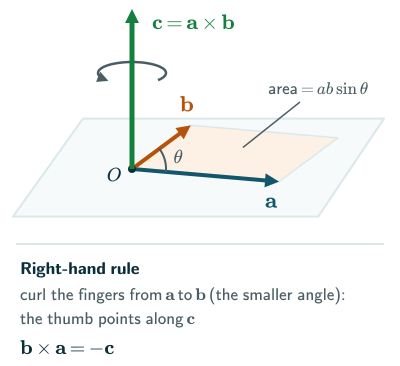
Area. The magnitude ab sin θ is the base a times the height b sin θ of the parallelogram with sides a and b. So |a × b| is the area of that parallelogram, and half of it is the area of the triangle with sides a and b (NCERT Exercise 6.4).
Properties of the vector product
It is not commutative. Turning from b to a is the opposite sense to turning from a to b, so the thumb points the other way:
Order matters
It is not associative: (a × b) × c is in general not a × (b × c). For example, , but . Keep the brackets.
It is distributive over addition, just like the scalar product:
Parallel vectors give zero. If θ is 0° or 180°, sin θ = 0, so a × b = 0, the null vector. In particular a × a = 0. For two non-zero vectors, a zero cross product is the quick test for parallel or antiparallel directions.
For two polar vectors, the product is unchanged by spatial inversion. NCERT takes reflection to mean x → −x, y → −y, z → −z (strictly, an inversion through the origin; a single plane mirror reverses only one coordinate). Then a becomes −a and b becomes −b, but (−a) × (−b) is a × b:
Thus, a × b does not change sign under reflection.
NCERT Physics Part I (Class 11), Section 6.5, page 102
So the vector product behaves differently from an ordinary vector such as a displacement. The cross product of two polar vectors gives an axial vector, such as torque or angular momentum (a term beyond the NCERT text).
Unit vectors. From the definition, with the axes forming a right-handed set:
Reverse the order and the sign changes: , and so on. An easy way to remember: going round the cycle i → j → k → i gives a plus sign; going against it gives a minus sign.
Vector product in component form
Write a = ax + ay + az and b in the same way. Multiply out with the distributive law. The three terms like axbx() vanish, and the six that remain, two from each component of a, are
Adding the three rows and collecting the terms of each unit vector gives the components of a × b:
Components of a × b
This is the expansion of a determinant, which is easier to remember:
Expand along the top row: cover the row and column of each unit vector and take the cross-difference of the 2 × 2 block left: (top-left × bottom-right) − (top-right × bottom-left). For this gives aybz − azby. The middle () term then takes a minus sign. For vectors in the xy-plane (az = bz = 0), only the term survives: a × b = (axby − aybx).
Where the vector product is used
- Torque, the turning effect of a force about a point: τ = r × F.
- Angular momentum of a particle about a point: l = r × p.
- Velocity in rotation: a point at position r on a body turning with angular velocity ω moves with v = ω × r.
- Areas and perpendiculars: the area of a parallelogram or triangle, and a unit vector perpendicular to two non-parallel, non-zero vectors, (a × b)/|a × b|.
- In Class 12, the magnetic force on a moving charge, F = qv × B.
Solved examples
Example 1: Scalar and vector products together
This is NCERT Example 6.4 (page 103). Find the scalar and vector products of a = 3 − 4 + 5 and b = −2 + − 3.
Scalar product: (3)(−2) + (−4)(1) + (5)(−3) = −6 − 4 − 15 = −25.
Vector product: by components,
- x: aybz − azby = (−4)(−3) − (5)(1) = 7;
- y: azbx − axbz = (5)(−2) − (3)(−3) = −1;
- z: axby − aybx = (3)(1) − (−4)(−2) = −5.
Answer: a · b = −25 and a × b = 7 − − 5; then b × a = −7 + + 5. Check: (a × b) · a = 21 + 4 − 25 = 0, so the product is indeed perpendicular to a.
Example 2: Area of a parallelogram and a triangle
Find the area of the parallelogram with sides a = 2 + 3 and b = + 4 (in metres), and of the triangle with the same two sides.
Both vectors lie in the xy-plane, so only the term survives:
Answer: the parallelogram has area 5 m, and the triangle half of it, 2.5 m.
Example 3: A unit vector perpendicular to two vectors
Find a unit vector perpendicular to both a = + and b = + .
With (ax, ay, az) = (1, 1, 0) and (bx, by, bz) = (0, 1, 1):
- x: (1)(1) − (0)(1) = 1;
- y: (0)(0) − (1)(1) = −1;
- z: (1)(1) − (1)(0) = 1.
So a × b = − + .
Its magnitude is √3, so the unit vector is ( − + )/√3. Check: its dot product with a is 1 − 1 + 0 = 0, and with b is 0 − 1 + 1 = 0.
Answer: ( − + )/√3, or its negative: both are perpendicular to a and b.
Common mistakes to avoid
Common mistake
Swapping the order freely
a × b and b × a have the same size but opposite directions. In torque and angular momentum the order is always r first.
Common mistake
Getting the middle term’s sign wrong
In the determinant, the term carries a minus sign: it is (azbx − axbz), not (axbz − azbx). Check the answer by dotting it with a or b: the result must be zero.
Common mistake
Using the cross product alone to find an angle
From |a × b| = ab sin θ, the angle could be θ or 180° − θ, since both have the same sine. Use the scalar product (cos θ) to fix the angle.
Common mistake
Writing the product of parallel unit vectors as 1
is the null vector 0, not 1; it is that equals 1. And is −, not +.
Common mistake
Turning through the larger angle
The right-hand rule uses the smaller angle between the vectors, less than 180°.
Quick revision summary
- The vector product a × b is a vector of magnitude ab sin θ, perpendicular to the plane of a and b, in the direction given by the right-hand rule.
- Its magnitude is the area of the parallelogram with sides a and b.
- It is not commutative (b × a = −a × b) but it is distributive; parallel vectors give 0.
- The cross product of two polar vectors is unchanged by spatial inversion; this is the sense of “reflection” used in NCERT’s statement.
- Unit vectors: and cyclically; the reverse order gives a minus sign; a unit vector crossed with itself gives 0.
- In components it is the determinant of the unit vectors and the two vectors’ components.
Formula sheet
- |a × b| = ab sin θ
- b × a = −a × b
- a × a = 0
- i × j = k, j × k = i, k × i = j
- a × b = (ay bz − az by)i + (az bx − ax bz)j + (ax by − ay bx)k
- area of parallelogram = |a × b|
Questions students ask
At what angle is the cross product of two vectors equal in magnitude to their dot product?
The magnitude of the cross product equals the dot product, |a × b| = a · b, for non-zero vectors when the angle between them is 45°: ab sin θ = ab cos θ gives tan θ = 1. The same method answers other versions of this exam question: if |a × b| = √3 (a · b), then tan θ = √3 and θ = 60°. If only the sizes must match, |a · b| = |a × b|, then 135° works as well.
How do you find the cross product of two vectors in 2D?
For two vectors in the xy-plane, with components (ax, ay) and (bx, by), the cross product a × b points along the z-axis, and its only component is axby − aybx. A positive value means that b lies anticlockwise from a (turning through the smaller angle, seen from the +z side), and a negative value means clockwise. For example, for a = (4, 1) and b = (1, 3) the z-component is 4 × 3 − 1 × 1 = 11, so the parallelogram they span has an area of 11 square units.
Is the cross product of two unit vectors a unit vector?
The cross product of two unit vectors is a unit vector only if they are perpendicular: its magnitude is 1 × 1 × sin θ = sin θ, which equals 1 only at θ = 90°, as for the unit vectors along x and y, whose cross product is the unit vector along z. For two unit vectors 60° apart its magnitude is sin 60° ≈ 0.87, and for parallel unit vectors it is the null vector.
What is the unit of the cross product of two vectors?
The cross product of two vectors has the product of their units, because its magnitude is ab sin θ and sin θ has no unit. So r × F, a torque, is in N m; r × p, an angular momentum, is in kg m s; and two displacements in metres give an area in m. For vectors that are pure numbers, the cross product has no unit.
What is the difference between the right-hand rule and the right-hand thumb rule?
The right-hand rule of the cross product and the right-hand thumb rule of magnetism use the same curled right hand but read it differently: for a × b the fingers curl from a to b through the smaller angle and the thumb gives the direction of the product, while in the thumb rule, met in Class 10, the thumb points along a current and the curled fingers give the direction of its magnetic field lines. Fleming’s left-hand and right-hand rules are different again: they use three fingers held at right angles, for the force on a current-carrying conductor in a magnetic field and for the current induced in a conductor moving through one.
Practice questions
Try each question first, then open the answer to check your working.
-
Q1. Two vectors of magnitudes 3 and 4 make an angle of 30° with each other. Find the magnitude of their vector product.
Show answerHide answer
ab sin θ = 3 × 4 × sin 30° = 12 × 0.5 = 6.
-
Q2. Find and .
Show answerHide answer
= − (against the cycle). By the distributive law, = = − + , that is − .
-
Q3. Show that the vector product of a = 2 − 3 + 4 and b = −4 + 6 − 8 is zero. What does this tell you?
Show answerHide answer
b = −2a, so a × b = −2(a × a) = 0. By components: (−3)(−8) − (4)(6) = 0, (4)(−4) − (2)(−8) = 0 and (2)(6) − (−3)(−4) = 0. The vectors are parallel (here, antiparallel).