Dynamics of rotation about a fixed axis
NCERT Class 11 Physics Chapter 6 Section 6.11
Quick answer
For rotation about a fixed axis, the total external torque about the axis equals the moment of inertia times the angular acceleration, τ = Iα (for a rigid body, with I constant), the rotational form of Newton’s second law. A torque does work dW = τ dθ and delivers power P = τω, and this work changes the rotational kinetic energy ½Iω. Torque, moment of inertia and angular velocity play the roles of force, mass and velocity in linear motion.
With your textbook
NCERT Physics Part I (Class 11), Chapter 6 “Systems of Particles and Rotational Motion”, Section 6.11 “Dynamics of rotational motion about a fixed axis”, pages 118–120.
Open the official NCERT chapter (PDF, 4.2 MB, ncert.nic.in) (opens in a new tab)
Checked against the 2026-27 reprint on .
What is rotational dynamics?
Torque and angular acceleration in NCERT’s words
The angular acceleration is directly proportional to the applied torque and is inversely proportional to the moment of inertia of the body.
NCERT Physics Part I (Class 11), Section 6.11, page 120
In plain words: for rotation about a fixed axis, torque does what force does in straight-line motion, and moment of inertia does what mass does. A larger torque gives a larger angular acceleration; a larger moment of inertia gives a smaller one. This is the rotational form of Newton’s second law:
Second law for rotation about a fixed axis
Here τ is the total external torque about the axis, I the moment of inertia about the same axis and α the angular acceleration. This page derives it, and the rules for work and power in rotation, as NCERT does.
Which torques count
Since the axis is fixed, only those components of torques, which are along the direction of the fixed axis need to be considered in our discussion.
NCERT Physics Part I (Class 11), Section 6.11, page 118
The bearings constrain the rotation axis. For a balanced body rotating about a principal axis, net transverse torque is zero. For an unbalanced body, however, the bearings can supply the non-zero transverse torque needed to turn its transverse angular momentum; they do not simply cancel every transverse torque. The axial component alone determines the fixed-axis angular acceleration. So, for a body turning about a fixed axis:
- only force components in planes perpendicular to the axis contribute to the axial torque; a force parallel to the axis has no torque along it;
- only the parts of the position vectors perpendicular to the axis matter.
In practice, the torque of a force about the axis is the force (its part perpendicular to the axis) times the perpendicular distance of its line of action from the axis (the moment arm), with a sign for the sense of turning.
Work and power in rotational motion
Let a force F1, in a plane perpendicular to the axis, act on a particle at distance r1 from the axis. When the body turns through a small angle dθ, the particle moves along its circle through ds1 = r1dθ, along the tangent. The work done is the component of the force along the tangent times ds1. That component is F1 sin β1, where β1 is the angle between F1 and the radius (NCERT writes α1 for this angle, which is not an angular acceleration, and φ1 for the angle with the tangent; φ1 + α1 = 90°), so
because r1F1 sin β1 is the torque of F1 about the axis. All particles turn through the same dθ, so adding the work of all the forces gives
Work done by a torque
where τ is the total torque about the axis. For a constant torque, W = τθ, where θ here denotes the angular displacement from the initial orientation. This is the rotational counterpart of dW = F ds. (In NCERT’s derivation on page 119, with O the origin on the axis and C the centre of the circle of P1, the line “OP1 = OC + OP1” should read OP1 = OC + CP1: the position vector of P1 splits into a part along the axis and the radius CP1.)
Dividing by dt gives the rate of doing work:
Power in rotation
just as P = Fv in linear motion.
Torque and angular acceleration
In the ideal fixed-axis rigid-body model, there is no deformation and the internal constraint forces do no net work. External work therefore changes the rotational kinetic energy, ½Iω. With I constant, its rate of increase is
Setting this equal to the power τω, then cancelling ω when it is non-zero:
This assumes I does not change: the mass is fixed, the body stays rigid and the axis keeps its place in the body. At an instant of rest the cancellation is unavailable, but the angular-momentum derivation still gives the same result. It follows from angular momentum, L = Iω, in the next section of NCERT.
Two useful tools:
- Work-energy theorem for rotation. The work done by the total torque equals the change in rotational kinetic energy: W = ½Iω − ½Iω02 (Example 1).
- Strings and pulleys. When a string wound on a wheel does not slip, the string’s acceleration a and the wheel’s angular acceleration are linked by a = Rα (Example 3).
Comparing linear and rotational motion
NCERT’s Table 6.2 sets the two side by side (it prints the rotational work as W = τ dθ; it should be dW):
| Linear motion | Rotation about a fixed axis |
|---|---|
| displacement x | angular displacement θ |
| velocity v = dx/dt | angular velocity ω = dθ/dt |
| acceleration a = dv/dt | angular acceleration α = dω/dt |
| mass M | moment of inertia I |
| force F = Ma | torque τ = Iα |
| work dW = F ds | work dW = τ dθ |
| kinetic energy Mv/2 | kinetic energy Iω/2 |
| power P = Fv | power P = τω |
| momentum p = Mv | angular momentum L = Iω |
One difference matters: a body’s mass is fixed, but its moment of inertia depends on the axis and can change if the body changes shape. When I changes, use dL/dt = τ, not τ = Iα.
Solved examples
Example 1: A cord unwinding from a flywheel
This is NCERT Example 6.12 (page 120). A cord of negligible mass is wound round the rim of a uniform-disc flywheel of mass 20 kg and radius 20 cm, mounted on a frictionless horizontal axle. A steady pull of 25 N is applied to the cord. Find (a) the angular acceleration, (b) the work done by the pull when 2 m of cord unwinds, and (c) the kinetic energy of the wheel then, starting from rest.
(a) The torque is FR = 25 × 0.20 = 5.0 N m, and the flywheel (a disc) has I = MR/2 = ½ × 20 × 0.2 = 0.4 kg m. So
(b) W = F × distance = 25 × 2 = 50 J (or W = τθ = 5.0 × 10 = 50 J, with θ from part (c)).
(c) 2 m of cord on a rim of radius 0.2 m means θ = 2/0.2 = 10 rad. From the equation of rotation ω = 0 + 2αθ = 2 × 12.5 × 10 = 250, the kinetic energy is ½Iω = ½ × 0.4 × 250 = 50 J.
Answer: 12.5 rad s; 50 J; 50 J. The two energies agree: with no friction, all the work of the pull becomes rotational kinetic energy.
Example 2: Power from torque
(a) To keep a rotor turning at a steady 200 rad s, an engine must supply a torque of 180 N m against friction (NCERT Exercise 6.14). What power does it need? (b) A grinding wheel with I = 2.0 kg m is brought from rest to 30 rad s in 10 s by a constant net torque. Neglect bearing friction and find the torque, the work done and the average power.
(a) P = τω = 180 × 200 = 36 000 W = 36 kW.
(b) α = 30/10 = 3 rad s, so τ = Iα = 2.0 × 3 = 6.0 N m. The work equals the kinetic energy gained: ½ × 2.0 × 30 = 900 J. Average power = 900/10 = 90 W. The instantaneous power τω rises from 0 to 6.0 × 30 = 180 W; the average is half of that, because ω grows uniformly.
Answer: (a) 36 kW; (b) 6.0 N m, 900 J and 90 W.
Example 3: A block hanging from a wheel
A light string wound on a uniform disc of mass 4 kg and radius 0.1 m, free to turn on a fixed frictionless axle, carries a 2 kg block. The block is released. Find its acceleration, the tension and the disc’s angular acceleration. Take g = 9.8 m s.
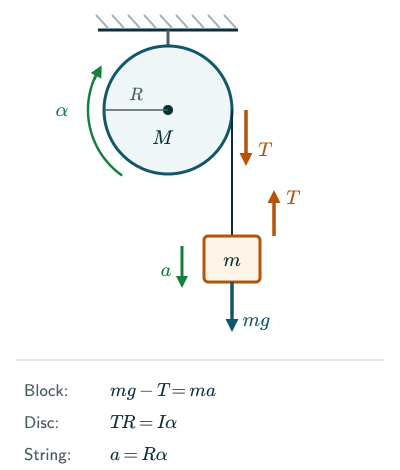
For the block (down positive): mg − T = ma. For the disc: TR = Iα with I = MR/2. The string does not slip, so a = Rα. From the last two, T = Iα/R = (M/2)a. Then mg = (m + M/2)a:
So T = (M/2)a = 2 × 4.9 = 9.8 N, and α = a/R = 4.9/0.1 = 49 rad s.
Answer: 4.9 m s, 9.8 N and 49 rad s. The block falls more slowly than g because part of the energy goes into turning the disc; the tension is less than mg (19.6 N).
Common mistakes to avoid
Common mistake
Using torque and moment of inertia about different axes
In τ = Iα, both must be about the same fixed axis.
Common mistake
Taking the tension equal to the weight
If the block accelerates downward under its weight and an upward tension, T is less than mg. For upward acceleration, T is greater than mg. Write a separate equation for each body, then link them with a = Rα.
Common mistake
Forgetting rotational kinetic energy
When a pulley or wheel turns, part of the energy goes into ½Iω. Energy conservation that ignores it gives too large a speed for the falling block.
Common mistake
Using τ = Iα when I changes
If the body changes shape, or the axis moves within it, use the rate of change of angular momentum instead.
Common mistake
Multiplying the whole force by the radius
The torque of a force about the axis is the force times the perpendicular distance of its line of action from the axis (the moment arm, r times the sine of the angle between the force and the radius). Only a force along the tangent, like a string unwinding from a rim, gives simply FR.
Quick revision summary
- The torque component along the fixed axis determines the angular acceleration; bearings enforce the axis constraint and may supply non-zero transverse torque.
- The work done by a torque is dW = τ dθ, and the power is P = τω.
- Equating power to the rate of increase of ½Iω gives τ = Iα, the second law for rotation about a fixed axis, valid while I is constant.
- Torque, moment of inertia, angular velocity and angular momentum play the roles of force, mass, velocity and momentum (NCERT’s Table 6.2).
- In string-and-wheel problems, write F = ma for each block, τ = Iα for each wheel, and link them with a = Rα.
Formula sheet
- τ = Iα (fixed axis)
- dW = τ dθ; W = τθ (constant τ)
- P = τω
- W = ½Iω − ½Iω (work-energy theorem)
- a = Rα (string on a wheel, no slipping)
Questions students ask
What is the difference between torque and power?
Torque is the turning effect of a force, in N m, while power is the rate at which work is done, in watts; for a body turning at angular speed ω they are linked by P = τω. So the same power can come as a large torque at low speed or a small torque at high speed, which is the trade that gears make. For example, a 1.5 kW motor running at 3000 rpm (100π rad s) supplies a torque of 1500/(100π) ≈ 4.8 N m; geared down to 300 rpm without losses, it gives about 48 N m.
Why are torque and work different, though both are measured in N m?
Torque and work have the same dimensions, [M L T], but they are different quantities: torque, τ = r × F, is a vector that measures the turning effect of a force at an instant, while work is a scalar, the energy transferred when the body actually turns. The two are linked by W = τθ for a constant torque, with θ in radians, so a torque on a nut too tight to move does no work at all. To keep them apart, torque is written in N m and work in joules.
Does a larger torque mean a larger angular velocity?
No, a larger torque does not mean a larger angular velocity: torque sets how fast the angular velocity changes, τ = I dω/dt for a rigid body turning about a fixed axis, not the angular velocity itself. A wheel on frictionless bearings can spin fast with no torque on it, and a large torque can act on a body that is at rest at the instant it starts. This is the rotational form of the rule that a force causes acceleration, not velocity.
Practice questions
Try each question first, then open the answer to check your working.
-
Q1. Torques of equal size act on a hollow cylinder and a solid sphere of the same mass and radius, about the cylinder’s axis and a diameter of the sphere. Which gains the greater angular speed in a given time? (NCERT Exercise 6.10.)
Show answerHide answer
The sphere (taking a thin-walled cylinder, both starting from rest). Its moment of inertia, 2MR/5, is less than the cylinder’s MR, so for the same torque its angular acceleration τ/I is 2.5 times as large, and so is its angular speed after the same time.
-
Q2. A rope of negligible mass is wound round a thin-walled hollow cylinder of mass 3 kg and radius 40 cm, mounted on a fixed frictionless central axle. What is the angular acceleration of the cylinder if the rope is pulled with a force of 30 N? What is the linear acceleration of the rope? The rope does not slip. (NCERT Exercise 6.13.)
Show answerHide answer
I = MR = 3 × 0.16 = 0.48 kg m and τ = 30 × 0.4 = 12 N m, so α = 12/0.48 = 25 rad s. The rope’s acceleration is Rα = 0.4 × 25 = 10 m s.
-
Q3. A wheel with I = 0.5 kg m turns at 40 rad s. A brake brings it to rest in 8 s with a constant torque. Find the torque and the work done by the brake.
Show answerHide answer
α = −40/8 = −5 rad s, so the braking torque is Iα = 0.5 × (−5) = −2.5 N m, that is 2.5 N m opposing the rotation. The work done by the brake is the change in kinetic energy: 0 − ½ × 0.5 × 40 = −400 J.