Equilibrium of a rigid body
NCERT Class 11 Physics Chapter 6 Section 6.8
Quick answer
A rigid body is in mechanical equilibrium when the total external force and the total external torque on it are both zero, so that its total linear and angular momenta stay constant in an inertial frame. For a lever this gives the principle of moments, dF = dF, where each force is multiplied by its distance from the fulcrum. The centre of gravity is the point about which the total torque of gravity is zero; in uniform gravity it coincides with the centre of mass.
With your textbook
NCERT Physics Part I (Class 11), Chapter 6 “Systems of Particles and Rotational Motion”, Section 6.8 “Equilibrium of a rigid body”, pages 109–114.
Open the official NCERT chapter (PDF, 4.2 MB, ncert.nic.in) (opens in a new tab)
Checked against the 2026-27 reprint on .
When is a rigid body in equilibrium?
Mechanical equilibrium in NCERT’s words
A rigid body is said to be in mechanical equilibrium, if both its linear momentum and angular momentum are not changing with time, or equivalently, the body has neither linear acceleration nor angular acceleration.
NCERT Physics Part I (Class 11), Section 6.8, page 109
In the problems here, equilibrium means constant total linear and angular momentum in an inertial frame. Static examples include a book, bridge or balanced see-saw at rest. An ideal balanced fan spinning steadily about a principal axis has constant angular momentum too, even though its orientation changes. The quoted equivalence with zero angular acceleration applies to the simple fixed/principal-axis model; a general asymmetric torque-free body can change its angular velocity while angular momentum stays fixed.
A particle needs only one condition, zero net force, as on the page on equilibrium of a particle. A rigid body needs two, because forces can also turn it.
On this page, as in NCERT, a vector is written in bold, F or τ, and its magnitude in italics.
The two conditions of equilibrium
The external forces change the body’s linear momentum (dP/dt = Fext) and their torques change its angular momentum (dL/dt = τext). For neither to change:
Conditions for equilibrium of a rigid body
The first is the condition for translational equilibrium; the second, for rotational equilibrium. Each vector equation is three scalar equations, so there are six conditions in all.
In most problems all the forces lie in one plane. Then only three conditions are left:
- the sum of the force components along x is zero;
- the sum of the force components along y is zero;
- the sum of the torques about an axis perpendicular to the plane is zero: anticlockwise moments balance clockwise ones.
Which point to take moments about? If the total force is zero, the total torque is the same about every point, so the rotational condition can be checked about any convenient point. A good choice is a point where an unknown force acts: its torque there is zero and it drops out of the equation, as in Examples 2 and 3.
Partial equilibrium. A body can satisfy one condition and not the other. Take a rod of finite mass with two equal forces at its ends, both at right angles to it:
- If both forces point the same way, their moments about the middle are equal and opposite, so the rod is in rotational equilibrium, but the net force 2F accelerates it.
- If they point opposite ways, the net force is zero, so it is in translational equilibrium, but both moments turn it the same way: it starts to spin without moving as a whole.
Couples
A pair of forces of equal magnitude but acting in opposite directions with different lines of action is known as a couple or torque. A couple produces rotation without translation.
NCERT Physics Part I (Class 11), Section 6.8, page 110
Fingers turning the lid of a bottle apply a couple; so do the Earth’s magnetic forces on the two poles of a compass needle that is not pointing north-south, and two hands on a steering wheel.
NCERT Example 6.7 (page 111) shows that the moment of a couple is the same about every point. If −F acts at A and F at B, with position vectors r1 and r2 respectively from any origin, the total moment is r1 × (−F) + r2 × F = (r2 − r1) × F, which is AB × F. The origin has dropped out. Its magnitude is Fd, where d is the perpendicular distance between the two lines of action.
Principle of moments
An ideal lever is a light rod pivoted at a point along its length, the fulcrum. A see-saw is the standard example. Let two parallel forces F1 and F2 act at right angles to the lever at distances d1 and d2 from the fulcrum, on opposite sides, and let R be the reaction of the support at the fulcrum.
- Translational equilibrium: R − F1 − F2 = 0.
- Rotational equilibrium, taking moments about the fulcrum (where R has no moment): d1F1 − d2F2 = 0.
Principle of moments
In words: load arm × load = effort arm × effort. Here F1 is the load to be lifted, at the load arm d1, and F2 is the effort, at the effort arm d2. The ratio of load to effort is the mechanical advantage:
Mechanical advantage of a lever
If the effort arm is longer than the load arm, M.A. is more than 1, and a small effort lifts a large load. Crowbars, scissors, bottle openers and the beam of a balance are all levers. For parallel forces making the same non-zero angle with the lever, both moment arms acquire the same sine factor, which cancels. If the forces act along the lever, both moments vanish and moment balance alone gives no force ratio. The metre-scale experiment in the JEE Main and NEET syllabuses uses the same principle to find an unknown mass.
Centre of gravity
Balance a piece of cardboard on the tip of a pencil. There is one point G where it stays level. The upward push of the pencil equals the weight Mg, so the card is in translational equilibrium; it does not tip, so the torques of the weights of all its particles about G add up to zero.
We may therefore, define the CG of a body as that point where the total gravitational torque on the body is zero.
NCERT Physics Part I (Class 11), Section 6.8.2, page 112
If g is the same at every particle, it comes out of the sum: the total torque about G is (Σmiri) × g, with each ri measured from G. At the centre of mass, Σmiri = 0, so this torque is zero for every orientation: the whole weight can be taken to act at the centre of mass. A zero cross product in one orientation alone does not prove that the sum is zero; a non-zero vector parallel to g also gives zero torque. The centre of gravity is identified by the body-fixed point that works for all orientations in uniform gravity.
The centre of gravity of a body coincides with its centre of mass only if the gravitational field does not vary from one part of the body to the other.
NCERT Physics Part I (Class 11), Chapter 6, Points to Ponder, page 124
Uniform gravity guarantees coincidence. In a non-uniform field the effective gravitational point may differ from the centre of mass, although special symmetric configurations can still coincide. In general there may be no single centre of gravity valid for every orientation. The centre of mass depends only on the mass distribution; gravitational torque also depends on the field.
Finding the centre of gravity of a flat body. Hang the body from a point A and let it come to rest. Its weight and the pull at A must have the same line of action (otherwise they would form a couple), so the vertical line through A passes through G. Mark that line, hang the body from another point B, and mark again. G is where the lines cross; a third point C checks it.
Solved examples
Example 1: A crowbar
A light crowbar 1.5 m long is held horizontal on a fulcrum 0.3 m from one end, where a 600 N load presses down. What vertical effort at the other end just lifts the load? What is the mechanical advantage?
The load arm is 0.3 m and the effort arm 1.5 − 0.3 = 1.2 m. By the principle of moments,
Answer: 150 N, with M.A. = 600/150 = 4, equal to 1.2/0.3.
Example 2: A bar on two knife-edges
This is NCERT Example 6.8 (page 113). A uniform metal bar 70 cm long, of mass 4.00 kg, rests on two knife-edges K1 and K2, each 10 cm from an end. A 6.00 kg load hangs 30 cm from one end, A. Find the reactions at the knife-edges. Take g = 9.8 m s.
The bar’s weight acts at its middle G, 35 cm from end A; the load hangs at P, 30 cm from A, so PG = 5 cm. K1 is the knife-edge 10 cm from A and K2 the one 10 cm from the other end; each is 25 cm from G. (NCERT writes the weights as “4.00 kg” and “6.00 kg”; it means the masses, and uses weights of 4.00g N and 6.00g N.)
Forces: R1 + R2 = 10.00g = 98.0 N.
Moments about G: the load is 5 cm from G on the K1 side, so 0.25R2 + 0.05 × 6.00g = 0.25R1, which gives R1 − R2 = 1.2g = 11.76 N.
Adding and subtracting the two equations:
Check by taking moments about K1 instead, which removes R1 at once: 0.50R2 = 0.25 × 4.00g + 0.20 × 6.00g, so R2 = 4.4g = 43.12 N.
Answer: about 55 N at the knife-edge nearer the load and 43 N at the other.
Example 3: A ladder against a smooth wall
This is NCERT Example 6.9 (pages 113–114). A ladder 3 m long, of mass 20 kg, leans against a frictionless wall with its foot on the floor 1 m from the wall. Find the reaction forces of the wall and the floor. Take g = 9.8 m s.
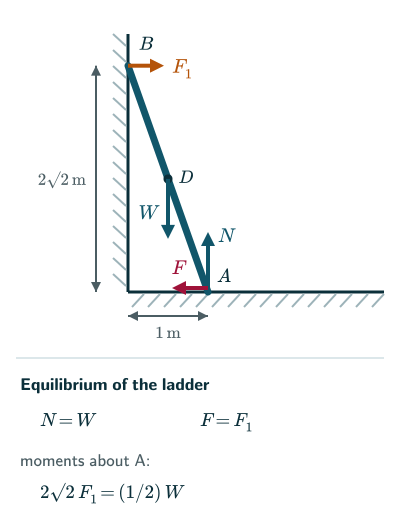
The top B is at a height √(3 − 1) = 2√2 m. The forces are the weight W = 20 × 9.8 = 196 N at the middle D; the wall’s push F1 at B, horizontal, because the wall is smooth; and the floor’s force at A, with a normal part N up and friction F towards the wall.
Forces: vertically, N = W = 196 N; horizontally, F = F1.
Moments about A (where N and F have no moment): F1 acts 2√2 m above A, and W acts 0.5 m horizontally from A, so
So F = 34.6 N too, and the floor’s total force is √(196 + 34.6), about 199 N, at tan(196/34.6), about 80°, to the horizontal.
A check: three coplanar, non-parallel forces in equilibrium must have concurrent lines of action. The lines of F1 and W meet 0.5 m from the wall at the height of B, so the floor’s force points from A to that point, at tan(2√2/0.5) = tan(4√2), about 80°, as found.
Answer: the wall pushes with 34.6 N; the floor pushes with about 199 N at about 80° to the floor (196 N up and 34.6 N of friction towards the wall).
Common mistakes to avoid
Common mistake
Checking only the forces
Zero net force does not mean equilibrium: a couple has zero net force but turns the body. Both conditions are needed.
Common mistake
Using the distance to the point where the force acts
A moment is force times the perpendicular distance from the point to the line of action. For a force at an angle, use the perpendicular distance or the perpendicular component.
Common mistake
Taking moments about an awkward point
Any point works once the forces balance, so choose one where unknown forces act; they then drop out, as at the foot of the ladder.
Common mistake
Putting the weight at the end or the support
For a uniform bar the weight acts at its middle; in general it acts at the centre of gravity.
Common mistake
Writing the floor’s friction as μN
Static friction takes whatever value equilibrium needs, up to μsN. In Example 3 it is 34.6 N, and the ladder stays put only if μs ≥ F1/N = 34.6/196, about 0.18.
Common mistake
Giving a smooth wall a frictional force
A smooth (frictionless) surface can push only at right angles to itself. The ladder needs friction at the floor, not at the wall.
Quick revision summary
- A rigid body is in mechanical equilibrium when the total external force and the total external torque on it are both zero.
- For forces in one plane this gives three equations: two for force components and one for moments.
- With zero total force, the total torque is the same about any point; take moments where unknown forces act.
- A couple, two equal and opposite forces with different lines of action, gives rotation without translation; its moment Fd is the same about every point.
- Principle of moments for a lever: load × load arm = effort × effort arm; M.A. = load/effort = effort arm/load arm.
- The centre of gravity is the point about which the total gravitational torque is zero; in uniform gravity it is the centre of mass.
Formula sheet
- ΣF = 0 and Στ = 0 (equilibrium of a rigid body)
- moment of a couple = Fd
- dF = dF (principle of moments)
- M.A. = F/F = d/d
Questions students ask
What is the difference between a couple and a torque?
Torque is the turning effect of any force about a point, τ = r × F, while a couple is one particular source of torque: two equal and opposite forces with different lines of action. A single force usually both pushes a body and turns it, and its torque depends on the point chosen; a couple has zero net force, so it only turns the body, and its moment, Fd, is the same about every point. So every couple exerts a torque, but not every torque comes from a couple. (NCERT sometimes uses “couple” loosely to mean torque.)
What are the SI unit and dimensional formula of the moment of a couple?
The moment of a couple is a torque, so its SI unit is the newton metre, N m, and its dimensional formula is [M L T]. Its magnitude is Fd, one of the forces times the perpendicular distance between their lines of action, and it is a vector at right angles to the plane of the two forces. For example, two forces of 15 N on parallel lines 0.2 m apart form a couple of moment 15 × 0.2 = 3 N m.
What is the condition for stable equilibrium of a rigid body?
For a body supported under gravity with no other destabilising forces, equilibrium is stable if a small allowed displacement produces a restoring gravitational torque; this happens when the displacement raises its centre of gravity, so that its potential energy is at a minimum. If a slight tilt lowers the centre of gravity, as for a pencil balanced on its point, the equilibrium is unstable; if the height does not change, as for a ball on a level floor, it is neutral. A body on a base stays upright while the vertical through its centre of gravity falls inside the base, so a low centre of gravity and a wide base resist toppling.
Practice questions
Try each question first, then open the answer to check your working.
-
Q1. A child of mass 30 kg sits 2 m from the pivot of a see-saw. Where must a child of mass 40 kg sit, on the other side, to balance it? Neglect the mass of the plank.
Show answerHide answer
Moments about the pivot balance: 30g × 2 = 40g × d, so d = 60/40 = 1.5 m from the pivot. The heavier child sits nearer the pivot.
-
Q2. A car of mass 1800 kg has its front and back axles 1.8 m apart, and its centre of gravity is 1.05 m behind the front axle. Assume the car is at rest with equal left/right loading on each axle; find the force exerted by the level ground on each front wheel and each back wheel. Take g = 9.8 m s. (NCERT Exercise 6.9.)
Show answerHide answer
The total upward force is 1800 × 9.8 = 17 640 N. Moments about the centre of gravity: Rf × 1.05 = Rb × 0.75, where Rf and Rb are the totals on the front and back axles. So Rf = 17 640 × 0.75/1.8 = 7350 N and Rb = 10 290 N. Each front wheel carries about 3675 N and each back wheel about 5145 N.
-
Q3. Two forces of 10 N, equal and opposite, act on a body along parallel lines 0.5 m apart. Find their total force and their moment about (a) a point on one line and (b) a point midway between the lines.
Show answerHide answer
The total force is zero: they form a couple. Its moment is Fd = 10 × 0.5 = 5 N m about any point. About a point on one line, only the other force has a moment, 10 × 0.5 = 5 N m; about the midpoint, each gives 10 × 0.25 = 2.5 N m in the same sense, 5 N m in all.