Angular velocity and linear velocity
NCERT Class 11 Physics Chapter 6 Section 6.6
Quick answer
For rotation about a fixed axis, angular velocity is the signed rate at which a body turns, ω = dθ/dt in rad s, and it is the same for every particle of a rigid body. A particle at perpendicular distance r from the axis has speed v = ωr when ω denotes angular speed; as vectors, v = ω × r, with ω along the axis by the right-hand rule. Angular acceleration is α = dω/dt, in rad s.
With your textbook
NCERT Physics Part I (Class 11), Chapter 6 “Systems of Particles and Rotational Motion”, Section 6.6 “Angular velocity and its relation with linear velocity”, pages 103–105.
Open the official NCERT chapter (PDF, 4.2 MB, ncert.nic.in) (opens in a new tab)
Checked against the 2026-27 reprint on .
What is angular velocity?
Angular velocity in NCERT’s words
Angular velocity is a vector. Its magnitude is ω = dθ/dt and it is directed along the axis of rotation.
NCERT Physics Part I (Class 11), Chapter 6, Summary, page 123
In plain words: when a rigid body turns about a fixed axis, every particle sweeps out the same angle θ in the same time. The rate at which that angle changes is the angular velocity ω (omega) of the whole body. It is measured in radians per second, rad s. Its direction is along the axis, given by the right-hand rule.
Vectors are written in bold. In speed formulas, v and ω denote non-negative magnitudes; in the fixed-axis derivative ω = dθ/dt, ω is a signed component after choosing a positive sense. The angular speed is then |ω|.
Angular displacement and angular velocity
Take any particle P of a body rotating about a fixed axis. It moves on a circle centred on the axis. In a time Δt it moves from P to P′, and the angle PCP′ at the centre C of its circle is its angular displacement Δθ.
The average angular velocity of the particle over the interval ∆t is ∆θ/∆t.
NCERT Physics Part I (Class 11), Section 6.6, page 104
As Δt gets smaller and smaller, this ratio approaches the instantaneous angular velocity:
Angular velocity
Angles must be in radians for the formulas linking linear and angular quantities (v = ωr, at = αr) to work. One revolution is 2π rad, so a body making n revolutions per second has ω = 2πn, and one making N revolutions per minute (rpm) has ω = 2πN/60.
All particles of a rigid body turn through the same angle in the same time, so ω is the same for all of them. That is why it is called the angular velocity of the body.
We have characterised pure translation of a body by all parts of the body having the same velocity at any instant of time. Similarly, we may characterise pure rotation by all parts of the body having the same angular velocity at any instant of time.
NCERT Physics Part I (Class 11), Section 6.6, page 104
Relation between linear and angular velocity
From circular motion, a particle moving on a circle of radius r with angular velocity ω has speed v = ωr. In a rigid body this holds for every particle at the same instant, with the same ω but its own radius:
Speed of a particle of a rotating body
Here ri is the perpendicular distance of the i-th particle from the axis. So the particles far from the axis move fast and those near it move slowly, while particles on the axis (r = 0) do not move at all. The tip of a fan blade moves much faster than a point near the hub, though both have the same ω.
Angular velocity as a vector
NCERT does not prove that angular velocity is a vector, but accepts it. For rotation about a fixed axis, the vector ω lies along the axis, pointing the way a right-handed screw would advance if its head turned with the body: curl the fingers of your right hand in the sense of rotation, and the thumb points along ω. If the body turns the other way, ω reverses.
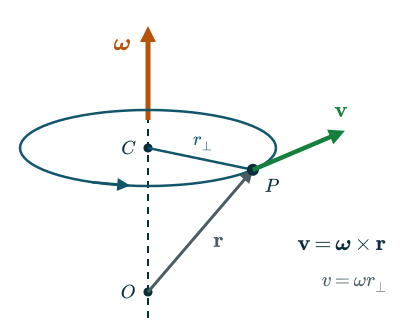
The velocity of P can be written with the vector product. With the origin O on the axis, the position vector of P is r = OC + CP. Since OC is along ω, the product ω × OC is zero, so
This vector is perpendicular to the axis and to the radius CP, so it lies along the tangent to the circle at P. Its magnitude is ω times the length of CP, written r⊥, because ω and CP are at right angles. That is exactly the velocity of P:
Linear velocity of a particle
Its magnitude, ωr sin φ (φ being the angle between ω and r), equals ωr⊥. The same relation holds for a body with only one point fixed, such as a spinning top, if r is measured from the fixed point. (NCERT’s text here refers to the top as Fig. 6.6(a); the spinning top is its Fig. 6.5(a), on page 94.)
For rotation about a fixed axis, ω always lies along the same line, the axis; only its magnitude and its sense along the axis can change. In more general rotation, its direction can change too.
Angular acceleration
If the body speeds up or slows down, its angular velocity changes. In analogy with linear acceleration, the angular acceleration is the rate of change of angular velocity:
Angular acceleration
For rotation about a fixed axis, ω stays along the axis, so the vector equation reduces to the scalar one, α = dω/dt, measured in rad s. For non-zero ω, the body speeds up when the signed α and ω have the same sign and slows down when they have opposite signs. A positive α can therefore slow clockwise motion if anticlockwise is chosen positive.
Each particle of the body then has two parts of acceleration (a link with circular motion that goes slightly beyond this section of NCERT):
- a tangential part, along the tangent (with the velocity when speeding up, against it when slowing down), with signed component at = αr and magnitude |α|r, which changes its speed;
- a centripetal part, towards the axis, of size ac = ωr (that is, v/r), which changes its direction.
| Linear motion | Rotation about a fixed axis |
|---|---|
| displacement x | angular displacement θ |
| velocity v = dx/dt | angular velocity ω = dθ/dt |
| acceleration a = dv/dt | angular acceleration α = dω/dt |
For a particle at distance r from the axis, the two columns are linked by v = ωr and at = αr.
Where it is used
- The Earth. It turns once in about 24 hours, so ω = 2π/86 400 s, about 7.3 × 10 rad s. A point on the equator, 6.37 × 10 m from the axis, moves at about 460 m s; a point near a pole hardly moves.
- Machines. Motors and engines are rated in rpm; converting to rad s is the first step in any calculation.
- Speedometers and gears. A vehicle’s speed follows from the angular velocity of its wheels and their radius (when they roll without slipping, v = ωR). Ideal meshing gears have equal tangential speeds at their pitch circles, so ω1r1 = ω2r2: the smaller gear turns faster, and two externally meshing gears turn in opposite senses.
Solved examples
Example 1: A table fan
A table fan turns at 1200 rpm. Find its angular velocity, and the speeds of the tip of a blade, 0.2 m from the axis, and of a point 0.1 m from it.
At the tip, v = ωr = 125.7 × 0.2, about 25.1 m s. At 0.1 m, half the distance, the speed is half as much, about 12.6 m s.
Answer: about 125.7 rad s; 25.1 m s at the tip and 12.6 m s halfway, with the same angular velocity.
Example 2: Using v = ω × r
A body rotates about the z-axis with ω = 2 rad s. Find the velocity of its particle at r = (3 + 4 + 5) m, with the origin on the axis.
using , and .
Answer: v = (−8 + 6) m s, of magnitude 10 m s. Check: the particle’s distance from the z-axis is √(3 + 4) = 5 m, and ωr⊥ = 2 × 5 = 10 m s. The z-component of r has no effect.
Example 3: A wheel speeding up
A wheel speeds up steadily from 60 rpm to 180 rpm in 4 s. Find its angular acceleration, and, at the end, the tangential and centripetal accelerations of a point 0.5 m from the axis.
In rad s, 60 rpm is 2π and 180 rpm is 6π, so
Tangential: at = αr = π × 0.5, about 1.57 m s. Centripetal: ac = ωr = (6π) × 0.5, about 178 m s.
Answer: α ≈ 3.14 rad s; at ≈ 1.57 m s and ac ≈ 178 m s. The centripetal part is far larger at this speed.
Common mistakes to avoid
Common mistake
Using degrees or rpm in v = ωr
The relation v = ωr needs ω in rad s. Convert rpm with ω = 2πN/60 first.
Common mistake
Measuring r from a point instead of from the axis
In v = ωr, r is the perpendicular distance from the axis. With a vector r from an origin on the axis, only its part perpendicular to the axis counts (Example 2).
Common mistake
Thinking different particles have different angular velocities
In a rigid body all particles have the same ω and the same α; only their linear speeds and accelerations differ with distance from the axis.
Common mistake
Drawing ω along the velocity
Angular velocity points along the axis, not along the motion of any particle. The linear velocity is at right angles to both ω and the radius.
Common mistake
Writing r × ω instead of ω × r
The order matters: r × ω = −(ω × r) gives a velocity pointing the wrong way. In Example 2 it would give (8 − 6) m s.
Common mistake
Forgetting the centripetal part of the acceleration
A point on a body rotating at constant ω still accelerates, towards the axis, at ωr. Only the tangential part is zero.
Quick revision summary
- Angular displacement is the angle swept about the axis; angular velocity is its rate of change, ω = dθ/dt, in rad s.
- All particles of a rigid body have the same angular velocity at any instant; that characterises pure rotation.
- Each particle moves at v = ωr, where r is its perpendicular distance from the axis.
- Angular velocity is a vector along the axis, by the right-hand rule, and v = ω × r with the origin on the axis.
- Angular acceleration is α = dω/dt, in rad s; a particle has tangential acceleration αr and centripetal acceleration ωr.
Formula sheet
- ω = dθ/dt (angular velocity)
- ω = 2πN/60 (N in rpm)
- v = ωr (r from the axis)
- v = ω × r (origin on the axis)
- α = dω/dt (angular acceleration)
- at = αr, ac = ω2r
Questions students ask
What is the difference between angular velocity and angular frequency?
Angular velocity, ω = dθ/dt, describes how fast a body actually turns and is a vector along the axis of rotation; angular frequency, ω = 2πν = 2π/T, describes how often any periodic motion repeats and is a scalar. For uniform rotation the two have the same value and unit, rad s, which is why they share a symbol: a wheel making 5 turns in 2 s has ω = 2π × 2.5 = 5π ≈ 15.7 rad s. But a mass oscillating on a spring has an angular frequency though nothing in it rotates, and a wheel that is speeding up has an angular velocity that changes from moment to moment.
What are the SI unit and dimensional formula of angular acceleration?
The SI unit of angular acceleration is the radian per second squared, rad s, and its dimensional formula is [M L T], because the radian, an arc divided by a radius, is dimensionless; angular velocity, in the same way, is in rad s with dimensions [M L T]. Writing “rad” is a reminder that angles must be in radians, not degrees or revolutions, before using at = αr or v = ωr.
What is the angular velocity of the hour and minute hands of a clock?
The minute hand of a clock turns once (2π rad) in 3600 s, so its angular velocity is 2π/3600 ≈ 1.75 × 10 rad s; the hour hand turns once in 12 hours, 43 200 s, so its angular velocity is 2π/43 200 ≈ 1.45 × 10 rad s. The minute hand turns 12 times as fast. Both hands turn clockwise as you look at the clock, so by the right-hand rule both angular velocities point into the clock face.
Practice questions
Try each question first, then open the answer to check your working.
-
Q1. The second hand of a clock is 2 cm long. Find its angular velocity and the speed of its tip.
Show answerHide answer
It turns once (2π rad) in 60 s, so ω = 2π/60, about 0.105 rad s. The tip moves at ωr = (2π/60) × 0.02 = π/1500, about 2.09 × 10 m s, or about 2.1 mm s.
-
Q2. A disc rotates at 300 rpm. Two points are 5 cm and 15 cm from the axis. Compare their angular velocities and their speeds.
Show answerHide answer
The angular velocities are equal: 2π × 300/60 = 10π, about 31.4 rad s. The speeds are ωr: about 1.57 m s and 4.71 m s, in the ratio 1 : 3, the ratio of the distances.
-
Q3. A wheel turning at 20 rad s is brought to rest steadily in 5 s. Find its angular acceleration.
Show answerHide answer
α = (0 − 20)/5 = −4 rad s. The minus sign shows that it is slowing down: the angular acceleration is opposite to the angular velocity.