Kinematics of rotation about a fixed axis
NCERT Class 11 Physics Chapter 6 Section 6.10
Quick answer
Rotation about a fixed axis is described by one angle θ, with angular velocity ω = dθ/dt and angular acceleration α = dω/dt. For constant angular acceleration, ω = ω + αt, θ − θ = ωt + ½αt and ω = ω + 2α(θ − θ), where ω and θ are the starting values, the same as the equations of linear motion with θ, ω and α for x, v and a. Use consistent units; radians are needed whenever you link θ, ω and α to a point’s s, v or a.
With your textbook
NCERT Physics Part I (Class 11), Chapter 6 “Systems of Particles and Rotational Motion”, Section 6.10 “Kinematics of rotational motion about a fixed axis”, pages 116–118.
Open the official NCERT chapter (PDF, 4.2 MB, ncert.nic.in) (opens in a new tab)
Checked against the 2026-27 reprint on .
What is rotational kinematics?
Rotation about a fixed axis, in NCERT’s words
This case of motion involves only one degree of freedom, i.e., needs only one independent variable to describe the motion.
NCERT Physics Part I (Class 11), Section 6.10, page 116
In plain words: when a body turns about a fixed axis, one number tells you where it is, the angle θ through which it has turned. That makes rotation about a fixed axis just like motion along a straight line, with angles in place of distances. Rotational kinematics describes this motion, how θ, the angular velocity ω and the angular acceleration α change with time, without asking what causes it (that is rotational dynamics).
Angular position, velocity and acceleration
Pick any particle P of the body that is not on the axis. It moves in a circle in a plane perpendicular to the axis. Its angular position θ is the angle its radius makes with a fixed direction in that plane, and this angle is the angular position of the whole body. At t = 0 it is θ0.
The angular velocity and angular acceleration are
Note since the axis of rotation is fixed, there is no need to treat angular velocity as a vector.
NCERT Physics Part I (Class 11), Section 6.10, page 117
So θ, ω and α can be handled as signed numbers: choose one sense of rotation as positive, and a negative value means the other sense.
Equations of rotation with constant angular acceleration
When α is constant, the three equations of rotation have exactly the form of the equations of motion with constant acceleration, with θ for x, ω for v and α for a:
Kinematic equations of rotation (constant α)
Here ω0 and θ0 are the values at t = 0. Angles are in radians: divide by 2π to get revolutions.
Where they come from. NCERT Example 6.10 obtains the first from dω/dt = α: integrating with constant α gives ω = αt + c, and ω = ω0 at t = 0 fixes c = ω0. It leaves the other two as an exercise:
- Since dθ/dt = ω0 + αt, integrating from 0 to t gives θ − θ0 = ω0t + ½αt.
- For non-zero α, eliminate t between the first two (put t = (ω − ω0)/α into the second):
which rearranges to ω = ω02 + 2α(θ − θ0). For α = 0 this equation also holds, since ω = ω0, but division by α is not a valid derivation in that case.
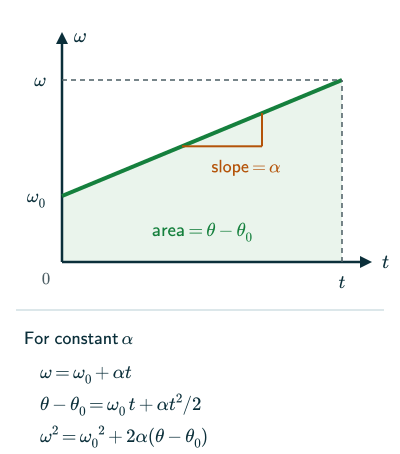
The graph gives a useful shortcut: the angular displacement is the area under the ω–t line, which for constant α is the average angular velocity times the time, θ − θ0 = ½(ω0 + ω)t.
Analogy with the kinematic equations of linear motion
| Linear motion (constant a) | Rotation about a fixed axis (constant α) |
|---|---|
| v = v0 + at | ω = ω0 + αt |
| x − x0 = v0t + ½at | θ − θ0 = ω0t + ½αt |
| v = v02 + 2a(x − x0) | ω = ω02 + 2α(θ − θ0) |
The analogy is exact because both are one-variable motions with a constant second derivative. A point at distance r from the axis links the two columns: its signed arc coordinate is s = rθ when both coordinates share a zero, its signed tangential velocity is vt = rω, and its signed tangential acceleration is at = rα. Its speed is r|ω|, with, as in any circular motion, a centripetal acceleration rω.
Solved examples
Example 1: A motor speeding up
This is NCERT Example 6.11 (pages 117–118). The angular speed of a motor wheel increases from 1200 rpm to 3120 rpm in 16 s. Find (a) its angular acceleration, assuming it is uniform, and (b) the number of revolutions it makes in this time.
Convert to rad s with ω = 2πN/60: ω0 = 2π × 1200/60 = 40π rad s and ω = 2π × 3120/60 = 104π rad s.
(a)
(b)
That is 1152π/2π = 576 revolutions.
Answer: 4π, about 12.6 rad s; 576 revolutions. Check with the average: (1200 + 3120)/2 = 2160 rpm, that is 36 rev s, for 16 s gives 576 revolutions.
Example 2: A fan slowing down
A fan turning at 900 rpm is switched off, slows down uniformly and stops in 30 s. Find its angular deceleration and the number of turns it makes before stopping.
ω0 = 2π × 900/60 = 30π rad s and ω = 0, so
The angle turned is the average angular velocity times the time: ½(30π + 0) × 30 = 450π rad, that is 225 turns.
Answer: a deceleration of π, about 3.14 rad s, and 225 turns. The minus sign means α is opposite to ω.
Example 3: A wheel starting from rest
A wheel starts from rest with a constant angular acceleration of 2 rad s. Find (a) its angular velocity after 5 s, (b) the angle it turns through in the fifth second, and (c) at 5 s, the speed and the tangential and centripetal accelerations of a point 0.5 m from the axis.
(a) ω = 0 + 2 × 5 = 10 rad s.
(b) In 5 s it turns ½ × 2 × 5 = 25 rad, and in 4 s, ½ × 2 × 4 = 16 rad, so in the fifth second it turns 25 − 16 = 9 rad.
(c) v = rω = 0.5 × 10 = 5 m s; at = rα = 0.5 × 2 = 1 m s; ac = rω = 0.5 × 100 = 50 m s.
Answer: 10 rad s; 9 rad; 5 m s, 1 m s and 50 m s.
Common mistakes to avoid
Common mistake
Mixing units
Use one consistent set of units: rad, rad s and rad s (safest), or rev, rev s and rev s. Never use rpm with t in seconds. Radians are essential in s = rθ, v = rω, at = rα and rω.
Common mistake
Using the equations when α is not constant
These equations hold only for constant angular acceleration. If α varies, integrate α = dω/dt and ω = dθ/dt directly.
Common mistake
Dropping the sign of a deceleration
A body slowing down has α opposite to ω. With ω positive, put α in as a negative number.
Common mistake
Counting revolutions when the body reverses
The equations give the net angular displacement. If ω passes through zero, find the angle up to the stop and the angle after it separately, and add their sizes. For ω0 = 10 rad s and α = −2 rad s, the formula gives 16 rad after 8 s, but the wheel turns 25 rad forward (stopping at 5 s) and 9 rad back: 34 rad in all.
Common mistake
Confusing the angle in t seconds with the angle in the t-th second
The angle in the fifth second is θ(5) − θ(4), not θ(5) (Example 3).
Quick revision summary
- Rotation about a fixed axis has one degree of freedom: the angle θ describes it completely.
- ω = dθ/dt and α = dω/dt; with a fixed axis they can be treated as signed numbers.
- For constant α: ω = ω0 + αt, θ − θ0 = ω0t + ½αt, and ω = ω02 + 2α(θ − θ0).
- These match the linear equations with θ, ω, α in place of x, v, a. Signed arc and tangential components obey s = rθ, vt = rω and at = rα; speed is r|ω|.
- The angular displacement is the (signed) area under the ω–t graph; for constant α it is the average angular velocity times the time.
Formula sheet
- ω = ω + αt
- θ − θ = ωt + ½αt
- ω = ω + 2α(θ − θ)
- θ − θ = ½(ω + ω)t
- s = rθ, vt = rω, at = rα (signed); speed = r|ω|
Questions students ask
What is the difference between rotational motion and circular motion?
Circular motion is the motion of a single particle, or of a body moving as a whole, along a circle; rotation about a fixed axis means that particles off the axis move on circles centred on it with a common angular velocity, while particles on the axis remain at rest. General rigid-body rotation can have a changing axis. In the fixed-axis case, but a body can move along a circle without rotating: the upright cabin of a giant wheel is in pure translation along its circular path. A stone whirled on a string is in circular motion; a potter’s wheel is in rotation.
Is rotational motion important for JEE Main and NEET?
Yes, rotational motion is a full unit of both exams: Unit 5, Rotational Motion, of the JEE Main 2027 and NEET (UG) 2026 Physics syllabuses covers the centre of mass, torque, angular momentum and its conservation, the moment of inertia, the axes theorems, equilibrium of rigid bodies and the equations of rotational motion. Its results are also used in other units, such as Kepler’s second law in gravitation, which follows from the conservation of a planet’s angular momentum about the Sun.
How do you solve rotational kinematics problems when the angular acceleration is not constant?
Rotational kinematics problems with a changing angular acceleration are solved by integration, not by the constant-α equations: ω = ω0 + ∫α dt and θ = θ0 + ∫ω dt, each integral taken from 0 to t. For example, a wheel that starts from rest with α = 4t rad s (t in seconds) has ω = 2t and θ = 2t/3, so after 3 s, ω = 18 rad s and θ = 18 rad. Using θ = ½αt with the final value α = 12 rad s would give 54 rad, three times too much.
Practice questions
Try each question first, then open the answer to check your working.
-
Q1. A wheel starts from rest with a constant angular acceleration of 3 rad s. Find its angular velocity and the angle it has turned through after 4 s, in radians and in revolutions.
Show answerHide answer
ω = 3 × 4 = 12 rad s. θ = ½ × 3 × 4 = 24 rad, which is 24/2π, about 3.82 revolutions.
-
Q2. A flywheel speeds up uniformly from 600 rpm to 1200 rpm in 10 s. Find its angular acceleration and the number of revolutions in this time.
Show answerHide answer
In rad s the speeds are 20π and 40π, so α = 20π/10 = 2π, about 6.28 rad s. The average speed is 900 rpm, that is 15 rev s, so it makes 15 × 10 = 150 revolutions.
-
Q3. A disc turning at 20 rad s slows down uniformly and stops after turning through 40 rad. Find its angular acceleration and the time it takes to stop.
Show answerHide answer
From ω = ω02 + 2αθ: 0 = 400 + 80α, so α = −5 rad s. Then t = (0 − 20)/(−5) = 4 s.