Kepler’s laws
NCERT Class 11 Physics Chapter 7 Section 7.2
Quick answer
In the fixed-Sun, negligible-planet-mass approximation, Kepler’s laws describe planetary motion: each planet moves in an ellipse with the Sun at one focus (law of orbits), the line from the Sun to it sweeps equal areas in equal times (law of areas), and the square of its period is proportional to the cube of its semi-major axis, T ∝ a (law of periods). The law of areas follows from conservation of angular momentum, so a planet moves fastest at its nearest point to the Sun. Newton’s law of gravitation later explained all three.
With your textbook
NCERT Physics Part I (Class 11), Chapter 7 “Gravitation”, Section 7.2 “Kepler’s laws”, pages 128–129.
Open the official NCERT chapter (PDF, 1.8 MB, ncert.nic.in) (opens in a new tab)
Checked against the 2026-27 reprint on .
What are Kepler’s laws?
Kepler’s first law in NCERT’s words
Law of orbits : All planets move in elliptical orbits with the Sun situated at one of the foci
NCERT Physics Part I (Class 11), Section 7.2, page 128
In plain words: Kepler’s three laws describe how the planets move round the Sun. Their orbits are ellipses with the Sun at one focus (the law of orbits); a planet moves faster when it is nearer the Sun, so that the line from the Sun to the planet sweeps out equal areas in equal times (the law of areas); and planets farther out take longer to go round, with the square of the period proportional to the cube of the orbit’s size (the law of periods).
Johannes Kepler (1571–1630) found these laws in the naked-eye observations of the planets that Tycho Brahe (1546–1601) had spent his life recording. They describe the motion without explaining it; Newton’s law of gravitation later explained all three. (NCERT’s text gives Kepler’s dates as 1571–1640; Kepler died in 1630.)
The formulas below use the Newtonian two-body approximation: the Sun is treated as fixed, the planet’s mass is negligible beside it, and other planets’ perturbations are ignored. Real planetary orbits follow these laws approximately.
Law of orbits
An ellipse is the curve traced by a pencil that keeps a length of string taut, with the ends of the string pinned at two points F1 and F2, the foci. For every point on an ellipse, the sum of its distances from the two foci is the same.
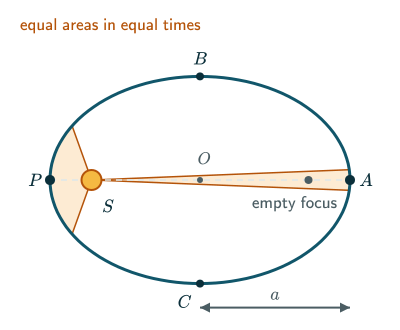
The line through the foci meets the ellipse at two points. For an orbit round the Sun, the nearest point P is the perihelion and the farthest point A the aphelion. Half the length PA is the semi-major axis a, and it equals the average of the nearest and farthest distances from the Sun:
Semi-major axis
A circle is the special case of an ellipse in which the two foci merge, and the semi-major axis becomes the radius. The planets’ orbits are in fact close to circles; the first law was still a break from the old Copernican model, which allowed only circles.
Law of areas
The line that joins any planet to the Sun sweeps equal areas in equal intervals of time
NCERT Physics Part I (Class 11), Section 7.2, page 128
So a planet moves faster near the Sun and slower far from it. In the figure, the planet covers the short wide sector near the perihelion in the same time as the long thin sector near the aphelion.
Why it holds. NCERT explains the law by conservation of angular momentum. In a short time Δt the planet, at position r from the Sun and moving with velocity v, sweeps a thin triangle of area
Taking the limit as Δt tends to zero and writing |r × v| = |r × mv|/m, with p = mv, the rate of sweeping is
Areal velocity
where L = |r × p| is the planet’s angular momentum about the Sun. Gravity on the planet points straight at the Sun, a central force, so it has no torque about the Sun and L is constant. Hence the area is swept at a constant rate.
At the perihelion and the aphelion the velocity is at right angles to the line to the Sun, so L = mvr there, and constant L gives
Speeds at perihelion and aphelion
Law of periods
In plain words, the third law says that the square of a planet’s period of revolution is proportional to the cube of the semi-major axis of its orbit (NCERT Physics Part I, Section 7.2, page 129).
Law of periods
So T/a has the same value for every planet of the Sun. NCERT’s Table 7.1 shows this with measured data, for example:
Here a is in 10 m, T in years, and the ratio Q = T/a is in 10 y m.
| Planet | a | T | Q |
|---|---|---|---|
| Earth | 15.0 | 1 | 2.96 |
| Mars | 22.8 | 1.88 | 2.98 |
| Jupiter | 77.8 | 11.9 | 3.01 |
| Neptune | 450 | 165 | 2.99 |
For a circular orbit of radius r the law follows from gravity. The Sun’s pull GMm/r supplies the centripetal force mv/r of circular motion, with v = 2πr/T:
which gives
(the universal law of gravitation and the gravitational constant G come in the next topics). In this approximation the constant 4π/GM depends only on the central mass M. More exactly, an isolated pair of masses M and m has T/a = 4π/[G(M + m)], where a is the semi-major axis of their relative separation. Thus the Sun’s low-mass planets nearly share one constant, while Jupiter’s moons nearly share another. The same law, with the Earth’s mass for M, governs the Moon and artificial satellites.
A handy form for the Sun’s planets: with T in years and a in astronomical units (AU, approximately the Earth’s semi-major axis), T ≈ a. The IAU defines one astronomical unit as exactly 149 597 870 700 m; it is not defined by the changing Earth–Sun distance. The examples use the convenient rounded relation T = a.
Solved examples
Example 1: Faster at perihelion
This builds on NCERT Example 7.1 (page 129). A planet is 1.5 × 10 m from the Sun at perihelion and 2.0 × 10 m at aphelion. (a) Compare its speeds there. (b) B and C are the ends of the minor axis. Does the planet take equal times to go from B to C through the aphelion and from C to B through the perihelion?
(a) From vPrP = vArA:
(b) No. The region bounded by SB, SC and the arc through the aphelion is larger than the region bounded by SB, SC and the arc through the perihelion, because the Sun is nearer the perihelion end. By the law of areas, the larger area takes the longer time.
Answer: it moves about 1.33 times as fast at perihelion, and takes longer over the half of the orbit through the aphelion, as NCERT concludes.
Example 2: The period from the size of the orbit
An asteroid moves round the Sun in an orbit with a semi-major axis of 4 AU. Find its period.
With T in years and a in AU, T = a = 4 = 64, so T = 8 years.
Answer: 8 years. A semi-major axis 4 times the Earth’s gives a period 43/2 = 8 times as long.
Example 3: Halley’s comet
Halley’s comet comes within about 0.59 AU of the Sun and goes out to about 35.1 AU. Estimate its period.
The semi-major axis is the average of the two distances:
Then T = a3/2 = 17.83/2, about 75 years.
Answer: about 75 years, close to the comet’s observed return time of roughly 76 years. Its speed at perihelion is about 35.1/0.59, some 60 times its speed at aphelion.
Common mistakes to avoid
Common mistake
Putting the Sun at the centre of the ellipse
The Sun is at one focus. No attracting body is required at the centre or at the other focus. In the circular special case the centre and both foci coincide with the Sun’s position in this model.
Common mistake
Using the nearest distance in T ∝ a
The law uses the semi-major axis, the average of the nearest and farthest distances, not either one of them.
Common mistake
Using one value of T/a for every orbit
The constant depends on the central body. The Moon round the Earth and the planets round the Sun have different values of T/a.
Common mistake
Using vr = constant at any point
mvr equals L only where the velocity is at right angles to the line to the Sun: at perihelion and aphelion for a noncircular ellipse, and at every point of a circle. Elsewhere use L = mvr sin θ, where θ is the angle between r and v.
Common mistake
Thinking equal areas means equal distances
Equal areas are swept in equal times, so the planet covers a longer arc near the Sun and a shorter one far away.
Quick revision summary
- Law of orbits: every planet moves in an ellipse with the Sun at one focus; the semi-major axis is the average of the nearest and farthest distances.
- Law of areas: the line from the Sun to a planet sweeps equal areas in equal times, because gravity is a central force and the angular momentum is constant; so vPrP = vArA.
- Law of periods: T ∝ a, with approximately one constant for low-mass bodies orbiting the same central mass; for a circular orbit T = (4π/GM)r.
- With T in years and a in AU, T ≈ a for low-mass bodies orbiting the Sun.
Formula sheet
- a = (rP + rA)/2
- dA/dt = L/(2m) (constant)
- vP rP = vA rA
- T ∝ a
- T = (4π/GM) r (circular orbit)
Questions students ask
What is the difference between Kepler’s second and third laws?
Kepler’s second law describes how one planet’s speed changes along its own orbit, while the third law compares the periods of different planets round the same Sun. By the second law the line from the Sun to a planet sweeps equal areas in equal times, so it moves faster near the Sun and slower far from it; by the third, the square of each period is proportional to the cube of the semi-major axis, T ∝ a, so the farther a planet is, the longer its year. The second law follows from conservation of angular momentum, the third from gravity falling off as 1/r.
How did Newton get the inverse square law from Kepler’s third law?
Newton combined Kepler’s third law with the centripetal acceleration of a circular orbit, and found an acceleration towards the Sun that falls off as 1/r. A planet moving in a circle of radius r with period T has a centripetal acceleration 4πr/T, and Kepler’s third law, T = kr with the same k for every planet, turns this into 4π/(kr). He checked the same inverse square law against the Moon’s orbit (the Moon test) and showed that it also gives the elliptical orbits of the first law.
Does Kepler’s second law hold only for gravity?
No, Kepler’s second law holds for any central force, one that always points along the line to a fixed point, however it depends on distance. Such a force has no torque about that point, so the angular momentum L stays constant and so does the areal velocity L/(2m); a puck on a smooth table, tied to a string that is pulled in through a hole, also sweeps equal areas in equal times. The first and third laws are different: an ellipse with the Sun at a focus and T ∝ a need a force that falls off exactly as 1/r.
What are the units of the constant in Kepler’s third law?
The constant in Kepler’s third law, T/a, has the SI unit s m and dimensions [M L T]. For the Sun’s planets it equals 4π/(GM), with M the Sun’s mass, about 3.0 × 10 s m. Any consistent units will do: with T in years and a in astronomical units the constant is approximately 1 for low-mass bodies orbiting the Sun.
Are Kepler’s laws in the JEE Main and NEET syllabus?
Yes, Kepler’s laws are in both syllabuses: the JEE Main 2027 syllabus and the NEET (UG) 2026 syllabus list “Kepler’s law of planetary motion” in Unit 6, Gravitation. Questions usually use T ∝ a to compare the periods and orbit sizes of two bodies round the same centre, vPrP = vArA for the speeds at the nearest and farthest points, and the constant areal velocity of the second law.
Practice questions
Try each question first, then open the answer to check your working.
-
Q1. Mars has a semi-major axis 1.52 times the Earth’s. Find its period in years.
Show answerHide answer
T = 1.523/2 years, about 1.87 years (NCERT’s Table 7.1 lists 1.88).
-
Q2. A comet moves at 59 km s at its perihelion, 0.5 AU from the Sun. How fast does it move at its aphelion, 30 AU from the Sun?
Show answerHide answer
vA = vPrP/rA = 59 × 0.5/30, about 0.98 km s (roughly 1 km s).
-
Q3. Where in its orbit does a planet move fastest, and why?
Show answerHide answer
At the perihelion, its nearest point to the Sun. Its angular momentum about the Sun is constant, and at the perihelion the distance is smallest, so the speed must be greatest (equivalently, equal areas are swept in equal times).