Earth satellites
NCERT Class 11 Physics Chapter 7 Section 7.9
Quick answer
The orbital velocity of a satellite in a circular orbit of radius r round the Earth is V = √(GM/r), where M is the Earth’s mass and r is measured from the Earth’s centre; just above the surface it is about 7.9 km/s. Gravity supplies the centripetal force, and the period T = 2πr/V makes T proportional to r, Kepler’s third law. An orbit just above the surface takes about 85 minutes.
With your textbook
NCERT Physics Part I (Class 11), Chapter 7 “Gravitation”, Section 7.9 “Earth satellites”, pages 137–138.
Open the official NCERT chapter (PDF, 1.8 MB, ncert.nic.in) (opens in a new tab)
Checked against the 2026-27 reprint on .
What is an Earth satellite?
Earth satellites are objects which revolve around the earth. Their motion is very similar to the motion of planets around the Sun and hence Kepler’s laws of planetary motion are equally applicable to them.
NCERT Physics Part I (Class 11), Section 7.9, page 137
Orbital speed and period (circular orbit)
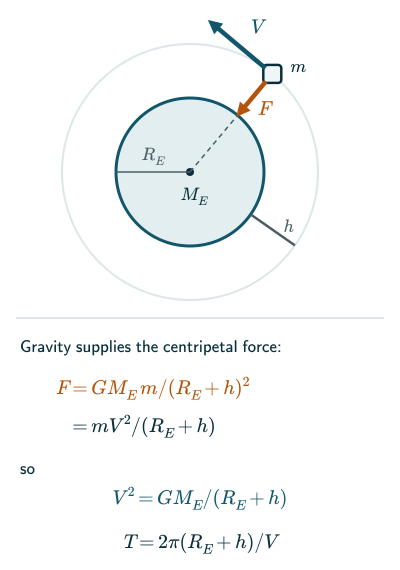
For a satellite in a circular orbit at height h above the Earth, that is, at a distance RE + h from its centre, the speed V and the period T are
where ME and RE are the Earth’s mass and radius (NCERT Section 7.9, pages 137–138).
The formulas below treat Earth as an isolated spherical mass, neglect the satellite’s mass beside it, and ignore drag and other perturbations. Unless stated otherwise, the orbit is circular.
In plain words: a satellite in a circular orbit is falling towards the Earth all the time, but it moves sideways so fast that the curved surface falls away beneath it as fast as it falls. Gravity does not slow it down; it only keeps turning its path into a circle.
The Moon is the Earth’s only natural satellite. It goes round in a nearly circular orbit in about 27.3 days, which is also roughly the time it takes to turn once on its own axis (NCERT, page 137); that is why we always see the same face of the Moon. Since 1957 many countries, India among them, have launched artificial satellites for uses such as telecommunication, geophysics and weather forecasting.
Orbital speed
A satellite of mass m moves with speed V in a circle of radius RE + h. To move in that circle it needs a centripetal force mV/(RE + h) towards the centre (see circular motion). The only force on it is the Earth’s gravity, GMEm/(RE + h), towards the centre. Setting the two equal and cancelling m:
Orbital speed
So the orbital speed decreases as the height increases, and it does not depend on the satellite’s mass. Just above the surface, h ≈ 0, and with GME = gRE2:
With g = 9.8 m s and RE = 6400 km this is about 7.9 km/s. At any height the same substitution gives V = RE√(g/(RE + h)), a form that uses g and RE in place of G and ME.
Period of revolution
In one revolution the satellite covers 2π(RE + h) at speed V. Putting in V from above:
Squaring both sides:
Kepler’s third law for satellites
This is Kepler’s law of periods for satellites of the Earth: the square of the period is proportional to the cube of the orbit’s radius. The same holds for elliptical orbits if RE + h is replaced by the semi-major axis, with the Earth at one focus (NCERT, page 138).
A satellite skimming the surface. If h is negligible compared with RE, the period is
Period just above the surface
With g = 9.8 m s and RE = 6.4 × 10 m, T0 = 2π√(6.53 × 10) s, about 5080 s or 85 minutes. This is the minimum period of a free, Earth-only Kepler orbit that stays outside the ideal spherical surface. Real low orbits must also clear the atmosphere and terrain.
Escape is not orbit. A body moving sideways at 7.9 km/s just above the surface keeps circling; at 11.2 km/s, the escape speed and √2 times faster, it escapes and never returns. Between the two speeds it moves on an ellipse whose nearest point to the Earth is the launch point; below 7.9 km/s its ellipse meets the ground and it falls back (air resistance ignored).
Weighing a planet with a satellite
Rearranging T = 4πr/(GM) gives the mass of the central body from the radius r and period T of a circular orbit, when the orbiting mass is negligible:
For an ellipse use its semi-major axis in place of r. More exactly, the two-body result gives the sum of the central and orbiting masses. NCERT uses the negligible-satellite-mass approximation in its Examples 7.5 and 7.6 to find the mass of Mars from its moon Phobos and the mass of the Earth from the Moon (Examples 2 and 3 below).
Geostationary satellites
This section goes beyond the NCERT text. The JEE Main 2027 and NEET (UG) 2026 syllabuses do not name geostationary satellites, but both list the motion of a satellite and its time period, which is all this section uses.
A satellite in a circular orbit in the plane of the equator, moving in the same direction as the Earth turns, with a period equal to the Earth’s rotation period, stays above the same point on the equator. It is called geostationary. The Earth turns once relative to the stars in 23 h 56 min 4 s (86 164 s), and Kepler’s law then fixes the radius: about 42 150 km from the centre, that is, about 36 000 km above the surface (Example 4). An aerial on the ground can point at it without moving, which is why geostationary satellites carry television, communication and weather instruments; India’s INSAT and GSAT satellites are examples.
Solved examples
Take g = 9.8 m s, RE = 6.4 × 10 m and G = 6.67 × 10 N m kg unless stated otherwise.
Example 1: A satellite 400 km up
Find the speed and period of a satellite in a circular orbit 400 km above the Earth, roughly the height of the International Space Station.
Here r = 6.8 × 10 m and GME = gRE2, about 4.01 × 10 m s.
V = √(GME/r) = √(5.90 × 10), about 7.68 × 10 m s.
T = 2πr/V = 2π × 6.8 × 10/(7.68 × 10), about 5560 s.
Answer: about 7.7 km/s and 93 minutes per orbit.
Example 2: The mass of Mars, from its moon
This is NCERT Example 7.5 (page 137). Mars has two moons, Phobos and Deimos (NCERT misprints the second as “delmos”). Phobos has a period of 7 hours 39 minutes and an orbital radius of 9.4 × 10 km. (i) Find the mass of Mars. (ii) Earth and Mars move in nearly circular orbits round the Sun, the Martian orbit being 1.52 times the Earth’s in radius. How long is the Martian year?
(i) T = 7 × 3600 + 39 × 60 = 27 540 s and R = 9.4 × 10 m. Then
with R ≈ 8.31 × 10 m and T ≈ 7.58 × 10 s, which gives M ≈ 6.48 × 10 kg.
(ii) Both planets orbit the Sun, so T ∝ R for both, and the Martian year is (1.52)3/2 × 365 days = 1.874 × 365 days, about 684 days.
Answer: about 6.48 × 10 kg; about 684 days.
Example 3: Weighing the Earth two ways
This is NCERT Example 7.6 (page 138). Given g = 9.81 m s, RE = 6.37 × 10 m, the distance to the Moon 3.84 × 10 m and the Moon’s period 27.3 days, find the Earth’s mass in two ways.
From g (the method used in acceleration due to gravity): ME = gRE2/G = 9.81 × (6.37 × 10)/(6.67 × 10), about 5.97 × 10 kg.
From the Moon: T = 27.3 × 86 400 s, about 2.359 × 10 s, so
which is about 6.02 × 10 kg.
Answer: 5.97 × 10 kg and 6.02 × 10 kg, less than 1% apart. Strictly, the Earth and the Moon both go round their common centre of mass, so the Moon’s period gives the Earth’s and the Moon’s masses together; the Moon has about 1.2% of the Earth’s mass. With data rounded to three figures, agreement within about 1% is as close as we can expect.
Example 4: Height of a geostationary satellite
Find the radius and height of a geostationary orbit. Take ME = 5.97 × 10 kg, RE = 6.37 × 10 m and T = 86 164 s.
GME = 6.67 × 10 × 5.97 × 10, about 3.98 × 10 m s. From T = 4πr/(GME),
that is, the cube root of about 7.49 × 10 m, about 4.215 × 10 m. The height is r − RE, about 3.578 × 10 m, and the speed 2πr/T is about 3.07 km/s.
Answer: about 42 150 km from the Earth’s centre (about 6.6 Earth radii), or about 36 000 km above the surface. Taking T = 24 h (86 400 s) instead of 86 164 s gives a height of about 35 860 km, still about 36 000 km.
Common mistakes to avoid
Common mistake
Using h instead of the distance from the centre
In V = GME/r and T = kr, r is measured from the Earth’s centre: r = RE + h.
Common mistake
Thinking a heavier satellite must move faster
The satellite’s mass cancels. Satellites of any mass in the same orbit have the same speed and period.
Common mistake
Thinking there is no gravity in orbit
At 400 km, g is still about 8.7 m s, about 89% of its surface value. Astronauts float because they and their spacecraft fall freely together with the same acceleration, so nothing presses them against the floor.
Common mistake
Thinking a higher satellite moves faster
Higher circular orbits are slower, V ∝ 1/√r, and also longer, so the period grows faster than the radius: T ∝ r3/2.
Quick revision summary
- Gravity supplies the centripetal force for a satellite, so for a circular orbit V = GME/(RE + h); the speed falls with height and does not depend on the satellite’s mass.
- Just above the surface, V0 = √(gRE), about 7.9 km/s, and T0 = 2π√(RE/g), about 85 minutes.
- The period obeys Kepler’s third law, T = k(RE + h) with k = 4π/(GME); it also holds for ellipses with the semi-major axis.
- A circular orbit’s period and radius give M ≈ 4πr/(GT) when the orbiting mass is negligible; for an ellipse replace r by its semi-major axis.
- A geostationary satellite circles above the equator eastwards once per sidereal day (about 23 h 56 min), about 36 000 km up.
- In short, with M the Earth’s mass and r the orbit’s radius: V = √(GM/r) and T = 2πr/V.
Formula sheet
- V = √(GME/(RE + h)) (orbital speed)
- V0 = √(gRE) ≈ 7.9 km/s (just above the surface)
- T = 2π(RE + h)/V, T2 = k(RE + h)3, k = 4π2/(GME)
- T0 = 2π√(RE/g) ≈ 85 min
- M ≈ 4πr/(GT) (circular orbit; negligible satellite mass)
Questions students ask
What is the difference between geostationary and polar satellites?
A geostationary satellite circles above the equator, about 36 000 km up, once a day in the direction the Earth turns, so it stays above one point and suits communication, television and weather pictures of one region. A polar orbit is defined by its plane passing over the poles, not by its height. Many remote-sensing satellites use low polar or near-polar orbits, a few hundred to about 1000 km up, taking roughly 90 to 105 minutes per lap. As the Earth turns beneath it, a polar satellite passes over the whole surface strip by strip, which suits mapping, remote sensing and global weather studies; India’s PSLV (Polar Satellite Launch Vehicle) is named after such orbits.
What is the difference between geostationary and geosynchronous satellites?
Every geostationary satellite is geosynchronous, but not every geosynchronous satellite is geostationary: a geosynchronous satellite only needs a period equal to the Earth’s rotation period, 23 h 56 min, while a geostationary one must also move in a circular orbit in the plane of the equator, in the direction the Earth turns, so that it seems fixed in the sky. A geosynchronous satellite in a tilted circular orbit returns to the same point in the sky once every 23 h 56 min, but in between it drifts north and south of the equator, tracing a figure of eight.
Why are geostationary satellites placed above the equator?
A geostationary satellite must be above the equator because the plane of every orbit passes through the Earth’s centre, the point that gravity pulls towards. A place on the ground away from the equator moves round a circle whose centre lies on the Earth’s axis, north or south of the Earth’s centre, so no unpowered orbit under Earth’s central gravity can stay above it; only the equator’s circle is centred on the Earth’s centre. That is why a geostationary satellite serving India sits over the equator, and dish aerials in India point towards the south.
Is critical velocity the same as orbital velocity?
Yes, in gravitation the critical velocity is another name for the orbital velocity: the speed V = √(GM/r) that a satellite needs, at right angles to the radius, to move in a circle of radius r round a planet of mass M, about 7.9 km/s just above the Earth’s surface. Given less than this at that height, the satellite moves on an ellipse that dips closer to the Earth, and falls back if the ellipse meets the ground or the atmosphere. The term is unrelated to the critical speed at which a fluid’s streamline flow turns turbulent.
What keeps a satellite in orbit?
A satellite stays in orbit because gravity, practically the only force on it, supplies exactly the centripetal force its circle needs: for a satellite of mass m moving at the orbital speed V at distance r from the centre of the Earth (mass M), the pull GMm/r equals mV/r. No engine is needed, because above almost all of the air nothing slows the satellite, and the sideways speed it was given at launch carries it round. In a low orbit the thin air left slowly takes energy away and the orbit shrinks, so many satellites carry a little fuel to raise their orbits from time to time.
Practice questions
Try each question first, then open the answer to check your working.
-
Q1. Two satellites circle the Earth at radii r and 4r. Compare their speeds and their periods.
Show answerHide answer
V ∝ 1/√r, so the outer one moves at half the speed. T ∝ r3/2, so its period is 43/2 = 8 times longer.
-
Q2. What is the period of a satellite at a height equal to the Earth’s radius? Take T0 = 84.6 minutes for an orbit just above the surface.
Show answerHide answer
The radius is 2RE, so T = 23/2 × T0 = 2.83 × 84.6 minutes, about 239 minutes, or 4.0 hours.
-
Q3. Find g at a height of 400 km. Why, then, do astronauts in a space station float?
Show answerHide answer
g = 9.8 × (6400/6800), about 8.7 m s. Gravity is still strong, but it is exactly what keeps the station and the astronauts falling round the Earth together; with nearly the same free-fall acceleration, no substantial support force presses them against the floor. Small tidal differences and spacecraft disturbances remain.