Variation of g with height and depth
NCERT Class 11 Physics Chapter 7 Section 7.6
Quick answer
For a uniform Earth, the variation of g with height and depth is a fall both ways: g is greatest at the surface and decreases both upwards and downwards. At a height h it is g(h) = gR/(R + h), about g(1 − 2h/R) when h is much less than the Earth’s radius R. At a depth d inside a uniform Earth it is g(d) = g(1 − d/R), falling to zero at the centre.
With your textbook
NCERT Physics Part I (Class 11), Chapter 7 “Gravitation”, Section 7.6 “Acceleration due to gravity below and above the surface of earth”, pages 133–134.
Open the official NCERT chapter (PDF, 1.8 MB, ncert.nic.in) (opens in a new tab)
Checked against the 2026-27 reprint on .
How does g change with height and depth?
Variation of g (NCERT Section 7.6, pages 133–134)
Treating the Earth as a uniform sphere of radius RE, with g the value at the surface:
- at a height h above the surface, g(h) = g RE2/(RE + h), which is close to g(1 − 2h/RE) when h is much less than RE;
- at a depth d below the surface, g(d) = g(1 − d/RE).
In plain words: for a uniform Earth, the acceleration due to gravity is greatest at the surface and becomes smaller whether you go up or go down, as NCERT points out (page 134). Going up, you move away from all the Earth’s mass, and the pull falls off as 1/r. Going down, the shell of rock above you exerts no net pull on you (its pulls cancel), and less mass is left beneath you, so the pull falls in a straight line, to zero at the centre.
The starting point is the result of the previous topic, acceleration due to gravity: at the surface, g = GME/RE2, where ME is the Earth’s mass and G the gravitational constant.
g above the surface of the Earth
A point mass m at height h is outside the Earth, at distance RE + h from its centre, so the Earth pulls it as if all its mass were at the centre:
Dividing by m (the force is mg(h) by Newton’s second law), and using GME = gRE2:
g at height h (exact)
For h > 0 this is less than g; at h = 0 it equals the surface value. When h is small compared with RE, write it as g(1 + h/RE) and use the binomial approximation (1 + x) ≈ 1 − 2x for small x:
g at small height h
The approximation is good for heights of a few kilometres or tens of kilometres, but not for heights comparable with the Earth’s radius. At h = RE the exact value is g/4, while the approximate formula would give −g, which is meaningless.
g below the surface of the Earth
A point mass m at depth d is at distance RE − d from the centre. Think of the Earth as a sphere of radius RE − d plus a shell of thickness d around it. The point is inside the shell, so the shell’s net pull on it is zero. It is on the surface of the inner sphere, which pulls as if its mass Ms were at the centre. For uniform density, mass is proportional to the cube of the radius:
Substituting Ms = ME(RE − d)/RE3, the force is
Dividing by m and using GME = gRE2 again:
g at depth d
This is exact for a uniform Earth, at any depth. At the centre, d = RE, and g = 0: the pulls of the surrounding mass cancel in every direction.
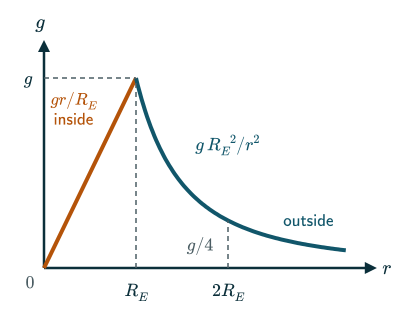
Height versus depth. For small h and d, g falls by 2gh/RE going up and by gd/RE going down. So near the surface g falls twice as fast with height as with depth: the fall at a small height h approximately equals the fall at depth 2h.
The real Earth. The linear depth result assumes uniform density. The exterior inverse-square result needs spherical symmetry, but not uniform density; both neglect rotation. The real Earth is much denser towards its centre (its mean density is about twice that of surface rocks), so in fact g changes little, and even rises slightly, for a long way below the surface before it falls to zero at the centre. The uniform-Earth formula is the NCERT model; in a problem with a different density profile, use the enclosed mass instead.
Solved examples
Take RE = 6400 km and g = 9.8 m s unless stated otherwise.
Example 1: g at a height of 10 km
Find g at a height of 10 km, using both the approximate and the exact formulas.
Approximate: g(h) ≈ 9.8 × (1 − 2 × 10/6400) = 9.8 × 0.996 875, about 9.769 m s.
Exact: g(h) = 9.8 × (6400/6410), about 9.769 m s as well.
Answer: about 9.77 m s, a drop of about 0.3%. At such heights the approximate formula is excellent.
Example 2: Where is g halved?
At what height above the surface is g half its surface value? At what depth?
Height: g(h) = g/2 means (RE + h) = 2RE2, so RE + h = √2 RE and
that is, about 2650 km. (The approximate formula, which would give RE/4, cannot be used here.)
Depth: 1 − d/RE = ½, so d = RE/2, that is 3200 km.
Answer: about 2650 km up, or 3200 km down.
Example 3: Equal changes up and down
A mine is 2 km deep. At what height above the surface is the fall in g the same as at the bottom of the mine? Find the fall.
At the bottom of the mine g falls by gd/RE; at a small height h it falls by 2gh/RE. These are equal when h = d/2 = 1 km. The fall is 9.8 × 2/6400, about 0.0031 m s.
Answer: at a height of approximately 1 km; g is lower by about 0.0031 m s (about 0.03%) in both places.
Common mistakes to avoid
Common mistake
Using 1 − 2h/R for large heights
The approximate formula holds only when h is much less than RE. For large heights use the exact gRE2/(RE + h), as in Example 2.
Common mistake
Using GM/r below the surface
Inside the Earth only the mass below the point pulls. Using the whole mass ME with r = RE − d would wrongly make g grow with depth, without limit towards the centre.
Common mistake
Thinking g is greatest at the centre of the Earth
For a uniform Earth g is zero at the centre, where the surrounding mass pulls equally in all directions.
Common mistake
Measuring h from the centre
In these formulas h is the height above the surface and d the depth below it; the distance from the centre is RE + h or RE − d.
Quick revision summary
- For a uniform Earth, g is greatest at the surface and decreases both upwards and downwards.
- At height h: g(h) = gRE2/(RE + h), about g(1 − 2h/RE) for small h.
- At depth d (uniform Earth): g(d) = g(1 − d/RE), exactly, falling to zero at the centre.
- Near the surface, g falls twice as fast with height as with depth: the fall at a small height h approximately equals that at depth 2h.
- In short, with R the Earth’s radius: g(h) = gR/(R + h) and g(d) = g(1 − d/R).
Formula sheet
- g(h) = gRE2/(RE + h)2 (exact)
- g(h) ≈ g(1 − 2h/RE) (h ≪ RE)
- g(d) = g(1 − d/RE) (uniform Earth)
- g = 0 at the centre
Questions students ask
How does g vary with latitude?
The acceleration due to gravity increases with latitude: on the real Earth it is about 9.78 m s at the equator and about 9.83 m s at the poles. Two effects cause this: the Earth’s bulge puts the equator farther from the centre, and the Earth’s spin uses part of the pull to keep a body moving in its circle round the axis; for a spherical Earth the inward radial component of effective gravity is g − ωRE cosλ at latitude λ. This is also the effective magnitude to first order in ωRE/g, not an exact magnitude away from the equator and poles: the centrifugal acceleration has a sideways component too. Here g is the gravitational magnitude without rotation and ω is the Earth’s angular speed. This goes beyond NCERT, which treats the Earth as a non-rotating sphere, and the JEE Main 2027 and NEET (UG) 2026 syllabuses name only the variation of g with altitude and depth.
What would happen to g if the Earth stopped rotating or spun faster?
Holding the spherical Earth’s mass and radius fixed, if it stopped rotating, effective gravity at the equator would rise by ωRE, about 0.034 m s, while g at the poles, where the spin has no effect, would not change. If it spun faster, g at the equator would fall, reaching zero in this ideal model when ωRE = g, that is, ω = √(g/RE) ≈ 1.24 × 10 rad s, about 17 times today’s value. A day would then last only about 84.6 minutes, the period of a satellite skimming the surface, and bodies on the equator would be weightless.
At what height does g fall by 1%?
The acceleration due to gravity falls by 1% at a height of about 32 km, taking RE = 6400 km: for small heights the fractional fall is 2h/RE, and 2h/RE = 0.01 gives h = RE/200. The exact formula gives almost the same height, about 32.2 km, because 32 km is small compared with RE. Going down instead, g falls by 1% at a depth d = RE/100, about 64 km, for a uniform Earth.
Practice questions
Try each question first, then open the answer to check your working.
-
Q1. What is the value of g at a height equal to the Earth’s radius?
Show answerHide answer
g(RE) = gRE2/(2RE) = g/4, about 2.45 m s.
-
Q2. At what depth below the surface is g one quarter of its surface value?
Show answerHide answer
1 − d/RE = ¼, so d = 3RE/4, about 4800 km.
-
Q3. By what percentage is a climber’s weight less at the top of a mountain 8.85 km high than at sea level? Take RE = 6371 km.
Show answerHide answer
The fractional fall is 2h/RE = 2 × 8.85/6371, about 0.0028, that is about 0.28%. (A 60 kg climber’s weight drops from about 588 N by about 1.6 N.)