Energy of an orbiting satellite
NCERT Class 11 Physics Chapter 7 Section 7.10
Quick answer
The energy of a satellite of mass m in a circular orbit of radius r round the Earth (mass M) is made up of kinetic energy GMm/(2r) and potential energy −GMm/r (taking it as zero at infinity), so its total energy is E = −GMm/(2r). The total energy is negative, as for every bound orbit, and the kinetic energy equals its size, K = −E. Moving to a higher circular orbit needs energy, yet the satellite ends up slower.
With your textbook
NCERT Physics Part I (Class 11), Chapter 7 “Gravitation”, Section 7.10 “Energy of an orbiting satellite”, pages 138–139.
Open the official NCERT chapter (PDF, 1.8 MB, ncert.nic.in) (opens in a new tab)
Checked against the 2026-27 reprint on .
What is the energy of an orbiting satellite?
Energy of a satellite in a circular orbit
For a satellite of mass m in a circular orbit of radius r = RE + h round the Earth (mass ME), with the potential energy taken as zero at infinity:
- kinetic energy K = GMEm/(2r), positive;
- potential energy U = −GMEm/r, negative and twice the size of K;
- total energy E = K + U = −GMEm/(2r), negative.
(NCERT Physics Part I (Class 11), Section 7.10, page 138, Eqs. (7.40) to (7.42).)
The model treats Earth as a fixed spherical source and the satellite as a small mass, ignoring other bodies and drag except in the section that explicitly discusses it.
In plain words: a satellite has kinetic energy because it moves, and negative gravitational potential energy because gravity is attractive and the zero is at infinity. Negative potential energy alone does not imply a bound orbit; an escaping body also has negative potential energy at any finite distance. For a circular orbit the two are locked together: the potential energy is always −2 times the kinetic energy, so the total is negative and equal in size to the kinetic energy. A negative total energy is what keeps the satellite bound; to free it completely, its total energy must be raised to zero.
Deriving the energies
As the previous topic showed for orbital speed, a circular orbit of radius r at speed V needs mV/r = GMEm/r, so mV = GMEm/r. The kinetic energy is therefore
Kinetic energy in a circular orbit
With the zero of potential energy at infinity, the gravitational potential energy at distance r is
Potential energy
Adding them:
Total energy in a circular orbit
So K = −E and U = 2E. All three get closer to zero as the orbit gets larger.
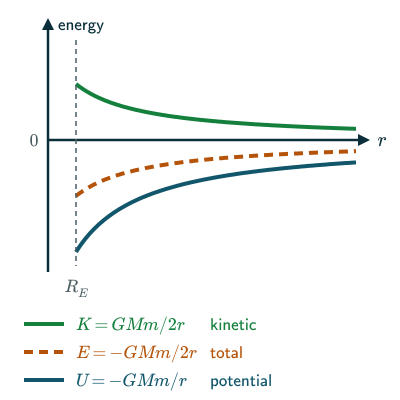
Why the total energy is negative
A body escapes to infinity if its total energy is zero or positive, as the escape speed calculation shows. A bound satellite remains within a finite maximum distance for all time, so its total energy is negative. Merely being at a finite distance at one instant does not establish binding. NCERT puts it this way:
Satellites are always at finite distance from the earth and hence their energies cannot be positive or zero.
NCERT Physics Part I (Class 11), Section 7.10, page 138
The same holds for orbits that are not circles:
When the orbit of a satellite becomes elliptic, both the K.E. and P.E. vary from point to point. The total energy which remains constant is negative as in the circular orbit case.
NCERT Physics Part I (Class 11), Section 7.10, page 138
For an ellipse with semi-major axis a, the total energy is −GMEm/(2a), the circular result with r replaced by a. This result goes beyond the NCERT text; Q6 uses it.
Binding energy. The energy that must be given to a satellite to free it from the Earth, raising its total energy to zero, is GMEm/(2r). This is called its binding energy.
Moving between orbits
Moving a satellite between circular orbits from radius r1 to a larger radius r2 raises its total energy by
which is the ideal net mechanical work supplied to the constant-mass satellite. It is not the rocket’s total fuel-energy requirement, which also includes exhaust energy and losses. Yet in the higher orbit it moves more slowly: its kinetic energy falls by ΔE, while its potential energy rises by 2ΔE. This is NCERT Example 7.8 (Example 1 below).
Energy to launch into orbit. Ignoring the Earth’s rotation and air resistance, putting a satellite at rest on the surface into a circular orbit of radius r takes
the rise from the surface potential energy −GMEm/RE to the orbital total energy −GMEm/(2r) (Example 2).
Slow orbital decay can increase orbital speed. This is beyond the NCERT text, and it follows from the energies above. A satellite in a low orbit loses a little energy to the thin air. Its total energy becomes more negative, so its orbit shrinks. For gentle decay through nearly circular orbits, K ≈ −E remains a good orbit-averaged relation. Drag itself acts against motion relative to the air and initially reduces speed; as the satellite falls to a lower orbit, gravity converts potential energy into kinetic energy. Its kinetic energy therefore increases: the satellite speeds up as it spirals in. The potential energy falls by twice the loss, which pays for both the gain in kinetic energy and the energy lost to the air.
Solved examples
Example 1: Raising a satellite from 2R to 4R
This is NCERT Example 7.8 (page 139). A 400 kg satellite is in a circular orbit of radius 2RE. How much energy is needed to move it to a circular orbit of radius 4RE? What are the changes in its kinetic and potential energies? Take g = 9.81 m s and RE = 6.37 × 10 m.
Ei = −GMEm/(4RE) and Ef = −GMEm/(8RE), so ΔE = Ef − Ei = −GMEm/(8RE) + GMEm/(4RE). Using GME = gRE2,
that is, 400 × 9.81 × 6.37 × 10/8, about 3.12 × 10 J.
The kinetic energy changes by −ΔE, so ΔK ≈ −3.12 × 10 J. The potential energy changes by 2ΔE, from −GMEm/(2RE) to −GMEm/(4RE), a rise: ΔU ≈ +6.25 × 10 J (exactly 2ΔE = 6.249 × 10 J).
Answer: about 3.12 × 10 J; the kinetic energy falls by about 3.12 × 10 J and the potential energy rises by about 6.25 × 10 J.
Note on the NCERT printing. NCERT gives ΔE and ΔK as 3.13 × 10 J and −3.13 × 10 J; the value works out to 3.1245 × 10 J, so 3.12 is the correctly rounded value. More importantly, NCERT prints the change in potential energy, which it writes as ΔV = Vf − Vi, as −6.25 × 10 J. The sign is wrong: the potential energy rises, from −GMEm/(2RE) to −GMEm/(4RE), so the change is +6.25 × 10 J, as the energy balance ΔE = ΔK + ΔU requires.
Example 2: Launching into an orbit at height R
Ignoring air resistance and the Earth’s rotation, how much energy is needed to put a 500 kg satellite, at rest on the surface, into a circular orbit at a height equal to the Earth’s radius? Take g = 9.8 m s and RE = 6.4 × 10 m.
The orbit radius is 2RE, so
that is, 0.75 × 500 × 9.8 × 6.4 × 10, about 2.35 × 10 J. Of this, mgRE/2 ≈ 1.57 × 10 J raises the potential energy and mgRE/4 ≈ 7.84 × 10 J is the kinetic energy in orbit.
Answer: about 2.35 × 10 J.
Example 3: Binding energy and escaping from orbit
A 200 kg satellite circles the Earth at r = 7.0 × 10 m. Find its total energy, and the extra speed it needs to escape from that orbit. Take GME = 4.01 × 10 m s.
E = −GMEm/(2r) = −4.01 × 10 × 200/(1.4 × 10), about −5.73 × 10 J, so the binding energy is 5.73 × 10 J.
Its orbital speed is √(GME/r), about 7.57 km/s. To escape it needs total energy zero, that is, speed √(2GME/r), about 10.7 km/s, √2 times the orbital speed. For an instantaneous prograde speed increase, the extra kinetic energy, ½m(2GME/r − GME/r) = GMEm/(2r), is exactly the binding energy.
Answer: −5.73 × 10 J; it must speed up by about 3.1 km/s, from 7.57 to 10.7 km/s.
Common mistakes to avoid
Common mistake
Thinking a higher orbit means more kinetic energy
A higher orbit has more total energy (less negative) but less kinetic energy: the satellite moves more slowly.
Common mistake
Using the height instead of the radius
In K, U and E, r is measured from the Earth’s centre: r = RE + h, not h.
Common mistake
Mixing up the factor of 2
In a circular orbit K = GMEm/(2r), U = −GMEm/r and E = −GMEm/(2r). The halves belong to K and E, not to U.
Common mistake
Getting the sign of ΔU wrong
Moving out, U goes from a larger negative number to a smaller negative one, so ΔU is positive. Check with ΔE = ΔK + ΔU.
Common mistake
Confusing drag’s immediate effect with the final orbital speed
Drag initially slows motion relative to the air. Over gradual decay between nearly circular orbits, the lower orbit has greater speed: gravitational potential energy pays for both the kinetic-energy increase and the dissipated energy. The relation K = −E is exact for circular orbits, not for every point on an ellipse.
Quick revision summary
- In a circular orbit of radius r: K = GMEm/(2r), U = −GMEm/r and E = −GMEm/(2r).
- So K = −E and U = 2E: the potential energy is negative and twice the size of the kinetic energy.
- A bound Kepler orbit has negative total energy, including an ellipse; zero or positive energy permits escape if the path clears Earth.
- For a circular orbit, binding energy GMEm/(2r) permits escape; moving between circular orbits to a higher one raises E and U but lowers K.
- In short, with M the Earth’s mass, m the satellite’s mass and r the orbit’s radius: E = −GMm/(2r), and K = −E.
Formula sheet
- K = GME m/(2r)
- U = −GME m/r
- E = K + U = −GME m/(2r)
- K = −E, U = 2E
- ΔE = (GME m/2)(1/r1 − 1/r2) (between circular orbits)
Questions students ask
What is the binding energy of a satellite?
The binding energy of a satellite is the least energy that must be given to it to free it completely from the Earth, raising its total energy to zero; in a circular orbit of radius r, where the total energy is −GMEm/(2r), the binding energy is GMEm/(2r), with ME the Earth’s mass and m the satellite’s. It equals the satellite’s kinetic energy in that orbit and half the size of its potential energy. The higher the orbit, the smaller the binding energy, so a satellite far out is less tightly bound.
How do you find the total energy of a satellite at a height h above the Earth?
The total energy of a satellite in a circular orbit at a height h is E = −GMEm/(2r), with r = RE + h its distance from the Earth’s centre; using GME = gRE2, E = −mgRE2/[2(RE + h)]. For example, a 1000 kg satellite at h = 3600 km, with RE = 6400 km and g = 9.8 m s, has r = 1.0 × 10 m and E ≈ −2.0 × 10 J. Its kinetic energy is then +2.0 × 10 J and its potential energy −4.0 × 10 J.
Does the energy of a satellite depend on its mass?
Yes, the kinetic, potential and total energies of a satellite are all proportional to its mass m: in a circular orbit of radius r, K = GMEm/(2r), U = −GMEm/r and E = −GMEm/(2r). Its orbital speed and period do not depend on m, so two satellites of different mass in the same orbit keep pace, but the heavier one has more kinetic energy and a larger binding energy, and needs proportionally more energy to launch or to raise to a higher orbit.
Practice questions
Try each question first, then open the answer to check your working. Take g = 9.8 m s and RE = 6.4 × 10 m.
-
Q1. For a satellite in a circular orbit, what is the ratio K : U : E?
Show answerHide answer
K = GMm/(2r), U = −GMm/r, E = −GMm/(2r), so K : U : E = 1 : −2 : −1.
-
Q2. Find the kinetic, potential and total energies of a 100 kg satellite in a circular orbit of radius 7.0 × 10 m.
Show answerHide answer
GME = gRE2 ≈ 4.014 × 10 m s. K = GMEm/(2r) ≈ 2.87 × 10 J, U ≈ −5.73 × 10 J and E ≈ −2.87 × 10 J.
-
Q3. Compare the least energy needed to send a 200 kg body from the Earth’s surface out to infinity with that needed to put it into a circular orbit just above the surface (no air, no rotation).
Show answerHide answer
Escape: E must rise from −mgRE to 0, so mgRE ≈ 1.25 × 10 J. Low orbit: E must rise to −mgRE/2, so mgRE/2 ≈ 6.27 × 10 J, half as much.