Elasticity and plasticity
NCERT Class 11 Physics Chapter 8 Section 8.1
Quick answer
Elasticity is the property by which a body tends to regain its original size and shape when the deforming force is removed; plasticity is the property by which a body stays permanently deformed when the force is removed, as putty and mud do. Most solids are elastic under small loads and deform plastically beyond their elastic limit. NCERT calls steel “more elastic” than rubber because its Young’s modulus is larger: this compares stiffness, not the greatest recoverable strain.
With your textbook
NCERT Physics Part II (Class 11), Chapter 8 “Mechanical Properties of Solids”, Section 8.1 “Introduction”, pages 167–168.
Open the official NCERT chapter (PDF, 1.2 MB, ncert.nic.in) (opens in a new tab)
Checked against the 2026-27 reprint on .
What are elasticity and plasticity?
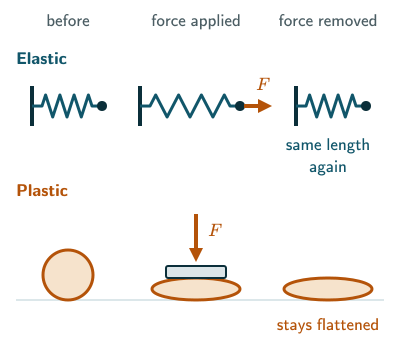
The property of a body, by virtue of which it tends to regain its original size and shape when the applied force is removed, is known as elasticity and the deformation caused is known as elastic deformation.
NCERT Physics Part II (Class 11), Section 8.1, page 167
However, if you apply force to a lump of putty or mud, they have no gross tendency to regain their previous shape, and they get permanently deformed. Such substances are called plastic and this property is called plasticity.
NCERT Physics Part II (Class 11), Section 8.1, page 167
In plain words: stretch a spring gently and let go, and it goes back to its old length. That is elastic behaviour. Press a lump of putty and let go, and it stays squashed. That is plastic behaviour. NCERT notes that putty and mud are close to ideal plastics.
Solids are not perfectly rigid
In rotational motion we treated solid objects as rigid bodies, whose shape never changes. That is an idealisation. Real bodies can be stretched, compressed and bent; even a steel bar deforms when a large enough force acts on it (NCERT Section 8.1, page 167). Often the change is far too small to see, but it is always there.
When a force deforms a body, the body pushes back: a restoring force develops inside it. When the body is in equilibrium, the restoring force is equal in size and opposite in direction to the applied force. For a spring this is the familiar F = −kx of the spring force, valid within the spring’s proportional range; complete shape recovery alone does not guarantee a linear force law.
Why solids spring back
This section goes beyond the NCERT text. For a small strain in a crystalline solid, a useful model is atoms held near equilibrium separations by interatomic forces. At the normal separation the attractive and repulsive forces balance. Pull the atoms slightly apart and a net attraction pulls them back; push them closer and a net repulsion pushes them apart. Near equilibrium the interactions act approximately like tiny springs. This explains small reversible strains in many solids; large rubber elasticity also involves changes in polymer-chain configurations, so the bond-stretching picture is not universal.
Under a larger force, the arrangement itself can change. In a metal, planes of atoms slip over one another, a row at a time, and the atoms settle next to new neighbours in an arrangement just as stable as before. When the force is removed, nothing pulls them back, so that part of the deformation stays (the elastic part still springs back): the body has deformed plastically.
Elastic or plastic depends on the load
The same material can behave in both ways:
- Small loads: most solids, including metals, are elastic. A steel spring under a gentle pull returns to its original length.
- Large loads: beyond a limit called the elastic limit, the deformation becomes partly permanent. An overstretched spring stays longer than before; the extra length left behind is called a permanent set.
- Ideal cases: no real body is perfectly elastic or perfectly plastic. Putty and mud come close to perfectly plastic (NCERT); beyond the NCERT text, a thin quartz fibre is the usual example of a body that comes close to perfectly elastic.
Some materials break with almost no plastic deformation at all; they are called brittle, like glass. Others, like copper or brass, can be deformed a great deal before breaking and can be drawn into wires; they are called ductile. These ideas are made precise with the stress-strain curve later in this chapter.
Fatigue (beyond the NCERT text). Loading and unloading a part many times, even within its elastic range, can slowly start cracks in it, until it breaks under a load it once carried easily. Engineers call this fatigue, and it limits the working life of parts such as aircraft wings and bridge members.
Why engineers care
Knowing how materials deform is essential in designing buildings, bridges, cars and ropeways, which need materials like steel and concrete whose elastic behaviour is well known (NCERT Section 8.1, page 167). NCERT also asks questions such as these: can an aeroplane be made very light yet strong enough? Why does a railway track have an I-shaped section? Why is glass brittle while brass is not? The answers start from the ideas of stress and strain and of elastic moduli that the rest of this chapter develops.
Solved examples
Example 1: Elastic or plastic?
Under small everyday forces, which of these behave elastically and which plastically: a rubber band, a steel ruler, wet clay, chewing gum, a glass rod?
- Rubber band: approximately elastic within its recoverable range; overstretching or holding it for a long time can change this.
- Steel ruler: elastic; bent gently, it springs back.
- Wet clay: plastic; it keeps any shape it is pressed into.
- Chewing gum: typically retains deformation on the timescale of this demonstration; it also has elastic and time-dependent behaviour.
- Glass rod: elastic, but brittle: bent too far, it snaps without first taking a permanent bend.
Answer: rubber band, steel ruler and glass rod are elastic (glass is also brittle); wet clay and chewing gum are plastic.
Example 2: Spotting a permanent set
A spring is 10.0 cm long. With a 2 N load it is 12.0 cm long, and when the load is removed it is 10.0 cm again. With a much larger load it stretches to 35.0 cm, and when that load is removed it is 11.5 cm long. Describe what happened in each case.
Small load: extension 2.0 cm, fully recovered. The deformation was elastic.
Large load: extension 35.0 − 10.0 = 25.0 cm, of which 35.0 − 11.5 = 23.5 cm was recovered. The remaining 11.5 − 10.0 = 1.5 cm is a permanent set: the spring was stretched beyond its elastic limit and deformed plastically.
Answer: elastic for the small load; for the large load, a permanent set of 1.5 cm, that is, 15% of the original length.
Example 3: Which is more elastic, steel or copper?
NCERT (Section 8.5.1, page 171) gives these data. To stretch a thin wire of cross-section 0.1 cm by 0.1% of its length takes 2000 N for steel but only 1100 N for copper. Which is more elastic?
In NCERT’s stiffness comparison, a material is called more elastic if, for samples of the same size given the same fractional stretch, it develops a larger restoring force; that is, it is harder to deform (later in this chapter: it has a larger elastic modulus). Steel needs 2000/1100, about 1.8 times, the force that copper needs for the same stretch. In NCERT’s words:
It means that steel is more elastic than copper, brass and aluminium.
NCERT Physics Part II (Class 11), Section 8.5.1, page 171
Answer: steel. By the same reasoning steel is far more elastic than rubber, although rubber can be stretched much further and still return: “more elastic” in physics does not mean “stretches more”.
Common mistakes to avoid
Common mistake
Thinking “elastic” means “stretches a lot”
Elasticity means recovery of shape and size. NCERT’s phrase “more elastic” compares elastic moduli, so steel is stiffer than rubber; this does not mean it can recover from a larger strain.
Common mistake
Thinking solid bodies are truly rigid
A rigid body is a useful idealisation. Every real solid deforms a little under a force, even if the change cannot be seen.
Common mistake
Labelling a material simply “elastic” or “plastic”
Behaviour depends on the load. A steel wire is elastic under small loads and plastic beyond its elastic limit.
Common mistake
Confusing brittle with plastic
A brittle material such as glass breaks with almost no permanent deformation; a plastic material deforms permanently without breaking.
Quick revision summary
- Elasticity: the tendency of a body to regain its original size and shape when the deforming force is removed; the deformation is then called elastic deformation.
- Plasticity: the property by which a body has no tendency to regain its shape and stays permanently deformed when the force is removed, as putty and mud do; they are close to ideal plastics.
- No solid is perfectly rigid. A deformed body develops a restoring force, equal and opposite to the applied force in equilibrium.
- Most solids are elastic under small loads and deform plastically beyond the elastic limit, leaving a permanent set.
- Brittle materials (glass) break with little plastic deformation; ductile materials (copper, brass) deform a lot before breaking.
- In NCERT’s modulus comparison, “more elastic” means stiffer: steel has a larger Young’s modulus than copper or rubber, although rubber can recover from much larger strains.
Formula sheet
- Restoring force = −(applied force) (body in equilibrium)
- Fractional change in length = ΔL/L (ΔL = change in length, L = original length; no unit)
- Permanent set = length after unloading − original length
- F = −kx (spring, small extensions, up to the proportional limit)
Questions students ask
What is the difference between elastic and plastic deformation?
Elastic deformation disappears when the deforming force is removed, while plastic deformation stays, leaving the body with a permanent set. For ideal reversible elastic behaviour, work is stored as elastic potential energy and given back on unloading, as when a stretched spring is released; most of the work done in a plastic deformation turns into heat, which is why a metal wire bent back and forth a few times becomes warm at the bend. When a metal loaded beyond its elastic limit is unloaded, only the elastic part of its strain is recovered, as its stress-strain curve shows.
What is the difference between plasticity, ductility and malleability?
Plasticity is the general property of staying permanently deformed after the force is removed, and ductility and malleability are two forms of it. A ductile material, such as copper, can be stretched plastically a great deal without breaking, so it can be drawn into wires; a malleable material, such as gold or aluminium, can be hammered or rolled into thin sheets without cracking. The opposite of ductility is brittleness: glass and cast iron break with almost no plastic deformation (see brittle and ductile materials).
How is elasticity measured, and what is its SI unit?
Elasticity is measured by a modulus of elasticity, the ratio of stress to strain within the proportional limit, whose SI unit is the pascal (N m) and whose dimensions are [MLT]. Elasticity itself is a property, not a single number, so a material has a separate modulus for each kind of deformation: Young’s modulus for a change of length, the shear modulus for a change of shape and the bulk modulus for a change of volume. The larger the modulus, the larger the stress needed for a given strain.
What factors affect the elasticity of a material?
The elasticity of a material depends mainly on its temperature, its composition and the way it has been worked. For metals and most other solids the elastic moduli fall as the temperature rises, because the atoms vibrate more and sit a little farther apart, so the forces between them weaken; an alloy called Elinvar (not Invar, the alloy that hardly expands) is made so that its modulus hardly changes with temperature, for watch hairsprings. Composition and processing can strongly change yield strength without a comparable change in modulus. Cold working commonly strengthens a ductile metal, and annealing a cold-worked metal commonly softens it; alloy and heat-treatment effects depend on the particular material, so these are not universal rules.
Practice questions
Try each question first, then open the answer to check your working.
-
Q1. A wire 2.000 m long is loaded. When the load is removed, the wire is 2.003 m long. Was the deformation elastic? What is the permanent set, as a fraction of the original length?
Show answerHide answer
No: a permanent set of 0.003 m remains, so the wire was stretched beyond its elastic limit. As a fraction, 0.003/2.000 = 0.0015, that is, 0.15%.
-
Q2. Why do we call a steel bar elastic even though we cannot see it stretch?
Show answerHide answer
Under a force it does deform, by a tiny amount, and develops a restoring force; when the force is removed it returns to its original size. Elasticity is about returning to the original shape, not about how large the deformation is.
-
Q3. A thin wire of aluminium of cross-section 0.1 cm needs 690 N to stretch it by 0.1% (NCERT Section 8.5.1, page 171). Using the data of Example 3, arrange steel, copper and aluminium in order of elasticity.
Show answerHide answer
For the same stretch, steel needs 2000 N, copper 1100 N and aluminium 690 N. The larger the force needed, the more elastic the material: steel, then copper, then aluminium.