Stress and strain
NCERT Class 11 Physics Chapter 8 Section 8.2
Quick answer
Stress is the restoring force per unit area that develops in a deformed body, average stress = F/A, measured in N m or pascal (Pa). Strain is the fractional change in a dimension: ΔL/L for a change in length, Δx/L = tan θ for a shear, and ΔV/V for a change in volume; it has no unit. The three kinds of stress are longitudinal (tensile or compressive), shearing and hydraulic.
With your textbook
NCERT Physics Part II (Class 11), Chapter 8 “Mechanical Properties of Solids”, Section 8.2 “Stress and strain”, pages 168–169.
Open the official NCERT chapter (PDF, 1.2 MB, ncert.nic.in) (opens in a new tab)
Checked against the 2026-27 reprint on .
What are stress and strain?
When a body is deformed in static equilibrium, internal forces across a section balance the external loading on the part being considered.
The restoring force per unit area is known as stress.
NCERT Physics Part II (Class 11), Section 8.2, page 168
Stress and strain
For a force component of size F distributed over a section of area A, the corresponding average stress is
measured in N m or pascal (Pa). Strain is the fractional change in a dimension of the body: change in length over original length, change in volume over original volume or, for a shear, the sideways shift of one face divided by the distance between the faces (NCERT Section 8.2, pages 168–169).
The formula gives a uniform stress only when loading is uniform. In the small-strain wire examples, A is the original cross-section, wire self-weight is neglected, and the load is axial; this is engineering stress.
In plain words: stress tells you how hard the material is being pulled, pushed or sheared, per square metre of the surface carrying the force. Strain tells you how much it has deformed, as a fraction of its original size. The same force produces a much larger stress in a thin wire than in a thick rod, because the area is smaller. How stress and strain are related is the subject of Hooke’s law and the elastic moduli.
The dimensions of stress are those of force divided by area: [MLT]/[L] = [MLT]. Strain is a ratio of two like quantities:
Since the strain is a ratio of change in dimension to the original dimension, it has no units or dimensional formula.
NCERT Physics Part II (Class 11), Section 8.2, page 169
Three kinds of stress
A solid can change its dimensions in three ways, and each has its own stress and strain.
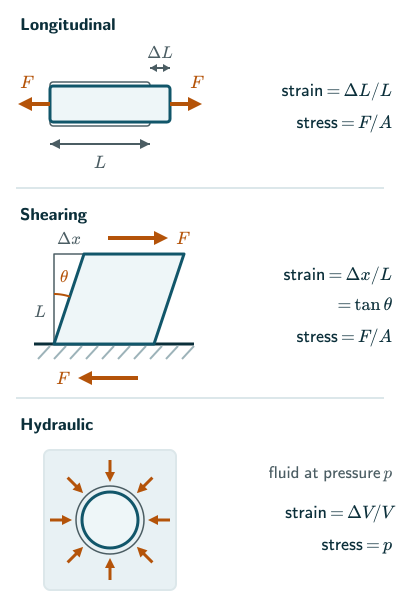
1. Longitudinal stress. Two equal and opposite forces act along the length of a cylinder, at right angles to its cross-section. If they stretch it, the stress is tensile; if they squeeze it, the stress is compressive.
Tensile or compressive stress can also be termed as longitudinal stress.
NCERT Physics Part II (Class 11), Section 8.2, page 168
The length changes by ΔL, and
Longitudinal strain
2. Shearing stress. Two equal and opposite forces act parallel to opposite faces, as when a book is pressed with the hand and pushed sideways. The restoring force per unit area of the face is the tangential or shearing stress, F/A, with A the area of the face along which the force acts. The faces slide by Δx relative to each other, and the sides tilt through an angle θ:
Shearing strain
Here L is the distance between the two faces, and θ is in radians. The approximation is good because θ is usually very small: even at θ = 10°, NCERT notes (page 168), θ and tan θ differ by only about 1%. (NCERT points to “Fig. 8.2 (c)” for the book example on page 168; the figure meant is Fig. 8.1 (c).)
3. Hydraulic stress. A solid body in a fluid under high pressure is pressed equally, at right angles to its surface, at every point. For a homogeneous isotropic solid, uniform pressure changes volume without changing shape. Write ΔV = final volume − original volume, so compression gives ΔV < 0. The restoring force per unit area, the hydraulic stress, is equal in size to the pressure p of the fluid, and
Volume strain
Thus ΔV/V is a signed volume strain; the positive fractional compression is −ΔV/V. This sign convention agrees with the bulk-modulus formula in the next topic.
Stress and pressure. Both are force per unit area, measured in pascal, but they are not the same. Pressure in a fluid at rest always pushes, at right angles to a surface. Stress in a solid can push (compressive), pull (tensile) or act along a surface (shearing). The two are equal in size only for hydraulic stress. So pressure is a scalar, as NCERT says in Chapter 9 (page 181), while stress is a tensor (beyond the NCERT text).
Solved examples
Take g = 9.8 m s.
Example 1: A loaded steel wire
A steel wire 2.0 m long and 1.0 mm in diameter carries a 10 kg mass and stretches by 1.2 mm. Find the stress and the strain.
The force is F = 10 × 9.8 = 98 N. The cross-section has radius 0.5 mm, so A = π(0.5 × 10), about 7.85 × 10 m.
Stress = F/A = 98/(7.85 × 10), about 1.25 × 10 Pa.
Strain = ΔL/L = 1.2 × 10/2.0 = 6.0 × 10.
Answer: stress about 1.25 × 10 Pa (tensile); strain 6.0 × 10, that is, 0.06%.
Example 2: Shearing a rubber block
A rubber block 4.0 cm high has its base glued to a table. A force of 200 N along its top face, which measures 10 cm × 10 cm, shifts the top by 2.0 mm. Find the shearing stress and the shearing strain.
The force acts along the top face, of area 0.10 × 0.10 = 0.010 m, so the shearing stress is 200/0.010 = 2.0 × 10 Pa.
The shearing strain is Δx/L = 2.0 × 10/(4.0 × 10) = 0.05, so θ ≈ 0.05 rad, about 2.9°.
Answer: 2.0 × 10 Pa; 0.05 (no unit).
Example 3: A solid rubber ball deep under water
A solid rubber ball of volume 1000 cm is taken 100 m down in water, where the pressure is greater than at the surface by ρgh. Its volume decreases by 0.5 cm. Find the extra hydraulic stress and the volume strain. Take the density of water as 1000 kg m.
The extra pressure is ρgh = 1000 × 9.8 × 100 = 9.8 × 10 Pa, and the extra hydraulic stress equals it.
Volume strain = ΔV/V = −0.5/1000 = −5 × 10; its magnitude, the fractional compression, is 5 × 10.
Answer: extra hydraulic stress 9.8 × 10 Pa; signed volume strain −5 × 10. The ball keeps its shape; only its volume changes.
Example 4: Stress in a pillar
A square concrete pillar, 0.50 m × 0.50 m in cross-section, carries a centred axial load of 50 000 kg. Neglecting the pillar’s own weight, find the compressive stress in it.
F = 50 000 × 9.8 = 4.9 × 10 N and A = 0.25 m, so the stress is 4.9 × 10/0.25 = 1.96 × 10 Pa.
Answer: about 2.0 × 10 Pa, compressive.
Common mistakes to avoid
Common mistake
Using the diameter as the radius
For a wire of diameter d, A = π(d/2) = πd/4. Using d in place of d/2 makes the area four times too large and the stress four times too small.
Common mistake
Doubling the force on a wire pulled at both ends
A wire pulled by a force F at each end has stress F/A, not 2F/A. The two end forces balance each other, and the tension in the wire is F.
Common mistake
Using the wrong area in shear
For longitudinal stress, A is the cross-section at right angles to the force. For shearing stress, A is the area of the face along which the force acts.
Common mistake
Giving strain a unit
Strain is a ratio of two lengths (or two volumes), so it has no unit and no dimensions. A shearing strain may be quoted as an angle in radians, which is also a pure number.
Common mistake
Using θ in degrees in Δx/L ≈ θ
The approximation tan θ ≈ θ holds only with θ in radians.
Quick revision summary
- Stress is the restoring force per unit area, F/A; unit N m or Pa; dimensions [MLT].
- Strain is the fractional change in a dimension; it has no unit or dimensions.
- Longitudinal (tensile or compressive) stress changes the length: strain ΔL/L.
- Shearing stress acts along a face and changes the shape: strain Δx/L = tan θ ≈ θ.
- Uniform hydraulic stress has the magnitude of fluid pressure; for an isotropic solid it changes volume without changing shape, with signed strain ΔV/V < 0 under compression.
- In short: stress = F/A, and Δx/L = tan θ for a shear.
Formula sheet
- Stress = F/A (unit Pa, dimensions [MLT])
- Longitudinal strain = ΔL/L
- Shearing strain = Δx/L = tan θ ≈ θ
- Volume strain = ΔV/V; hydraulic stress = p
Questions students ask
What is the difference between stress and strain?
Stress is the restoring force per unit area inside a deformed body, measured in pascals, while strain is the fractional change in the body’s size or shape, which has no unit. Stress describes the internal forces and strain the deformation that goes with them: for a stretched wire, stress = F/A and strain = ΔL/L. Within the proportional limit the two are proportional, and their ratio is the material’s modulus of elasticity (Hooke’s law); for steel, a strain of 0.1% goes with a stress of about 2 × 10 Pa.
What is the difference between stress and tension?
Tension is a force, measured in newtons, while stress is a force per unit area, measured in pascals: the tensile stress in a wire is its tension divided by its cross-sectional area. So wires with the same tension can have very different stresses; a tension of 60 N gives a stress of 2.0 × 10 Pa in a wire of cross-section 0.30 mm but only 2.0 × 10 Pa in one of 3.0 mm. It is the stress, not the tension, that decides whether a wire stretches permanently or breaks, because each material has its own yield strength and breaking stress.
What are the normal and shearing stresses on a slanting section of a rod under tension?
In a rod of cross-section A pulled by a force F, a plane whose normal makes an angle θ with the rod’s axis carries a normal (tensile) stress (F/A) cos θ and a shearing stress (F/A) sin θ cos θ. This is because the slanting plane has the larger area A/cos θ, while the force resolves into F cos θ at right angles to the plane and F sin θ along it. The shearing stress is greatest, F/(2A), on planes at 45° to the axis, so even a simple pull sets up shear inside a material (beyond the NCERT text).
Is stress a vector or a scalar?
Stress is neither a vector nor a scalar but a tensor, because its value at a point depends on two directions: that of the force and that of the surface on which it acts. In a rod under a simple pull, the stress on a cross-section is a pure tension, while on a slanting section through the same point it is part tension and part shear, so no single arrow or number describes it. Pressure in a fluid at rest is the special case that acts equally, at right angles, on every surface through a point, which is why it can be treated as a scalar.
Practice questions
Try each question first, then open the answer to check your working. Take g = 9.8 m s.
-
Q1. Stress and pressure have the same unit. Name two ways in which they differ.
Show answerHide answer
(1) Pressure is the normal force per unit area that a fluid, or a body pressing on a surface, exerts on it; stress is the restoring force per unit area that a deformed body develops inside itself. (2) Pressure always pushes at right angles to the surface; stress can push (compressive), pull (tensile) or act along the surface (shearing).
-
Q2. A 2.0 kg mass hangs from a wire of radius 0.20 mm. Find the stress in the wire.
Show answerHide answer
A = π(0.20 × 10), about 1.26 × 10 m. Stress = 2.0 × 9.8/(1.26 × 10), about 1.6 × 10 Pa.
-
Q3. The top face of a metal cube of side 10 cm moves 0.10 mm sideways relative to the bottom face under a shearing force. Find the shearing strain.
Show answerHide answer
Δx/L = 0.10 × 10/0.10 = 1.0 × 10 (that is, θ ≈ 1.0 × 10 rad).