Pressure in fluids
NCERT Class 11 Physics Chapter 9 Section 9.2
Quick answer
Fluid pressure is the normal force per unit area that a fluid exerts on a surface, P = F/A, a scalar measured in pascal. In a fluid at rest it acts equally in all directions and is the same at all points at one level (Pascal’s law), and at a depth h below an open surface it is P = P + ρgh, where P is atmospheric pressure and ρ the fluid’s density; ρgh is the gauge pressure. Because applied pressure is transmitted undiminished, a hydraulic lift multiplies a force by the ratio of the piston areas.
With your textbook
NCERT Physics Part II (Class 11), Chapter 9 “Mechanical Properties of Fluids”, Section 9.2 “Pressure”, pages 180–186.
Open the official NCERT chapter (PDF, 2.2 MB, ncert.nic.in) (opens in a new tab)
Checked against the 2026-27 reprint on .
What is pressure?
Pressure
The average pressure on a surface is the normal force per unit area:
and the pressure at a point is the limit of ΔF/ΔA as the area shrinks to zero (NCERT Section 9.2, page 181). Only the component of force normal to the area counts. The SI unit is N m, named the pascal (Pa); the dimensions are [MLT].
In plain words: the same force does more damage when it is concentrated on a small area. A needle pierces the skin, but the back of a spoon pressed with the same force does not. Pressure measures this concentration of force.
A fluid at rest pushes on any surface in contact with it at right angles to that surface. If the fluid pushed along the surface, the surface would push back along it, by Newton’s third law, and the fluid would flow; a fluid at rest cannot, so the force must be normal.
Pressure is a scalar quantity.
NCERT Physics Part II (Class 11), Section 9.2, page 181
Units. Besides the pascal, NCERT lists (pages 181 and 184):
- 1 standard atmosphere (atm) = 101 325 Pa exactly, approximately 1.013 × 10 Pa; actual sea-level air pressure varies with weather;
- 1 bar = 10 Pa (used in meteorology, with the millibar);
- 1 torr ≈ 1 mm of mercury ≈ 133 Pa (used in medicine).
Density. For a fluid of mass m in volume V, the density is ρ = m/V, in kg m. Liquids are nearly incompressible, so their density hardly changes with pressure; gases change density a great deal. Water at 4 °C has density 1.0 × 10 kg m, and the relative density of a substance is its density divided by this, a pure number (2.7 for aluminium).
Pascal’s law
Under ordinary gravity, points at the same height in a connected fluid at rest have the same pressure. This statement assumes there are no additional horizontal body forces or separating membranes. NCERT (Section 9.2.1, page 182) proves two facts about a fluid at rest:
- At a point, pressure acts equally in all directions. NCERT shows this with a tiny right-angled prism of fluid, so small that gravity can be ignored. Let its sloping face (area A) carry force F, and the two perpendicular faces (areas A cos θ and A sin θ) carry Fx and Fy. Equilibrium gives Fx = F cos θ and Fy = F sin θ. Dividing, Fx/(A cos θ) = F/A = Fy/(A sin θ): the pressure is the same on every face, whatever its orientation.
Hence, pressure exerted is same in all directions in a fluid at rest.
NCERT Physics Part II (Class 11), Section 9.2.1, page 182
- At the same horizontal level, the pressure is the same. A horizontal bar of fluid at rest has equal and opposite forces on its two ends, so the pressures there are equal; otherwise the fluid would flow.
A second form of Pascal’s law describes what happens when extra pressure is applied:
We can say whenever external pressure is applied on any part of a fluid contained in a vessel, it is transmitted undiminished and equally in all directions.
NCERT Physics Part II (Class 11), Section 9.2.4, page 185
Variation of pressure with depth
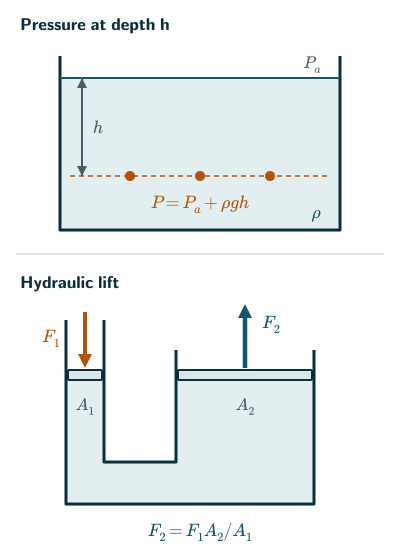
Take a vertical cylinder of fluid, of cross-section A and height h, inside a fluid at rest. Assume uniform density ρ and constant g over this height. The fluid below pushes up on its base with force P2A; the fluid above pushes down on its top with force P1A; and its weight mg = ρhAg acts down. For equilibrium, (P2 − P1)A = ρhAg, so
Pressure difference between two depths
If the top is the open surface, where the pressure is atmospheric, Pa:
Pressure at depth h
Thus, the pressure P, at depth below the surface of a liquid open to the atmosphere is greater than atmospheric pressure by an amount ρgh.
NCERT Physics Part II (Class 11), Section 9.2.2, page 183
The excess P − Pa = ρgh is the gauge pressure; P itself is the absolute pressure. The area A has cancelled: pressure depends on the depth, not on the shape or size of the container. This is the hydrostatic paradox: vessels of different shapes joined at the bottom fill to the same level, although they hold different amounts of water, because the pressure at the bottom must be the same under each of them. In a moving fluid the pressure also depends on the speed, as Bernoulli’s principle shows.
Atmospheric pressure and gauge pressure
The pressure of the atmosphere at a point is the weight of a column of air of unit cross-section above it, up to the top of the atmosphere; standard sea-level pressure is approximately 1.013 × 10 Pa, but the measured value varies.
The mercury barometer (Torricelli). A long glass tube closed at one end is filled with mercury and turned upside down in a dish of mercury. The mercury falls until its column is about 76 cm high at sea level; the space above it holds only mercury vapour, at negligible pressure. Inside the tube, at the level of the mercury in the dish, the pressure is 0 + ρgh; outside at that level it is Pa; so Pa = ρgh, with ρ the density of mercury. That is why pressure is often quoted in cm or mm of mercury.
The open-tube manometer. A U-tube containing a liquid (oil for small pressure differences, mercury for large ones) has one end open to the air and the other joined to the vessel being tested. Points at the same level in the same liquid at rest have the same pressure (NCERT’s points A and B in its Fig. 9.5 (b)), so the gas pressure is P = Pa + ρgh, where h is how far the open-arm level stands above the other and ρ is the density of the manometer liquid. The gauge pressure is ρgh. If the open-arm level is lower, the gauge pressure is negative: the gas is below atmospheric pressure.
Hydraulic machines
In a hydraulic lift, a small piston of area A1 and a large piston of area A2 are joined by a liquid. A force F1 on the small piston creates a pressure F1/A1, which is transmitted undiminished to the large piston, so
Hydraulic lift
Here the forces are net applied loads, both exposed piston faces have the same atmospheric pressure, and piston weight and friction are neglected. The formula assumes the pistons are at the same level; if the large piston is a height d lower, the gauge pressure under it is F1/A1 + ρgd. The force is multiplied by A2/A1, the mechanical advantage. Energy is not created: the liquid is incompressible, so the volume pushed in equals the volume pushed out, A1L1 = A2L2, and the large piston moves a shorter distance. For equal piston levels, the ideal input and output works are equal. If the levels differ, the change in gravitational energy of the displaced liquid must also be included.
Hydraulic brakes work the same way: a small force on the pedal pushes a piston in the master cylinder, and the pressure, carried by brake oil, acts on the wheel pistons (NCERT, page 186). Equal transmitted pressure does not by itself mean equal braking force: force also depends on piston area and the brake mechanism.
Solved examples
These are NCERT Examples 9.1 to 9.6 (pages 182–186).
Example 1: Pressure on the thighbones
The two thighbones (femurs), each of cross-section 10 cm, support the upper part of a body of mass 40 kg. Estimate the average pressure on them. Take g = 10 m s.
A = 2 × 10 cm = 20 × 10 m and F = 40 × 10 = 400 N, acting normally. Pav = 400/(20 × 10) = 2 × 10 N m.
Answer: 2 × 10 Pa, about twice atmospheric pressure.
Example 2: A swimmer 10 m down
What is the pressure on a swimmer 10 m below the surface of a lake? Take ρ = 1000 kg m, g = 10 m s and Pa = 1.01 × 10 Pa.
P = Pa + ρgh = 1.01 × 10 + 1000 × 10 × 10 = 2.01 × 10 Pa.
Answer: about 2 atm: every 10 m of water adds about one atmosphere.
Example 3: If the air had constant density
The density of air at sea level is 1.29 kg m. If it did not change with height, how high would the atmosphere reach? Take g = 9.8 m s and Pa = 1.01 × 10 Pa.
ρgh = 1.01 × 10 Pa gives h = 1.01 × 10/(1.29 × 9.8), about 7989 m.
Answer: about 8 km. In reality the density of air falls with height, and the atmosphere thins out over more than 100 km.
Example 4: A submarine window 1000 m down
At a depth of 1000 m in the sea (density 1.03 × 10 kg m, g = 10 m s), find (a) the absolute pressure, (b) the gauge pressure, and (c) the force on a 20 cm × 20 cm submarine window, the inside being kept at atmospheric pressure. Take Pa = 1.01 × 10 Pa.
(a) P = 1.01 × 10 + 1.03 × 10 × 10 × 1000 = 104.01 × 10 Pa.
(b) Pg = ρgh = 103 × 10 Pa.
(c) The inside is at Pa, so the net pressure on the window is the gauge pressure, and F = PgA = 103 × 10 × 0.04 = 4.12 × 10 N.
Answer: about 1.04 × 10 Pa (about 103 atm); 1.03 × 10 Pa (about 102 atm); 4.12 × 10 N.
Note on the NCERT printing. NCERT rounds these pressures to “104 atm” and “103 atm”, which treats 1 atm as 10 Pa. With 1 atm = 1.013 × 10 Pa they are about 103 atm and 102 atm (104 and 103 bar). NCERT’s working also cites Eq. (9.6) for P = Pa + ρgh, which is its Eq. (9.7).
Example 5: Two syringes
Two water-filled syringes, with pistons of diameter 1.0 cm and 3.0 cm, are joined by a tube. (a) What force acts on the larger piston when 10 N is applied to the smaller? (b) If the smaller piston moves in 6.0 cm, how far does the larger move out?
(a) F2 = F1A2/A1 = 10 × (3.0/1.0) = 90 N, since the areas go as the squares of the diameters.
(b) Equal volumes: L2 = L1A1/A2 = 6.0/9 cm, about 0.67 cm.
Answer: 90 N; about 0.67 cm. (Atmospheric pressure acts on both pistons and has been ignored, as NCERT notes.)
Example 6: A car lift
In a car lift, compressed air pushes on a small piston of radius 5.0 cm, and the pressure is passed on to a piston of radius 15 cm carrying a car of mass 1350 kg. Find the force on the small piston and the air pressure needed. Take g = 9.8 m s.
F1 = F2A1/A2 = 1350 × 9.8 × (5.0/15) = 1470 N, about 1.5 × 10 N.
Pressure = F1/(π × 0.050) = 1470/(7.85 × 10), about 1.9 × 10 Pa.
Answer: about 1.5 × 10 N; about 1.9 × 10 Pa, almost twice atmospheric pressure. This is a gauge pressure; atmospheric pressure acts on both pistons and cancels. (NCERT’s problem points to “Fig 9.7” for the lift; the lift is its Fig. 9.6 (b), and Fig. 9.7 shows streamlines.)
Common mistakes to avoid
Common mistake
Mixing up absolute and gauge pressure
Absolute pressure P = Pa + ρgh; gauge pressure is P − Pa = ρgh. Tyre gauges and manometers read gauge pressure.
Common mistake
Thinking a wider container gives more pressure at the bottom
Pressure at a depth depends only on h, ρ and g, not on the shape or area of the container (the hydrostatic paradox). The force due to pressure above atmospheric on a horizontal base is ρghA; the liquid’s total force on that base is (Pa + ρgh)A. The gauge-pressure force equals the liquid’s weight for a straight vessel with vertical walls. In a flared vessel the walls carry the difference.
Common mistake
Using the diameter ratio for the force ratio
In a hydraulic lift the force ratio is the area ratio, the square of the diameter ratio: 3 times the diameter gives 9 times the force.
Common mistake
Thinking a hydraulic lift creates energy
The large piston moves a shorter distance; the work in equals the work out (ignoring friction).
Common mistake
Giving pressure a direction
Pressure is a scalar. The force it produces on a surface is normal to that surface, whatever way the surface faces.
Quick revision summary
- Pressure is normal force per unit area, P = F/A; unit Pa; a scalar; 1 atm = 1.013 × 10 Pa.
- Pascal’s law: in a fluid at rest, pressure acts equally in all directions, is the same at all points at one level, and applied pressure is transmitted undiminished.
- P2 − P1 = ρgh; at depth h below an open surface, P = Pa + ρgh; ρgh is the gauge pressure.
- A mercury barometer reads Pa = ρgh, about 76 cm of mercury at sea level; a manometer reads gauge pressure.
- A hydraulic lift gives F2 = F1A2/A1, with A1L1 = A2L2.
- In short: P = Pa + ρgh, and the gauge pressure is ρgh.
Formula sheet
- P = F/A (normal force; unit Pa)
- P − P = ρgh
- P = P + ρgh; gauge pressure = ρgh
- P = ρgh (barometer; about 76 cm of mercury)
- F = FA/A; AL = AL (hydraulic lift)
Questions students ask
If pressure rises with depth, how can Pascal’s law say it is the same everywhere in a fluid?
Pascal’s law does not say that the pressure is the same everywhere in a fluid: it says that in a fluid at rest the pressure is the same at all points at the same level and acts equally in all directions at a point, and that an extra pressure applied to an enclosed fluid is passed on undiminished to every point. Over a depth h, the pressure still rises by ρgh, so 2.0 m down in water the gauge pressure is 1.96 × 10 Pa, while at the surface it is zero. A piston pressing on the surface with an extra 5.0 × 10 Pa raises the pressure at both places by the same 5.0 × 10 Pa, so the difference between them stays ρgh.
What is the difference between gauge pressure and absolute pressure, and can gauge pressure be negative?
Absolute pressure is measured from a perfect vacuum, while gauge pressure is measured from atmospheric pressure: gauge pressure = P − Pa. The absolute pressure of a gas can never be negative, but gauge pressure is negative whenever a pressure is below atmospheric, as in a partial vacuum or in the air inside a drinking straw while you suck on it. A tyre gauge reading 2.2 × 10 Pa, for example, means an absolute pressure of about 3.2 × 10 Pa, because atmospheric pressure, 1.013 × 10 Pa, has to be added.
What is the effect of gravity on fluid pressure?
Gravity is the reason the pressure in a fluid at rest increases with depth: each layer supports the weight of the fluid above it, so the pressure rises by ρgh over a depth h, and without gravity it would be the same at every depth. In an accelerating container g is replaced by the effective gravity: in a lift accelerating upwards at a the gauge pressure at depth h is ρ(g + a)h, and in free fall the depth-dependent pressure difference is zero; an imposed pressure can still remain. For instance, 0.20 m down in a bucket of water in a lift accelerating upwards at 2.2 m s, the gauge pressure is 1000 × 12 × 0.20 = 2400 Pa instead of 1960 Pa.
Why does a body in a liquid feel an upward buoyant force?
A body in a liquid feels an upward buoyant force, or upthrust, because the pressure on its lower surface is greater than the pressure on its upper surface, pressure rising by ρgh with depth, while the sideways pushes on it cancel. For a block of cross-section A and height h completely under the surface of a liquid of density ρ, the net upward force is (P2 − P1)A = ρghA = ρVg, the weight of the liquid it displaces, which is Archimedes’ principle. A 10 cm cube under water, for example, feels an upthrust of 1000 × 9.8 × 1.0 × 10 = 9.8 N at any depth.
What is the difference between Pascal’s law and Bernoulli’s principle?
Pascal’s law describes a fluid at rest, while Bernoulli’s principle describes a fluid in steady flow. At rest, the pressure is the same at all points at one level, acts equally in all directions and passes on any applied change undiminished; in the steady flow of a non-viscous, incompressible fluid, Bernoulli’s equation says that P + ½ρv + ρgh is constant along a streamline, so at one level the pressure falls where the fluid moves faster. With v = 0, Bernoulli’s equation reduces to P1 − P2 = ρg(h2 − h1), the rise of pressure with depth.
Practice questions
Try each question first, then open the answer to check your working. Take g = 9.8 m s. Hydraulic examples assume equal piston levels, negligible friction and equal atmospheric pressure on both exposed faces.
-
Q1. What is the gauge pressure 5.0 m below the surface of a swimming pool? Take the density of water as 1000 kg m.
Show answerHide answer
ρgh = 1000 × 9.8 × 5.0 = 4.9 × 10 Pa, about half an atmosphere.
-
Q2. The large piston of a hydraulic lift has 50 times the area of the small one. What force on the small piston holds up a 2000 kg load?
Show answerHide answer
F1 = F2A1/A2 = 2000 × 9.8/50 = 392 N.
-
Q3. The mercury in an open-tube manometer stands 15 cm higher in the open arm than in the arm joined to a gas cylinder. Find the gauge pressure of the gas. Take the density of mercury as 13.6 × 10 kg m.
Show answerHide answer
ρgh = 13.6 × 10 × 9.8 × 0.15, about 2.0 × 10 Pa above atmospheric.