Experiment: surface tension by capillary rise
Beyond NCERT In the JEE Main and NEET syllabus; the Class 11 book has no section for it.
Quick answer
The surface tension of water is found by measuring how high it rises in a clean glass capillary of inner radius r: a travelling microscope reads the bottom of the meniscus and the tip of a pointer touching the water surface, and their difference is the rise h. For water in clean glass the angle of contact is nearly zero, so S = rhρg/2, where ρ is the density of water. Detergent lowers the surface tension, so the rise is much smaller.
What is this experiment?
The principle behind it
Water rises in a narrow tube in spite of gravity because of the pressure difference across its curved surface. The rise h is given by (NCERT Section 9.6.5, pages 196–197)
Thus the pressure of the water inside the tube, just at the meniscus (air-water interface) is less than the atmospheric pressure.
NCERT Physics Part II (Class 11), Section 9.6.5, page 197
The aim is to find the surface tension S of water from how high it rises in a narrow glass tube (a capillary), and to see how a detergent changes it. Here h is the rise, r the inner radius of the tube (NCERT writes it a), ρ the density of water and θ the angle of contact.
Both the NEET (UG) 2026 and the JEE Main 2027 syllabuses list this under Unit 20, Experimental Skills: “Surface tension of water by capillary rise and effect of detergents”. The NCERT textbook gives the theory (Section 9.6.5; see capillary rise) but not the method. NCERT’s Class XI Physics Laboratory Manual, Experiment 12, describes the capillary-rise procedure.
Apparatus
- A clean glass capillary tube of narrow, uniform bore, held vertically by a clamp on a stand.
- A beaker of distilled water (impurities change S), and a solution of a little detergent in distilled water, on an adjustable platform.
- A pointer (a pin bent at a right angle) fixed beside the tube, which can be lowered until its tip just touches the water surface.
- A travelling microscope (a microscope that slides along a vertical scale with a vernier) to read heights, and a thermometer.
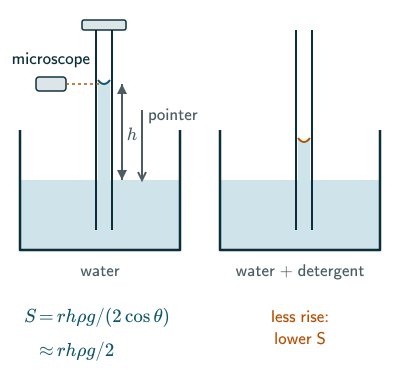
Theory
Water wets clean glass, so its angle of contact is very nearly zero and cos θ ≈ 1. The water in the tube rises until the weight of the column balances the upward pull of surface tension round the rim of the meniscus, so that the column is in equilibrium. Only the vertical part of the pull holds the column up: S cos θ × 2πr = ρg × πrh. So
Surface tension from capillary rise
A small correction (in NCERT’s laboratory manual, beyond the textbook). The meniscus is curved, so the water in it, above the lowest point of the meniscus, adds a little to the column. For a hemispherical meniscus (valid when θ ≈ 0, so the meniscus is a hemisphere of radius r) this is allowed for by using h + r/3 in place of h. For narrow tubes the correction is tiny (Example 1).
Since hr = 2S/(ρg) for a given liquid, tubes of different radii give rises in inverse proportion to their radii (Example 4).
Procedure
- Use a thoroughly cleaned capillary (grease or dirt changes the angle of contact). Have the laboratory supervisor carry out the prescribed cleaning and glass cutting; rinse thoroughly with distilled water and clamp the tube vertically with its lower end in the water.
- Raise the beaker so the water climbs well up the tube, then lower it again. The meniscus then settles down a wet wall; one that has climbed a dry wall can stick below its true level.
- Fix the pointer beside the tube and adjust it, or the water level, until the tip of the pointer just touches the water surface (it and its reflection meet).
- Focus the travelling microscope on the lowest point of the meniscus inside the tube, with the horizontal cross-wire touching it, and note the reading. (The microscope’s image is inverted, so set the cross-wire on what looks like the top of a convex curve.)
- Without moving the tube or the pointer, lower the beaker carefully and focus the microscope on the tip of the pointer; note the reading. The difference of the two readings is the rise h. Mark the level of the meniscus on the tube.
- Effect of detergent: rinse the tube with the detergent solution and repeat steps 2 to 5 with it; allow the surface to settle and compare the rise at the same temperature. In clean glass with θ already near zero, the detergent solution usually rises less. Mark this meniscus level too.
- After both liquid measurements, have the tube cut first at the higher mark and then at the lower one, so that both sections remain available. Measure the inner diameter at each cut with the microscope in two perpendicular directions. Half the mean diameter at each mark is the r for that liquid.
- Note the temperature, since surface tension falls as the temperature rises.
A typical observation table (for distilled water, data of Example 1):
| Reading | Value |
|---|---|
| Microscope on meniscus | 9.640 cm |
| Microscope on pointer tip | 3.740 cm |
| Rise h | 5.900 cm |
| Inner diameter (two directions) | 0.50 mm, 0.50 mm |
Precautions. Use a clean tube of uniform bore and distilled water. Keep the tube vertical. Read the bottom of the meniscus, not its edge. Do not disturb the tube or the pointer between the two microscope readings.
Solved examples
Take g = 9.8 m s and the density of water as 1000 kg m.
Example 1: Surface tension of water
Water rises 5.90 cm in a clean glass capillary of inner radius 0.25 mm. Find its surface tension, with and without the meniscus correction.
S = rhρg/2 = 0.25 × 10 × 0.0590 × 1000 × 9.8/2, about 0.0723 N m.
With the correction, h + r/3 = 0.0590 + 0.000083 m, a change of only 0.14%, giving about 0.0724 N m.
Answer: about 0.0723 N m (0.0724 with the correction), within about 0.6% of the 0.0727 N m that NCERT Table 9.3 gives for water at 20 °C.
Example 2: The effect of a detergent
In the same tube, water with a little detergent rises only 2.4 cm. Find its surface tension.
Assuming near-complete wetting (θ ≈ 0, not merely θ < 90°) and density approximately 1000 kg m, S = 0.25 × 10 × 0.024 × 1000 × 9.8/2, about 0.029 N m.
Answer: about 0.029 N m, about 0.4 times that of pure water. The detergent lowers the surface tension and makes the angle of contact with fabric smaller, so water penetrates it better (NCERT calls detergents wetting agents).
Example 3: A first-order worst-case error estimate
In Example 1, the radius is known to 0.01 mm and the rise to 0.01 cm. Estimate the largest percentage error in S to first order, treating density, g and cos θ as exact.
For the uncorrected formula S ∝ rh, the first-order worst-case relative error is the sum of the relative input bounds: 0.01/0.25 + 0.01/5.90 = 4.0% + 0.17%, about 4.2%.
Answer: about 4.2% as a first-order worst-case bound, not a statistical standard uncertainty. Here Δh is the uncertainty in the measured height difference; if each microscope reading has its own error bound, combine those to obtain Δh. The radius dominates this example, but not necessarily every setup.
Example 4: Tubes of different radii
Tubes of inner radii 0.20, 0.25 and 0.40 mm give rises of 7.40, 5.90 and 3.70 cm in water. Show that hr is constant and find S.
The products hr are 0.20 × 10 × 0.0740 = 1.48 × 10 m, 0.25 × 10 × 0.0590 = 1.475 × 10 m and 0.40 × 10 × 0.0370 = 1.48 × 10 m: constant within the readings. Taking the mean hr = 1.478 × 10 m, S = hrρg/2 = 1.478 × 10 × 1000 × 9.8/2, about 0.0724 N m.
Answer: hr is constant, as the theory predicts; S ≈ 0.0724 N m.
Common mistakes to avoid
Common mistake
Using the diameter as the radius
The formula needs the inner radius r, half the measured inner diameter. Using the diameter doubles S.
Common mistake
Measuring h from the bottom of the tube or from the meniscus edge
h is the height of the lowest point of the meniscus above the flat water surface outside, which is why the pointer is set to touch that surface.
Common mistake
Using a dirty tube
Grease raises the angle of contact, so cos θ is no longer close to 1 and the rise is too small, giving too low a value of S.
Common mistake
Expecting water to overflow from a short tube
If the tube is shorter than h, water does not overflow: it reaches the top and the meniscus flattens (its radius of curvature grows) so that the pressure difference just supports the shorter column.
Common mistake
Thinking detergent makes water rise higher
In clean glass with θ already near zero, detergent generally lowers the rise by lowering S. More generally, rise depends on S cos θ/ρ, so a simultaneous change in wetting must be considered.
Quick revision summary
- Water rises in a clean capillary until the weight of the column balances the pull of surface tension: S = rhρg/(2 cos θ) ≈ rhρg/2 for water in glass.
- h is read with a travelling microscope, from the bottom of the meniscus to the tip of a pointer touching the water surface; r is the inner radius at the meniscus.
- The rise is inversely proportional to the radius: hr is constant for a given liquid.
- Detergent lowers the surface tension, so the rise is much smaller.
- The radius causes most of the error.
- In short: S = rhρg/2 for water in clean glass.
Formula sheet
- S = rhρg/(2 cos θ) ≈ rhρg/2 (water in clean glass)
- S ≈ r(h + r/3)ρg/2 (hemispherical meniscus correction; θ ≈ 0)
- hr = 2S/(ρg) (constant for a liquid)
- ΔS/S ≈ Δr/r + Δh/h (first-order worst-case; other inputs exact)
Questions students ask
What other methods are used to measure surface tension?
Besides capillary rise, surface tension is measured by the plate, ring, drop-weight and bubble-pressure methods. The simple force formulas below are ideal estimates; real plate wetting, buoyancy, ring geometry and drop detachment require corrections or calibration. In the plate method a balance reads the extra pull F on a thin plate of edge l, S = F/(2l); the du Noüy ring method measures the force, about 4πRS, to lift a wire ring of radius R off the surface; in the drop-weight method a drop falls from a tube of radius r when its weight reaches about 2πrS. Jaeger’s method finds the greatest pressure needed to blow a bubble from a narrow tube in the liquid, 2S/r above the liquid’s pressure there; all but the plate method are beyond NCERT.
How does the surface tension of water change as more detergent is added?
The surface tension of water falls steeply as the first small amounts of detergent are added, because detergent molecules crowd into the surface with their water-repelling tails pointing out of the water, and it levels off once the surface is full. Beyond this point, the critical micelle concentration, extra detergent molecules gather into clusters (micelles) inside the liquid, so the surface tension stays nearly constant, typically 0.025 to 0.040 N m, roughly a third to a half of pure water’s 0.0727 N m (an idea beyond NCERT). That is why a little detergent already gives most of the fall in capillary rise, and adding more hardly changes it.
Does the capillary rise change if the tube is tilted?
No, tilting a capillary tube does not change the vertical height of the rise, if the tube is long enough: the column must still balance the same pressure difference across the meniscus, and only its vertical height h counts in the pressure hρg. The liquid therefore fills a longer length of the tube, l = h/cos α, where α is the tube’s angle with the vertical, so a rise of 6.0 cm becomes a column 12 cm long at 60°. In the experiment the tube is still kept vertical, so that the meniscus is symmetrical and its lowest point is easy to read.
Practice questions
Try each question first, then open the answer to check your working.
-
Q1. Why is a pointer set to touch the water surface in this experiment?
Show answerHide answer
The rise h is measured from the flat water surface outside the tube. The microscope cannot see that surface clearly beside the tube, so it is focused on the pointer tip, which marks the surface level exactly.
-
Q2. Water rises 4.9 cm in a clean capillary of inner radius 0.30 mm. Find its surface tension. Take g = 9.8 m s and the density of water as 1000 kg m.
Show answerHide answer
S = rhρg/2 = 0.30 × 10 × 0.049 × 1000 × 9.8/2, about 0.072 N m.
-
Q3. What happens to the capillary rise when detergent is added to the water, and why?
Show answerHide answer
It falls, because the detergent lowers the surface tension of water, and the rise is proportional to S cos θ. In clean glass θ is already about 0, so cos θ cannot rise to make up for it.