Temperature and heat
NCERT Class 11 Physics Chapter 10 Section 10.2
Quick answer
Temperature measures how hot or cold a body is, in kelvin or degrees Celsius; heat is energy transferred because of a temperature difference, measured in joules. Spontaneous net heat transfer is from hotter to colder, and thermal equilibrium means no net heat transfer. A temperature in kelvin is its Celsius value plus 273.15, while temperature differences have the same numerical value on both scales.
With your textbook
NCERT Physics Part II (Class 11), Chapter 10 “Thermal Properties of Matter”, Section 10.2 “Temperature and heat”, pages 202–203.
Open the official NCERT chapter (PDF, 2.3 MB, ncert.nic.in) (opens in a new tab)
Checked against the 2026-27 reprint on .
What are temperature and heat?
Temperature is a relative measure, or indication of hotness or coldness.
NCERT Physics Part II (Class 11), Section 10.2, page 202
So, we can say that heat is the form of energy transferred between two (or more) systems or a system and its surroundings by virtue of temperature difference.
NCERT Physics Part II (Class 11), Section 10.2, page 203
Temperature and heat
- Temperature tells how hot or cold a body is. Its SI unit is the kelvin (K); the degree Celsius (°C) is also in common use.
- Heat is energy that flows from one body to another because of a difference in temperature, on its own always from the hotter body to the colder one. Its SI unit is the joule (J).
In plain words: temperature is a property of a body, like its pressure or density. Heat is not something a body has; what a body has is internal energy, the total kinetic and potential energy of its molecules. Heat is energy on the move, flowing only while there is a temperature difference. At thermal equilibrium there is no net heat transfer between them; microscopic energy exchanges can still occur in both directions.
Temperature: hot and cold
An object with a higher temperature than another is said to be hotter; hot and cold are relative terms, like tall and short (NCERT, page 202). We can sense temperature by touch, but this sense is unreliable and covers only a narrow range. On a cold morning a metal railing feels colder than a wooden bench beside it, though both are at the same temperature: the metal draws heat from your hand much faster. For science we need a thermometer.
Heat: energy in transit
Leave a glass of ice-cold water and a cup of hot tea on a table on a summer day. The water warms up and the tea cools down. Heat flows into the cold water from the surroundings and out of the hot tea into them, and in each case the flow continues until the drink and its surroundings are at the same temperature (NCERT, pages 202–203). In the idealised model without evaporation or other energy inputs, that final state, with no net heat transfer, is called thermal equilibrium.
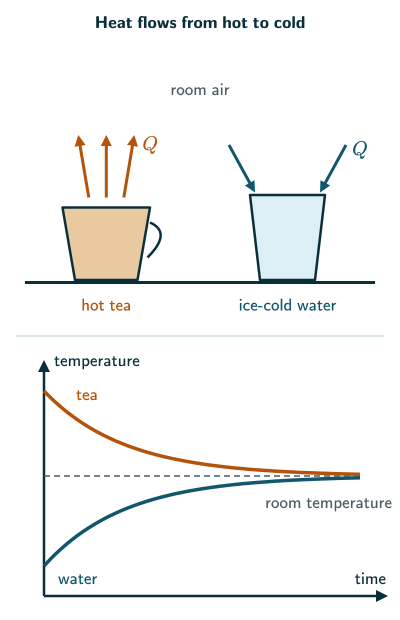
Three points are worth holding on to:
- Direction. Heat flows from the higher temperature to the lower one, whatever the sizes of the bodies. A hot spoon dipped in a bucket of cool water loses heat to the water, even though the bucket holds far more energy in total.
- What heating does. When a body takes in heat, its temperature may rise, it may expand, or it may change state, for example melt or boil (NCERT, page 203). These effects are the subject of the rest of this chapter.
- Heat is energy. Heat is measured in joules like any other energy. Older books, and food labels, use the calorie: 1 cal ≈ 4.186 J in the convention used here (NCERT gives this in its Thermodynamics chapter, Section 11.6, page 232). Beyond the NCERT text, the food “Calorie” is a kilocalorie, and James Joule showed in the 1840s that a given amount of mechanical work always produces the same warming as a fixed amount of heat, which established heat as a form of energy (Example 4).
Temperature differences. A change of 1 K is the same as a change of 1 °C, so a temperature difference has the same number in kelvin and in degrees Celsius. A temperature itself is converted by T = t + 273.15, where t is in °C (NCERT Section 10.4, page 203).
Solved examples
Example 1: Which way does heat flow?
A block of iron at 80 °C is dropped into water at 20 °C. Neglect the container, surroundings and any phase change. Describe the heat flow and final state.
Heat flows from the iron (higher temperature) into the water (lower temperature). The iron cools and the water warms until both reach the same temperature, somewhere between 20 °C and 80 °C; then net heat transfer stops. The final temperature depends on the masses and on what the materials are made of, which the calorimetry topic of this chapter deals with.
Answer: from iron to water, until they reach a common temperature (thermal equilibrium).
Example 2: Kelvin and Celsius
(a) Express 25 °C in kelvin. (b) Water warms from 35 °C to 60 °C. What is the rise in temperature in kelvin?
(a) T = 25 + 273.15 = 298.15 K.
(b) The rise is 60 − 35 = 25 °C, which is also 25 K, since the two scales have the same size of degree.
Answer: 298.15 K; 25 K.
Example 3: Energy in a snack
A food packet says it provides 250 kcal. Using 1 cal = 4.186 J, express this in joules.
250 kcal = 250 × 1000 × 4.186 J, about 1.05 × 10 J.
Answer: about 1.05 MJ.
Example 4: Work that warms water
In an experiment like Joule’s, a 2.0 kg mass falls slowly, at a steady speed, through 1.0 m, turning paddles in a tank of water, and this is repeated 20 times. Assuming no energy is lost elsewhere, how much work is done on the water, and how many calories of heat would produce the same warming? Take g = 9.8 m s.
Each fall releases gravitational potential energy mgh = 2.0 × 9.8 × 1.0 = 19.6 J, which the paddles pass to the water as work. Twenty falls do 392 J of work on the water. This raises its internal energy, and so its temperature, exactly as 392/4.186 ≈ 94 cal of heat would.
Answer: 392 J of work; the same warming as about 94 cal of heat. With the same sample, initial state and experimental constraints, equal energy transfers by work or heat produce the same final internal energy. The temperature rise also depends on the material and process.
Common mistakes to avoid
Common mistake
Saying a body “contains heat”
A body contains internal energy. Heat is the energy that flows because of a temperature difference; once the flow stops, there is no more heat, only a body with more (or less) internal energy than before.
Common mistake
Thinking heat flows from the body with more energy
Heat flows from the higher temperature to the lower one. A small hot spoon heats a large bucket of cool water, though the bucket has far more internal energy.
Common mistake
Converting a temperature difference with 273
A temperature is converted with T = t + 273.15, but a temperature difference is the same in kelvin and degrees Celsius.
Common mistake
Trusting touch to compare temperatures
Metal at room temperature feels colder than wood at the same temperature because it draws heat from your hand faster. Touch responds to how fast your skin loses heat, not to the object’s temperature.
Quick revision summary
- Temperature is a measure of hotness or coldness; SI unit kelvin (K), with °C in common use.
- Heat is energy transferred because of a temperature difference, on its own always from hotter to colder; SI unit joule (J).
- Heat flows until the bodies reach the same temperature: thermal equilibrium.
- Heating can raise a body’s temperature, make it expand or change its state.
- A temperature difference is the same in K and °C; a temperature converts as T = t + 273.15.
Formula sheet
- T (K) = t (°C) + 273.15
- ΔT (K) = Δt (°C)
- 1 cal ≈ 4.186 J (NCERT convention); 1 thermochemical cal = 4.184 J exactly
Questions students ask
What is the difference between heat and temperature?
Heat and temperature differ in kind: temperature is a property of a body that tells how hot or cold it is, measured in kelvin (or °C) with a thermometer, while heat is energy that flows from one body to another because of a temperature difference, measured in joules. Temperature does not depend on the amount of matter, but the heat given out or taken in does: a cup and a bucket of water at 50 °C have the same temperature, yet the bucket gives out far more heat as it cools to room temperature. Temperature decides the direction of heat flow, from higher to lower temperature, and there is no net heat transfer at thermal equilibrium.
How are heat and temperature explained by the motion of molecules?
For a classical ideal gas, temperature measures average random translational kinetic energy. In other materials the connection involves their available microscopic motions and interactions, so temperature is not universally defined by kinetic energy alone. Collisions can transfer energy from a hotter body to a colder one; radiation transfers energy without direct molecular contact. For an ideal gas the average translational kinetic energy of a molecule is (3/2)kBT, proportional to the absolute temperature (see temperature in kinetic theory). Temperature is therefore an average over very many molecules: a single molecule has kinetic energy but no temperature.
What is one calorie, and how many joules is it?
The historical 15 °C calorie refers to heating 1 g of water from 14.5 °C to 15.5 °C at 1 atm, and is approximately 4.186 J (see the calorie and water’s specific heat). The thermochemical calorie is defined as exactly 4.184 J, and a food Calorie is normally a kilocalorie, 4184 J. Thus a biscuit labelled 40 Calories supplies about 1.67 × 10 J; the worked exercises explicitly use NCERT’s rounded conversion. The calorie is not an SI unit; the SI unit of heat, as of every form of energy, is the joule.
Does supplying heat to a body always raise its temperature?
No, heat supplied to a body does not always raise its temperature: while a substance melts or boils, the heat goes into changing its state and the temperature stays constant until the change is complete. Ice at 0 °C, for example, takes in about 3.33 × 10 J per kilogram as it melts while staying at 0 °C (see latent heat). A gas can also take in heat with no rise in temperature if it does an equal amount of work as it expands, as in an isothermal expansion. For a specified heating process with no phase change and approximately constant specific heat, ΔT = Q/(ms). At constant pressure the appropriate specific heat already includes the effect of expansion work; zero work is not a necessary condition.
Practice questions
Try each question first, then open the answer to check your working.
-
Q1. On a cold morning, a steel railing feels much colder than a wooden bench beside it. Are they at different temperatures?
Show answerHide answer
No; both are at the temperature of the surroundings. Steel conducts heat away from your hand much faster than wood, so it feels colder. Touch responds to how fast your skin loses heat, not to the object’s temperature.
-
Q2. Is it correct to say that a hot iron ball “has more heat” than an identical cold one?
Show answerHide answer
Not strictly. The hot ball has more internal energy and a higher temperature. Heat is the energy that flows from it when it is placed in contact with something colder.
-
Q3. Normal body temperature is about 37 °C. Express it in kelvin.
Show answerHide answer
T = 37 + 273.15 = 310.15 K.