Specific heat capacity
NCERT Class 11 Physics Chapter 10 Section 10.6
Quick answer
Specific heat capacity s is heat supplied per unit mass per kelvin for a specified heating process. With no phase change and approximately constant s, ΔQ = msΔT, where s is in J kg K; heat capacity is for the whole body and molar heat capacity is per mole. Water’s value near ordinary conditions is about 4186 J kg K, making it useful for carrying thermal energy.
With your textbook
NCERT Physics Part II (Class 11), Chapter 10 “Thermal Properties of Matter”, Section 10.6 “Specific heat capacity”, pages 208–209.
Open the official NCERT chapter (PDF, 2.3 MB, ncert.nic.in) (opens in a new tab)
Checked against the 2026-27 reprint on .
What is specific heat capacity?
Heat capacity and specific heat capacity
For a specified heating process with no phase change, if heat ΔQ produces temperature rise ΔT, the average capacities over that interval are:
- its heat capacity is S = ΔQ/ΔT (unit J K);
- its specific heat capacity is the heat capacity per unit mass, s = S/m = ΔQ/(mΔT) (unit J kg K);
- its molar specific heat capacity is the heat capacity per mole, C = ΔQ/(μΔT) (unit J mol K).
Here μ = m/M is the number of moles (M is the molar mass in kg mol), so C = Ms.
(NCERT Section 10.6, page 208, Eqs. 10.10–10.12.)
It is defined as the amount of heat per unit mass absorbed or given off by the substance to change its temperature by one unit.
NCERT Physics Part II (Class 11), Section 10.6, page 208
In plain words: some substances warm up quickly, others slowly. Specific heat capacity measures how much heat it takes to warm one kilogram of a substance by one kelvin. Water needs a lot; metals need little. For equal absorbed power, negligible losses and the same mass, iron’s lower specific heat gives a faster temperature rise than water’s; equal sunshine alone need not mean equal absorbed power.
What the heat needed depends on
NCERT describes a simple experiment with a burner and a stopwatch (page 208):
- heating a quantity of water through 40 °C takes about twice as long as through 20 °C, so the heat needed is proportional to the temperature rise ΔT;
- heating twice the amount of water through 20 °C also takes twice as long, so the heat needed is proportional to the mass m;
- heating the same mass of mustard oil through 20 °C takes less time than water, so the heat needed depends on the nature of the substance.
Together these give the working formula:
Heat to change the temperature
With constant specific heat, a heater of constant power P and no losses, the temperature rises at a steady rate ΔT/Δt = P/(ms), so a temperature–time graph is a straight line of slope P/(ms).
The specific heat capacity depends on the substance and, to some extent, on its temperature. For gases the conditions must also be stated: NCERT (page 208) defines the molar specific heat at constant pressure, Cp, and at constant volume, Cv, and leaves the details to the Thermodynamics chapter. Cp is the larger. For the same temperature rise, an ideal gas gains the same internal energy either way, but at constant pressure it also expands and does work PΔV on its surroundings. For one mole, PΔV = RΔT, so Cp − Cv = R (NCERT Eq. 11.8, page 232).
Values, and why water matters
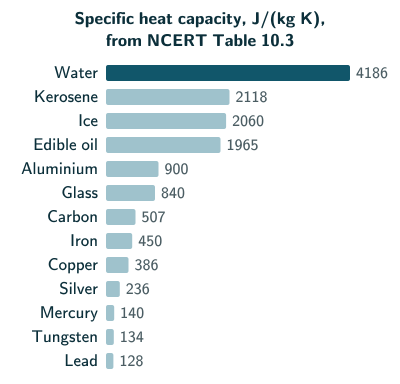
NCERT Table 10.3 (page 209) gives specific heat capacities with its heading referring to room temperature and atmospheric pressure, in J kg K: water 4186, ice 2060, kerosene 2118, edible oil 1965, aluminium 900, glass 840, carbon 506.5, iron 450, copper 386.4, silver 236.1, mercury 140, tungsten 134.4, lead 127.7. Ice is an exception to that heading: ordinary ice is stable below its melting point at 1 atm, and its quoted value is a near-freezing approximation. Use each value only over a suitable temperature range.
In the laboratory, the specific heat of a solid or another liquid is found in a calorimeter by the method of mixtures, taking water’s value as known. Of the substances in the table, water has the highest specific heat capacity, and that has everyday consequences:
For this reason water is also used as a coolant in automobile radiators, as well as, a heater in hot water bags.
NCERT Physics Part II (Class 11), Section 10.6, page 209
Water also warms up more slowly than land in summer, so a breeze from the sea feels cool (see sea breezes); and in deserts, where there is little water, the ground heats up quickly by day and cools quickly at night (NCERT, page 209).
Gases. NCERT Table 10.4 (page 209) gives molar specific heats in J mol K: helium Cp = 20.8, Cv = 12.5; hydrogen 28.8, 20.4; nitrogen 29.1, 20.8; oxygen 29.4, 21.1; carbon dioxide 37.0, 28.5. For every one of them Cp − Cv is close to 8.3 J mol K, the gas constant R (Example 5).
Solved examples
Use the values of NCERT Tables 10.3 and 10.4 given above.
Example 1: Heating water
How much heat is needed to warm 2.0 kg of water from 20 °C to 80 °C?
ΔQ = msΔT = 2.0 × 4186 × 60, about 5.02 × 10 J.
Answer: about 5.0 × 10 J (0.50 MJ).
Example 2: The same heat, a different metal
If the heat of Example 1 were given to 2.0 kg of aluminium instead, by how much would its temperature rise (assuming its specific heat remains 900 J kg K and no phase change occurs)?
ΔT = ΔQ/(ms) = 5.02 × 10/(2.0 × 900), about 279 K.
Answer: about 279 K, more than four times the 60 K rise of the water, because aluminium’s specific heat is less than a quarter of water’s.
Example 3: Heat capacity of a pot
What is the heat capacity of a copper pot of mass 0.50 kg?
S = ms = 0.50 × 386.4, about 193 J K: the pot takes in 193 J for every kelvin its temperature rises.
Answer: about 193 J K.
Example 4: Molar specific heat of copper
Copper has a molar mass of 63.5 g mol. Find its molar specific heat capacity.
Since μ = m/M, C = MΔQ/(mΔT) = Ms, with M = 63.5 g mol = 0.0635 kg mol.
C = 0.0635 × 386.4, about 24.5 J mol K. This is close to 3R = 24.9 J mol K, the value that NCERT’s Thermodynamics chapter (Section 11.6, pages 231–232) predicts for solids at ordinary temperatures. Carbon is an exception (NCERT, page 232): with M = 0.0120 kg mol, C = 0.0120 × 506.5, only about 6.1 J mol K. The 3R rule also fails at low temperatures.
Answer: about 24.5 J mol K.
Example 5: Molar heats of a gas at constant pressure and volume
Using NCERT Table 10.4, find Cp − Cv for helium and for carbon dioxide.
Helium: 20.8 − 12.5 = 8.3 J mol K. Carbon dioxide: 37.0 − 28.5 = 8.5 J mol K.
Answer: about 8.3–8.5 J mol K for both, close to R = 8.31 J mol K. The other gases give nearby differences. Rounded real-gas table entries are approximate evidence, not a proof of exact equality to R.
Common mistakes to avoid
Common mistake
Confusing heat capacity with specific heat capacity
Heat capacity S belongs to a particular body (J K); specific heat capacity s belongs to the material (J kg K). A large pot has more heat capacity than a small one of the same metal, but the same specific heat.
Common mistake
Using ΔQ = msΔT during melting or boiling
While a substance changes state, heat goes in with no change in temperature, so this formula does not apply; latent heat is needed instead.
Common mistake
Forgetting that a gas needs a condition
For a gas, say whether the heating is at constant pressure (Cp) or constant volume (Cv); for an ideal gas they differ by R per mole; real-gas values can deviate.
Common mistake
Mixing grams and kilograms
With s in J kg K, the mass must be in kilograms.
Common mistake
Mixing up degrees, kelvins and calories
A temperature change of 1 °C equals a change of 1 K, so ΔT can come straight from Celsius readings. But s given in cal g °C must be converted: water’s 1 cal g °C is 4186 J kg K.
Quick revision summary
- Heat capacity S = ΔQ/ΔT; specific heat capacity s = ΔQ/(mΔT), unit J kg K; molar specific heat C = ΔQ/(μΔT) = Ms, unit J mol K.
- The heat needed is proportional to mass and temperature rise and depends on the substance: ΔQ = msΔT.
- Water has a very high specific heat (4186 J kg K): a good coolant, a slow-warming sea, mild coasts.
- For gases, Cp > Cv; Cp − Cv = R for an ideal gas, and close to R for the real gases of NCERT Table 10.4.
- In short: ΔQ = msΔT.
Formula sheet
- S = ΔQ/ΔT (heat capacity, J K)
- s = ΔQ/(mΔT) (specific heat capacity, J kg K)
- C = ΔQ/(μΔT) (molar specific heat capacity, J mol K)
- ΔQ = msΔT
- C = Ms (M = molar mass in kg mol)
- Cp − Cv = R (ideal gas; ≈ R for the real gases in NCERT Table 10.4)
Questions students ask
Why does water have such a high specific heat capacity?
Water has a high specific heat capacity, 4186 J kg K, mainly because of hydrogen bonding between its molecules: part of the heat supplied goes into stretching and breaking these bonds rather than into speeding up the molecules, so the temperature rises less for each joule. Its molecules are also light, so a kilogram of water holds many more of them than a kilogram of a metal holds atoms (about 3.3 × 10, against about 1.1 × 10 in a kilogram of iron), and each molecule can store energy by rotating as well as by moving. As a result, a kilogram of water needs over nine times as much heat as a kilogram of iron for the same rise in temperature.
What is the specific heat of water, ice and steam?
The specific heat of water is about 4186 J kg K (1 cal g °C in cgs units), while ice and steam need only about half as much heat per kilogram per kelvin: about 2100 J kg K for ice (NCERT’s table gives 2060) and about 2000 J kg K for steam at constant pressure (a handbook value; NCERT gives none), roughly 0.5 cal g °C each. So when ice is heated to steam, each state warms with its own specific heat, and on a graph of temperature against heat the sloping part for ice is steeper than the one for water.
Does specific heat capacity change with temperature?
Yes, specific heat capacity changes with temperature, though for most solids and liquids only slowly near room temperature, which is why tables quote it at a stated temperature. Water’s value varies by only about 1% between 0 °C and 100 °C, with a shallow minimum near 35–40 °C, so 4186 J kg K can be used across that range. At very low temperatures the specific heats of solids fall steeply towards zero, which is where the Dulong–Petit law fails.
Does water have the highest specific heat capacity of all substances?
No, water does not have the highest specific heat capacity of all substances, though it has the highest in NCERT’s Table 10.3 of common solids and liquids. Hydrogen and helium have more at constant pressure: dividing NCERT’s molar values of Cp by the molar mass gives about 14 300 J kg K for hydrogen and 5200 J kg K for helium, because a kilogram of these light gases holds very many molecules. These gas examples are enough to disprove a universal “highest specific heat” claim. Water is widely used because its high heat capacity is combined with practical availability and useful operating properties.
Practice questions
Try each question first, then open the answer to check your working.
-
Q1. Why is water used in car radiators and in hot-water bags?
Show answerHide answer
Water has a very high specific heat capacity, so a given mass of it can carry away (or store) a large amount of heat for a small change in its temperature.
-
Q2. A 1000 W kettle heats 1.0 kg of water from 25 °C to 75 °C. Ignoring losses and the kettle’s own heat capacity, how long does it take? Take s = 4186 J kg K.
Show answerHide answer
ΔQ = 1.0 × 4186 × 50, about 2.09 × 10 J. At 1000 J per second this takes about 209 s, roughly 3.5 minutes.
-
Q3. On a sunny day, why does dry sand on a beach get much hotter than the sea?
Show answerHide answer
Sand has a far smaller specific heat capacity than water, so the same sunlight raises its temperature much more. (Water also spreads the heat by mixing and evaporating.)