Experiment: specific heat by the method of mixtures
Beyond NCERT In the JEE Main and NEET syllabus; the Class 11 book has no section for it.
Quick answer
The specific heat of a solid is found by heating it in steam to a known temperature, dropping it quickly into water in a calorimeter and reading the highest steady temperature: heat lost by the solid equals heat gained by the water and calorimeter. For a liquid, the liquid replaces the water and a solid of known specific heat is dropped in. The small temperature rise in the calorimeter and heat lost to the surroundings are the main sources of error.
What is this experiment?
The principle behind it
When a hot body is put into cooler water in a calorimeter and no heat escapes, the heat lost by the hot body equals the heat gained by the water and the calorimeter (NCERT Section 10.7, page 209). Each heat is mass × specific heat × temperature change, so one unknown specific heat can be found from measured masses and temperatures.
The outer jacket acts as a heat shield and reduces the heat loss from the inner vessel.
NCERT Physics Part II (Class 11), Section 10.7, page 209
The aim is to find the specific heat capacity of (i) a given solid and (ii) a given liquid by mixing a hot body with a cooler one in a calorimeter and reading the temperatures.
Both the JEE Main 2027 and the NEET (UG) 2026 syllabuses list this under Unit 20, Experimental Skills: “Specific heat capacity of a given (i) solid and (ii) liquid by method of mixtures”. The NCERT textbook gives the principle and a worked example (Section 10.7, pages 209–210; see calorimetry) but not the laboratory method. This page uses a dry-chamber steam-heater variant. NCERT’s Class XI Physics Laboratory Manual, Experiment 17, instead heats the solid in a water bath and removes adhering water before transfer; both use the same energy balance.
Apparatus
- A copper calorimeter with a copper stirrer and a lid, inside an insulating jacket.
- A steam heater (hypsometer) with a burner, to heat the solid to a steady, known temperature: steam surrounds the dry inner chamber that holds the solid.
- The solid under test, in one piece or as small pieces, tied with a thread or held in a small cage.
- Two thermometers reading to 0.1 °C (or 0.5 °C), one for the solid and one for the calorimeter.
- A physical balance reading to 0.01 g, water, and for part (ii) the liquid under test (for example kerosene) and a solid of known specific heat.
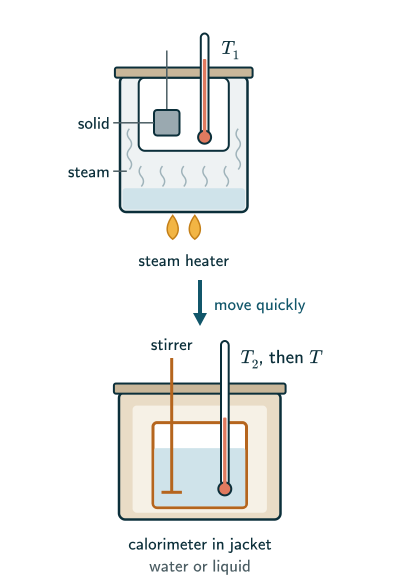
Theory
Let the solid have mass m and specific heat s, and start at T1. The thermally participating calorimeter parts, including the stirrer and lid when they warm with the liquid, have total mass mc and specific heat sc. It holds a mass mw of water (specific heat sw) at T2, and all end at T.
(i) A solid. Heat lost by the solid = heat gained by the water and calorimeter: ms(T1 − T) = (mwsw + mcsc)(T − T2). So
Specific heat of a solid
(ii) A liquid. Put a mass ml of the liquid in the calorimeter instead of water. Drop in a hot solid whose specific heat s is known, from part (i) or a table. Then ms(T1 − T) = (mlsl + mcsc)(T − T2), which gives
Specific heat of a liquid
Assume no phase change or reaction, negligible heat loss, and approximately constant specific heats. Include the thermometer and holder heat capacities if significant. In both parts the specific heats of water and copper come from a table, such as NCERT Table 10.3 (page 209): 4186 and 386.4 J kg K (see specific heat capacity).
A calorimeter’s heat capacity is often given as its water equivalent W = mcsc/sw, the mass of water that takes the same heat per kelvin; then mwsw + mcsc = (mw + W)sw.
Procedure
- Weigh the clean, dry calorimeter with its stirrer and any lid included in the heat-capacity model: mc.
- Fill it about half full with water, enough to cover the solid, and weigh again; the difference is mw. Put it in its jacket.
- Weigh the solid (m), hang it in the steam heater beside a thermometer, and heat until the reading stays steady. Note this reading as T1; it may be a little below 100 °C if the air pressure is low.
- Stir the water and note its steady temperature T2 just before the transfer.
- Move the solid quickly into the calorimeter without splashing, close the lid and stir gently. Note the highest steady temperature T.
- Work out s from the formula for a solid.
- For a liquid: repeat steps 1 to 5 with the liquid in place of water (weighing it gives ml), using a solid of known specific heat. Work out sl.
A typical observation table (for the solid, data of Example 1):
| Quantity | Value |
|---|---|
| Calorimeter and stirrer, mc | 0.120 kg |
| Water, mw | 0.150 kg |
| Solid, m | 0.050 kg |
| T1, T2, T | 99.5, 25.0, 29.7 °C |
Precautions. Move the solid quickly, so that it loses little heat on the way, and do not let it carry water or splash. Keep the lid on and stir gently all the time. Read the highest steady temperature after mixing. Use enough water to cover the solid but not so much that the rise becomes too small to read well (Example 4). Keep the steam heater and burner away from the calorimeter, or put a screen between them, so the water is not warmed before the transfer. Keep the thermometer bulb fully in the water, clear of the solid and the walls. In part (ii), use a liquid that does not react with the solid or with copper and does not evaporate easily, and keep kerosene well away from the flame.
Sources of error. Heat is lost from the solid during the transfer and from the calorimeter through the jacket, and the thermometers can only be read to their least count. The temperature rise of the water is only a few degrees, so its reading error matters most (Example 3). When the calorimeter is warmer than the room, these losses lower T. For a solid this makes s come out low; for a liquid it makes sl come out high, because the heat given out by the known solid is overestimated. For products and quotients, small worst-case relative error bounds add, as in the Young’s modulus experiment. Sums and differences first require absolute-error accounting; statistical uncertainties require a different calculation, including correlations.
Solved examples
Use NCERT Table 10.3 (page 209): water 4186, copper 386.4, aluminium 900 and kerosene 2118 J kg K.
Example 1: Specific heat of a solid
An aluminium piece of mass 0.050 kg is heated in steam to 99.5 °C and dropped into 0.150 kg of water at 25.0 °C in a copper calorimeter whose mass with its stirrer is 0.120 kg. The highest steady temperature is 29.7 °C. Find the specific heat of the aluminium.
Water and calorimeter, per kelvin: 0.150 × 4186 + 0.120 × 386.4 = 627.9 + 46.37 = 674.3 J K.
Heat gained over a rise of 4.7 K: 674.3 × 4.7, about 3169 J.
Heat lost by the aluminium over a fall of 69.8 K: 0.050 × s × 69.8 = 3.49 s.
So s = 3169/3.49, about 908 J kg K.
Answer: about 908 J kg K, within about 1% of NCERT’s 900 J kg K.
Example 2: Specific heat of a liquid
A 0.200 kg copper block at 99.5 °C is dropped into 0.120 kg of kerosene at 25.0 °C in the same calorimeter (0.120 kg of copper). The highest steady temperature is 40.2 °C. Find the specific heat of the kerosene.
Heat lost by the block: 0.200 × 386.4 × 59.3, about 4583 J.
Heat gained by the calorimeter over 15.2 K: 0.120 × 386.4 × 15.2, about 705 J.
Heat gained by the kerosene: 4583 − 705, about 3878 J. So sl = 3878/(0.120 × 15.2), about 2126 J kg K.
Answer: about 2126 J kg K, within 0.4% of NCERT’s 2118 J kg K.
Example 3: Which reading limits the accuracy?
In Example 1, assume an error bound of ±0.1 °C for each temperature reading; resolution alone does not establish that bound. Then each temperature difference may be out by up to 0.2 °C. Estimate the largest error in s from the temperatures.
To first order in worst-case error bounds, Δs/s ≈ Δ(T − T2)/(T − T2) + Δ(T1 − T)/(T1 − T).
Rise: 0.2/4.7, about 4.3%. Fall: 0.2/69.8, about 0.29%.
Answer: about 4.5%, almost all of it from the small rise of the water. For assumed ±0.01 g bounds on each weighing, including the two readings used to obtain the water mass by subtraction, the mass contribution is about 0.03%. This does not include transfer losses or calibration errors.
Example 4: Too much water
Repeat Example 1 with 0.300 kg of water instead of 0.150 kg, using s = 900 J kg K for aluminium. What rise would you see, and how good would the result be?
Cold side per kelvin: 0.300 × 4186 + 46.37, about 1302 J K. Hot side: 0.050 × 900 = 45 J K.
T = (45 × 99.5 + 1302 × 25.0)/
Answer: about 2.5 °C. The same 0.2 °C reading error is now about 8% of the rise, so the result is roughly half as precise as in Example 3. Use only as much water as covers the solid.
Common mistakes to avoid
Common mistake
Leaving out the stirrer
The stirrer is part of the calorimeter and warms up with it. Weigh the calorimeter and stirrer together.
Common mistake
Reading T too early or too late
Stir and wait for the highest steady reading. Read too early and the mixture has not finished warming; wait too long and heat lost to the surroundings lowers the reading.
Common mistake
Assuming the solid is at exactly 100 °C
Steam is at 100 °C only at standard air pressure. Read T1 from the thermometer beside the solid.
Common mistake
Using the specific heat of water for the liquid
In part (ii) the liquid replaces the water, so the water term disappears and mlsl takes its place. The known specific heat in that part belongs to the hot solid.
Quick revision summary
- Principle: heat lost by the hot body = heat gained by the cooler body and the calorimeter, if no heat escapes.
- Solid: s = (mwsw + mcsc)(T − T2)/
[m(T1 − T)]. - Liquid: heat a solid of known s, and replace the water by the liquid.
- Heat the solid in steam, transfer it quickly, stir, and read the highest steady temperature.
- The small temperature rise is the main source of error. Heat losses make s of a solid come out low, but sl of a liquid come out high.
Formula sheet
- s = (mw sw + mc sc)(T − T2)/
[m(T1 − T)] (solid) - sl = [ms(T1 − T)/(T − T2) − mc sc]/ml (liquid)
- Δs/s ≈ Δ(T − T)/(T − T) + Δ(T − T)/(T − T) (first-order worst-case temperature bounds)
Questions students ask
Why is the water in the calorimeter sometimes started a little below room temperature?
Starting the water a little below room temperature, by about as much as it is expected to end above it, is a correction for heat exchange with the surroundings, often called Rumford’s compensation: while the calorimeter is cooler than the room it gains heat, and once warmer it loses heat. Approximate cancellation depends on the whole temperature-versus-time history; symmetric starting and ending temperatures alone do not guarantee it. Without it, a calorimeter that stays above room temperature throughout only loses heat, and the specific heat of a solid comes out low. Keep the surface above the room’s dew point to avoid condensation; the required margin depends on humidity.
How do you find the specific heat of a solid that dissolves in or reacts with water?
The specific heat of a solid that dissolves in or reacts with water is found by the same method of mixtures, with the water replaced by a liquid of known specific heat in which the solid neither dissolves nor reacts, such as kerosene. The balance becomes ms(T1 − T) = (mlsl + mcsc)(T − T2), with sl now known and s the unknown. The same precautions apply, and a flammable liquid must be kept well away from the burner.
Can the specific heat of a liquid be found by the method of cooling instead?
Yes, the specific heat of a liquid can also be found by the method of cooling, based on Newton’s law of cooling, though JEE Main and NEET list only the method of mixtures. The same calorimeter is filled in turn with equal volumes of water and of the liquid, and the times tw and tl each takes to cool through the same range in the same room are noted. If both runs have the same heat-loss rate at each temperature and each total heat capacity is approximately constant over the range, so (mwsw + mcsc)/tw = (mlsl + mcsc)/tl, giving sl.
Practice questions
Try each question first, then open the answer to check your working.
-
Q1. Why is the solid heated in steam rather than taken straight out of boiling water?
Show answerHide answer
In the steam heater it reaches a steady temperature that can be read on a thermometer beside it, and, sitting in a dry chamber with steam all round it, it comes out dry. Hot water carried into the calorimeter would bring extra heat and make s come out too high.
-
Q2. A 0.200 kg metal piece at 98.0 °C is dropped into 0.100 kg of water at 20.0 °C in a calorimeter of water equivalent 0.010 kg. The final temperature is 26.0 °C. Find the specific heat of the metal.
Show answerHide answer
Heat gained = (0.100 + 0.010) × 4186 × 6.0, about 2763 J. Heat lost = 0.200 × s × 72.0 = 14.4 s. So s = 2763/14.4, about 192 J kg K.
-
Q3. Why is the highest steady temperature taken as the final temperature T?
Show answerHide answer
Heat flows from the solid into the water until they reach the same temperature, so the reading rises to a highest value. After that the calorimeter slowly loses heat to the surroundings and the reading falls. The highest steady value is closest to the true common temperature.