Thermal expansion
NCERT Class 11 Physics Chapter 10 Section 10.5
Quick answer
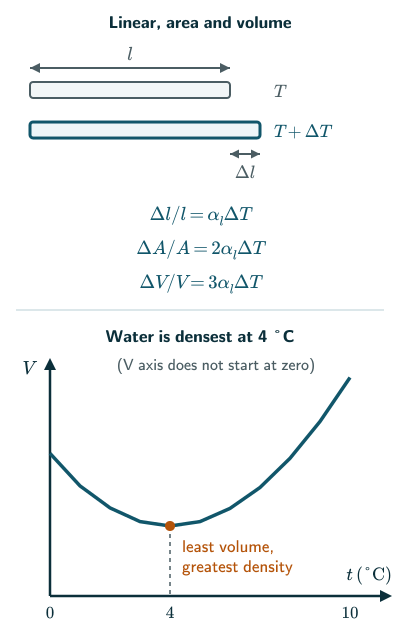
Most substances expand on heating: for a small uniform rise ΔT, a free length grows by the fraction αlΔT and a volume by αVΔT. In an isotropic material αV = 3αl, while the first-order area increase is 2αlΔT; an ideal gas at constant pressure has αV = 1/T. Fresh water near atmospheric pressure contracts on heating from 0 °C to about 4 °C, where its density is greatest.
With your textbook
NCERT Physics Part II (Class 11), Chapter 10 “Thermal Properties of Matter”, Section 10.5 “Thermal expansion”, pages 204–207.
Open the official NCERT chapter (PDF, 2.3 MB, ncert.nic.in) (opens in a new tab)
Checked against the 2026-27 reprint on .
What is thermal expansion?
The increase in the dimensions of a body due to the increase in its temperature is called thermal expansion.
NCERT Physics Part II (Class 11), Section 10.5, page 205
Coefficients of expansion
For small, uniform temperature changes, with the material free to expand and approximately constant coefficients:
- linear expansion: Δl/l = αlΔT, where αl is the coefficient of linear expansion;
- volume expansion: ΔV/V = αVΔT, where αV is the coefficient of volume expansion;
- and for a solid that expands equally in all directions (an isotropic solid), area expansion is 2αlΔT and αV = 3αl.
(NCERT Section 10.5, pages 205–207, Eqs. 10.4, 10.5 and 10.9.) The unit of each coefficient is K. A change of 1 °C equals a change of 1 K, so ΔT may be taken in either.
In plain words: most things get bigger when heated and smaller when cooled. A tight metal lid loosens in hot water; mercury climbs a thermometer; a half-blown balloon fills out in warm water (NCERT, pages 204–205). This proportionality is a local or small-change approximation; the coefficient depends on the material and temperature.
Linear expansion
For a long rod, the fractional increase in length is proportional to the temperature rise:
Linear expansion
Some values from NCERT Table 10.1 (page 205), for 0 °C to 100 °C, in units of 10 K: aluminium 2.5, brass 1.8, iron 1.2, copper 1.7, silver 1.9, gold 1.4, glass (pyrex) 0.32. Metals expand more than glass: copper expands about five times as much as pyrex for the same rise in temperature (NCERT, page 205).
NCERT’s Table 10.1 also lists lead at 0.29 × 10 K. That value is ten times too small: the accepted coefficient for lead is about 2.9 × 10 K, larger than for most common metals. (At 0.29, lead would expand less than pyrex, which contradicts NCERT’s own remark on the same page that metals normally expand more.)
Area and volume expansion
For volume, NCERT defines the coefficient of volume expansion by
Volume expansion
It depends on material, state and temperature. NCERT’s copper graph shows a nearly constant high-temperature region; that is not a universal rule for every material. Some values from NCERT Table 10.2 (page 206), in 10 K: iron 3.55, ordinary glass 2.5, pyrex 1, invar (an iron-nickel alloy) 0.2, mercury 18.2, water 20.7, ethanol 110. Solids and liquids expand only slightly; alcohol expands more than mercury.
Why area goes as 2α and volume as 3α. Heat a rectangular sheet of sides a and b. Each side grows by the factor (1 + αlΔT), so the area grows from ab to ab(1 + αlΔT) = ab(1 + 2αlΔT + αl2ΔT). Since αlΔT is tiny (about 10 × ΔT), its square can be dropped, giving ΔA/A ≈ 2αlΔT (NCERT Example 10.1, page 207). The same argument for a cube gives ΔV/V ≈ 3αlΔT, so αV = 3αl (NCERT Eqs. 10.7–10.9). A hole in a uniformly heated, unconstrained isotropic plate expands as though it contained the same material (Example 3). The relations between differential coefficients, β = 2α and γ = 3α, are exact for isotropic expansion; the finite-change formulas neglect higher powers of αΔT.
Density falls when volume increases. The mass is fixed while the volume grows, so the density becomes ρ′ = ρ/(1 + αVΔT) ≈ ρ(1 − αVΔT).
Gases. Gases expand far more than solids and liquids, and their coefficient depends strongly on temperature. For an ideal gas (μ moles, R the gas constant) at constant pressure, the ideal-gas equation PV = μRT gives PΔV = μRΔT. Dividing by PV = μRT gives ΔV/V = ΔT/T, so, with T in kelvin,
Ideal gas at constant pressure
At 0 °C this is 3.7 × 10 K, and at room temperature about 3.3 × 10 K (NCERT, page 206), larger than for most liquids (page 207); at room temperature it is about 18 times mercury’s value but only about three times the tabulated ethanol value.
Thermal stress
For a uniformly heated rod with fixed ends, initially unstressed and remaining linearly elastic without buckling, the supports compress it by the amount it would have expanded. The compressive strain is αlΔT, and by Hooke’s law the stress set up, called thermal stress, is
Thermal stress
where Y is the Young’s modulus of the material (NCERT, page 207). It can be very large (Example 2), which explains gaps in traditional jointed rails and expansion joints in bridges. Continuous welded rail is largely restrained against expansion and develops thermal stress; its stability depends on rail anchorage and the stress-free installation temperature.
Anomalous expansion of water
Water exhibits an anomalous behaviour; it contracts on heating between 0 °C and 4 °C.
NCERT Physics Part II (Class 11), Section 10.5, page 206
As water cools from room temperature its volume falls, as for other liquids, until 4 °C; below 4 °C it expands as it cools further. So:
This means that water has the maximum density at 4 °C.
NCERT Physics Part II (Class 11), Section 10.5, page 206
This matters for life in lakes and ponds. As a lake cools towards 4 °C, the surface water becomes denser and sinks, and warmer water rises. Once the surface water is below 4 °C it is less dense and stays on top, where it freezes. So lakes freeze from the top down; otherwise, NCERT notes, they would freeze from the bottom up, destroying much of their animal and plant life (page 206). In a sufficiently deep freshwater lake, floating ice insulates water below, which can remain near 4 °C. Shallow ponds can freeze through; depth, mixing and salinity affect the outcome.
Solved examples
Example 1: Fitting an iron ring on a wheel
This is NCERT Example 10.2 (page 207). A blacksmith fits an iron ring on the rim of a wooden cart wheel. At 27 °C the diameters of the rim and the ring are 5.243 m and 5.231 m. To what temperature must the ring be heated to fit the rim? Take αl = 1.20 × 10 K for iron.
The ring’s diameter must grow from 5.231 m to 5.243 m, that is by 0.012 m. With Δl = αllΔT, 0.012 = 5.231 × 1.20 × 10 × (T2 − 27).
So 1.20 × 10 × (T2 − 27) = 0.012/5.231 = 2.294 × 10.
Then T2 − 27 = 2.294 × 10/(1.20 × 10), about 191, and T2 ≈ 218 °C.
Answer: about 218 °C. On cooling, the ring shrinks and grips the rim tightly.
Example 2: Thermal stress in a rail
This is NCERT’s worked case (page 207). A steel rail 5 m long, of cross-section 40 cm, is prevented from expanding while its temperature rises by 10 °C. Find the thermal stress and the force. Take αl = 1.2 × 10 K and Y = 2 × 10 N m for steel.
Strain = αlΔT = 1.2 × 10 × 10 = 1.2 × 10. Stress = Y × strain = 2 × 10 × 1.2 × 10 = 2.4 × 10 N m. Force = 2.4 × 10 × 40 × 10, about 9.6 × 10 N.
Answer: 2.4 × 10 N m, a force of about 10 N, which can promote buckling if restraint is inadequate. The ideal axial stress is independent of length; the buckling threshold also depends on length and support conditions.
Example 3: A hole in a hot plate
A brass plate has a hole 2.000 cm across at 20 °C. What is the diameter of the hole at 220 °C? Take αl = 1.8 × 10 K for brass.
The hole expands like the brass around it: d = 2.000 × (1 + 1.8 × 10 × 200) = 2.0072 cm.
Answer: about 2.007 cm; the hole gets bigger, not smaller.
Example 4: Mercury overflowing a flask
A glass flask of volume 100 cm (ordinary glass, αV = 2.5 × 10 K) is filled to the brim with mercury (αV = 18.2 × 10 K) and heated by 50 °C. How much mercury overflows?
The mercury expands by 100 × 18.2 × 10 × 50 cm and the flask by 100 × 2.5 × 10 × 50 cm. The flask’s inside expands as if it were solid glass (like the hole in Example 3). The overflow is the difference, 100 × (18.2 − 2.5) × 10 × 50 = 0.785 cm; the apparent coefficient is 18.2 − 2.5 = 15.7 × 10 K.
Answer: about 0.79 cm. The flask expands too, so the mercury’s apparent expansion is less than its real expansion.
Common mistakes to avoid
Common mistake
Thinking a hole shrinks when a plate is heated
Under uniform, unconstrained heating of an isotropic plate, every length, including the hole’s diameter, grows by the same fraction. The hole gets bigger.
Common mistake
Using α for volume
For volume, use αV = 3αl for an isotropic solid, and 2αl for area.
Common mistake
Forgetting that the container expands too
When a liquid is heated in a vessel, the overflow is set by the difference between the liquid’s and the vessel’s volume expansion.
Common mistake
Thinking all liquids expand on heating at all temperatures
Water between 0 °C and 4 °C contracts when heated, and is densest at 4 °C.
Quick revision summary
- Most substances expand on heating: Δl/l = αlΔT, ΔV/V = αVΔT.
- For an isotropic solid, area expansion is 2αlΔT and αV = 3αl; many common metals expand more than pyrex, though this is not universal.
- For an ideal gas at constant pressure, αV = 1/T, far larger than for solids and liquids.
- A rod kept from expanding develops a thermal stress YαlΔT.
- Water contracts on heating from 0 °C to 4 °C and is densest at 4 °C, so lakes freeze from the top.
- In short: αV = 3αl.
Formula sheet
- Δl/l = αl ΔT
- ΔA/A = 2αl ΔT
- ΔV/V = αV ΔT, αV = 3αl
- αV = 1/T (ideal gas, constant pressure, T in kelvin)
- Thermal stress = Yαl ΔT
Questions students ask
What is the relation between α, β and γ in thermal expansion?
For an isotropic solid the coefficients of linear (α), area (β) and volume (γ) expansion are related by β = 2α and γ = 3α, so α : β : γ = 1 : 2 : 3. NCERT writes αl for α and αV for γ. For instantaneous differential coefficients these relations are exact under isotropic expansion. Using them in linear finite-change formulas assumes αΔT is small, so higher powers can be neglected. For a crystal that expands by different amounts along three perpendicular directions, the volume coefficient is the sum αx + αy + αz.
What is the SI unit and dimensional formula of the coefficient of linear expansion?
The coefficient of linear expansion has the SI unit K (per kelvin, which is the same as per °C) and the dimensional formula [K], because αl = Δl/(lΔT) is a fractional change in length, which has no dimensions, divided by a change in temperature. Its value depends on the material and slightly on the temperature, but not on the length or shape of the body: a 1 m and a 10 m iron rod have the same αl, about 1.2 × 10 K, though the longer rod grows ten times as much. The coefficients of area and volume expansion have the same unit and dimensions.
Why does water expand when it is cooled below 4 °C?
Water expands when cooled below 4 °C because of hydrogen bonding between its molecules: as it nears freezing, more and more molecules join into open, ice-like groups that take up more room than the closely packed liquid. Between 0 °C and 4 °C this opening-up outweighs the normal contraction on cooling, so the volume grows as the temperature falls; above 4 °C ordinary thermal contraction wins, which is why water is densest at 4 °C. On freezing, the whole structure becomes the open hexagonal lattice of ice, about 9% larger in volume than the water it came from, which is why ice floats and frozen water pipes can burst.
What are some examples of thermal expansion in daily life?
Everyday examples of thermal expansion include the small gaps left between rail lengths and the expansion joints in bridges and concrete roads, which give them room to grow on hot days, and overhead power lines, which sag more in summer than in winter. A thick glass tumbler can crack when boiling water is poured into it, because its inner surface expands before the outer one; heat-resistant glassware is made of borosilicate glass (pyrex), which expands less than half as much as ordinary glass. Thermostats in electric irons and water heaters use a bimetallic strip, two metals that expand by different amounts and so bend when heated, to switch the current off and on.
Does a metal scale read too high or too low on a hot day?
A metal scale calibrated at a lower temperature reads too low on a hot day, because its marks spread apart, so each ‘centimetre’ on it is slightly longer than a true centimetre. The true length of the object, at the temperature of measurement, is about the reading × (1 + αlΔT), where αl is for the scale’s metal and ΔT is the rise above the calibration temperature. For a steel scale calibrated at 20 °C and used at 45 °C (αl = 1.2 × 10 K), a reading of 80.00 cm means 80.00 × (1 + 1.2 × 10 × 25) ≈ 80.024 cm.
Practice questions
Try each question first, then open the answer to check your working.
-
Q1. A steel bridge is 100 m long. Over a year its temperature ranges from −10 °C to 40 °C. By how much does its length change? Take αl = 1.2 × 10 K.
Show answerHide answer
Δl = 1.2 × 10 × 100 × 50 = 0.06 m, that is 6 cm, which is why bridges have expansion joints.
-
Q2. Why does a lake freeze at the top first, while the water at the bottom stays liquid?
Show answerHide answer
Below 4 °C water expands as it cools, so the coldest water is the least dense and stays at the surface, where it freezes. Ice is less dense still and floats, and the water at the bottom stays near 4 °C.
-
Q3. Using NCERT Table 10.1, estimate the coefficient of volume expansion of aluminium and compare it with Table 10.2’s value of 7 × 10 K.
Show answerHide answer
αV = 3αl = 3 × 2.5 × 10 = 7.5 × 10 K, close to the table’s 7 × 10 K.