Newton’s law of cooling
NCERT Class 11 Physics Chapter 10 Section 10.10
Quick answer
Newton’s law of cooling models heat-loss rate as proportional to the temperature excess over the surroundings. If the surroundings, heat-transfer coefficient and heat capacity stay constant and the body is nearly uniform in temperature, its excess temperature decays exponentially. Small temperature differences often make this approximation useful; a log plot of positive excess against time is then a straight line.
With your textbook
NCERT Physics Part II (Class 11), Chapter 10 “Thermal Properties of Matter”, Section 10.10 “Newton’s law of cooling”, pages 219–221.
Open the official NCERT chapter (PDF, 2.3 MB, ncert.nic.in) (opens in a new tab)
Checked against the 2026-27 reprint on .
What is Newton’s law of cooling?
Newton’s law of cooling
The rate at which a body loses heat is directly proportional to the difference between its temperature T2 and the temperature T1 of its surroundings (NCERT Section 10.10, page 220):
Here k is an effective heat-transfer coefficient in W K, depending on area, surface and surrounding flow conditions. A nearly constant value is often a good approximation for small temperature differences; some forced-convection systems also permit a wider range.
The law holds good only for small difference of temperature.
NCERT Physics Part II (Class 11), Section 10.10, page 220
In plain words: if both have the same constant heat-transfer coefficient and heat capacity, a body 10 K above its surroundings cools twice as fast as an identical body 5 K above them. As the tea cools, the difference shrinks and so does the rate of cooling, so it cools quickly at first and then ever more slowly, approaching room temperature without quite reaching it.
NCERT’s activity
NCERT describes a simple experiment (pages 219–220):
- Put about 300 mL of water in a calorimeter with a stirrer, and cover it with a two-holed lid holding the stirrer and a thermometer. The first reading is the room temperature T1.
- Heat the water to about 40 °C above room temperature, then remove the heat source.
- Stirring gently, note the water’s temperature T2 every minute until it is about 5 °C above room temperature.
- Plot the excess temperature ΔT = T2 − T1 against time t (NCERT Fig. 10.19, page 220).
You will also notice that initially the rate of cooling is higher and decreases as the temperature of the body falls.
NCERT Physics Part II (Class 11), Section 10.10, page 220
NCERT says the activity shows that a hot body loses heat to its surroundings “in the form of heat radiation” (page 220). That is only part of the story: water in a calorimeter also loses heat by conduction through its walls and by convection in the air around it. NCERT itself says so later on the same page:
For small temperature differences, the rate of cooling, due to conduction, convection, and radiation combined, is proportional to the difference in temperature.
NCERT Physics Part II (Class 11), Section 10.10, page 220
The law works well for a radiator warming a room, heat lost through the walls of a room, or a cup of tea cooling on a table (page 220).
The cooling equation
Assume the body is nearly uniform in temperature, its mass m and specific heat s are constant, and no phase change or appreciable evaporation occurs. The surroundings and effective coefficient are held constant. Include the container’s heat capacity in ms when it participates. In a short time dt its temperature changes by dT2, which is negative while it cools. So the heat it gains is dQ = ms dT2, and dQ/dt = ms dT2/dt (NCERT Eq. 10.20). The rate of loss of heat is −dQ/dt = −ms dT2/dt. Setting this equal to k(T2 − T1) and dividing by ms:
Rate of fall of temperature (NCERT Eq. 10.21)
Here K = k/(ms).
So the rate of cooling, in kelvin per second, is proportional to the excess temperature. (NCERT’s text on page 220 says this follows “From Eqs. (10.15) and (10.16)”; it means Eqs. 10.19 and 10.20, since 10.15 and 10.16 are Wien’s and Stefan’s laws.)
Integrating, with the surroundings at a steady T1, gives ln(T2 − T1) = −Kt + c (NCERT Eq. 10.22), or
Temperature after time t (NCERT Eq. 10.23)
Here C′ is the signed initial temperature difference: positive for cooling, negative for warming. For a rigorous dimensionless logarithm, write ln[(T − T)/(T(0) − T)] = −Kt; the simpler plotted logarithm uses fixed temperature units. The excess falls exponentially: in each equal interval of time it shrinks by the same factor. This equation gives the time a body takes to cool through any range of temperature (page 220). If the excess falls from ΔTstart to ΔTend in a time t, then ΔTend = ΔTstarte−Kt, so t = ln(ΔTstart/ΔTend)/K.
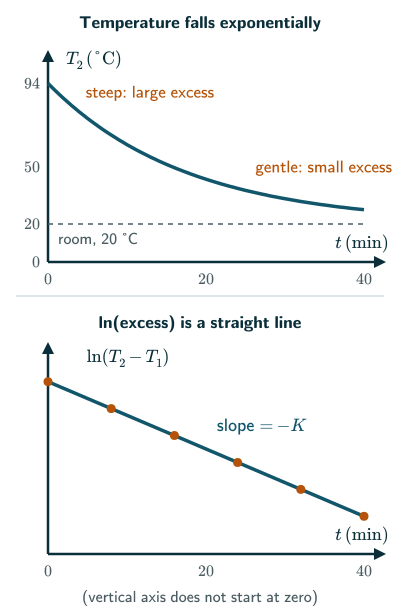
Verifying the law. NCERT’s Fig. 10.20 (page 220) shows a copper calorimeter of hot water placed inside a double-walled vessel with water between the walls. One thermometer reads the calorimeter water T2, the other the water between the walls T1. NCERT’s text calls the water between the walls “hot water”, but it is the surroundings: its large mass keeps it at a steady temperature T1, usually room temperature. For cooling, the calorimeter is warmer than the surrounding jacket; both could be above room temperature provided the jacket temperature remains stable. A graph of ln(T2 − T1) against t comes out as a straight line with negative slope, which supports Eq. 10.22 (pages 220–221).
Why the law needs a small temperature difference. For radiation alone, by the Stefan–Boltzmann law, a body loses heat at the net rate eσA(T24 − T14), with temperatures in kelvin (NCERT Eq. 10.18, page 219). This is not proportional to T2 − T1. Put T2 = T1 + ΔT: expanding (T1 + ΔT) gives T14 + 4T13ΔT plus terms in ΔT, which are tiny when ΔT is much smaller than T1. So the loss is about 4eσAT13ΔT. This is Newton’s law with k = 4eσAT13 (Example 4). This step goes beyond the NCERT text.
Solved examples
The following cooling calculations assume a constant-K Newton model over the stated ranges. “Exact” means exact within that model, not an exact prediction for a real pan or evaporating drink.
Example 1: A pan of hot food (NCERT Example 10.8)
A pan of hot food cools from 94 °C to 86 °C in 2 minutes in a room at 20 °C. How long will it take to cool from 71 °C to 69 °C?
NCERT uses the average temperature over each interval. From 94 °C to 86 °C the average is 90 °C, 70 °C above the room, and the pan cools at 8 °C/2 min = 4 °C per minute. So 4 = K × 70.
From 71 °C to 69 °C the average is 70 °C, 50 °C above the room: 2/t = K × 50.
Dividing the two: (4)/(2/t) = 70/50, so 2t = 1.4 and t = 0.7 min.
Answer: about 0.7 min, that is 42 s (page 221). In general, over a short interval, (Ti − Tf)/t ≈ K[(Ti + Tf)/2 − T1], where Ti and Tf are the starting and final temperatures.
Example 2: The same pan, using the exact equation
Solve Example 1 with NCERT Eq. 10.23 instead of averages.
The excess falls from 74 °C to 66 °C in 2 min, so K = ln(74/66)/2 = 0.1144/2, about 0.0572 per minute.
From 71 °C to 69 °C the excess falls from 51 °C to 49 °C, taking t = ln(51/49)/K = 0.0400/0.0572, about 0.699 min.
Answer: about 0.70 min (42 s). The average method agrees closely here because each interval is short.
Example 3: A cup of tea
Tea cools from 80 °C to 60 °C in 5 minutes in a room at 20 °C. How long does it take to cool from 60 °C to 40 °C?
Exact: the excess falls from 60 °C to 40 °C in 5 min, so K = ln(60/40)/5, about 0.0811 per minute. From an excess of 40 °C to 20 °C: t = ln(40/20)/K = 0.693/0.0811, about 8.55 min.
Average method: the first interval has an average excess of 50 °C and a rate of 4 °C per minute, so K = 0.08 per minute. The second has an average excess of 30 °C, so the rate is 2.4 °C per minute and t = 20/2.4, about 8.33 min.
Answer: about 8.5 min. The second 20 °C takes longer because the tea is nearer room temperature. The average method gives 8.33 min, about 2.5% short, because the intervals are long.
Example 4: When does radiation follow Newton’s law?
Surroundings are at 300 K. Compare T24 − T14 with 4T13ΔT for a body at 310 K and at 360 K.
At 310 K: 310 − 300 ≈ 1.135 × 10 K, while 4 × 300 × 10 = 1.08 × 10 K, about 5% less.
At 360 K: 360 − 300 ≈ 8.70 × 10 K, while 4 × 300 × 60 = 6.48 × 10 K, about 25% less.
Answer: with a 10 K excess the linear (Newton) form is good to about 5%; with a 60 K excess it is about 25% low. That is why the law needs a small temperature difference.
Common mistakes to avoid
Common mistake
Using the body’s own temperature instead of the excess
The rate of cooling is proportional to T2 − T1, the excess over the surroundings, not to T2 itself.
Common mistake
Assuming the rate of cooling is constant
The rate falls as the body cools, so equal temperature drops take longer and longer (Example 3).
Common mistake
Using the law for large temperature differences
Newton’s law is an approximation for small differences. For a large excess, especially when radiation dominates, use Stefan’s law with temperatures in kelvin.
Common mistake
Mixing up k and K
k is the heat-loss constant in −dQ/dt = kΔT. Since −dQ/dt is a rate of energy loss, a power in watts, k is in W K. K = k/(ms) is the rate constant for the temperature (per second or per minute). “Rate of cooling” can mean the rate of heat loss (∝ k, so ∝ surface area) or the rate of fall of temperature (∝ K = k/(ms)). For geometrically similar bodies of the same material, with equal surface heat-transfer conditions and temperature excess, a larger body loses more heat per second but cools more slowly in temperature.
Quick revision summary
- Newton’s law of cooling: the rate of loss of heat is proportional to the excess temperature over the surroundings, for small differences.
- −dQ/dt = k(T2 − T1); with dQ = ms dT2, the rate of fall of temperature is K(T2 − T1) with K = k/(ms).
- Solution: T2 = T1 + C′e−Kt; ln(T2 − T1) against t is a straight line of slope −K.
- The rate of cooling is fast at first and slows as the body nears room temperature.
- It covers conduction, convection and radiation together; for radiation it follows from Stefan’s law when ΔT is small.
Formula sheet
- −dQ/dt = k(T − T)
- dT/dt = −K(T − T), K = k/(ms)
- T2 = T1 + C′e−Kt
- t = ln(ΔTstart/ΔTend)/K
- (Ti − Tf)/t ≈ K[(Ti + Tf)/2 − T1] (short interval, average method)
Questions students ask
Is Newton’s law of cooling in the JEE Main 2027 and NEET (UG) 2026 syllabuses?
Newton’s law of cooling is not explicitly named in the JEE Main 2027 or NEET (UG) 2026 syllabuses; Unit 7 lists conduction, convection and radiation. That omission alone is not a guarantee that no application can be asked. It is in the JEE Advanced 2026 syllabus, under thermal physics, and in NCERT Class 11 (Section 10.10).
How accurate is Newton’s law of cooling, and what are its limitations?
Newton’s law of cooling is a good approximation when the body’s excess temperature over its surroundings is small, the surroundings stay at a steady temperature, and the body loses heat in the same way throughout, so that k stays constant (the same surface and the same air flow). It also assumes that the whole body is at one temperature, as a stirred liquid or a small piece of metal nearly is, and its cooling curve does not hold while the body freezes or condenses, since its temperature then stays fixed. When a steady wind carries the heat away (forced convection), the law holds well even for larger differences, because that heat loss is itself nearly proportional to the excess.
What is the difference between Newton’s law of cooling, Fourier’s law and Stefan’s law?
Fourier’s law describes conduction through a material, Newton’s law of cooling a body’s total heat loss to its surroundings, and Stefan’s law radiation alone. Fourier’s law gives the heat current through a bar of length L and area A as H = KAΔT/L; for a body at T2 in surroundings at T1, Newton’s law gives the rate of heat loss as k(T2 − T1), by all three modes; and Stefan’s law gives the net radiated power as eσA(T24 − T14), in kelvin. For a small excess, Stefan’s law reduces to Newton’s form.
Does Newton’s law of cooling also apply to heating?
Yes, Newton’s law of cooling applies equally to a body warming up in hotter surroundings, such as a cold drink left in a warm room: the rate at which it gains heat is proportional to the difference between the room’s temperature and its own, for small differences. Its temperature therefore rises quickly at first and then more and more slowly, approaching room temperature exponentially, with the same constant K = k/(ms) as for cooling. For example, a drink at 10 °C in a room at 30 °C that reaches 20 °C in 15 min reaches 25 °C after another 15 min, since each 15 min halves the difference.
Can two readings tell us when cooling began?
Only if the initial temperature, ambient temperature and constant-K model are known. Suppose a metal block starts at 37 °C in a room at 17 °C, and later reads 30 °C and 28 °C one hour apart. The readings give K = ln(13/11) ≈ 0.167 per hour; cooling from an initial excess of 20 K to 13 K took ln(20/13)/K ≈ 2.6 h before the first reading. If the initial temperature or cooling conditions are unknown, two readings do not determine a unique start time.
Practice questions
Try each question first, then open the answer to check your working.
-
Q1. Why does a hot cup of tea cool faster at first than later?
Show answerHide answer
The rate of cooling is proportional to the difference between the tea’s temperature and the room’s. At first the difference is large, so the tea cools fast; as it cools, the difference and so the rate fall.
-
Q2. Within a constant-K Newton model, two identical cups of water are 60 °C and 30 °C above room temperature. Compare their initial rates of cooling.
Show answerHide answer
By Newton’s law, the rate is proportional to the excess temperature, so the first cools 60/30 = 2 times as fast at first.
-
Q3. What graph would you plot to check Newton’s law of cooling from temperature readings, and what would you expect to see?
Show answerHide answer
Plot ln(T2 − T1) against time t. If the law holds, the points lie on a straight line with negative slope −K.