Calorimetry
NCERT Class 11 Physics Chapter 10 Section 10.7
Quick answer
Calorimetry is the measurement of heat. Its principle is that in an isolated system the heat lost by the hotter part equals the heat gained by the colder part, each heat being found from msΔT when no change of state occurs. In the method of mixtures, a hot body is dropped into water in a calorimeter (a copper or aluminium vessel and stirrer inside an insulating jacket), and this balance gives an unknown specific heat or the final temperature.
With your textbook
NCERT Physics Part II (Class 11), Chapter 10 “Thermal Properties of Matter”, Section 10.7 “Calorimetry”, pages 209–210.
Open the official NCERT chapter (PDF, 2.3 MB, ncert.nic.in) (opens in a new tab)
Checked against the 2026-27 reprint on .
What is calorimetry?
Calorimetry and its principle
Calorimetry means the measurement of heat. It rests on one principle: when parts of an isolated system at different temperatures are brought together, heat flows from the hotter part to the colder part until they reach a common temperature, and
- heat lost by the hotter part = heat gained by the colder part (NCERT Section 10.7, page 209).
When there is no change of state, each amount of heat is found from ΔQ = msΔT (NCERT Section 10.6, page 208; see specific heat capacity), with ΔT taken as a positive temperature change.
A system is said to be isolated if no exchange or transfer of heat occurs between the system and its surroundings.
NCERT Physics Part II (Class 11), Section 10.7, page 209
The heat lost by the part at higher temperature is equal to the heat gained by the part at lower temperature.
NCERT Physics Part II (Class 11), Section 10.7, page 209
Strictly, an isolated system exchanges neither matter nor energy, including work, with its surroundings; the NCERT quotation emphasises the heat-transfer condition. In these mixture problems, work, chemical reactions and external heat exchange are negligible.
In plain words: drop a hot iron ball into a bucket of cool water. The ball cools, the water warms, and they settle at one temperature in between. If no heat leaks out, every joule the ball gives up ends up in the water. This is energy conservation applied to heat, the same bookkeeping that shows up when mechanical energy is lost as heat (see conservation of mechanical energy).
The calorimeter
A device in which heat measurement can be done is called a calorimeter.
NCERT Physics Part II (Class 11), Section 10.7, page 209
NCERT describes it this way (page 209):
- a metal vessel and a stirrer of the same material, such as copper or aluminium;
- a wooden jacket around the vessel, holding a heat-insulating material such as glass wool; the jacket acts as a heat shield and reduces the heat lost from the inner vessel;
- an opening in the jacket through which a mercury thermometer goes into the calorimeter.
NCERT does not give reasons for these choices, but they are simple. The vessel and stirrer are made of the same metal so that one specific heat covers both. A good conductor such as copper quickly reaches the temperature of the water inside, and its small specific heat means it takes up only a little of the heat (about 5% in Example 1). Stirring keeps the whole of the water at one temperature.
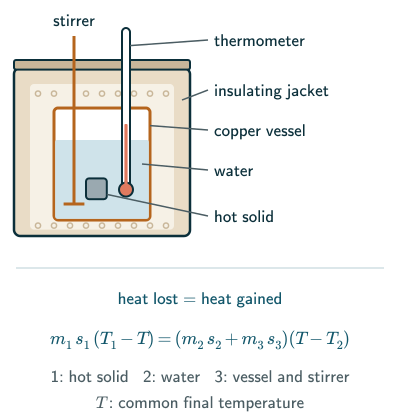
NCERT’s text points to Fig. 10.20 (page 220) for the calorimeter. That figure is drawn for Newton’s law of cooling (Section 10.10): it shows a copper calorimeter inside a double-walled vessel with water between its walls, not the wooden jacket and glass wool that Section 10.7 describes. The figure above shows the set-up as the text describes it.
The method of mixtures
Suppose a solid of mass m1 and specific heat s1, heated to T1, is dropped into a calorimeter holding water (mass m2, specific heat s2). The vessel and stirrer have total mass m3 and specific heat s3. The water and vessel start at T2, and everything ends at the common temperature T. Assume constant specific heats, no chemical reaction or phase change, negligible external heat/work, and include the heat capacity of other participating parts if significant.
- Heat lost by the solid: m1s1(T1 − T).
- Heat gained by the water and the vessel: (m2s2 + m3s3)(T − T2).
Setting them equal gives the working equation:
Principle of calorimetry (method of mixtures)
Each side is written as (higher temperature − lower temperature), so both are positive. If s1 is the unknown, measure everything else and solve:
s1 = (m2s2 + m3s3)(T − T2) / [m1(T1 − T)].
This is how NCERT finds the specific heat of aluminium in its Example 10.3 (Example 1 below).
Mixing two bodies with no container. If only two bodies mix and the container can be ignored, the final temperature is the heat-capacity-weighted average of the two starting temperatures:
T = (m1s1T1 + m2s2T2) / (m1s1 + m2s2).
For two samples of the same liquid, s cancels and T is the mass-weighted average. With more than two bodies, T = ΣmsT/Σms.
The same balance gives the specific heat of a liquid: put the liquid in the calorimeter in place of water and drop in a hot solid whose specific heat is known (see the method-of-mixtures experiment, part (ii)).
Water equivalent. A calorimeter of mass m3 and specific heat s3 absorbs as much heat per kelvin as a mass W = m3s3/sw of water, where sw is the specific heat of water. W is called its water equivalent. Adding W to the mass of water lets you treat the calorimeter as extra water (Example 3).
Where the method goes wrong. The simple heat-lost-equals-heat-gained equation assumes no external transfer. Energy conservation still holds when heat leaks; an additional heat-exchange term must then be included. In practice some heat is lost while the hot solid is carried to the calorimeter, and, if the calorimeter ends up warmer than the room, some leaks out through the jacket while the mixture settles. Both make the measured specific heat of the solid come out a little low. The method also assumes no change of state: if ice melts or water boils, latent heat must be added to the balance.
Solved examples
Use the values of NCERT Table 10.3 (page 209) unless an example says otherwise.
Example 1: Specific heat of aluminium (NCERT Example 10.3)
A 0.047 kg aluminium sphere is kept in boiling water until it is at 100 °C. It is then moved at once into a 0.14 kg copper calorimeter holding 0.25 kg of water at 20 °C. The water settles at 23 °C. Find the specific heat capacity of aluminium. (NCERT uses sw = 4.18 × 10 J kg K and sCu = 0.386 × 10 J kg K here.)
Heat lost by the sphere = 0.047 × sAl × (100 − 23) = 3.619 sAl.
Water and calorimeter, per kelvin: 0.25 × 4180 + 0.14 × 386 = 1045 + 54.0 = 1099 J K.
Heat gained over 3 K: 1099 × 3, about 3297 J.
So 3.619 sAl = 3297, giving sAl ≈ 911 J kg K.
Answer: about 0.911 kJ kg K, as NCERT finds (page 210). That is within about 1.2% of the 900 J kg K in Table 10.3.
Example 2: Mixing hot and cold water
0.20 kg of water at 80 °C is mixed with 0.30 kg of water at 20 °C. Ignoring the container and any heat loss, find the final temperature.
Both are water, so s cancels in the two-body formula above. Here 0.20 × 80 + 0.30 × 20 = 22, so T = 22/0.50 = 44 °C.
Check: heat lost = 0.20 × 4186 × 36, about 30 140 J; heat gained = 0.30 × 4186 × 24, also about 30 140 J.
Answer: 44 °C, closer to 20 °C because there is more cold water.
Example 3: Water equivalent of a calorimeter
Find the water equivalent of the 0.14 kg copper calorimeter of Example 1, using NCERT Table 10.3.
W = m3s3/sw = 0.14 × 386.4/4186, about 0.0129 kg.
Answer: about 13 g. The calorimeter behaves like an extra 13 g of water, so Example 1 could be solved with 0.25 + 0.013 kg of water and no separate copper term.
Example 4: Finding the final temperature
A 0.10 kg iron block at 100 °C is dropped into 0.20 kg of water at 20 °C in a 0.10 kg aluminium calorimeter. Find the final temperature.
Heat capacities: iron 0.10 × 450 = 45 J K; water 0.20 × 4186 = 837.2 J K; calorimeter 0.10 × 900 = 90 J K.
Heat lost = heat gained: 45(100 − T) = (837.2 + 90)(T − 20) = 927.2(T − 20).
So 4500 − 45T = 927.2T − 18 544, which gives 972.2T = 23 044 and T about 23.7 °C.
Answer: about 23.7 °C. The iron gives up about 3.43 × 10 J, and the water and calorimeter take in the same.
Example 5: What if the calorimeter is ignored?
Repeat Example 1 but leave out the heat taken up by the copper calorimeter.
sAl = (0.25 × 4180 × 3)/
Answer: about 866 J kg K, roughly 5% lower than the 911 of Example 1. The calorimeter’s share of the heat is small, but it is not negligible.
Common mistakes to avoid
Common mistake
Getting the signs tangled
Write each side as mass × specific heat × (higher temperature − lower temperature): heat lost uses (T1 − T), heat gained uses (T − T2). Then both sides are positive and the equation can be solved directly.
Common mistake
Forgetting the calorimeter
The vessel and stirrer warm up with the water and take part of the heat. Leave them out and the answer shifts (Example 5).
Common mistake
Taking the simple average
The final temperature is the plain average of the two starting temperatures only when the two bodies have equal heat capacities ms. Otherwise it lies nearer the starting temperature of the body with the larger heat capacity.
Common mistake
Using *ms*Δ*T* across a change of state
If ice melts or water boils during the mixing, latent heat must be included. Check your answer against melting and boiling points: for equilibrium at about 1 atm, an answer outside the assumed phase’s stable range means the phase assumption must be reconsidered. Pressure, supercooling and superheating can change the situation; always state the model.
Quick revision summary
- Calorimetry is the measurement of heat. In an isolated system, heat lost by the hotter part equals heat gained by the colder part.
- A calorimeter is a copper or aluminium vessel and stirrer inside an insulating jacket, with a thermometer through an opening.
- Method of mixtures: m1s1(T1 − T) = (m2s2 + m3s3)(T − T2).
- Two bodies alone: T = (m1s1T1 + m2s2T2)/
(m1s1 + m2s2). - Water equivalent of a calorimeter: W = m3s3/sw.
- Heat lost on the way, and leakage from a calorimeter warmer than the room, make the measured specific heat of a solid a little low.
Formula sheet
- heat lost = heat gained (isolated system)
- ms(T − T) = (ms + ms)(T − T)
- T = (msT + msT) / (ms + ms) (two bodies, no container)
- W = m3s3/sw (water equivalent)
Questions students ask
What is the difference between the water equivalent and the heat capacity of a calorimeter?
The heat capacity of a calorimeter, also called its calorimeter constant, is the heat it takes in per kelvin, ms, in J K, while its water equivalent is the mass of water that has the same heat capacity, W = ms/sw, in kilograms or grams. Both describe the same property in different ways: an aluminium calorimeter of mass 0.20 kg has a heat capacity of 0.20 × 900 = 180 J K and a water equivalent of 180/4186 ≈ 0.043 kg, about 43 g. In calories, with sw = 1 cal g °C, the two have the same number: a water equivalent of 43 g means a heat capacity of 43 cal °C.
Should temperatures be in degrees Celsius or kelvin in calorimetry problems?
Temperatures in calorimetry problems can be taken in degrees Celsius or in kelvin, because the heat equations contain only temperature differences, and a difference of 1 °C equals a difference of 1 K. So a fall from 100 °C to 23 °C is 77 K as well as 77 °C, and the final temperature comes out on whichever scale the data used. This is unlike the ideal-gas equation and the Stefan–Boltzmann law, where temperatures themselves appear and must be in kelvin.
What is a bomb calorimeter, and how is it different from the calorimeter used in physics?
A bomb calorimeter is a sealed, strong steel vessel (the ‘bomb’) in which a sample is burnt in oxygen at constant volume while it stands in a known mass of water; the rise in the water’s temperature gives the heat released, and chemists use it to measure heats of combustion and the change in internal energy ΔU of a reaction. The calorimeter of Class 11 physics is a simple copper or aluminium vessel in which hot and cold bodies are mixed, used to measure specific heats and latent heats. Both rest on the same idea: the heat released or lost is found from the temperature rise of something whose heat capacity is known.
What is the difference between a calorimeter and a colorimeter?
A calorimeter measures heat, while a colorimeter measures colour: a calorimeter is an insulated vessel in which the heat given out or taken in is found from a change in temperature, whereas a colorimeter shines light of a chosen colour through a solution and measures how much of it is absorbed, which tells the solution’s concentration. The two names differ by one letter and are often confused, but they come from different Latin words, ‘calor’ (heat) and ‘color’ (colour). Calorimeters are used in physics and in chemistry, for heats of reaction; colorimeters mainly in chemistry and biology.
Is calorimetry in the JEE Main 2027 and NEET (UG) 2026 syllabuses?
Yes, calorimetry is in both the JEE Main 2027 and NEET (UG) 2026 physics syllabuses, in Unit 7, Properties of Solids and Liquids, which lists specific heat capacity, calorimetry, change of state and latent heat. Both also list the experiment “Specific heat capacity of a given (i) solid and (ii) liquid by method of mixtures” under Unit 20, Experimental Skills. Typical questions ask for a final temperature, a specific heat or a water equivalent, often with ice melting or steam condensing in the mixture.
Practice questions
Try each question first, then open the answer to check your working.
-
Q1. Why is a calorimeter made of copper and kept inside a wooden jacket packed with glass wool?
Show answerHide answer
Copper conducts heat well, so the vessel quickly comes to the temperature of the water, and its small specific heat means it takes up little of the heat. The wooden jacket and glass wool are poor conductors; they act as a heat shield and reduce the heat lost to the surroundings, so heat lost very nearly equals heat gained.
-
Q2. 0.50 kg of water at 60 °C is mixed with 0.25 kg of water at 30 °C. Ignoring the container and heat loss, find the final temperature.
Show answerHide answer
T = (0.50 × 60 + 0.25 × 30)/0.75 = 37.5/0.75 = 50 °C.
-
Q3. A 0.20 kg copper block at 150 °C is dropped into 0.50 kg of water at 25 °C. Ignoring the container, find the final temperature. Use NCERT Table 10.3.
Show answerHide answer
Heat capacities: copper 0.20 × 386.4 = 77.28 J K; water 0.50 × 4186 = 2093 J K. T = (77.28 × 150 + 2093 × 25)/
(77.28 + 2093), about 29.5 °C. The water’s far larger heat capacity keeps the rise small.