Change of state
NCERT Class 11 Physics Chapter 10 Section 10.8
Quick answer
A change of state is a transition such as melting, boiling or sublimation. For a pure substance changing phase in equilibrium at fixed pressure, temperature stays at the transition value and Q = mL gives the latent heat transferred. At about 1 atm, water has Lf = 3.33 × 10⁵ J kg−1 at melting and Lv = 22.6 × 10⁵ J kg−1 at boiling.
With your textbook
NCERT Physics Part II (Class 11), Chapter 10 “Thermal Properties of Matter”, Section 10.8 “Change of state”, pages 210–214.
Open the official NCERT chapter (PDF, 2.3 MB, ncert.nic.in) (opens in a new tab)
Checked against the 2026-27 reprint on .
What is a change of state?
Change of state
Matter normally exists as a solid, a liquid or a gas. A change from one of these states to another is a change of state:
- solid to liquid is melting (or fusion); liquid to solid is freezing;
- liquid to vapour is vaporisation; vapour to liquid is condensation;
- solid straight to vapour is sublimation.
While a change of state goes on, the two states coexist in thermal equilibrium and the temperature stays constant. (NCERT Section 10.8, pages 210–212.) Strictly, this holds for a pure substance changing phase slowly at fixed pressure; mixtures, changing pressure and nonequilibrium processes need not show a constant-temperature plateau (reasoned).
A transition from one of these states to another is called a change of state.
NCERT Physics Part II (Class 11), Section 10.8, page 210
In plain words: heat a beaker of ice and the thermometer stops at 0 °C until the last bit of ice has melted, even though the burner keeps supplying heat. That heat is not lost. It goes into breaking the solid apart into a liquid, not into raising the temperature. The same happens at 100 °C while water boils away.
Melting and regelation
NCERT’s activity: heat ice cubes slowly in a beaker, stirring all the time, and note the temperature every minute (page 210). The temperature does not change as long as there is ice in the beaker.
It is observed that the temperature remains constant until the entire amount of the solid substance melts.
NCERT Physics Part II (Class 11), Section 10.8, page 210
The temperature at which the solid and the liquid are in thermal equilibrium is the melting point. It is a property of the substance, and it also depends on pressure. The melting point at standard atmospheric pressure is the normal melting point (page 210).
Regelation. NCERT describes a metal wire with a 5 kg block hung from each end, laid over a slab of ice (Fig. 10.10, pages 210–211). The wire slowly passes right through the ice, yet the slab does not split. Just below the wire the high pressure lowers the melting point, so the ice there melts; once the wire has passed, the water above it is no longer under that pressure and freezes again.
This phenomenon of refreezing is called regelation.
NCERT Physics Part II (Class 11), Section 10.8, page 210
Two points beyond NCERT’s account help explain why the activity works. A metal wire works much better than a string, because it conducts the heat released by the refreezing water above it down to the ice below, where that heat is needed for melting. And the ice must be close to 0 °C, because pressure lowers the melting point of ice by only about 0.0074 °C per atmosphere.
Skating. NCERT says skating on snow is possible because the pressure of the skates melts the ice beneath them into a lubricating layer of water (page 210). The water layer is real, but pressure alone is far too weak to make it: a skater’s weight lowers the melting point by well under 1 °C (Example 5), yet people skate on ice at −20 °C. Frictional heating, surface molecular mobility and a liquid-like interfacial layer all matter; their relative roles depend on temperature, speed and local contact pressure. Exam questions set from the textbook may still expect NCERT’s answer, so know both.
Boiling and pressure
When the ice has all melted, the temperature rises again until it is nearly 100 °C, then stays steady while the water turns to vapour (NCERT, page 211; Fig. 10.9 on page 210). The temperature at which the liquid and its vapour coexist in equilibrium is the boiling point.
NCERT’s flask activity (pages 211–212) shows the stages and the effect of pressure:
- As the water warms, dissolved air comes out as small bubbles. Later, steam bubbles form at the bottom but collapse as they rise into cooler water.
- When the whole of the water reaches 100 °C, steam bubbles reach the surface: the water boils.
- Closing the steam outlet for a few seconds raises the pressure, and boiling stops until the water gets hotter (NCERT page 212).
- NCERT then lets the water cool to about 80 °C, closes the flask with an airtight cork, turns it upside down and pours ice-cold water over it: the vapour inside condenses, the pressure falls, and the water boils again at a lower temperature (NCERT page 212). Do both steps only under a teacher’s supervision with a round-bottomed flask: a closed, heated flask can burst (reasoned).
Thus boiling point increases with increase in pressure.
NCERT Physics Part II (Class 11), Section 10.8, page 212
This is why cooking is slow on hills, where the lower air pressure lowers the boiling point of water, and fast in a pressure cooker, where the raised pressure raises it (page 212). The boiling point at standard atmospheric pressure is the normal boiling point.
Boiling should not be confused with evaporation. Evaporation goes on from the surface of a liquid at any temperature. Boiling forms vapour bubbles within the liquid once local pressure and temperature permit; nucleation and surface tension can affect its onset.
Sublimation
The change from solid state to vapour state without passing through the liquid state is called sublimation, and the substance is said to sublime.
NCERT Physics Part II (Class 11), Section 10.8, page 212
Dry ice (solid carbon dioxide) sublimes, and so does iodine (NCERT page 212). During sublimation the solid and the vapour coexist in thermal equilibrium (NCERT page 212). Strictly, that equilibrium holds on the sublimation curve; a solid subliming into open, unsaturated air is not in equilibrium with its vapour (reasoned).
Phase diagram and triple point
A graph of pressure P against temperature T for a substance is its phase diagram (NCERT box “Triple Point”, page 211). Three curves divide it into solid, liquid and vapour regions:
- on the sublimation curve (BO), solid and vapour coexist;
- on the fusion curve (AO), solid and liquid coexist;
- on the vaporisation curve (OC), liquid and vapour coexist.
The three curves meet at the triple point O, the one temperature and pressure at which all three states coexist.
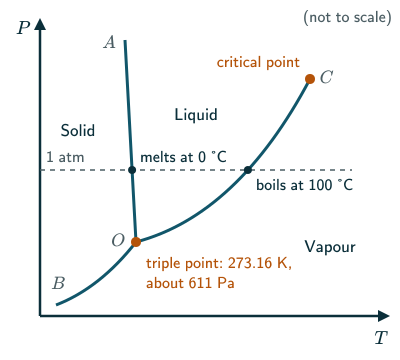
For water, the triple point is at 273.16 K (0.01 °C) and a pressure of about 611 Pa, roughly 0.006 atm. NCERT’s figure on page 211 marks it correctly as 0.006 atm, but the text of the box gives the pressure as 6.11 × 10 Pa, which is 10 times too small. The correct value is about 6.1 × 10 Pa (611.657 Pa). NCERT’s figure also shows the critical point C of water at 374 °C and 218 atm, the end of the vaporisation curve. Above the critical temperature there is no distinct liquid–vapour phase transition on compression; a dense supercritical fluid can form, but pressure alone does not produce a separate liquid phase.
For carbon dioxide, NCERT’s figure puts the triple point at −56.6 °C and 5.11 atm. Since that pressure is above 1 atm, liquid carbon dioxide cannot exist in open air: at 1 atm, dry ice sublimes straight to gas at −78.5 °C.
Ice is unusual: it is less dense than water, so more pressure lowers its melting point. Most substances, such as wax and carbon dioxide, expand on melting, so more pressure raises their melting point; in NCERT’s carbon dioxide figure the fusion curve leans to the right.
Latent heat
The amount of heat per unit mass transferred during change of state of the substance is called latent heat of the substance for the process.
NCERT Physics Part II (Class 11), Section 10.8.1, page 212
If a mass m changes state, the heat taken in or given out is
Latent heat (NCERT Eq. 10.13)
L is the latent heat, a property of the substance, with SI unit J kg. It depends on pressure and is usually quoted at standard atmospheric pressure. For melting it is the latent heat of fusion Lf; for boiling it is the latent heat of vaporisation Lv (page 213).
For water, Lf = 3.33 × 10 J kg and Lv = 22.6 × 10 J kg (page 213). Boiling 1 kg of water away takes almost seven times the heat needed to melt 1 kg of ice. In calories these are about 80 cal g and 540 cal g; NCERT Fig. 10.12 shows 80 kcal/kg and 540 kcal/kg. Some other values from NCERT Table 10.5 (page 213), at 1 atm:
- ethanol melts at −114 °C (Lf = 1.0 × 10 J kg) and boils at 78 °C (Lv = 8.5 × 10 J kg);
- mercury melts at −39 °C (0.12 × 10) and boils at 357 °C (2.7 × 10);
- lead melts at 328 °C (0.25 × 10) and boils at 1744 °C (8.67 × 10);
- nitrogen melts at −210 °C (0.26 × 10) and boils at −196 °C (2.0 × 10).
The table’s gold boiling point, 2660 °C, differs from later reference compilations, which place it around 2800–2900 °C. In a numerical exercise, use the value explicitly supplied.
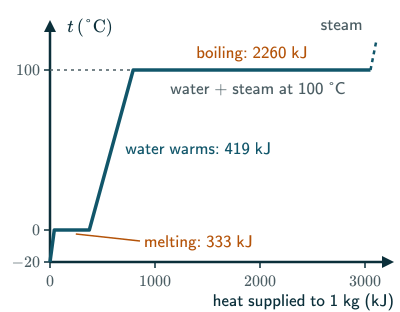
Unlike NCERT’s Fig. 10.12, which is not to scale, the graph above is drawn to scale. On both, the sloping parts are steeper for ice than for water. On a graph of temperature against heat, each sloping part has slope Δt/Q = 1/(ms), so a smaller specific heat gives a steeper line: the slopes show that the specific heats of the states differ (page 213).
Why steam burns are worse. At 1 atm, steam that fully condenses at 100 °C releases 22.6 × 10 J kg before the condensed water cools. This is a latent-energy difference, not heat stored as a substance; the comparison assumes equal masses and complete condensation (Example 4).
This is why burns from steam are usually more serious than those from boiling water.
NCERT Physics Part II (Class 11), Section 10.8.1, page 213
Solved examples
Use s = 4186 J kg K for water, 2060 J kg K for ice, Lf = 3.33 × 10 J kg and Lv = 22.6 × 10 J kg unless an example gives other values.
Example 1: Latent heat of fusion by mixing (NCERT Example 10.4)
0.15 kg of ice at 0 °C is mixed with 0.30 kg of water at 50 °C. The final temperature is 6.7 °C. Find the latent heat of fusion of ice.
Heat lost by the warm water: 0.30 × 4186 × (50.0 − 6.7) = 54 376.14 J.
Heat gained by the ice: 0.15 Lf to melt, then 0.15 × 4186 × 6.7 = 4206.93 J to warm the melted ice to 6.7 °C.
Heat lost = heat gained: 54 376.14 = 0.15 Lf + 4206.93, so 0.15 Lf = 50 169.21 J and Lf = 50 169.21/0.15.
Answer: Lf ≈ 3.34 × 10 J kg, as NCERT finds (page 213).
Example 2: Ice to steam (NCERT Example 10.5)
How much heat turns 3 kg of ice at −12 °C into steam at 100 °C? NCERT takes sice = 2100 J kg K, Lf = 3.35 × 10 J kg and Lv = 2.256 × 10 J kg here.
Warm the ice to 0 °C: 3 × 2100 × 12 = 75 600 J.
Melt it: 3 × 3.35 × 10 = 1 005 000 J.
Warm the water to 100 °C: 3 × 4186 × 100 = 1 255 800 J.
Boil it: 3 × 2.256 × 10 = 6 768 000 J.
Answer: the total is 9 104 400 J, about 9.1 × 10 J (page 214). Boiling alone is about three-quarters of it.
Example 3: Does all the ice melt?
0.10 kg of ice at 0 °C is dropped into 0.20 kg of water at 30 °C. Ignoring the container, find the final state.
Most heat the water can give while cooling to 0 °C: 0.20 × 4186 × 30 = 25 116 J.
Heat needed to melt all the ice: 0.10 × 3.33 × 10 = 33 300 J. That is more than the water can give, so not all the ice melts and the mixture ends at 0 °C.
Ice melted: 25 116/(3.33 × 10), about 0.0754 kg.
Answer: the mixture ends at 0 °C with about 75 g of the ice melted and about 25 g left.
Example 4: Steam versus boiling water
Compare the heat given to the skin by 10 g of steam at 100 °C and by 10 g of water at 100 °C, each ending as water at 37 °C.
Water: 0.010 × 4186 × 63, about 2637 J.
Steam: condensing gives 0.010 × 22.6 × 10 = 22 600 J, then cooling gives 2637 J, about 25 237 J in all.
Answer: in this idealised equal-mass, complete-condensation comparison, the steam transfers about 9.6 times as much energy. Actual injury also depends on contact and heat-transfer conditions.
Example 5: How much does a skate lower the melting point?
A 70 kg skater stands on one blade 3 mm wide with 30 cm of it on the ice. Pressure lowers the melting point of ice by about 0.0074 °C per atmosphere (a measured value beyond NCERT). Estimate the drop in melting point (take g = 9.8 m s).
Pressure: 70 × 9.8/(0.003 × 0.30), about 7.6 × 10 Pa, about 7.5 atm.
Drop in melting point: 7.5 × 0.0074, about 0.056 °C.
Answer: about 0.06 °C. Even if only a tenth of the blade touched the ice, the drop would be about 0.6 °C, far too little to melt ice at −20 °C.
Common mistakes to avoid
Common mistake
Thinking the temperature rises while ice melts
During a change of state the temperature stays constant (NCERT page 210); the heat transferred goes into the change of state, as latent heat (NCERT page 212). Strictly, this holds for a pure substance at fixed pressure, in equilibrium (reasoned).
Common mistake
Using msΔT across a change of state
msΔT works only within one state. Where the state changes, add mL for that step, as in Example 2.
Common mistake
Assuming all the ice melts
First compare the heat available with the heat needed to melt all the ice. If the heat is not enough, the mixture ends at 0 °C with ice left (Example 3).
Common mistake
Treating 100 °C as a fixed boiling point
Water boils at 100 °C only at standard atmospheric pressure. At lower pressure it boils at a lower temperature, at higher pressure at a higher one.
Common mistake
Dropping the power of ten
NCERT Table 10.5 lists latent heats in units of 10 J kg: Lv for water is 22.6 × 10 J kg, that is 2.26 × 10 J kg, not 22.6 J kg.
Quick revision summary
- A change of state is a change between solid, liquid and gas: melting, freezing, vaporisation, condensation, sublimation.
- During a change of state the temperature stays constant and the two states coexist in thermal equilibrium (for a pure substance at fixed pressure).
- The melting point and boiling point depend on pressure: more pressure raises the boiling point and lowers the melting point of ice (regelation).
- On a phase diagram, the sublimation, fusion and vaporisation curves meet at the triple point; for water 273.16 K and about 611 Pa.
- Latent heat: Q = mL. For water, Lf = 3.33 × 10 J kg and Lv = 22.6 × 10 J kg.
Formula sheet
- Q = mL (heat for a change of state)
- Lf = 3.33 × 10⁵ J kg−1 (water)
- Lv = 22.6 × 10⁵ J kg−1 (water)
- Triple point of water: 273.16 K, about 611 Pa
Questions students ask
What is the difference between latent heat and sensible heat?
Latent heat changes the state of a substance at constant temperature, while sensible heat changes its temperature: sensible heat can be ‘sensed’ with a thermometer, but latent (hidden) heat cannot, because during melting or boiling it goes mainly into the potential energy of the molecules, pulling them apart, not into their kinetic energy. Sensible heat is found from Q = msΔT, with the specific heat capacity s in J kg K, and latent heat from Q = mL, with L in J kg. For water the latent heats are large: melting 1 kg of ice at 0 °C takes 3.33 × 10 J, as much heat as warming 1 kg of water by about 80 K.
Why is the latent heat of vaporisation of water much larger than its latent heat of fusion?
The latent heat of vaporisation of water, 22.6 × 10 J kg, is almost seven times its latent heat of fusion, 3.33 × 10 J kg, because boiling must pull the molecules completely apart, while melting only loosens them. In ice and in liquid water the molecules stay about the same distance apart, so melting breaks only some of the hydrogen bonds; in the vapour they are far apart, so nearly all the attraction must be overcome. Boiling also pushes back the atmosphere, as 1 g of water becomes about 1671 cm of steam; at 1 atm this work is about 1.7 × 10 J kg, part of Lv (see water turning to steam).
What is the difference between evaporation and boiling?
Evaporation and boiling both turn a liquid into vapour, but evaporation happens only at the surface and at any temperature, while boiling happens throughout the liquid, with bubbles of vapour, at one fixed temperature for a given pressure, the boiling point. Evaporation is slow, and it speeds up with a larger surface, a higher temperature, wind and dry air; continued boiling at fixed temperature needs an energy supply, but reducing pressure can also initiate boiling that cools the liquid. Evaporation cools the liquid left behind, because the fastest molecules escape and each kilogram carries away its latent heat, which is why sweating cools the body and water stays cool in an earthen pot.
Can water boil at room temperature?
Yes, water can boil at room temperature if the pressure above it is lowered enough: at 25 °C it boils once the pressure falls to about 3.2 kPa, roughly 3% of atmospheric pressure, which is the vapour pressure of water at that temperature. This is the same effect as in NCERT’s flask activity, where cooling the sealed flask lowers the pressure and the water boils again below 100 °C (see boiling and pressure). Water boiling at room temperature is not hot: without an external heat supply it draws on its own internal energy and cools as it boils.
What is the SI unit and dimensional formula of latent heat?
Latent heat has the SI unit J kg and the dimensional formula [L T], since L = Q/m is an energy, [M L T], divided by a mass (see the table of dimensional formulae). Unlike specific heat capacity, J kg K, it has no kelvin in it, because a change of state happens at constant temperature. In older units it is given in cal g or kcal kg, which are the same size: 1 cal g = 1 kcal kg = 4186 J kg.
Practice questions
Try each question first, then open the answer to check your working.
-
Q1. Why does food take longer to cook in an open pot on a high mountain?
Show answerHide answer
The air pressure is lower at high altitude, so water boils at a temperature below 100 °C. The food is cooked in water that is not as hot, so it takes longer.
-
Q2. How much heat is needed to melt 0.50 kg of ice at 0 °C?
Show answerHide answer
Q = mLf = 0.50 × 3.33 × 10, about 1.67 × 10 J.
-
Q3. A beaker of ice and water is heated steadily and stirred. Why does its temperature stay at 0 °C until all the ice has melted?
Show answerHide answer
The heat supplied is used to change ice into water, not to raise the temperature. While both states are present they stay in thermal equilibrium at the melting point.