First law of thermodynamics
NCERT Class 11 Physics Chapter 11 Section 11.5
Quick answer
The first law expresses energy conservation. For a closed system with negligible bulk kinetic and potential-energy changes, ΔQ = ΔU + ΔW, where ΔQ is heat supplied, ΔU is internal-energy change and ΔW is work done by the system. Boundary work against constant pressure is PΔV; heat and work depend on the path, but ΔU depends only on the end states.
With your textbook
NCERT Physics Part II (Class 11), Chapter 11 “Thermodynamics”, Section 11.5 “First law of thermodynamics”, pages 230–231.
Open the official NCERT chapter (PDF, 1.8 MB, ncert.nic.in) (opens in a new tab)
Checked against the 2026-27 reprint on .
What is the first law of thermodynamics?
First law of thermodynamics
The heat ΔQ supplied to a system goes partly into raising its internal energy, ΔU, and the rest into work ΔW done by the system on its surroundings (NCERT Section 11.5, page 230):
This form assumes a closed system with negligible changes in bulk kinetic and external potential energy. With those changes present, use ΔE = ΔU + ΔKE + ΔPE; flowing matter also carries energy. NCERT’s ΔQ and ΔW denote transfers, not changes of stored heat or work.
Here ΔQ is the heat supplied to the system, ΔW the work done by the system, and ΔU the change in its internal energy.
It is simply the general law of conservation of energy applied to any system in which the energy transfer from or to the surroundings is taken into account.
NCERT Physics Part II (Class 11), Section 11.5, page 230
In plain words: energy is never created or destroyed, only moved around. Heat a gas in a cylinder and some of that energy warms the gas, while the rest pushes the piston out. Add up what went in, what was stored, and what was used for pushing, and the books balance.
Signs and the path
Written as ΔQ − ΔW = ΔU (NCERT Eq. 11.2), the law shows something important. A system can go from one state to another by many paths. ΔQ and ΔW generally depend on the path, but ΔU does not, because internal energy is a state variable. So the combination ΔQ − ΔW is the same for every path between the same two states (page 230).
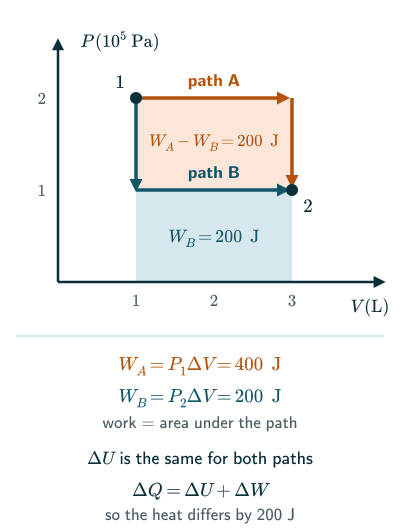
NCERT’s example (page 230): to take a gas from (P1, V1) to (P2, V2), we can first change the volume at constant pressure and then the pressure at constant volume, or do these the other way round. The work and heat differ, but ΔU is the same (Example 4).
Sign convention. With NCERT’s choice:
- ΔQ > 0 when heat flows into the system, ΔQ < 0 when it flows out;
- ΔW > 0 when the system does work, and ΔW < 0 when work is done on it; for ordinary positive-pressure boundary work these correspond to expansion and compression;
- ΔU > 0 when the internal energy rises.
Two special cases.
- If ΔU = 0, then ΔQ = ΔW: all the heat supplied is used by the system to do work (page 230). An example is the isothermal expansion of an ideal gas, whose U depends only on temperature. Isothermal does not always mean ΔU = 0: boiling 1 g of water stays at 100 °C, yet its ΔU is 2086.8 J (Example 1).
- If no heat flows (ΔQ = 0), then ΔU = −ΔW: a fixed-composition ideal gas that does positive work cools, while work done on it raises its temperature; an insulated free expansion has no work and no ideal-gas temperature change.
Work done by a gas at constant pressure
A gas in a cylinder pushes on a piston of area A with force PA. If the piston moves out a distance Δx while the pressure stays constant, the gas does work PAΔx. Since AΔx is the change in volume ΔV:
Work done by a gas at constant pressure
So for this case the first law reads ΔQ = ΔU + PΔV (NCERT Eq. 11.3, page 231). Here P is the steady pressure the gas pushes against. In a slow expansion it equals the gas pressure; if a gas expands against a fixed outside pressure, such as the atmosphere in the boiling-water example below, use that outside pressure. For a quasi-static piston process, boundary work is the area under the gas-pressure versus volume curve. In an irreversible expansion use the opposing boundary pressure with an appropriate piston/energy model. Work depends on the path taken.
Boiling water (NCERT, page 231). When 1 g of water boils at atmospheric pressure, it takes in 2256 J of heat (the latent heat) and its volume grows from 1 cm to 1671 cm. The work done pushing back the atmosphere is
ΔW = P(Vg − Vl)
= 1.013 × 10 × 1670 × 10
≈ 169.2 J,
so ΔU = 2256 − 169.2 = 2086.8 J. NCERT’s working on page 231 puts 1671 × 10 in the bracket, which would give 169.3 J; its answer, 169.2 J, is the value for Vg − Vl = 1670 cm. The 0.1 J difference is negligible beside 2256 J.
We see that most of the heat goes to increase the internal energy of water in transition from the liquid to the vapour phase.
NCERT Physics Part II (Class 11), Section 11.5, page 231
Solved examples
Example 1: Water turning to steam (NCERT, page 231)
1 g of water at atmospheric pressure (1.013 × 10 Pa) becomes steam, taking in 2256 J of heat. Its volume grows from 1 cm to 1671 cm. Find the work done and the change in internal energy.
ΔW = PΔV = 1.013 × 10 × 1670 × 10, about 169.2 J.
ΔU = ΔQ − ΔW = 2256 − 169.2 = 2086.8 J.
Answer: ΔW ≈ 169.2 J and ΔU ≈ 2086.8 J. About 92.5% of the heat goes into internal energy, mostly to pull the molecules apart.
Example 2: Heat in, work out
A gas takes in 800 J of heat and does 500 J of work on its surroundings. Find the change in its internal energy.
ΔU = ΔQ − ΔW = 800 − 500 = 300 J.
Answer: the internal energy rises by 300 J.
Example 3: Expansion at constant pressure
A gas at a steady 1.0 × 10 Pa expands from 2.0 L to 5.0 L while taking in 750 J of heat. Find the work it does and the change in its internal energy.
ΔW = PΔV = 1.0 × 10 × 3.0 × 10 = 300 J.
ΔU = 750 − 300 = 450 J.
Answer: 300 J of work; the internal energy rises by 450 J.
Example 4: Two paths, one Δ*U*
A gas goes from state 1 (2.0 × 10 Pa, 1.0 L) to state 2 (1.0 × 10 Pa, 3.0 L). Path A: expand at 2.0 × 10 Pa to 3.0 L, then lower the pressure at constant volume. Path B: lower the pressure first at 1.0 L, then expand at 1.0 × 10 Pa. If ΔU = 150 J, find the heat supplied on each path.
No work is done at constant volume, so only the expansions count.
Path A: ΔW = 2.0 × 10 × 2.0 × 10 = 400 J, so ΔQ = 150 + 400 = 550 J.
Path B: ΔW = 1.0 × 10 × 2.0 × 10 = 200 J, so ΔQ = 150 + 200 = 350 J.
Answer: 550 J by path A and 350 J by path B. The heat and work depend on the path; ΔQ − ΔW = 150 J does not.
Example 5: A heater and a working gas
A heater supplies 60 W to a gas, and the gas does work on a piston at a rate of 20 W. At what rate does its internal energy rise, and by how much in 5 minutes?
Dividing the first law by time, dQ/dt = dU/dt + dW/dt, so dU/dt = 60 − 20 = 40 W. In 300 s: 40 × 300 = 12 000 J.
Answer: 40 J s, that is 12 kJ in 5 minutes.
Common mistakes to avoid
Common mistake
Mixing sign conventions
NCERT’s ΔW is work done by the system. Chemistry books often write ΔU = q + w, where w is the work done on the system, so w = −ΔW; for expansion against a steady pressure, w = −PΔV. Both say the same thing; just do not mix them in one problem (see the sign convention in chemistry).
Common mistake
Thinking all the heat raises the temperature
Part of the heat may go into work. In an isothermal expansion of an ideal gas, all of it does (ΔU = 0).
Common mistake
Using PΔV when the pressure changes
PΔV is the work only at constant pressure. For a quasi-static process use ∫P dV; an irreversible process generally has no equilibrium gas-pressure path, so use the opposing boundary pressure and the first law.
Common mistake
Forgetting that no work is done at constant volume
If the volume does not change, the gas does no PΔV work, so (with no stirring or electrical work) ΔW = 0 and all the heat goes into internal energy.
Common mistake
Forgetting to convert volumes
1 L = 10 m and 1 cm = 10 m. PΔV comes out in joules only with P in Pa and ΔV in m.
Quick revision summary
- First law: ΔQ = ΔU + ΔW, conservation of energy with heat and work counted.
- ΔQ: heat supplied to the system; ΔW: work done by the system; ΔU: change in internal energy.
- ΔU is path-independent; ΔQ and ΔW depend on the path, but ΔQ − ΔW does not.
- At constant pressure ΔW = PΔV, so ΔQ = ΔU + PΔV; for quasi-static boundary work, integrate P dV.
- If ΔU = 0, ΔQ = ΔW; at constant volume with no other work, ΔQ = ΔU.
Formula sheet
- ΔQ = ΔU + ΔW
- ΔW = PΔV (constant pressure)
- ΔQ = ΔU + PΔV
Questions students ask
Is the first law of thermodynamics the same as the law of conservation of energy?
Yes, the first law of thermodynamics is the law of conservation of energy, applied to a system that exchanges heat as well as work with its surroundings. It adds two ideas that mechanics alone does not have: heat is energy in transit that must be counted, and every system has an internal energy U that depends only on its state. One consequence is that no machine working in a cycle can give out more work than the net heat it takes in, since ΔU = 0 over a cycle makes the net work equal to the net heat.
Why is the first law of thermodynamics written differently in physics and chemistry?
The first law of thermodynamics is the same law in physics and chemistry; only the sign given to work differs. NCERT Physics writes ΔQ = ΔU + ΔW with ΔW the work done by the system, a habit from heat engines, whose useful output is work, while NCERT Chemistry writes ΔU = q + w, counting every energy gain of the system, including work done on it, as positive (the convention IUPAC recommends). For a gas that takes in 100 J of heat and does 40 J of work, physics gives ΔU = 100 − 40 = 60 J, and chemistry, with w = −40 J, gives ΔU = 100 + (−40) = 60 J.
How do you find the work done by a gas when its pressure changes?
The work done by a gas whose pressure changes is W = ∫ P dV from V1 to V2, the area under its path on a pressure–volume graph, provided the change is slow (quasi-static) so that the gas has one pressure throughout. For a straight-line path the area is a trapezium: a gas expanding from 1.0 L at 3.0 × 10 Pa to 4.0 L at 1.0 × 10 Pa does W = ½ × (3.0 + 1.0) × 10 × 3.0 × 10 = 600 J. For an ideal gas the integral gives the isothermal and adiabatic work formulas.
Can a gas cool down even when heat is supplied to it?
Yes, an ideal gas cools while taking in heat if it does more work than the heat it receives, because then ΔU = ΔQ − ΔW is negative and its internal energy depends only on its temperature. For example, if 180 J of heat flows into an ideal gas while it does 420 J of work, ΔU = 180 − 420 = −240 J, so the gas gets colder. This happens when a gas expands quickly against a load while gaining only a little heat through its walls.
Does the first law of thermodynamics apply to every process?
Yes, the first law of thermodynamics applies to every process, reversible or irreversible, fast or slow, because energy is always conserved; the simplified ΔQ = ΔU + ΔW form additionally assumes a closed system with no bulk kinetic or potential-energy change. The formula ΔW = PΔV concerns boundary work against constant pressure; other work modes must be counted separately. What the first law cannot do is say which processes actually happen: an ice cube getting colder while the warm drink around it gets hotter would conserve energy too. That direction is set by the second law.
Practice questions
Try each question first, then open the answer to check your working.
-
Q1. State the first law of thermodynamics and say which conservation law it expresses.
Show answerHide answer
ΔQ = ΔU + ΔW: the heat supplied to a system equals the rise in its internal energy plus the work it does on its surroundings. It is the law of conservation of energy, applied with heat and work included.
-
Q2. A gas is compressed: 500 J of work is done on it, and it gives out 200 J of heat. Find ΔU.
Show answerHide answer
ΔW = −500 J (work done on the gas) and ΔQ = −200 J (heat given out). ΔU = ΔQ − ΔW = −200 − (−500) = 300 J: the internal energy rises by 300 J.
-
Q3. Why does a gas cool when it expands quickly by pushing a piston out, with no time to take in heat?
Show answerHide answer
With ΔQ = 0, ΔU = −ΔW. The gas does positive work as it expands, so its internal energy, and so its temperature, falls. (If it expands into a vacuum instead, it does no work, so ΔU = 0 and an ideal gas does not cool.)