Specific heat capacity of solids, water and gases
NCERT Class 11 Physics Chapter 11 Section 11.6
Quick answer
For an ideal gas, Mayer’s relation is Cp − Cv = R for molar heat capacities: at constant pressure the gas also does expansion work. Heat capacity depends on the specified process and temperature. The classical lattice limit for an elemental solid is Cv ≈ 3R per mole of atoms; it often fits room-temperature data but fails when quantum effects suppress vibration.
With your textbook
NCERT Physics Part II (Class 11), Chapter 11 “Thermodynamics”, Section 11.6 “Specific heat capacity”, pages 231–232.
Open the official NCERT chapter (PDF, 1.8 MB, ncert.nic.in) (opens in a new tab)
Checked against the 2026-27 reprint on .
Heat capacity, specific heat and molar specific heat
Three measures of how much heat a substance needs
For a specified process without phase change, interval-average capacities are defined when heat ΔQ raises the temperature of a body from T to T + ΔT (NCERT Section 11.6, page 231):
- heat capacity S = ΔQ/ΔT (NCERT Eq. 11.4), which grows with the amount of substance;
- specific heat capacity s = S/m = (1/m)ΔQ/ΔT, per kilogram, in J kg K (NCERT Eq. 11.5);
- molar specific heat capacity C = S/μ = (1/μ)ΔQ/ΔT, per mole, in J mol K (NCERT Eq. 11.6), where μ is the number of moles.
s and C do not depend on the amount of substance, but they do depend on the substance, its temperature, and the conditions under which the heat is supplied.
C depends on the nature of the substance, its temperature and the conditions under which heat is supplied.
NCERT Physics Part II (Class 11), Section 11.6, page 231
(In the printed NCERT Eq. 11.6, page 231, the mole symbol μ appears as the proportional sign ∝; read it as μ.) These definitions are the same as in the specific heat capacity topic of the previous chapter. What is new here is that thermodynamics can predict some of these values: for solids, and for the difference between the two molar specific heats of a gas.
Molar specific heat of solids
Picture a solid as N atoms, each vibrating about its mean position. NCERT uses the law of equipartition of energy (explained in the next chapter, Kinetic Theory) to give each atom an average energy kBT for each of the three directions it can vibrate in (each vibration has ½kBT of kinetic and ½kBT of potential energy), 3kBT in all (page 231). In the classical harmonic approximation, for one mole of atoms, with NA atoms and kBNA = R:
The temperature-dependent vibrational contribution is U − U = 3RT, where U is a temperature-independent reference contribution.
NCERT neglects thermal expansion and the associated change in lattice energy, so ΔQ ≈ ΔU and C ≈ C in this model. Small external PΔV work alone does not prove that C and C are equal for every real solid or liquid. In the classical high-temperature limit:
Molar specific heat of a solid (NCERT Eq. 11.7)
That is, about 24.9 J mol K.
The experimental rule that most solid elements have C ≈ 3R is known as the Dulong–Petit law (a name not used in NCERT); equipartition explains it. NCERT Table 11.1 (page 231) shows how well it works at room temperature: aluminium 24.4, copper 24.5, lead 26.5, silver 25.5 and tungsten 24.9 J mol K. Carbon, at 6.1, is the exception (page 232).
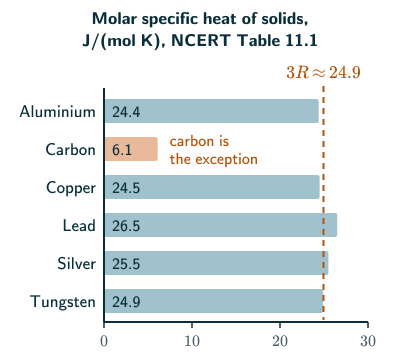
The agreement is known to break down at low temperatures.
NCERT Physics Part II (Class 11), Section 11.6, page 232
Notice that the specific heats per kilogram in the same table differ a lot (aluminium 900, lead 127.7 J kg K), while the molar values are nearly equal. A mole of any element has the same number of atoms, NA, so the heat per mole is nearly the same; a kilogram of a light element such as aluminium has far more atoms than a kilogram of lead, so it needs far more heat per kelvin (Examples 1–2).
Specific heat capacity of water
The calorie was first defined as the heat needed to raise the temperature of 1 g of water by 1 °C. More precise measurements showed that the specific heat of water changes slightly with temperature: NCERT Fig. 11.5 (page 232) shows it falling from about 1.008 cal g °C near 0 °C to a minimum near 40 °C, and rising again to about 1.008 at 100 °C. So the temperature interval had to be fixed:
One calorie is defined to be the amount of heat required to raise the temperature of 1g of water from 14.5 °C to 15.5°C.
NCERT Physics Part II (Class 11), Section 11.6, page 232
Near 15 °C, NCERT uses water’s specific heat as approximately 4186 J kg K, or 4.186 J g K, giving 1 historical 15 °C cal ≈ 4.186 J. The thermochemical calorie is instead defined as exactly 4.184 J; water’s specific heat is temperature-dependent. The old “mechanical equivalent of heat”, the work needed to produce 1 cal of heat, is just this conversion factor between two units of energy. Since heat, work and every other form of energy are now measured in joules, NCERT notes that the term is no longer needed:
the term mechanical equivalent is now superfluous and need not be used.
NCERT Physics Part II (Class 11), Section 11.6, page 232
Molar specific heats of a gas
For a gas the conditions matter a great deal, so two molar specific heats are defined (page 232):
- Cv, at constant volume;
- Cp, at constant pressure.
For an ideal gas they are linked by a simple relation, often called Mayer’s relation:
Mayer’s relation (NCERT Eq. 11.8)
Proof (NCERT, page 232). Start from the first law for 1 mole, ΔQ = ΔU + PΔV.
- At constant volume, ΔV = 0, so Cv = (ΔQ/ΔT)v = (ΔU/ΔT)v = ΔU/ΔT (NCERT Eq. 11.9). The subscript v can be dropped in the last step because the internal energy of an ideal gas depends only on its temperature.
- At constant pressure, Cp = (ΔQ/ΔT)p = (ΔU/ΔT)p + P(ΔV/ΔT)p (NCERT Eq. 11.10). For the same reason the subscript p can be dropped from the first term, so it equals Cv.
- For a mole of ideal gas PV = RT, so at constant pressure PΔV = RΔT, that is, P(ΔV/ΔT)p = R (NCERT Eq. 11.11).
So Cp = Cv + R, that is, Cp − Cv = R.
In words: for the same rise in temperature, the gas gains the same internal energy either way, but at constant pressure it also expands and does work RΔT per mole, so it needs that much more heat. The real gases in NCERT Table 10.4 fit this closely: for each, Cp − Cv lies between 8.3 and 8.5 J mol K, close to R = 8.31 J mol K (see molar specific heats of gases). Chemistry reaches the same result through enthalpy (see heat capacity in chemistry).
Solved examples
Take R = 8.31 J mol K.
Example 1: Iron and the 3R rule
Iron has s = 450 J kg K (NCERT Table 10.3) and a molar mass of 55.85 g mol. Find its molar specific heat and compare it with 3R.
With M = 0.05585 kg mol, C = Ms = 0.05585 × 450, about 25.1 J mol K.
Answer: about 25.1 J mol K, within 1% of 3R ≈ 24.9 J mol K.
Example 2: Predicting a specific heat
Use the 3R rule to estimate the specific heat of gold (molar mass 197 g mol).
With M = 0.197 kg mol, s = 3R/M = 24.93/0.197, about 127 J kg K.
Answer: about 127 J kg K. Heavy atoms mean few atoms per kilogram, so a small specific heat per kilogram.
Example 3: Heating helium two ways
Using NCERT Table 10.4 (helium: Cv = 12.5, Cp = 20.8 J mol K), find the heat needed to warm 2 mol of helium by 50 K (a) at constant volume and (b) at constant pressure. Where does the extra heat go?
(a) Q = μCvΔT = 2 × 12.5 × 50 = 1250 J.
(b) Q = μCpΔT = 2 × 20.8 × 50 = 2080 J.
The difference, 830 J, is the work done in expanding at constant pressure: PΔV = μRΔT = 2 × 8.31 × 50, about 831 J.
Answer: 1250 J and 2080 J; the extra heat at constant pressure is used to do work.
Example 4: Finding Cp from Cv
NCERT Table 10.4 gives Cv = 20.8 J mol K for nitrogen. Treating it as an ideal gas, find Cp.
Cp = Cv + R = 20.8 + 8.31, about 29.1 J mol K.
Answer: about 29.1 J mol K, the same as the measured value in NCERT Table 10.4.
Example 5: Food calories
A snack is labelled 250 kcal (food Calories are kilocalories). Use the thermochemical conversion 1 kcal = 4184 J and assume complete transfer to water with s = 4186 J kg K. How much energy is this, and how much water could it warm by 25 K?
250 × 4184 J = 1.046 × 10 J, about 1.05 MJ.
Mass of water: 1.046 × 10/(4186 × 25) ≈ 9.995 kg, about 10.0 kg.
Answer: about 1.05 MJ, enough to warm 10 kg of water by 25 K.
Common mistakes to avoid
Common mistake
Using Cp − Cv = R per kilogram
Cp − Cv = R is per mole. Per kilogram, the difference is R/M: for nitrogen (M = 0.028 kg mol) about 297 J kg K.
Common mistake
Applying 3R everywhere
The 3R classical limit is per mole of atoms in a solid. A formula unit containing r atoms has a classical lattice limit of about 3rR per mole of formula units; the temperature must be high enough to excite its vibrational modes. The room-temperature approximation fails for carbon, and quantum effects suppress the lattice heat capacity at low temperatures. The rule is not a general law for gases or liquids.
Common mistake
Thinking Cp and Cv differ because the internal energy changes differently
For an ideal gas, ΔU is the same for the same ΔT in both cases. Cp is larger only because of the extra work of expansion.
Common mistake
Treating the mechanical equivalent as a physical constant
4.186 J per calorie is just the conversion factor between two units of energy (its value comes from water’s specific heat near 15 °C). It is not a separate law of nature, which is why NCERT calls the term superfluous.
Quick revision summary
- Heat capacity S = ΔQ/ΔT; specific heat s = S/m; molar specific heat C = S/μ. They depend on the substance, its temperature and the conditions.
- Classical harmonic solids: the vibrational energy varies as 3RT per mole of atoms, giving C ≈ 3R; this often approximates room-temperature elemental solids, with carbon and low temperatures as important exceptions.
- The historical 15 °C calorie is about 4.186 J; the thermochemical calorie is exactly 4.184 J. Water’s specific heat varies with temperature.
- Gases: Cp at constant pressure, Cv at constant volume; for an ideal gas Cp − Cv = R.
Formula sheet
- S = ΔQ/ΔT; s = S/m; C = S/μ
- Cv ≈ 3R ≈ 24.9 J mol K (classical solid, per mole of atoms)
- 1 historical 15 °C cal ≈ 4.186 J; 1 thermochemical cal = 4.184 J
- Cp − Cv = R (ideal gas, per mole)
Questions students ask
How do you find Cp and Cv from γ?
For an ideal gas, Cp and Cv follow from γ by combining Mayer’s relation, Cp − Cv = R, with γ = Cp/Cv: putting Cp = γCv gives Cv = R/(γ − 1) and Cp = γR/(γ − 1), per mole. For example, a gas with γ = 1.30 has Cv = 8.31/0.30 ≈ 27.7 J mol K and Cp = 1.30 × 27.7 ≈ 36.0 J mol K.
Is Cp − Cv = R true for solids and liquids?
No, Cp − Cv = R holds per mole for an ideal gas, not for solids and liquids. For many solids and for water near room temperature, C and C are fairly close, but the difference depends on thermal expansion and compressibility as well as temperature. It cannot be inferred solely from the small external PΔV work; neither 3R nor Mayer’s relation is universal for liquids. The gas values themselves, such as Cv = (3/2)R for a monatomic gas, come from kinetic theory.
What is the dimensional formula of molar specific heat?
Molar specific heat has the dimensional formula [M L T K mol] and the SI unit J mol K, the same as the gas constant R, which is why Cp − Cv = R is dimensionally consistent. Specific heat capacity per kilogram, by contrast, has the dimensions [L T K], because dividing by mass removes the M (see the table of dimensional formulae).
What is the molar specific heat of water?
The molar specific heat of liquid water is about 75 J mol K: multiplying its specific heat, 4186 J kg K, by its molar mass, 0.018 kg mol, gives C = Ms ≈ 75.3 J mol K. That is about 9R, far more than the 3R of a solid metal. In older units it is about 18 cal mol K, since water’s specific heat is close to 1 cal g K and its molar mass is 18 g mol.
What is the Dulong–Petit law, and why does it fail at low temperatures?
The Dulong–Petit law says that the molar specific heat of most solid elements is about 3R ≈ 24.9 J mol K, as equipartition predicts for atoms vibrating in three directions. It fails at low temperatures because the energy of an atom’s vibration can change only in steps (a quantum result beyond Class 11): once kBT is small compared with a step, the atoms cannot take up their full share of energy, so C falls below 3R and tends to zero as T approaches 0 K. Carbon’s atoms are light and strongly bonded, so its steps are large, which is why its value at room temperature, 6.1 J mol K in NCERT Table 11.1, is far below 3R.
Practice questions
Try each question first, then open the answer to check your working.
-
Q1. Why is Cp greater than Cv for a gas?
Show answerHide answer
At constant pressure the gas expands as it warms and does work on its surroundings, so it needs extra heat beyond what raises its internal energy. For an ideal gas the extra is R per mole per kelvin.
-
Q2. Oxygen has Cp = 29.4 J mol K (NCERT Table 10.4). Treating it as ideal, find Cv.
Show answerHide answer
Cv = Cp − R = 29.4 − 8.31, about 21.1 J mol K, matching the table.
-
Q3. Why did the calorie need a definition with a particular temperature interval, 14.5 °C to 15.5 °C?
Show answerHide answer
The specific heat of water changes slightly with temperature (NCERT Fig. 11.5), so the heat needed for a 1 °C rise depends on where that degree is. Specifying the interval and pressure makes that historical definition reproducible; its conversion to joules is measured. The distinct thermochemical calorie is exactly 4.184 J by definition.