Reversible and irreversible processes
NCERT Class 11 Physics Chapter 11 Section 11.10
Quick answer
A process is reversible if it can be turned back so that both the system and its surroundings return to their original states with no change left anywhere. That needs the process to be quasi-static and free of friction and other dissipation, so reversible processes are ideal limits. Real processes, such as heat flowing across a finite temperature difference, free expansion, combustion and diffusion, are irreversible.
With your textbook
NCERT Physics Part II (Class 11), Chapter 11 “Thermodynamics”, Section 11.10 “Reversible and irreversible processes”, pages 236–237.
Open the official NCERT chapter (PDF, 1.8 MB, ncert.nic.in) (opens in a new tab)
Checked against the 2026-27 reprint on .
What are reversible and irreversible processes?
Reversible and irreversible processes
A process that takes a system from state i to state f is reversible if it can be turned back so that both the system and its surroundings return to their original states, with no change left anywhere else. Any other process is irreversible.
A process is reversible only if it is quasi-static (the system passing through equilibrium states, with infinitesimal driving differences across active heat/work contacts) and has no dissipative effects such as friction or viscosity. (NCERT Section 11.10, pages 236–237.)
The spontaneous processes of nature are irreversible.
NCERT Physics Part II (Class 11), Section 11.10, page 236
In plain words: film a cup of tea cooling, gas leaking from a cylinder, or a sliding box coming to rest. Play the film backwards and you know at once something is wrong. The tea does not warm itself up from the room, the gas does not gather back into the cylinder, the box does not start moving by cooling down. Real processes have a direction.
Why real processes are irreversible
NCERT’s examples (page 236):
- A hot vessel base. Taken off the stove, the hot base passes heat to the rest of the vessel until it is at one temperature. The vessel never cools in one part to heat the base again; that would break the second law.
- Free expansion of a gas into a vacuum.
- Combustion of a petrol–air mixture ignited by a spark.
- Diffusion: cooking gas leaking from a cylinder spreads through the room and never returns to the cylinder.
- Stirring a liquid in contact with a reservoir: the work done becomes internal energy of the reservoir. Reversing it exactly would turn that heat entirely into work, breaking the second law (its Kelvin–Planck statement).
Irreversibility arises mainly from two causes (page 236):
- the process takes the system through non-equilibrium states, as in a free expansion or an explosion;
- the process involves friction, viscosity or other dissipative effects, which turn ordered mechanical energy into internal energy. Examples are a moving body stopping on a floor, or a rotating blade stopping in a liquid because of the liquid’s viscosity.
Dissipative effects can be reduced but never fully removed, so almost every real process is irreversible.
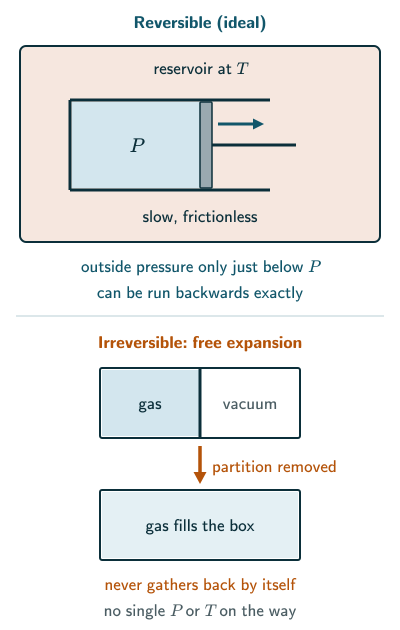
Conditions for a reversible process
A process is reversible only if it is quasi-static (system in equilibrium with the surroundings at every stage) and there are no dissipative effects.
NCERT Physics Part II (Class 11), Section 11.10, page 237
NCERT’s example of a reversible process is the quasi-static isothermal expansion of an ideal gas in a cylinder with a frictionless piston (page 237). The outside pressure is kept only infinitesimally below the gas pressure, so a tiny increase in it would push the piston back along exactly the same path. Heat flows only across an infinitesimal temperature difference, so it too can be reversed. When the process is run backwards, the work done on the gas and the heat it gives out exactly undo the forward process (Example 3).
A reversible process is an idealisation, like a frictionless surface in mechanics. Real processes can approach it by being made slow, and by keeping friction and temperature differences small.
Why reversibility matters
Thermodynamics asks how much of the heat an engine takes in can become work. The second law already forbids an engine with 100% efficiency. So what is the best possible efficiency for an engine working between two reservoirs at temperatures T1 and T2? NCERT’s answer (page 237): the best engine is one built only from idealised reversible processes, and any irreversibility, which every practical engine has, lowers the efficiency. The next section of the chapter calls this ideal engine the Carnot engine.
Solved examples
Example 1: Reversible or not?
Classify each process: (a) a quasi-static, frictionless isothermal compression of an ideal gas exchanging heat across an infinitesimal temperature difference; (b) ice melting in a drink at 25 °C; (c) a gas rushing through an opened valve into an evacuated chamber; (d) a car braking to a stop.
(a) Quasi-static and without dissipation: reversible (an idealisation).
(b) Heat flows across a finite temperature difference (25 °C to 0 °C): irreversible.
(c) A free expansion through non-equilibrium states: irreversible.
(d) Friction turns kinetic energy into internal energy: irreversible.
Answer: only (a) is reversible.
Example 2: A block sliding to rest
A 2.0 kg block sliding at 3.0 m s comes to rest on a rough floor. What happens to its kinetic energy, and why can the process not reverse by itself?
Kinetic energy: ½ × 2.0 × 3.0 = 9.0 J, which becomes internal energy of the block and the floor.
For the block to start moving again by itself, the floor and block would have to cool and turn 9.0 J of heat entirely into kinetic energy, with no other change. The Kelvin–Planck statement forbids that.
Answer: 9.0 J goes into internal energy; reversing it would break the second law.
Example 3: Running a reversible process backwards
1.0 mol of an ideal gas expands reversibly and isothermally at 300 K to twice its volume. It is then compressed reversibly back. What happens?
Take R = 8.31 J mol K; μ is the number of moles. Forward: W = μRT ln(V2/V1) = 1.0 × 8.31 × 300 × ln 2, about 1728 J; ΔU = 0, so Q = 1728 J.
Back: W = 1.0 × 8.31 × 300 × ln ½, about −1728 J. The surroundings do 1728 J of work on the gas, and the gas gives 1728 J of heat back to the reservoir.
Answer: the gas, the reservoir and the rest of the surroundings (which give back the 1728 J of work they stored, for example as a raised weight) all return exactly to their starting states, with no change left anywhere: the process is reversible.
Example 4: Free expansion
An ideal gas fills one half of an insulated box; the other half is a vacuum. The partition is removed and the gas fills the box. Find W, Q and ΔU, and say whether the process is reversible.
Nothing pushes back, so W = 0; the box is insulated, so Q = 0; by the first law ΔU = 0, and for an ideal gas the final temperature equals the initial one.
Answer: W = Q = ΔU = 0, yet the process is irreversible. The gas never gathers back into its half by itself. To push it back, the surroundings must do work on it and take away an equal amount of heat, so they end up with less work and more heat. Undoing that would mean turning heat entirely into work, which the Kelvin–Planck statement forbids.
Common mistakes to avoid
Common mistake
Thinking ‘reversible’ means the system can be brought back
Almost any system can be brought back to its starting state. A process is reversible only if the surroundings return too, with no change left anywhere.
Common mistake
Calling every slow process reversible
Being quasi-static is necessary but not enough: there must also be no friction, viscosity or other dissipation. And slow is not the same as quasi-static: heat leaking slowly through a wall across a finite temperature difference is slow but irreversible.
Common mistake
Treating a free expansion as isothermal
For an ideal gas the final temperature of a free expansion equals the initial one, but the process is not isothermal. On the way the gas has no single P or T, so it cannot be drawn as a curve on a P–V graph, and W = μRT ln(V2/V1) does not apply. For 1.0 mol doubling its volume at 300 K, ΔU = 0 on both paths, but W = Q = 1728 J on the reversible path (Example 3) and W = Q = 0 in a free expansion (Example 4).
Common mistake
Thinking Q = 0 means nothing irreversible happens
An insulated free expansion has Q = W = ΔU = 0 for an ideal gas, yet it is irreversible.
Quick revision summary
- Reversible: can be turned back so that system and surroundings return to their original states, with no other change anywhere.
- Conditions: quasi-static at every stage, and no dissipative effects (friction, viscosity).
- Spontaneous natural processes are irreversible: heat flow across a finite temperature difference, free expansion, combustion, diffusion, stirring, friction.
- Causes: non-equilibrium states and dissipative effects.
- An engine using only reversible processes has the highest possible efficiency between two reservoirs at given temperatures.
Formula sheet
- Reversible ⇔ quasi-static and no dissipation
- Insulated free expansion (ideal gas): W = 0, Q = 0, ΔU = 0, yet irreversible
Questions students ask
How do you identify whether a process is reversible or irreversible?
To identify a reversible process, check two things: the process must be quasi-static, with infinitesimal driving differences at the boundaries where work or heat is exchanged, and it must involve no dissipation such as friction, viscosity or electrical resistance. If either check fails, the process is irreversible, so look for a sudden change, heat flowing across a finite temperature difference, mixing or diffusion, burning, or ordered energy being turned into internal energy. For example, warming milk on a gas flame is irreversible (the flame is far hotter than the milk), and so is heating water with an electric heater, whose resistance dissipates energy.
Is an adiabatic process reversible or irreversible?
An adiabatic process can be either: a quasi-static, non-dissipative one is reversible and, for a fixed-composition ideal gas with constant γ, follows PVγ = constant, while one that takes the gas through non-equilibrium states is irreversible. A gas in an insulated cylinder expanding against a lower constant outside pressure Pext, or rushing into a vacuum, has Q = 0 but no single pressure on the way, so PVγ = constant does not apply; against Pext the first law gives ΔU = −PextΔV. A sudden compression is not automatically quasi-static or reversible. Negligible heat transfer establishes Q = 0; it does not establish PV^γ = constant. Use the actual work constraint and the first law unless a reversible constant-γ model is justified.
Is the work done in an irreversible isothermal expansion less than in a reversible one?
Yes, between the same two states at the reservoir’s temperature, an irreversible expansion does less work than the reversible isothermal one, because the gas pushes against an outside pressure lower than its own. For example, 2.0 mol of an ideal gas at 400 K tripling its volume reversibly does W = μRT ln 3 ≈ 7.30 kJ, but expanding in one step against a constant outside pressure equal to its final pressure P2, it does only W = P2(V2 − V1) = (2/3)μRT ≈ 4.43 kJ. In both cases ΔU = 0 for an ideal gas, so the heat taken in equals the work and is also smaller on the irreversible path.
What is the difference between a cyclic process and a reversible process?
A cyclic process brings the system back to its starting state, while a reversible process is one that can be run backwards so that the system and its surroundings both return to their starting states, with no change left anywhere. Every cycle restores the system, since its state variables return to their old values, but only a cycle made of reversible steps, like the Carnot cycle, can also be undone in the surroundings. A real engine cycle is cyclic but irreversible: it restores the working gas each time, yet friction and heat flow across finite temperature differences leave lasting changes in the surroundings.
Practice questions
Try each question first, then open the answer to check your working.
-
Q1. State the two conditions a process must meet to be reversible.
Show answerHide answer
It must be quasi-static, with infinitesimal driving differences across active thermal and mechanical contacts, and it must have no dissipative effects such as friction or viscosity.
-
Q2. Why is heat flowing from a hot body to a cold body by conduction an irreversible process?
Show answerHide answer
Reversing it would mean heat flowing by itself from the cold body to the hot one, which the Clausius statement of the second law forbids. Heat flow is reversible only in the ideal limit of an infinitesimal temperature difference.
-
Q3. Give two reasons why no real engine can be reversible.
Show answerHide answer
Real engines run at a finite speed, so the gas passes through non-equilibrium states, and heat flows across finite temperature differences. They also have friction in moving parts and viscous losses in the working fluid.