Second law of thermodynamics
NCERT Class 11 Physics Chapter 11 Section 11.9
Quick answer
The second law restricts the direction and efficiency of energy transfers. Kelvin–Planck forbids taking heat from one reservoir and converting it completely into work as the sole result. Clausius forbids moving heat from cold to hot as the sole result; a work-driven refrigerator needs work, while heat-driven designs require additional thermal exchanges.
With your textbook
NCERT Physics Part II (Class 11), Chapter 11 “Thermodynamics”, Section 11.9 “Second law of thermodynamics”, page 236.
Open the official NCERT chapter (PDF, 1.8 MB, ncert.nic.in) (opens in a new tab)
Checked against the 2026-27 reprint on .
What is the second law of thermodynamics?
Second law of thermodynamics
The first law allows any process that conserves energy, but many such processes never happen. The second law is the principle that rules them out (NCERT Section 11.9, page 236). It has two equivalent statements:
- Kelvin–Planck: no process can have as its sole result the absorption of heat from a reservoir and its complete conversion into work. No heat engine can be 100% efficient.
- Clausius: no process can have as its sole result the transfer of heat from a colder object to a hotter one. A two-reservoir, work-driven refrigerator requires work; other refrigerator designs may use a heat input and an additional reservoir.
This principle, which disallows many phenomena consistent with the First Law of Thermodynamics is known as the Second Law of Thermodynamics.
NCERT Physics Part II (Class 11), Section 11.9, page 236
In plain words: energy is always conserved, but it does not always go where it could. Heat flows by itself from hot to cold, never the other way, and an engine working in a cycle can never turn all the heat it takes in into work: some must always be given out to a colder body.
Why the first law is not enough
NCERT’s example (page 236): a book lying on a table never jumps up by itself. Energy conservation alone would allow it. The table could cool a little, turning some of its internal energy into mechanical energy of the book, which would then rise to the height that energy allows. The energy accounts would balance, yet this never happens (Example 1). Some further principle of nature forbids it: the second law.
The same is true of everyday events. A cup of tea cools to room temperature but never warms up again by drawing heat from the cooler room, although that too would conserve energy. Heat flows on its own only from the hotter body to the colder one.
Heat engines and refrigerators
NCERT says the second law limits the efficiency of a heat engine and the coefficient of performance of a refrigerator (page 236), but does not define them there. It writes the efficiency as η = W/Q1 = 1 − Q2/Q1 later, for the Carnot engine (NCERT Section 11.11, page 238). Its summary names the coefficient of performance α (page 241) but gives no formula. On this page the refrigerator model exchanges heat with exactly two reservoirs and is driven by work. Heat-driven absorption refrigerators use an additional thermal source; they do not violate Clausius because refrigeration is not their sole effect. We use these definitions:
- A heat engine works in a cycle. Each cycle it takes heat Q1 from a hot reservoir at temperature T1, does work W, and gives out heat Q2 to a cold reservoir at T2. Over a cycle ΔU = 0, so Q1 = W + Q2. Its efficiency is η = W/Q1 = 1 − Q2/Q1. Here Q1, Q2 and W are all magnitudes, taken as positive.
- A refrigerator runs the other way. Using work W, it takes heat Q2 from the cold reservoir and delivers Q1 = Q2 + W to the hot one. Its coefficient of performance is α = Q2/W.
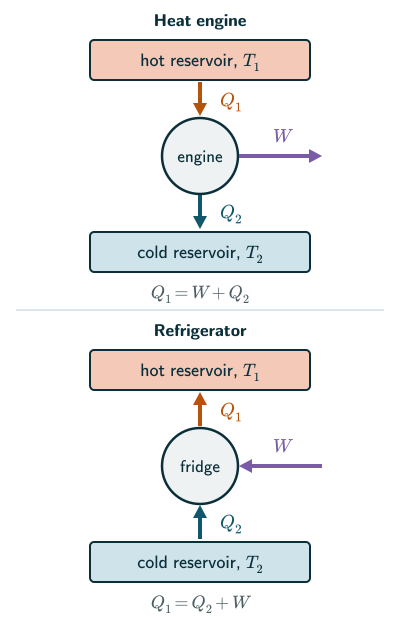
In these terms the second law says (page 236):
- the efficiency of a heat engine can never be 1: some heat Q2 must always be given out to the cold reservoir;
- for a work-driven refrigerator between two distinct fixed reservoir temperatures, the coefficient of performance is finite: work is needed, and the Carnot bound is α ≤ T/(T − T).
The two statements
Kelvin–Planck statement, which denies a perfect heat engine:
No process is possible whose sole result is the absorption of heat from a reservoir and the complete conversion of the heat into work.
NCERT Physics Part II (Class 11), Section 11.9, page 236
Clausius statement, which denies a perfect refrigerator or heat pump:
No process is possible whose sole result is the transfer of heat from a colder object to a hotter object.
NCERT Physics Part II (Class 11), Section 11.9, page 236
The words “sole result” matter. An ideal gas expanding isothermally does turn all the heat it takes in into work (ΔU = 0, so Q = W), but that is not its only result: the gas ends up at a larger volume and lower pressure. To repeat the conversion the gas must be brought back. Compressing it back at the same temperature would use up all the work just gained. The only way to keep some net work is to reject some heat to a colder body. Likewise, a two-reservoir refrigerator moves heat from cold to hot with work supplied from outside. An absorption refrigerator instead uses additional heat exchanges, so the cold-to-hot transfer is still not the sole result.
It can be proved that the two statements above are completely equivalent.
NCERT Physics Part II (Class 11), Section 11.9, page 236
The idea of the proof, beyond the NCERT text: if a perfect refrigerator existed, it could return to the hot reservoir all the heat an ordinary engine rejects, and the two together would act as a perfect engine (the cold reservoir has no net change; the pair takes Q1 − Q2 from the hot reservoir and turns all of it into work). If a perfect engine existed, its work could drive an ordinary refrigerator, and the pair would move heat from cold to hot with no work from outside (the refrigerator gives Q2 + W to the hot reservoir, and the engine took only W from it). So breaking either statement would break the other.
Solved examples
Example 1: The book that never jumps
A 1.0 kg book would need to gain 9.8 J to jump 1.0 m (g = 9.8 m s). If this came from a 20 kg wooden table (specific heat about 1700 J kg K), by how much would the table cool?
ΔT = 9.8/(20 × 1700), about 2.9 × 10 K.
Answer: about 0.0003 K, a cooling far too small to notice. Energy would be conserved, yet this never happens; the second law forbids it.
Example 2: Efficiency of an engine
In each cycle an engine takes 1000 J of heat from the hot reservoir and rejects 600 J to the cold one. Find the work done per cycle and the efficiency.
W = Q1 − Q2 = 1000 − 600 = 400 J.
η = W/Q1 = 400/1000 = 0.40.
Answer: 400 J per cycle; efficiency 40%.
Example 3: A refrigerator
A refrigerator removes 300 J of heat from its inside for every 100 J of electrical work. How much heat goes out into the kitchen, and what is its coefficient of performance?
Q1 = Q2 + W = 300 + 100 = 400 J. α = Q2/W = 300/100 = 3.
Answer: 400 J into the kitchen; coefficient of performance 3. With the door open, both sides exchange with the kitchen: 300 J is removed and 400 J returned, giving a net 100 J of warming per cycle.
Example 4: A power station
A power station delivers 1000 MW of electrical power with an efficiency of 35%. At what rate does it take in heat, and how much does it reject?
Heat in: 1000/0.35, about 2857 MW. Heat rejected: 2857 − 1000, about 1857 MW.
Answer: about 2.86 × 10 MW in and 1.86 × 10 MW rejected, usually to a river or cooling towers. By the second law some heat must always be rejected.
Common mistakes to avoid
Common mistake
Thinking the second law forbids converting heat into work
It forbids converting heat completely into work as the sole result of a process. Engines convert part of the heat into work all the time.
Common mistake
Thinking a refrigerator breaks the Clausius statement
The work-driven refrigerator here moves heat from cold to hot with work put in. The Clausius statement forbids doing it with nothing else happening.
Common mistake
Thinking the coefficient of performance must be less than 1
Efficiency is a fraction of the heat taken in, so η < 1. The coefficient of performance compares heat moved with work used and is usually more than 1 (3 in Example 3). For given reservoir temperatures it gives the stronger bound α ≤ T/(T − T), with equality for a reversible refrigerator.
Common mistake
Expecting a 100% efficient engine with better engineering
No improvement in design can reach 100%; the limit comes from the second law, not from friction alone.
Quick revision summary
- The first law conserves energy; the second law forbids many energy-conserving processes that never happen.
- Kelvin–Planck: no process whose sole result is complete conversion of heat from a reservoir into work, so a heat engine’s efficiency is less than 1.
- Clausius: no process whose sole result is heat flowing from a colder to a hotter body, so a two-reservoir work-driven refrigerator needs work; additional heat exchanges can drive other designs.
- The two statements are equivalent.
- Heat engine: Q1 = W + Q2, η = W/Q1 = 1 − Q2/Q1. Refrigerator: α = Q2/W.
Formula sheet
- Q = W + Q (one cycle)
- η = W/Q = 1 − Q/Q < 1
- α = Q/W (refrigerator, finite)
Questions students ask
What is the difference between the first and second laws of thermodynamics?
The first law of thermodynamics says energy is conserved, ΔQ = ΔU + ΔW, while the second law says which energy-conserving processes can actually happen: heat flows by itself only from hotter to colder, and no engine working in a cycle can turn all the heat it takes in into work. The first law alone would allow an engine of 100% efficiency or a cyclic device that transfers heat from cold to hot with no other effect, as long as the energy accounts balance; the second law forbids both. So the first law is about the amount of energy, and the second about the direction of processes and how much heat can become work.
How is a heat pump different from a refrigerator?
A heat pump is the same kind of machine as a refrigerator, used for a different job: both use work W to take heat Q2 from a colder place and deliver Q1 = Q2 + W to a warmer one. A refrigerator is judged by the heat it removes from the cold side, α = Q2/W, and a heat pump, used to warm a building, by the heat it delivers to the warm side, Q1/W = 1 + Q2/W. In this model, while it absorbs positive heat from the cold side, a heat pump delivers more heat than the work it uses, which is why it can warm a room with less electricity than an electric heater.
Does the second law of thermodynamics have a formula?
The second law of thermodynamics has no single equation in NCERT Class 11 Physics; it is stated in words, as the Kelvin–Planck and Clausius statements, and appears as inequalities: an engine must reject some heat, Q2 > 0, so η = 1 − Q2/Q1 < 1, and the two-reservoir work-driven refrigerator needs W > 0, with its coefficient of performance bounded by T/(T − T). For engines working between reservoirs at T1 and T2 (in kelvin), it caps the efficiency at 1 − T2/T1, the Carnot efficiency. In terms of entropy, which Class 11 Physics does not use, it reads ΔS ≥ 0 for an isolated system.
What are some examples of the second law of thermodynamics in daily life?
Everyday examples of the second law are processes that go only one way: ice cubes in a drink melt as heat flows into them from the warmer drink, never the reverse, and a hot iron left switched off cools to room temperature. A car engine must throw away much of the heat from its fuel through the exhaust and radiator, because no engine can turn all of it into work. An air conditioner moves heat from a cool room to the hot outdoors only by using electrical work, and its outdoor unit blows out both the heat taken from the room and the energy of that work.
Is the second law of thermodynamics in the JEE Main and NEET syllabus?
Yes, the second law of thermodynamics is in both the JEE Main 2027 and NEET (UG) 2026 Physics syllabuses: Unit 8, Thermodynamics, lists “the second law of thermodynamics: reversible and irreversible processes”. Heat engines, refrigerators and the Kelvin–Planck and Clausius statements are not named separately, but NCERT states the second law through them, so their efficiency and coefficient of performance are studied with this topic. The JEE Advanced 2026 syllabus lists the second law together with the Carnot engine and its efficiency.
Practice questions
Try each question first, then open the answer to check your working.
-
Q1. State the Kelvin–Planck and Clausius statements of the second law.
Show answerHide answer
Kelvin–Planck: no process is possible whose sole result is the absorption of heat from a reservoir and its complete conversion into work. Clausius: no process is possible whose sole result is the transfer of heat from a colder object to a hotter one.
-
Q2. An engine takes in 3000 J of heat and rejects 2400 J per cycle. Find its efficiency.
Show answerHide answer
η = 1 − Q2/Q1 = 1 − 2400/3000 = 0.20, that is 20%.
-
Q3. A ship’s designer proposes to drive the ship by taking heat from the sea water and turning it all into work. Which law does this break?
Show answerHide answer
The Kelvin–Planck statement of the second law: the only result would be heat taken from one reservoir, the sea, and turned completely into work. Energy would be conserved, so the first law is not broken.