State variables and equation of state
NCERT Class 11 Physics Chapter 11 Section 11.7
Quick answer
State variables describe a system’s equilibrium state. A gas undergoing free expansion may lack a single pressure or temperature, although mass and total energy still exist. For a fixed amount of ideal gas, PV = μRT links P, V and T so only two are independent; extensive quantities scale with amount, while intensive quantities remain unchanged when a homogeneous system is scaled.
With your textbook
NCERT Physics Part II (Class 11), Chapter 11 “Thermodynamics”, Section 11.7 “Thermodynamic state variables and equation of state”, pages 232–233.
Open the official NCERT chapter (PDF, 1.8 MB, ncert.nic.in) (opens in a new tab)
Checked against the 2026-27 reprint on .
What are state variables?
State variables and equation of state
- Every equilibrium state of a thermodynamic system is completely described by the values of a few macroscopic quantities, its state variables. For a gas these are pressure, volume, temperature and mass (and composition, for a mixture).
- The state variables are not all independent. The relation that connects them is the equation of state; for an ideal gas it is PV = μRT.
- State variables are either extensive, depending on the size of the system, or intensive, not depending on it.
(NCERT Section 11.7, pages 232–233.)
In short, thermodynamic state variables describe equilibrium states of systems.
NCERT Physics Part II (Class 11), Section 11.7, page 233
In plain words: to say what state a gas is in, you do not need to know what each molecule is doing. A pressure gauge, a measure of the volume, a thermometer and a balance tell you all you need. And because the gas obeys an equation of state, you do not even need all of these: knowing a few fixes the rest.
Why equilibrium needs special treatment
A system is not always in equilibrium. NCERT gives two examples (pages 232–233; NCERT Fig. 11.6):
- Free expansion. A partition is suddenly removed and a gas rushes into an empty part of a box. While it expands, its pressure is not the same throughout.
- An explosion. A mixture of petrol vapour and air ignited by a spark. Its temperature and pressure are not uniform.
In such states there is no single pressure or temperature for the whole gas, so they cannot be described by state variables (NCERT page 233, NCERT Fig. 11.6). Eventually the gas attains a uniform temperature and pressure, in thermal and mechanical equilibrium with its surroundings (NCERT page 233). Strictly, its mass, volume and total energy are still defined during the expansion, local pressure or temperature may be meaningful where local equilibrium holds, and a gas inside insulating walls settles to its own equilibrium, not to the outside temperature (reasoned).
The equation of state
The connection between the state variables is called the equation of state.
NCERT Physics Part II (Class 11), Section 11.7, page 233
For an ideal gas the equation of state is the ideal-gas relation:
Equation of state of an ideal gas
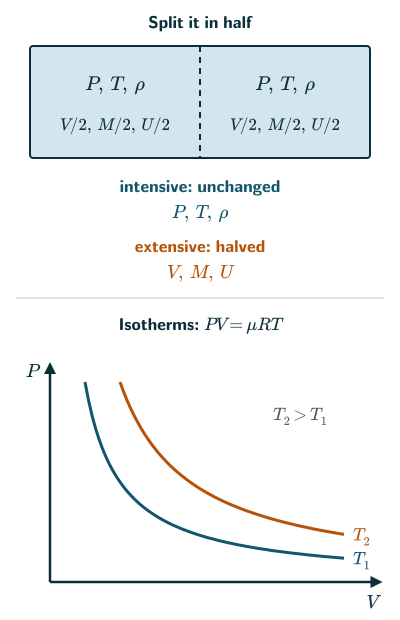
For a fixed amount of gas (given μ), there are only two independent variables, say P and V, or T and V: choose two, and the equation fixes the third (NCERT page 233; see Example 2 below). A curve of pressure against volume at a fixed temperature is an isotherm; for an ideal gas it is the curve PV = constant (see isothermal processes). Real gases may have more complicated equations of state.
Extensive and intensive variables
Extensive variables measure the “size” of a system; intensive ones do not. NCERT’s test (page 233): imagine a system in equilibrium divided into two equal parts.
The variables that remain unchanged for each part are intensive. The variables whose values get halved in each part are extensive.
NCERT Physics Part II (Class 11), Section 11.7, page 233
- Extensive: internal energy U, volume V, total mass M (and the number of moles μ).
- Intensive: pressure P, temperature T, density ρ.
For a homogeneous bulk system, scaling two extensive quantities together leaves their ratio intensive: density M/V, specific heat capacity (heat capacity per kilogram) and molar volume V/μ do not depend on how much of the substance there is.
A check on equations. The two sides of an equation must be of the same kind. In ΔQ = ΔU + PΔV, every term is extensive: ΔU is, and the product of an intensive P with an extensive ΔV is extensive. Heat Q is not a state variable, but ΔQ is proportional to the total mass of the system and so is extensive too (NCERT footnote, page 233). Strictly, ΔQ scales with mass only when the copies of the system go through the same change of intensive state, such as the same ΔT by the same process (reasoned).
A note on NCERT’s footnote on page 227. It says a thermodynamic state is specified by five state variables: pressure, volume, temperature, internal energy and entropy. These are all state variables, but they are not independent: for a fixed amount of a simple gas only two are independent, and a suitable pair such as P and V specifies its equilibrium state. Calculating U also requires a caloric relation such as U(T), which PV = μRT alone does not supply. NCERT says this for P, V and T on page 233. Not every pair works: for an ideal gas U depends only on T, so T and U together do not fix V. The same footnote calls enthalpy “a measure of total heat content”. Since a body does not contain heat, enthalpy is better described as the state variable H = U + PV, whose change equals the heat taken in for a closed constant-pressure process with only expansion work and negligible bulk kinetic/potential-energy changes (a definition beyond this NCERT Physics chapter).
Solved examples
Take R = 8.31 J mol K.
Example 1: Sorting variables
Classify as extensive or intensive: pressure, volume, temperature, internal energy, mass, density, number of moles, heat capacity, specific heat capacity, molar volume.
Halve the system and see what halves. Heat capacity ΔQ/ΔT halves, because half the gas needs half the heat for the same ΔT. Dividing it by mass (specific heat capacity), or dividing V by μ (molar volume), gives a ratio of two extensive quantities, which is intensive.
Answer: extensive: volume, internal energy, mass, number of moles, heat capacity. Intensive: pressure, temperature, density, specific heat capacity, molar volume.
Example 2: Two variables fix the third
2.0 mol of an ideal gas is held at 300 K in a 0.050 m container. Find its pressure.
P = μRT/V = 2.0 × 8.31 × 300/0.050, about 9.97 × 10 Pa.
Answer: about 9.97 × 10 Pa (about 1.0 × 10 Pa). Once μ, T and V are fixed, the equation of state leaves no freedom for P.
Example 3: Points on an isotherm
For 1 mol of an ideal gas at 300 K, find the pressure at volumes of 0.010 m and 0.025 m.
On this isotherm PV = μRT = 1 × 8.31 × 300, about 2493 J.
P = 2493/0.010, about 2.49 × 10 Pa; P = 2493/0.025, about 9.97 × 10 Pa.
Answer: about 2.49 × 10 Pa and 9.97 × 10 Pa. Increasing the volume 2.5 times lowers the pressure by the same factor.
Example 4: Splitting a box of gas
A 2.0 L box holds an ideal gas at 1.0 × 10 Pa and 300 K. A partition divides it into two equal halves. Find the amount of gas and the pressure in each half.
Total amount: μ = PV/(RT) = 1.0 × 10 × 2.0 × 10/(8.31 × 300), about 0.0802 mol. Each half holds about 0.0401 mol in 1.0 L.
Pressure in each half: 0.0401 × 8.31 × 300/(1.0 × 10), that is 1.0 × 10 Pa.
Answer: about 0.040 mol each, still at 1.0 × 10 Pa and 300 K. The amount and volume halve (extensive); pressure and temperature do not (intensive).
Common mistakes to avoid
Common mistake
Giving a pressure to a gas that is not in equilibrium
During a free expansion or an explosion the pressure and temperature are not uniform, so the gas has no single P or T.
Common mistake
Thinking all state variables are independent
For a fixed amount of an ideal gas, P, V and T are linked by PV = μRT; only two can be chosen freely.
Common mistake
Calling density extensive
Density is mass divided by volume, two extensive quantities; halving the system leaves it unchanged, so it is intensive.
Common mistake
Treating heat or work as a state variable
ΔQ is extensive, but neither Q nor W is a state variable: both depend on the path, and a system does not contain a definite amount of heat or work (NCERT page 230).
Quick revision summary
- State variables (pressure, volume, temperature, mass, composition, internal energy) describe equilibrium states only.
- Free expansion and explosions pass through non-equilibrium states with no single P or T.
- The equation of state links the state variables; for an ideal gas, PV = μRT, so for a fixed amount only two of P, V and T are independent.
- An isotherm is the P–V curve at fixed temperature; for an ideal gas PV = constant.
- Extensive variables (U, V, M) halve when the system is halved; intensive ones (P, T, ρ) do not. In ΔQ = ΔU + PΔV all terms are extensive.
Formula sheet
- PV = μRT (equation of state of an ideal gas)
- Isotherm: PV = constant (fixed T and μ)
Questions students ask
What is the difference between a state variable and a path function?
A state variable (also called a state function) has a value fixed by the present equilibrium state alone, such as pressure, volume, temperature or internal energy; a path function, such as heat or work, is an amount of energy transferred during a process, so its value depends on the path taken between two states. A simple test is a closed cycle: every state variable returns to its starting value, but the net heat and the net work need not be zero, since the net work is the area enclosed by the cycle on a P–V graph. Because state variables depend only on the end states, their changes can be worked out along any convenient path.
Is the equation of state the same as the ideal gas law?
No, the ideal gas law PV = μRT is one equation of state, the one for an ideal gas; an equation of state is any relation between the state variables of a system in equilibrium. Real gases at high pressure or low temperature are better described by other equations of state, such as the van der Waals equation, (P + aμ/V)(V − μb) = μRT, where a allows for the attraction between molecules and b for their own volume (beyond the NCERT text; see real gases). At low pressure and high temperature the van der Waals equation reduces to PV = μRT.
Is the ideal gas equation PV = nRT or PV = μRT?
PV = nRT and PV = μRT are the same ideal-gas equation: NCERT Physics writes the number of moles as μ, while NCERT Chemistry and most other books write it as n. In terms of the number of molecules N it becomes PV = NkBT, since μ = N/NA and kB = R/NA ≈ 1.38 × 10 J K (see the equation in terms of molecules).
Practice questions
Try each question first, then open the answer to check your working.
-
Q1. Why can a gas undergoing a free expansion not be described by state variables during the expansion?
Show answerHide answer
Its pressure (and temperature) is not the same throughout while it rushes into the empty space, so there is no single value to assign to the whole gas: state variables describe only equilibrium states (NCERT page 233). Its mass, volume and total energy are still defined (reasoned).
-
Q2. Is the product PV of a gas extensive or intensive?
Show answerHide answer
Extensive: P is intensive and V is extensive, so halving the system halves PV. This matches PV = μRT, where μ is extensive and R and T are not.
-
Q3. 2.0 mol of an ideal gas has a pressure of 2.0 × 10 Pa in a volume of 0.0249 m. Find its temperature.
Show answerHide answer
T = PV/(μR) = 2.0 × 10 × 0.0249/(2.0 × 8.31), about 300 K.